Continually Updated Clinical Reference
 
 
  All Sources     eMedicine     Medscape     Drug Reference     MEDLINE
 
eMedicine - Psoriasis, Plaque : Article by

Quick Find
Authors & Editors
Introduction
Clinical
Differentials
Workup
Treatment
Medication
Follow-up
Miscellaneous
Multimedia
References

Related Articles
Bowen Disease

Cutaneous T-Cell Lymphoma

Drug Eruptions

Erythema Annulare Centrifugum

Extramammary Paget Disease

Lichen Planus

Lichen Simplex Chronicus

Lupus Erythematosus, Discoid

Lupus Erythematosus, Subacute Cutaneous

Nummular Dermatitis

Parapsoriasis

Pityriasis Rosea

Pityriasis Rubra Pilaris

Seborrheic Dermatitis

Syphilis

Tinea Corporis


Patient Education
Psoriasis Center

What Is Psoriasis?

Plaque Psoriasis Overview

Plaque Psoriasis Causes

Plaque Psoriasis Symptoms

Plaque Psoriasis Diagnosis and Treatment

Types of Psoriasis Overview

Understanding Psoriasis Medications

Nail Psoriasis Overview


Author: Harvey Lui, MD, FRCPC, Professor and Chairman, Department of Dermatology and Skin Science, Vancouver General Hospital, University of British Columbia

Harvey Lui is a member of the following medical societies: American Academy of Dermatology and American Society for Laser Medicine and Surgery

Coauthor(s): Adam J Mamelak, MD, Staff Physician, Department of Dermatology, Johns Hopkins University

Editors: Mark G Lebwohl, MD, Chairman, Department of Dermatology, Mount Sinai School of Medicine; Richard P Vinson, MD, Assistant Clinical Professor, Department of Dermatology, Texas Tech University School of Medicine; Consulting Staff, Mountain View Dermatology, PA; Christen M Mowad, MD, Assistant Professor, Department of Dermatology, Geisinger Medical Center; Glen H Crawford, MD, Assistant Clinical Professor, Department of Dermatology, University of Pennsylvania School of Medicine; Chief, Division of Dermatology, The Pennsylvania Hospital; Dirk M Elston, MD, Director, Department of Dermatology, Geisinger Medical Center

Author and Editor Disclosure

Synonyms and related keywords: psoriasis vulgaris, chronic stable plaque psoriasis, plaque psoriasis, psoriatic arthritis, epidermal hyperproliferation, dermal inflammation, pustular psoriasis, erythrodermic psoriasis

Background

Psoriasis is a common, chronic, relapsing, inflammatory skin disorder with a strong genetic basis. The plaque type is the most common, although several other distinctive clinical variants of psoriasis are recognized. Plaque psoriasis is most typically characterized by circular-to-oval red plaques distributed over extensor body surfaces and the scalp. The plaques usually exhibit scaling as a result of epidermal hyperproliferation and dermal inflammation. The extent and duration of the disease is highly variable from patient to patient, and up to 10-20% of patients with plaque psoriasis also experience psoriatic arthritis. Acute flares or relapses of plaque psoriasis may also evolve into more severe disease, such as pustular or erythrodermic psoriasis.

Pathophysiology

The pathophysiology of psoriasis must be understood in terms of the prominent pathologies occurring in both major components of the skin—the epidermis and the dermis (see Histologic Findings).

Psoriasis is fundamentally an inflammatory skin condition with reactive abnormal epidermal differentiation and hyperproliferation. Current research suggests that the inflammatory mechanisms are immune based and most likely initiated and maintained primarily by T cells in the dermis.

In this model, antigen-presenting cells in the skin, such as Langerhans cells, are believed to migrate from the skin to regional lymph nodes, where they interact with T cells. Presentation of an as yet unidentified antigen to the T cells, as well as a number of co-stimulatory signals, triggers an immune response, leading to T-cell activation and the release of cytokines. Co-stimulatory signals are initiated via the interaction of adhesion molecules on the antigen-presenting cells, such as lymphocyte function–associated antigen (LFA)–3 and intercellular adhesion molecule-1, with their respective receptors CD2 and LFA-1 on T cells. These T cells are released into the circulation and traffic back into the skin. Reactivation of T cells in the dermis and epidermis and the local effects of cytokines such as tumor necrosis factor lead to the inflammation, cell-mediated immune responses, and epidermal hyperproliferation observed in persons with psoriasis.

Both genetic and environmental factors have been implicated in the pathophysiology of psoriasis.

  • Genetic factors: HLA-B13, -B17, and -Cw6 are all associated with plaque psoriasis. Multifactorial inheritance mechanisms and etiologies without any genetic component have not yet been excluded, although many families appear to exhibit autosomal dominant patterns of inheritance with decreased penetrance. Studies of twin siblings have shown concordant disease in 73% of monozygotic twins compared with 20% in dizygotic twins. Several putative genetic susceptibility loci have also been identified, including psoriasis susceptibility 1 (PSOR1) on chromosome 6, which is associated with up to 50% of cases. Six other psoriasis susceptibility loci (PSOR2, PSOR3, PSOR4, PSOR5, PSOR6, PSOR7) have been discovered, as well as the transcription factor RUNX1. While this certainly points to a genetic mechanism, the absence of 100% concordance among monozygotes suggests that environmental factors must play a role in the pathophysiology of this disease.
  • Environmental factors: Infection and a number of physical agents (eg, HIV infection, alcoholism, smoking, UV light) all can affect the course, duration, and clinical appearance of plaque psoriasis. See Causes for more details on the role of environmental factors.

Frequency

United States

One to 2% of the American population has plaque psoriasis. Family history has been shown to predict disease occurrence. When both parents are affected by psoriasis, the rate in siblings of probands is as high as 50%. When one parent is affected, the rate is 16.4%. When neither parent has psoriasis, only 7.8% of siblings of probands are affected. Other studies have shown that 36-71% of patients with psoriasis have one relative who is also affected by psoriasis.

International

Plaque psoriasis is universal in its occurrence and varies with race, geography, and environmental factors (eg, sun exposure).

Mortality/Morbidity

  • Pustular flares of disease may be provoked by systemic corticosteroid therapy. Such flares can be fatal. Other than this, disease-related mortality is exceedingly rare in psoriasis, and even then, the primary cause of mortality is related to its therapy. Adverse effects of systemic treatments (eg, hepatic fibrosis from methotrexate) and phototherapy (eg, psoralen plus UVA [PUVA]–induced skin cancers with metastases) are the primary disease-related causes of death.
  • Morbidity is a much greater problem in patients with psoriasis and is often related to pruritus, dry and peeling skin, fissuring, and the adverse effects of therapy. By far, the patient's quality of life is most affected in plaque psoriasis, and studies have demonstrated patients with psoriasis have deficiencies in quality of life similar to those for persons with congestive heart failure. Self-consciousness and embarrassment about appearance, inconvenience, and the high cost of antipsoriatic treatment regimens all add to the morbidity of this chronic and relapsing disease.

Race

Psoriasis can affect persons of any race; however, epidemiologic studies have shown a higher prevalence in western European and Scandinavian populations. In these groups, 1.5-3% of the population is affected by the disease.

  • The highest documented disease prevalence is in Arctic Kasach'ye, with 12% of the population affected, followed by Norway, where 4.8% of the population has psoriasis.
  • Lower prevalence rates for psoriasis have been reported among Japanese and Inuit populations.
  • Psoriasis is thought to be rare in West Africans and African Americans and is nearly absent in North American Indians. Psoriasis was undetected in the Samoan population and in a study that examined 26,000 South American Indians.

Sex

Psoriasis affects adult males and females equally. Among children and adolescents, plaque psoriasis has been found to affect females more than males, but this observation may be due to the earlier age of onset in females.

Age

Plaque psoriasis first appears during 2 peak age ranges.

  • The first peak occurs in persons aged 16-22 years, and the second occurs in persons aged 57-60 years.
  • Females develop plaque psoriasis earlier than males, and patients with a positive family history for psoriasis also tend to have an earlier age of onset.
  • For siblings of patients whose psoriasis appeared before age 15 years, a 3-fold higher risk exists of developing disease compared with siblings of patients who first presented after age 30 years.


History

The typical history given by a patient with plaque psoriasis is relatively straightforward.

  • Patients report prominent itchy, red areas with increased skin scaling and peeling.
  • Patients are particularly aware of lesions on the scalp and extensor surfaces.
  • Patients typically are self-conscious about their lesions and commonly report using clothing to cover affected sites and avoiding potentially embarrassing social activities.
  • Patients commonly recognize that new lesions appear at sites of injury or trauma to the skin.
    • This isomorphic phenomenon (Koebner reaction) typically occurs 7-14 days after the skin has been injured and has been found in 38-76% of patients with plaque psoriasis.
    • In some patients, so-called reverse-Koebner reactions have also been noted in which preexisting psoriatic plaques actually clear after injury or trauma to the skin.
  • Patients may report that their disease worsens in the winter and improves in the summer.
  • Significant joint pain, stiffness, and deformity are reported in the 10-20% of patients with psoriasis who develop psoriatic arthritis.

Physical

The diagnosis of psoriasis is usually made on the basis of clinical findings, and ancillary laboratory tests are very rarely required.

  • Several cardinal features of plaque psoriasis can be readily observed during the physical examination.
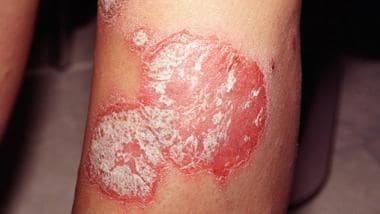
    • Plaques: Psoriasis manifests as elevated lesions that vary in size from one to several centimeters. The thickened epidermis, expanded dermal vascular compartment, and infiltrate of neutrophils and lymphocytes account for the psoriatic lesions being raised and easily palpable. The number of lesions may range from few to many at any given time. The plaques are irregular to oval and are most often located on the scalp, trunk, and limbs, with a predilection for extensor surfaces such as the elbows and knees. Smaller plaques may coalesce into larger lesions, especially on the legs and sacral regions. Fissuring within plaques can occur when lesions are present over joint lines or on the palms and soles.
    • Well-circumscribed margins: Psoriatic plaques are well defined and have sharply demarcated boundaries. Psoriatic plaques occasionally appear to be immediately encircled by a paler peripheral zone referred to as the halo or ring of Woronoff.
    • Red color: The color of psoriatic lesions is a very distinctive rich, full, red color. When present on the legs, lesions sometimes carry a blue or violaceous tint.
    • Scale: Psoriatic plaques typically have a dry, thin, silvery-white or micaceous scale; however, the amount and thickness of this scale is quite variable. Removing the scale reveals a smooth, red, glossy membrane with tiny punctate bleeding points. These points represent bleeding from enlarged dermal capillaries after removal of the overlying suprapapillary epithelium. This phenomenon is known as the Auspitz sign.
    • Symmetry: Psoriatic plaques tend to be symmetrically distributed over the body. Lesions typically have a high degree of uniformity with few morphologic differences between the 2 sides.
  • The following are psoriatic variations and associations that can be observed in persons with plaque psoriasis:
    • Nail psoriasis: Nail changes are commonly observed in patients with plaque psoriasis. Nails may exhibit pitting, onycholysis, subungual hyperkeratosis, or the oil-drop sign. A proper assessment of any patient suspected of having psoriasis should include careful examination of the nails.
    • Psoriasis in children: Plaque psoriasis manifests slightly differently in children. Plaques are not as thick, and the lesions are less scaly. Psoriasis may often appear in the diaper region in infancy and in flexural areas in children. The disease more commonly affects the face in children compared with adults.
    • Inverse psoriasis: This is a variant of psoriasis that spares the typical extensor surfaces and affects intertriginous (ie, axillae, inguinal folds, inframammary creases) areas with minimal scale.
    • Psoriatic arthritis: Red, warm, tender, and inflamed joints; joint deformity; dactylitis; and sausage digits may be observed in patients who also experience psoriatic arthritis.

Causes

Exacerbating causes of plaque psoriasis can be divided into local and systemic factors.

  • Local factors
    • Trauma: All types of trauma have been associated with the development of plaque psoriasis (eg, physical, chemical, electrical, surgical, infective, and inflammatory types of injury). Even excessive scratching can aggravate or precipitate localized psoriasis. The development of psoriatic plaques at a site of injury is known as the Koebner reaction. See History for more details on the Koebner reaction.
    • Sunlight: Most patients generally consider sunlight to be beneficial for their psoriasis. Most report a decrease in illness severity during the summer months or periods of increased sun exposure; however, a small minority find that their symptoms are aggravated by strong sunlight, and these individuals actually experience a worsening of their disease in the summer. A severe sunburn can lead to an exacerbation of plaque psoriasis via the Koebner reaction.
  • Systemic factors
    • Infection: Pharyngeal streptococcal infections have been shown to produce a clinically distinctive disease flare known as guttate psoriasis. Some evidence suggests that subclinical streptococcal colonization or overgrowth could be responsible for refractory plaque psoriasis.
    • HIV: An increase in psoriasis activity has been observed in patients who are or become infected with HIV. The extent and severity of skin disease initially appears to parallel the disease stage. Psoriasis often becomes less active in advanced HIV infection.
    • Drugs: A number of medications have been shown to cause an exacerbation of psoriasis. Lithium and withdrawal from systemic corticosteroids are well known to cause flares of disease. Beta-blockers, antimalarials, and nonsteroidal anti-inflammatory drugs (NSAIDs) have also been implicated.
    • Psychogenic/emotional factors: Many patients report an increase in psoriasis severity with psychological stress. A clear cause-and-effect relationship between disease exacerbation and stress unfortunately has not been proven. Patients may show a decreased capacity to cope with their treatment regimen with higher levels of stress. Pruritus in the setting of increased anxiety or depression may promote scratching and a Koebner reaction.
    • Smoking: An increased risk of chronic plaque psoriasis exists in persons who smoke cigarettes.
    • Alcohol: Alcohol is considered a risk factor for psoriasis, particularly in young to middle-aged males.
    • Endocrine: Psoriasis severity has been noted to fluctuate with hormonal changes. Disease incidence peaks at puberty and during menopause. Pregnant patients' symptoms are more likely to improve than worsen, if any changes occur at all. In contrast, the disease is more likely to flare in the postpartum period, again if any changes occur at all.


Bowen Disease
Cutaneous T-Cell Lymphoma
Drug Eruptions
Erythema Annulare Centrifugum
Extramammary Paget Disease
Lichen Planus
Lichen Simplex Chronicus
Lupus Erythematosus, Discoid
Lupus Erythematosus, Subacute Cutaneous
Nummular Dermatitis
Parapsoriasis
Pityriasis Rosea
Pityriasis Rubra Pilaris
Seborrheic Dermatitis
Syphilis
Tinea Corporis

Other Problems to be Considered

Superficial basal cell carcinoma


Lab Studies

  • Plaque psoriasis is almost always a clinical diagnosis, and laboratory investigations are rarely indicated.
  • In severe cases, patients may have mild hyperuricemia and low folate levels, presumably because of enhanced epidermopoiesis.

Procedures

  • Skin biopsies can confirm the diagnosis of plaque psoriasis; however, this is usually reserved for evaluating atypical cases or for excluding other conditions in cases of diagnostic uncertainty. See Histologic Findings for more details on plaque histology.

Histologic Findings

Epidermis

Mitotic activity of basal keratinocytes is increased almost 50-fold, with keratinocytes migrating from the basal to the cornified layers in only 3-5 days compared to the normal 28-30 days. With hyperproliferation of skin cells, the epidermis becomes thickened or acanthotic in appearance and an increase in size of the rete ridges is observed. Abnormal keratinocyte differentiation is noted throughout the psoriatic plaques, as manifested by the loss of the granular layer. The stratum corneum is also thickened, and the retention of cell nuclei in this layer is referred to as parakeratosis. Neutrophils and lymphocytes can be observed migrating upwards from the dermis into the acanthotic epidermis. Neutrophils may form localized collections known as Munro microabscesses. The presence of alternating collections of neutrophils sandwiched between layers of parakeratotic stratum corneum is virtually pathognomonic for psoriasis.

Dermis

Signs of inflammation can be observed throughout the dermis in persons with plaque psoriasis. Marked hypervascularity and an increase in the size of the dermal papillae occur. An activated CD3+ lymphocytic infiltrate is noted around blood vessels, with T cells expressing cutaneous lymphocyte–associated antigen, co-stimulatory molecules such as CD2, and LFA-1 adhesion molecules. An aggregation of neutrophils in the dermis occurs that extends up into the epidermis.


Medical Care

Plaque psoriasis is a chronic skin condition. Any approach to the treatment of this disease must be considered for the long term. Treatment regimens must be individualized according to age, sex, occupation, personal motivation, other health conditions, and available resources. Disease severity is defined by the number and extent of plaques present, as well as by the patient's perception and acceptance of the disease. Treatment, therefore, must be designed with the patient's specific expectations in mind rather than the extent of the body surface area involved.

Many treatments exist for psoriasis; however, the construction of an effective therapeutic regimen is not necessarily complicated. Three basic treatment modalities are available for the overall management of psoriasis (ie, topical agents, phototherapy, and systemic agents, including biologic therapies). All of these treatments may be used alone or in combination.

  • Topical therapy
    • Outpatient topical therapy is the first-line approach in the treatment of plaque psoriasis. A number of topical treatments are available (eg, corticosteroids, coal tar, anthralin, calcipotriene, tazarotene). No single topical agent is ideal for plaque psoriasis, and many are often used concurrently in a combined approach. With the different adverse effect profiles for the various agents, using a rotational therapeutic approach in which different topical agents are used sequentially over time in the same patient is common. In general, the effects of topical therapy should become evident within the first 2-3 weeks of use. Clearing of scale is usually observed first, followed by flattening of the treated plaques. Resolution of erythema may take 6-8 weeks.
    • Auxiliary agents such as keratolytics can often be added to these preparations. However, some auxiliary agents are incompatible with the active ingredients of these preparations. For example, salicylic acid inactivates calcipotriene. On the other hand, agents such as anthralin require the auxiliary agent salicylic acid for chemical stability.
  • Phototherapy: Initiate phototherapy only in the presence of extensive and widespread disease (generally practically defined as more lesions than can be easily counted). Resistance to topical treatment is another indication for phototherapy. Proper facilities are required for the 2 main forms of phototherapy.
    • UVB irradiation uses light with wavelengths of 290-320 nm (visible light range, 400-700 nm). Narrow-band UVB therapy offers superior efficacy with less risk of burning.
      • UVB therapy is usually combined with one or more topical treatments. The Goeckerman regimen uses coal tar followed by UVB exposure and has been shown to induce disease remission in more than 80% of patients. The Ingram method is based on anthralin application following a tar bath and UVB treatment.
      • Now, UVB is more commonly combined with topical corticosteroids, calcipotriene, tazarotene, or simply bland emollients. UVB phototherapy is extremely effective for treating moderate-to-severe plaque psoriasis.
      • The major drawback of this therapy is the time commitment required for treatments and the accessibility of the UVB equipment. Patients may dislike the unfavorable odor when coal tar is added.
      • Home ultraviolet therapy can overcome some of the logistical problems associated with phototherapy. Because of the expense of the home units, it is most suitable for patients who require long-term maintenance therapy.
    • Narrow-band UVB phototherapy uses a fluorescent bulb with a narrow emission spectrum that peaks at 311 nm (UVB spectrum, 290-320 nm). This selective and relatively longer wavelength is more effective than broadband UVB for the treatment of plaque-type psoriasis.
    • PUVA photochemotherapy, also known as PUVA, uses the photosensitizing drug methoxsalen (8-methoxypsoralens) in combination with UVA irradiation to treat patients with more extensive disease. UVA irradiation uses light with wavelengths of 320-400 nm. PUVA interferes with DNA synthesis, decreases cellular proliferation, and induces apoptosis of cutaneous lymphocytes, leading to a localized immunosuppression.
      • More than 85% of patients report relief of disease symptoms with 20-30 treatments. Therapy is usually administered 2-3 times per week in an outpatient setting, with maintenance treatments every 2-4 weeks until remission.
      • Adverse effects of PUVA therapy include nausea, pruritus, and a burning sensation. Long-term complications include increased risks of photo damage to the skin and (more importantly) skin cancer. PUVA has been combined with oral retinoid derivatives to decrease the cumulative dose of UVA radiation to the skin.
    • Excimer laser UVB therapy can deliver high-dose light to limited plaques.
  • Systemic agents: Initiate systemic treatment only after both topical treatments and phototherapy have been unsuccessful. Consider systemic therapy for patients with very active psoriatic arthritis. Patients who have disease that is physically, psychologically, socially, or economically disabling are also considered candidates for systemic treatment. All patients must be informed of the risks and adverse effects of systemic therapy before treatment is initiated.
  • Biologic therapies: These relatively new systemic therapies provide selective, immunologically directed intervention at key steps in the pathogenesis of the disease.
    • These steps include (1) inhibiting the initial cytokine release and Langerhans cell migration; (2) targeting activated T cells, preventing further T-cell activation, and eliminating pathologic T cells; (3) blocking the interactions that lead to T-cell activation or migration into tissue; (4) altering the balance of T-cell types; and (5) inhibition of proinflammatory cytokines, such as tumor necrosis factor.
    • Similar to the systemic agents, these therapies are typically reserved for more severe and recalcitrant cases. Patients with active psoriatic arthritis in addition to their skin disease should also be considered.

Surgical Care

Surgical intervention has no role in the treatment of plaque psoriasis.

Consultations

Consider consultation with a rheumatologist for patients who have evidence of psoriatic arthritis.

Diet

Alcohol is considered a risk factor for psoriasis in young to middle-aged males. All patients with psoriasis should avoid or minimize alcohol use; patients with dependency states should be appropriately treated. Otherwise, specific dietary restrictions or supplements other than a well-balanced and adequate diet are unimportant in the management of plaque psoriasis.


The goals of pharmacotherapy are to reduce morbidity and prevent complications.

Drug Category: Vitamins

Essential for normal DNA synthesis and cell function.

Drug NameCalcipotriene and betamethasone topical ointment (Taclonex)
DescriptionCalcipotriene is a synthetic vitamin D3 analog that regulates skin cell production and development. Inhibits epidermal proliferation, promotes keratinocyte differentiation, and has immunosuppressive effects on lymphoid cells. Betamethasone is a corticosteroid that decreases inflammation by suppressing migration of polymorphonuclear leukocytes and reversing capillary permeability. Available as a topical ointment containing calcipotriene 0.005% and betamethasone dipropionate 0.064%. Indicated for psoriasis vulgaris.
Adult DoseApply to affected area qd; not to exceed 100 g/wk; do not use > 4 wk
Pediatric Dose<18 years: Not established
>18 years: Apply as in adults
ContraindicationsDocumented hypersensitivity; known or suspected calcium metabolism disorders; erythrodermic, exfoliative, or pustular psoriasis
InteractionsCoadministration with other corticosteroids may increase toxicity
PregnancyC - Fetal risk not established in humans; use if benefits outweigh risk to fetus
PrecautionsMay cause hypercalcemia; systemic absorption of topical corticosteroids has caused HPA-axis suppression, Cushing syndrome manifestations, hyperglycemia, and glucosuria; not for prolonged use (ie, > 4 wk), large surface areas (ie, >30% of body surface area), or application with occlusive dressings; do not use on face, eyes, axillae, or groin; may cause contact dermatitis

Drug NameCalcipotriene (Dovonex)
DescriptionSynthetic vitamin D3 analog that regulates skin cell production and development. Used in the treatment of moderate plaque psoriasis. Available as 0.005% ointment, cream, and scalp solution.
Adult DoseApply a thin film and rub completely into affected areas qd/bid to response
Pediatric DoseNot established
ContraindicationsDocumented hypersensitivity; hypercalcemia; vitamin D toxicity
InteractionsTopical salicylic acid inactivates calcipotriene
PregnancyC - Safety for use during pregnancy has not been established.
PrecautionsNot for use on face, eyes, mucous membranes, or orally; use no more than 100 g/wk; transient hypercalcemia has been noted; major limiting factor is cost; impractical and expensive for widespread application and can cause irritation; evaluation of serum calcium levels may be required if used in excess

Drug Category: Tar-containing preparations

Contain literally thousands of different substances extracted from the primary condensation process of coal carbonization. Exact mechanism of action is unknown, although an antimitotic effect has been ascribed.

Drug NameCoal tar (DHS Tar, Doak Tar, Theraplex T)
DescriptionAvailable at varying concentrations for topical application. Coal tar distillate, for example, is used at 5-10% concentrations. Liquor carbonis detergens is an alcohol-extracted tar. All preparations (except liquor carbonis detergens) must be used in grease- or oil-based vehicles. Tar is commonly available in shampoos and is often combined with salicylic acid. Available as 0.5-33.3% topical preparations (eg, shampoo, bath oil, cream, gel, lotion, ointment, paste, solution, stick, susp).
Adult DoseRub copious amounts of shampoo into wet hair and scalp or skin and rinse thoroughly; repeat and leave on for 5 min and rinse thoroughly; apply qd (severe psoriasis) to 2 times/wk
Pediatric DoseApply as in adults
ContraindicationsDocumented hypersensitivity; acute inflammation; open lesions
InteractionsNone reported
PregnancyC - Safety for use during pregnancy has not been established.
PrecautionsAvoid contact with eyes, mucous membranes, or open wounds; discontinue use if irritation develops or response is unsatisfactory; may stain clothing and linens; some agents have a displeasing pungent odor; documented adverse effects include photosensitivity and folliculitis

Drug Category: Psoralens

These agents have no effect unless combined with ultraviolet radiation. They are used in combination with UVA light (320-400 nm) for PUVA therapy of psoriasis.

Drug NameMethoxsalen (Oxsoralen-Ultra, 8-MOP)
DescriptionExact mechanism of action with epidermal melanocytes and keratinocytes is not known. Acts as a photosensitizer. Inhibits mitosis by binding covalently to pyrimidine bases in DNA.
Adult Dose8-MOP: 0.6-0.8 mg/kg (lean body weight) PO 1-2 h prior to UVA light exposure; also can be administered topically as a cream, lotion, or bath soak
Oxsoralen-Ultra: 0.3-0.4 mg/kg (lean body weight) PO 1-2 h prior to UVA light exposure; available as 10-mg caps
Caution: Oxsoralen-Ultra (methoxsalen soft gelatin caps) should not be used interchangeably with regular Oxsoralen or 8-MOP (methoxsalen hard gelatin caps); new dosage form of methoxsalen exhibits significantly greater bioavailability and earlier photosensitization onset time than previous dosage forms; patients should be treated in accordance with the dosimetry specifically recommended for this product; determine minimum phototoxic dose and phototoxic peak time after drug administration prior to onset of photochemotherapy with this dosage form
Pediatric Dose<12 years: Not recommended
>12 years: Administer as in adults
ContraindicationsDocumented hypersensitivity; history of melanoma or squamous cell carcinoma; photosensitivity diseases (eg, porphyria, lupus erythematosus, xeroderma pigmentosum, albinism); photosensitizing agents with internal or external effects; patients who cannot tolerate prolonged standing or heat (eg, cardiac disease); arsenic therapy
InteractionsFurocoumarin-containing foods (eg, limes, figs, mustard, carrots, celery) may increase photosensitivity of skin; photosensitizing agents (eg, phenothiazines, bacteriostatic soaps, sulfonamides, tetracyclines, thiazides, organic staining dyes) can also cause more severe reactions
PregnancyC - Safety for use during pregnancy has not been established.
PrecautionsKnown to be carcinogenic, with risk being dose dependent; advise patients to minimize exposure to outdoor or bright indoor light for 24 h after each dose because it induces generalized cutaneous photosensitivity; used in conjunction with ultraviolet light therapy and should only be used by physicians trained in this modality of therapy; wear wrap-around sunglasses that block all ultraviolet light for 24 h after a dose of methoxsalen to protect eyes from cataract formation

Drug NameTrioxsalen (Trisoralen)
DescriptionInhibits mitosis by covalently binding, in presence of UVA radiation, to pyrimidine bases in DNA.
Adult Dose10 mg/d PO once, 2-4 h before controlled exposure to UVA or sunlight; not to exceed 14 d
Pediatric Dose<12 years: Not established
>12 years: Administer as in adults
ContraindicationsDocumented hypersensitivity; history of melanoma; acute lupus erythematosus; porphyria
InteractionsNone reported
PregnancyC - Safety for use during pregnancy has not been established.
PrecautionsSevere burns may occur from sunlight or UVA exposure if dose or frequency is exceeded; should be supervised by trained physicians; wear wrap-around sunglasses that block all ultraviolet light for 24 h after a dose to protect eyes from cataract formation

Drug Category: Antiproliferative agents

These agents may upset oxidative metabolic processes, decreasing the rate of epidermal cell proliferation.

Drug NameAnthralin (Dithranol, Anthra-Derm, Drithocreme)
DescriptionSynthetic derivative of a tree bark extract. Although considered one of the most effective antipsoriatic agents available, not in widespread use because of high potential to cause irritation and staining.
Two different methods of application. Prolonged contact method uses 0.1-0.4% preparations applied for several hours. Short contact method uses higher concentrations of anthralin (1-3%), but usually applied for only <1 h; reserved for lesions on trunk, extremities, and scalp; available as cream, ointment, or paste.
Adult DoseSkin: Apply sparingly and gently rub only into psoriatic lesions; avoid excessive quantities
Scalp: Remove scale and rub into involved areas; avoid forehead, eyes, and uninvolved scalp margins; do not apply excessive quantities
Pediatric DoseAdminister as in adults
ContraindicationsDocumented hypersensitivity; acutely or actively swollen psoriatic lesions; lesions on face, neck, flexures, and genitalia; plaques that appear secondarily excessively irritated
InteractionsApplications in excessive amounts may stain clothing; long-term corticosteroid treatment withdrawal may cause complications of rebound phenomenon (allow 1-wk interval between discontinuation of corticosteroids and initiation of anthralin therapy); requires salicylic acid for stabilization
PregnancyC - Safety for use during pregnancy has not been established.
PrecautionsCaution in renal disease; caution in patients who may not be able to comply with application instructions; use with great care in children because of potential for irritation and staining; do not apply to face or genitalia and avoid eye contact; discontinue application if redness develops; great care must be taken to apply only to plaques and not to surrounding normal skin; stains linens and clothes and can cause hyperpigmentation of skin; may cause burning and irritation; must give explicit instructions on proper administration; must be reserved only for patients expected to comply with instructions

Drug Category: Immunomodulators

Psoriasis is now considered an immunologic skin disorder, and systemic immunosuppressive agents (eg, methotrexate, cyclosporine) and biologic therapy (eg, alefacept, efalizumab, etanercept, infliximab) can be used for patients with extensive, widespread, or resistant disease. Generally considered second- or third-line therapy.

Drug NameAlefacept (Amevive)
DescriptionIndicated for moderate-to-severe plaque psoriasis. Binds to lymphocyte antigen, CD2, and inhibits LFA-3/CD2 interaction and lymphocyte activation. Also causes a reduction in CD2+ T-lymphocyte subsets (primarily CD45RO+), presumably by bridging between CD2 on target lymphocytes and immunoglobulin Fc receptors on cytotoxic cells (eg, NK cells).
Adult Dose15 mg IM qwk for 12 wk; may repeat 12-wk regimen if CD4+ T-lymphocyte counts are within reference range and a minimum of 12 wk has passed since first course
Pediatric DoseNot established
ContraindicationsDocumented hypersensitivity; CD4 count <250 cells/µL; history of systemic malignancy; presence of clinically significant infection; history of recurrent infection; concurrent treatment with other immunosuppressive agents; concurrent phototherapy; pregnancy or breastfeeding; congenital or acquired immunodeficiency
InteractionsAdministration with other immunosuppressive agents (eg, corticosteroids, cyclosporine) may cause excessive immunosuppression; no formal interaction studies performed
PregnancyB - Usually safe but benefits must outweigh the risks.
PrecautionsWomen who become pregnant while on therapy should be enrolled in manufacturer's pregnancy registry (1-866-263-8483); may increase risk of malignancy or infection; may cause anaphylaxis or angioedema; may cause induration, inflammation, bleeding, or edema at injection site; reduces CD4+ T-lymphocyte count

Drug NameMethotrexate (Folex, Rheumatrex, Amethopterin, MTX)
DescriptionFolic acid antagonist that inhibits DNA synthesis in tissues with high rates of turnover, such as psoriatic plaques. Potential systemic treatment after phototherapy is unsuccessful. Has immunosuppressive effect by acting on mononuclear cells in skin, blood, and lymphatics. Folic acid has been used to try to alleviate adverse effects.
Adult DoseAdminister 2.5-mg test dose; check CBC count and LFTs in 1 wk; if laboratory results are normal, may then proceed; 2.5-10 mg PO q12h for 3 doses/wk (average dose 10-25 mg PO/IM/IV qwk) until adequate response; not to exceed 30 mg/wk
Note that doses should be given on 2 consecutive days, with 12 h between doses; alternatively, dose may be given once weekly; midweek doses can produce severe toxicity and must be avoided
Pediatric DoseNot recommended
ContraindicationsAbsolute: Pregnancy or desire to get pregnant; active peptic ulcer; alcoholism; primary/secondary immunodeficiency; blood dyscrasias; active hepatitis; cirrhosis; chronic renal failure; active infections
Relative: History of excessive ethanol intake or substance abuse; increased LFTs; recent hepatitis; diabetes; obesity; family history of heritable liver disease; unreliable patient; CrCl <50 mL/min; males contemplating conception (must be off therapy for 3 mo)
InteractionsAntibiotics may decrease absorption and blood levels of concurrent PO MTX; charcoal lowers levels; coadministration with acitretin may increase hepatotoxicity; coadministration with NSAIDs may be fatal; indomethacin and phenylbutazone can increase plasma levels; may decrease phenytoin serum levels
Probenecid, salicylates, procarbazine, and sulfonamides (including TMP-SMZ) may increase effects and toxicity of MTX; may increase plasma levels of thiopurines; dipyridamole, probenecid, retinoids, ethanol, triamterene, pyrimethamine, tetracycline, chloramphenicol, penicillin or other broad-spectrum antibiotics, trimethoprim, dapsone, theophylline, phenytoin, phenothiazines, barbiturates, and nitrofurantoin (impair folic acid absorption), ascorbic acid, phenylbutazone, cyclosporin, aminoglycosides
PregnancyX - Contraindicated in pregnancy
PrecautionsCaution in impaired renal function and/or NSAID therapy, active peptic ulcer, active hepatitis, and active infections; laboratory monitoring is recommended; monthly CBC count with differential, renal panel, urinalysis, and LFTs; baseline CrCl has been recommended if >50 y; has toxic effects on hematologic, renal, GI, pulmonary, and neurologic systems; phototoxicity and sunburn or radiation recall has been reported; discontinue if significant decrease in blood counts occurs; aspirin, NSAIDs, or low-dose steroids may be administered concomitantly (possibility of increased toxicity with NSAIDs, including salicylates, has not been tested); performing liver biopsy after cumulative dose of 1.5 g suggested; titrate to lowest effective dose
Pretreatment liver biopsy necessary if patient has personal or family history of liver disease; diabetes; obesity; abnormal baseline LFTs; significant history of exposure to hepatotoxins (eg, ethanol, drugs)

Drug NameCyclosporine (Cyclosporin A, Neoral)
DescriptionDemonstrated to be helpful in a variety of skin disorders, especially psoriasis. Immunosuppressant that acts by inhibiting production of interleukin 2, the cytokine responsible for inducing T-cell proliferation. Used in extensive disease refractory to other treatments. Remission is rapid with this therapy; however, skin lesions tend to recur within days to weeks after treatment is stopped. Maintenance therapy is usually required at lower doses.
Adult Dose2-5 mg/kg/d PO in divided doses; dose on ideal body weight for patients who are obese
Pediatric DoseSafety in patients <18 y not established; however, transplant recipients as young as 1 y have been treated with no unusual effects
ContraindicationsAbsolute: Significantly decreased renal function; uncontrolled hypertension; hypersensitivity; clinically cured or persistent malignancy (except nonmelanoma skin cancer)
Relative: Age <18 y or >64 y controlled hypertension; planning to receive live attenuated vaccine; active infection or evidence of immunodeficiency; concurrent phototherapy, coal tar, or MTX (or other immunosuppressive agents); pregnancy or lactation; unreliable patient; severe hepatic dysfunction
InteractionsErythromycin, clarithromycin, azithromycin, norfloxacin ciprofloxacin, cephalosporins, doxycycline, ketoconazole, itraconazole, fluconazole, ritonavir, indinavir, saquinavir, nelfinavir, diltiazem, verapamil, nicardipine, cimetidine, methylprednisolone, dexamethasone, thiazides, furosemide, allopurinol, bromocriptine, danazol, amphotericin B, metoclopramide, oral contraceptive pills, warfarin, and grapefruit juice increase levels
Rifampin, rifabutin, nafcillin, carbamazepine, phenobarbital, phenytoin, valproate, octreotide, and ticlopidine decrease levels
Tobramycin, gentamicin, ketoconazole, azapropazone, TMP-SMZ, vancomycin, sulindac, amphotericin B, indomethacin, naproxen, cimetidine, ranitidine, diclofenac, tacrolimus, and melphalan potentiate renal toxicity
Digoxin decreases renal clearance and may lead to digitalis toxicity; lovastatin decreases renal clearance may lead to myositis; methylprednisolone and prednisolone decrease renal clearance and may lead to convulsions; ACE inhibitors, potassium supplements, and potassium-sparing diuretics increased risk of hyperkalemia
PregnancyC - Safety for use during pregnancy has not been established.
PrecautionsAdverse effects include hypertension and impaired renal function, both of which should be monitored; theoretical increased risk of cancer; generally should not be administered for > 1 y; combination treatment with PUVA or UVB not advised because of increased risk of malignancy; use with MTX is dangerous

Drug NameEfalizumab (Raptiva)
DescriptionRecombinant humanized IgG1-kappa isotype monoclonal antibody produced from Chinese hamster ovary mammalian cell expression system in a nutrient medium.
Anti-CD11a antibody. T-cell activation starts with LFA-1 (on a CD4 or CD8 T cell) binding to ICAM-1 (on a Langerhans cell). LFA-1 is composed of an alpha (CD11a) and a beta (CD18) chain. Blocks integrin to decrease CD4 and CD8 penetration into skin (homing). Down-regulates (decreases) surface expression of CD11a by 75-85% at psoriasis doses.
Adult DoseInitial dose: 0.7 mg/kg SC
Subsequent doses: 1 mg/kg/wk SC, not to exceed 200 mg/dose
Pediatric DoseNot established
ContraindicationsDocumented hypersensitivity
InteractionsMay decrease immune response to vaccines; do not administer acellular, live, and live-attenuated vaccines during treatment; do not administer other immunosuppressive agents (eg, antineoplastics, cyclosporine, azathioprine) during treatment due to risk of excessive immunosuppression
PregnancyC - Safety for use during pregnancy has not been established.
PrecautionsAge <18 (not studied) or >65 y (increased incidence of infections); latent chronic infections; history of recurrent infections; thrombocytopenia; concurrent treatment with other immunosuppressives (but can use with topical steroids); pregnancy or breastfeeding
May cause first-dose reaction (eg, headache, chills, fever, nausea, vomiting); may decrease platelets; monitor platelet count and other symptoms of thrombocytopenia (eg, bleeding gums, bruising, petechiae); may increase infection risk; back pain, joint pain, peripheral edema, and hemolytic anemia may also occur; worsening of psoriasis occurs in a small percentage of patients, and rebound flares may occur when drug is discontinued

Drug NameEtanercept (Enbrel)
DescriptionDimeric fusion protein of soluble TNF receptors fused to Fc portion of human IgG (p75) antibody. This molecule serves as an exogenous TNF receptor and prevents excess TNF from binding to cell-bound receptors.
Adult Dose50 mg SC given twice weekly for 3 mo, then 50 mg SC qwk
Pediatric DoseNot established
ContraindicationsDocumented hypersensitivity to drug; sepsis; active infection; concurrent live vaccination
InteractionsShould not be used with concurrent live vaccines; administration with other immunosuppressive agents (eg, corticosteroids, cyclosporine, TNF blocking agents, anakinra, natalizumab, imatinib) may cause excessive immunosuppression
PregnancyB - Usually safe but benefits must outweigh the risks.
PrecautionsReported adverse events include injection site reactions (most common), upper respiratory tract infections, increased ANA antibody levels, reactive hemophagocytic lymphohistiocytosis, congestive heart failure, unmasking of demyelinating disease (eg, optic neuritis and multiple sclerosis), precipitation of diabetes mellitus, and hyperthyroidism

Drug NameInfliximab (Remicade)
DescriptionChimeric (human–mouse) monoclonal antibody that targets TNF and inhibits its activity. Testing for TB exposure with PPD placement is required prior to treatment.
Adult Dose3-5 mg/kg IV over at least 2 h at weeks 0, 2, and 6 for induction, followed by q8wk for maintenance
Pediatric DoseNot established
ContraindicationsDocumented hypersensitivity to drug and/or murine proteins; active infection; NYHA congestive heart failure class III or IV
InteractionsShould not be used with concurrent live vaccines; administration with other immunosuppressive agents (eg, corticosteroids, cyclosporine, TNF blocking agents, anakinra, natalizumab, imatinib) may cause excessive immunosuppression
PregnancyX - Contraindicated in pregnancy
PrecautionsInfusion reactions (including itchy skin, hives, skin rash, nausea, and headache) are common; serum sickness–like reactions and TB reactivation reported; chronic or recurrent infection, advanced age, concurrent live vaccination, history of demyelinating disorders, hematologic abnormalities, poorly controlled or advanced diabetes, and concurrent immunosuppression are other considerations

Drug Category: Retinoids

These agents have a variety of actions. They cause differential expression of proteins by altering genomic functions. They stimulate cell differentiation and inhibit malignant transformation in the skin. Retinoid derivatives alter the delayed hypersensitivity response and increase the number of Langerhans cells in the psoriatic lesions. For plaque psoriasis, retinoids can be used in combination with UV phototherapy to minimize the dose of each. Otherwise, the use of oral retinoid monotherapy has shown limited efficacy for chronic stable plaque psoriasis.

Drug NameTazarotene (Tazorac)
DescriptionTopical retinoid derivative available for qd applications. Particularly useful for psoriasis involving scalp. Produces prolonged clearing of disease, yet typically has delayed onset of action. May be combined with midpotency topical steroids for increased therapeutic effect and to decrease irritation that very commonly occurs when used alone. Emphasize to patient avoidance of application to healthy skin. Available as 0.05% and 0.1% gels. Dry skin before application.
Adult DoseApply thin film qd to cover lesion (2 mg/cm2); not to exceed >20% of BSA
Pediatric Dose<12 years: Not established
>12 years: Administer as in adults
ContraindicationsDocumented hypersensitivity; normal skin; disease in skin folds; pregnancy
InteractionsTopical medications and cosmetics that dry skin may worsen effects
PregnancyX - Contraindicated in pregnancy
PrecautionsMay cause burning or stinging sensation; discontinue with excessive irritation; rinse thoroughly if contact with eyes, eyelids, or mouth occurs; may cause severe irritation in eczematous skin; photosensitivity may occur; not recommended while breastfeeding

Drug NameAcitretin (Soriatane)
DescriptionAcitretin is a second-generation oral retinoid derived from etretinate (Tegison). Preferred retinoid for psoriasis because it does not accumulate in body for as long as etretinate. Mechanism of action unknown, but probably induces cellular differentiation, antiproliferation, anti-inflammation, and antikeratinization and inhibits neutrophil chemotaxis. Supplied as 10- and 25-mg caps.
Adult DoseDosing not based on body weight
Initial: 25 mg/d PO and increase; lesions clear faster at higher initial starting doses, but hair loss and paronychia occur more frequently
Maintenance: 20-50 mg/d PO recommended
Pediatric DoseNot recommended
ContraindicationsAbsolute: Pregnancy, likely to become pregnant, or intend to become pregnant within 3 y following cessation of treatment; females who cannot use reliable contraception while undergoing treatment and for at least 3 y after discontinuation; noncompliance with contraception; nursing mothers; concurrent use of methotrexate (increased liver toxicity) or tetracyclines (pseudotumor cerebri); hypersensitivity
Relative: Leukopenia; moderate-to-severe cholesterol or triglyceride elevation; significant hepatic dysfunction; significant renal dysfunction
InteractionsAbsorption enhanced with food, especially fatty foods (warn patients to not consume excessively fatty diet)
Bioavailability, 60%; protein bound, 99.9%; steady state, 3 wk
Interferes with contraceptive effect of microdosed minipill progestin; not known whether other progestational contraceptives (eg, implants, injectables) are adequate methods of contraception during therapy; also not established if pharmacokinetic interaction occurs between acitretin and other birth control pills
Interacts with hormonal contraceptives (reports of breakthrough bleeding and pregnancies)
Ethanol causes acitretin to be re-esterified to etretinate, which has a much longer half-life; concomitant vitamin A should be limited to <5000 IU/d (package insert says no vitamin A)
Glibenclamide (a sulfonylurea) potentiated its glucose-lowering effect in 3 of 7 patients studied; concurrent methotrexate increases risk of hepatitis (do not use concurrently); protein binding of phenytoin may be reduced; increased risk of pseudotumor cerebri with concurrent tetracyclines (do not administer concurrently)
PregnancyX - Contraindicated in pregnancy
PrecautionsAlcohol consumption causes acitretin (half-life 2 d) to be metabolized to etretinate (half-life 120 d) and has been found in serum up to 4 y and 4 mo after discontinuation
Consider alternative treatment in women of childbearing potential; women of childbearing potential must be capable of complying with effective contraceptive measures and continue contraception for at least 3 y after stopping treatment; always ensure pregnancy is not present before initiating therapy; all female patients of childbearing potential should receive extensive birth control counseling, as well as counseling on long-term implications of this therapy on future childbearing plans; Soriatane Patient Referral Form available from manufacturer for free counseling; written consent form provided by manufacturer should be completed prior to initiation of therapy
Caution in impaired renal or liver function; perform AST, ALT, and LDH tests prior to initiation of therapy and at 1- to 2-wk intervals until stable and thereafter at intervals as clinically indicated; not recommended while breastfeeding; monitor triglyceride and cholesterol levels at baseline and monthly for the first 3 mo; CBC count, urinalysis, and BUN/creatinine monthly for first 3 mo
Consider ophthalmologic examination for patients with history of cataracts or retinopathy; consider wrist, ankle, and thoracic spine radiographs if long-term therapy planned, with yearly monitoring

Drug Category: Corticosteroids

Topical corticosteroids are considered the treatment of choice for the face, neck, skin folds, and genitalia. These agents are available in a number of different potencies. Studies have shown good correlation between steroid potency and symptomatic relief. All topical steroids have anti-inflammatory, antipruritic, and vasoconstrictive effects. In addition, these agents modify the body's immune response to diverse stimuli. In general, physicians administering these agents topically should be familiar with the different classes of topical steroids, the different bases in which they are prepared and how this affects potency, and which steroids are safe for which areas and for how long. Application of corticosteroids under occlusion with plastic wrap can increase the potency of any topical steroid preparation; however, occlusion can also increase the adverse effects of this therapy.

Intralesional corticosteroid injections (triamcinolone) have also been used in the treatment of plaque psoriasis. Strictly speaking, this is not a topical therapy; however, this approach may be worth considering before moving on to phototherapy or systemic agents. Care must be taken in monitoring the total steroidal dose if intralesional steroids are administered.

Corticosteroids have been shown to induce tachyphylaxis and cause rebound flares of disease when stopped. On the face and intertriginous areas, corticosteroids can more rapidly cause atrophy, striae, purpura, telangiectasia, and perioral dermatitis or steroid rosacea. Systemic absorption is always a risk with any topical corticosteroid preparation. High and ultra-high potencies are of particular concern because they are more likely to induce cushingoid features or suppress the pituitary-adrenal axis. Avoid widespread application of high and ultra-high potency corticosteroids.

Drug NameTriamcinolone acetonide (Aristocort); Betamethasone (Maxivate, Diprolene)
DescriptionTriamcinolone acetonide: For inflammatory dermatosis responsive to steroids; decreases inflammation by suppressing migration of polymorphonuclear leukocytes and reversing capillary permeability. Intralesional injections may be used for localized skin disorder. Intralesional application is particularly useful for smaller recalcitrant lesions of limited distribution. Available as 0.5% cream or ointment or 0.1% and 0.025% cream, ointment, or lotion.
Betamethasone dipropionate: For inflammatory dermatoses responsive to steroids. Decreases inflammation by suppressing migration of polymorphonuclear leukocytes and reversing capillary permeability. Affects production of lymphokines and has an inhibitory effect on Langerhans cells. Available as 0.05% cream, lotion, or ointment. Betamethasone valerate 0.12% foam (Luxiq) is available in United States and is particularly useful for scalp application.
Adult DoseTriamcinolone acetonide: Apply thin film qd topically or administer 3-5 mg/mL intralesionally
Lotions are more cosmetically elegant for hairy scalps
Betamethasone dipropionate: Apply thin film qd until response
Pediatric DoseApply as in adults
ContraindicationsDocumented hypersensitivity; paronychia; cellulitis; impetigo; angular cheilitis; erythrasma; erysipelas; rosacea; perioral dermatitis; fungal, viral, and bacterial skin infections
InteractionsEffects decrease with coadministration of barbiturates, phenytoin, and rifampin; decreases effect of salicylates and vaccines used for immunization if enough is systemically absorbed (eg, applied to large body surface areas for prolonged periods)
PregnancyC - Safety for use during pregnancy has not been established.
PrecautionsProlonged use, applications over large areas, and use of potent steroids and occlusive dressings may result in systemic absorption; systemic absorption may cause Cushing syndrome, reversible HPA axis suppression, hyperglycemia, and glycosuria; caution must be used to limit the total amount injected to avoid a rebound flare from too much systemic absorption
Can cause atrophy of groin, face, and axillae; may cause striae distensae and rosacealike eruption; may increase skin fragility; rarely may suppress HPA axis; if infection develops and is not responsive to antibiotic treatment, discontinue until infection is under control; do not use monotherapy to treat widespread plaque psoriasis

Drug NameFluocinolone acetonide (Fluonex); Clobetasol (Temovate, Olux)
DescriptionFluocinolone acetonide: High-potency topical corticosteroid that inhibits cell proliferation; is immunosuppressive, antiproliferative, and anti-inflammatory. Available as 0.025% cream or ointment, 0.01% solution, or 0.01% shampoo.
Clobetasol: Class I superpotent topical steroid; suppresses mitosis and increases synthesis of proteins that decrease inflammation and cause vasoconstriction. Available as ointment, cream, lotion, or solution. Also available as foam (Olux) in United States. Foam and solutions tend to be more cosmetically elegant for hairy scalps.
Adult DoseFluocinolone: Apply sparingly qd as severity warrants
Clobetasol: Apply qd-bid for up to 2 wk; not to exceed 50 g/wk
Pediatric DoseFluocinolone: Apply as in adults
Clobetasol
<12 years: Not recommended
>12 years: Administer as in adults
ContraindicationsDocumented hypersensitivity; paronychia; cellulitis; impetigo; angular cheilitis; erythrasma; erysipelas; rosacea; perioral dermatitis; herpes simplex infection; fungal, viral, and bacterial skin infections
InteractionsEffects decrease with coadministration of barbiturates, phenytoin, and rifampin; decreases effect of salicylates and vaccines used for immunization if enough is systemically absorbed (eg, applied it to large body surface areas for prolonged periods)
PregnancyC - Safety for use during pregnancy has not been established.
PrecautionsProlonged use, applications over large areas, and use of potent steroids and occlusive dressings may result in systemic absorption; systemic absorption may cause Cushing syndrome, reversible HPA axis suppression, hyperglycemia, and glycosuria; caution must be used to limit the total amount injected to avoid a rebound flare from too much systemic absorption
Can cause atrophy of groin, face, and axillae; may cause striae distensae and rosacealike eruption; may increase skin fragility; rarely may suppress HPA axis; if infection develops and is not responsive to antibiotic treatment, discontinue until infection is under control; do not use monotherapy to treat widespread plaque psoriasis


Further Outpatient Care

  • Plaque psoriasis is a chronic disease with a relapsing course. Follow-up is geared toward the extent of disease at any given time.

Deterrence/Prevention

  • Avoiding specific exacerbating factors (see Causes for details) may help prevent or minimize flare-ups of psoriasis in some patients, although the cause of disease exacerbation in many patients often is unknown.

Complications

  • Complications of the disease are relatively uncommon.
  • Approximately 10-20% of all cases of plaque psoriasis are associated with psoriatic arthritis.
  • Pruritus, one of the main symptoms of plaque psoriasis, is quite variable in intensity but should not be ignored.
  • Emotional instability (eg, high levels of anxiety, depression) that might be induced by the disease often manifests as an increased tendency to scratch.
  • Many of the complications of plaque psoriasis are related to the treatments for the disease.
    • Overly aggressive use of topical steroids could produce progression from plaque psoriasis to pustular and erythrodermic forms.
    • Topical steroids used with occlusion increase the risk of developing cutaneous atrophy.
    • Potential adverse effects of systemic agents and phototherapy should be monitored on a regular basis and treated as soon as possible.
  • Alcoholism can also be considered a complication of psoriasis. Male patients with severe disease are particularly at risk for this type of substance abuse.
  • Plaque psoriasis may evolve into erythrodermic or generalized pustular psoriasis in rare instances.

Prognosis

  • The course of plaque psoriasis is unpredictable. Predicting the duration of active disease, the time or the frequency of relapses, or the duration of a remission is impossible. The disease rarely is life threatening but often is intractable to treatment, with relapses occurring in most patients.
  • Both early onset and a family history of disease are considered poor prognostic indicators.
  • Some suggest that stress is also associated with an unfavorable prognosis.
  • Environmental factors (particularly sunlight and warm weather) help alleviate the disease and are considered advantageous.
  • Methotrexate, PUVA, cyclosporine, oral retinoids, and biologic therapies all have helped induce and maintain remission in severe cases of plaque psoriasis.

Patient Education


Medical/Legal Pitfalls

  • Failure to fully inform patients of all the risks associated with the therapeutic options being considered (some of which can cause serious morbidity and even death in rare instances)


Media file 1:  Courtesy of University of British Columbia, Division of Dermatology.
Click to see larger pictureClick to see detailView Full Size Image
Media type:  Photo

Media file 2:  Courtesy of University of British Columbia, Division of Dermatology.
Click to see larger pictureClick to see detailView Full Size Image
Media type:  Photo

Media file 3:  Photomicrograph of psoriasis. (1) Hyperkeratosis and parakeratosis, (2) neutrophils in the epidermis, (3) thinning of the epidermis overlying the dermal papillae, (4) vessels close to the epidermis, and (5) elongated rete ridges. Courtesy of Richard Crawford, MD, University of British Columbia, Division of Dermatology.
Click to see larger pictureClick to see detailView Full Size Image
Media type:  Photo


  • Calzavara-Pinton P, Leone G, Venturini M, et al. A comparative non randomized study of narrow-band (NB) (312 +/- 2 nm) UVB phototherapyversus sequential therapy with oral administration of low-dose Cyclosporin A and NB-UVB phototherapyin patients with severe psoriasis vulgaris. Eur J Dermatol. Nov-Dec 2005;15(6):470-3. [Medline].
  • Camisa C. Psoriasis. Boston, Mass:. Blackwell Science Inc;1995.
  • Camp RDR. Psoriasis. In: Champion RH, Burton JL, Burns DA, Breathnach S, eds. Textbook of Dermatology. Vol 2. Oxford, England:. Blackwell Science;1998:1589-649.
  • Christophers E, Mrowietz U. Psoriasis. In: Freedberg IM, Eisen AZ, eds. Fitzpatrick's Dermatology in General Medicine. Vol 1. New York, NY:. McGraw-Hill;1999:495