
Practice Essentials
Constipation is a symptom rather than a disease, generally defined as when bowel movements occur three or fewer times a week and are difficult to pass. [1] It is the one of the most common digestive complaints in the United States [2] in ambulatory centers and a common cause for referral to gastroenterologists and colorectal surgeons. [3] Despite its frequency, it often remains unrecognized until the patient develops sequelae, such as anorectal disorders. (See the image below.)
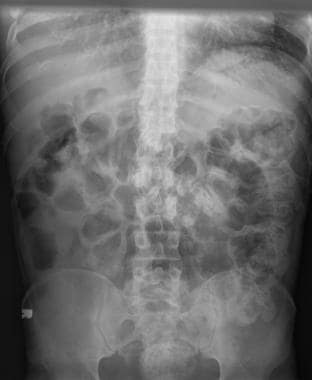 Constipation. Note the large amount of stool throughout the colon on this radiograph.
Signs and symptoms
According to the Rome IV criteria for constipation, a patient must have experienced at least two of the following symptoms over the preceding 6 months:
-
Fewer than three spontaneous bowel movements per week
-
Straining for more than 25% of defecation attempts
-
Lumpy or hard stools for at least 25% of defecation attempts
-
Sensation of anorectal obstruction or blockage for at least 25% of defecation attempts
-
Sensation of incomplete defecation for at least 25% of defecation attempts
-
Manual maneuvering required to defecate for at least 25% of defecation attempts
In addition, the patient must rarely have loose stools present without use of a laxative and must not meet Rome IV criteria for irritable bowel syndrome (IBS).
A constipated patient may be otherwise totally asymptomatic or may complain of one or more of the following:
-
Abdominal bloating
-
Pain on defecation
-
Rectal bleeding
-
Spurious diarrhea
-
Low back pain
The following also suggest that the patient may have difficult rectal evacuation:
-
Feeling of incomplete evacuation
-
Digital extraction
-
Tenesmus
-
Enema retention
The following signs and symptoms, if present, are grounds for particular concern:
-
Rectal bleeding
-
Abdominal pain (suggestive of possible IBS with constipation [IBS-C])
-
Inability to pass flatus
-
Vomiting
See Presentation for more detail.
Diagnosis
An extensive workup of the constipated patient is performed on an outpatient basis and usually occurs after approximately 3-6 months of failed medical management. Anorectal tests should be used to evaluate for defecatory disorders if over-the-counter agents do not relieve the constipation. [3]
Features of the workup are as follows:
-
Rectal and perineal examination should already have been performed but should be repeated
-
Laboratory evaluation does not play a large role in the initial assessment of the patient
-
Imaging studies are used to rule out acute processes that may be causing colonic ileus or to evaluate causes of chronic constipation
-
In patients with acute abdominal pain, fever, leukocytosis, or other symptoms suggesting possible systemic or intra-abdominal processes, imaging studies are used to rule out sources of sepsis or intra-abdominal problems
-
Lower gastrointestinal (GI) endoscopy, colonic transit study, defecography, anorectal manometry, surface anal electromyography (EMG), and balloon expulsion testing may be used in the evaluation of constipation
See Workup for more detail.
Management
Initial treatment measures for constipation include manual disimpaction and transrectal enemas. A well-lubricated gloved finger might be required in patients with lower anorectal impactions. These initial measures are then followed by elective evaluation of the causes of constipation.
Medical care should focus on dietary changes and exercise rather than laxatives, enemas, and suppositories, none of which really address the underlying problem.
The key to treating most patients with constipation is correction of dietary deficiencies, which generally involves increasing intake of fiber and fluid and decreasing the use of constipating agents (eg, milk products, coffee, tea, alcohol).
Medications to treat constipation include the following:
-
Bulk-forming agents (fibers; eg, psyllium): arguably the best and least expensive medication for long-term treatment
-
Emollient stool softeners (eg, docusate): Best used for short-term prophylaxis (eg, postoperative)
-
Rapidly acting lubricants (eg, mineral oil): Used for acute or subacute management of constipation
-
Prokinetics (eg, tegaserod): Proposed for use with severe constipation-predominant symptoms
-
Stimulant laxatives (eg, senna): Over-the-counter agents commonly but inappropriately used for long-term treatment of constipation
Newer therapies for constipation include the following:
-
Prucalopride is a prokinetic selective 5-hydroxytryptamine-4 (5-HT4) receptor agonist that stimulates colonic motility and decreases the transit time
-
Another osmotic laxative is lactitol, which is indicated for adults with chronic idiopathic constipation (CIC) [6]
-
Several peripherally-acting mu-opioid receptor antagonists (PAMORA) have been approved by the FDA for opioid-induced constipation in adults with chronic noncancer pain and/or for palliative care (eg, naloxegol, methylnaltrexone, naldemedine)
See Treatment and Medication for more detail.

Background
Constipation is one of the most common digestive complaints in the United States [2] in ambulatory centers and a common cause for referral to gastroenterologists and colorectal surgeons. [3] It is a symptom rather than a disease and, despite its frequency, often remains unrecognized until the patient develops sequelae, such as anorectal disorders.
No widely accepted clinically useful definition of constipation exists. Healthcare providers usually use the frequency of bowel movements (ie, less than three bowel movements per week) to define constipation. [1] However, the Rome criteria, initially introduced in 1988 and subsequently modified three times to yield the Rome IV criteria, have become the research-standard definition of constipation. [10]
According to the Rome IV criteria for constipation, a patient must have experienced at least two of the following symptoms over the preceding 3 months:
-
Fewer than three spontaneous bowel movements per week
-
Straining for more than 25% of defecation attempts
-
Lumpy or hard stools for at least 25% of defecation attempts
-
Sensation of anorectal obstruction or blockage for at least 25% of defecation attempts
-
Sensation of incomplete defecation for at least 25% of defecation attempts
-
Manual maneuvering required to defecate for at least 25% of defecation attempts
The Rome IV criteria also stipulate that a patient should not meet the suggested criteria for irritable bowel syndrome (IBS) and that loose stools are rarely present without the use of laxatives.
For surgical purposes, the most useful definition of constipation is simply a change in bowel habit or defecatory behavior that results in acute or chronic symptoms or diseases that would be resolved with relief of the constipation.
Acute or subacute constipation in middle-aged or elderly patients should prompt a search for an obstructing colonic lesion. Acute constipation must be carefully distinguished from ileus secondary to intra-abdominal emergencies, including infections.
Constipation is frequently chronic, can significantly affect an individual’s quality of life, and may be associated with significant health care costs. It is considered chronic if it is present for at least 12 weeks (in total, not necessarily consecutively) during the previous year. Chronic constipation may be associated with psychological disturbances, and the reverse is true as well. However, these issues are beyond the scope of this article.
Laboratory evaluation does not play a large role in the initial assessment of the patient. Imaging studies are used to rule out acute processes that may be causing colonic ileus, to evaluate causes of chronic constipation, or to rule out sources of sepsis or intra-abdominal problems. Lower gastrointestinal (GI) endoscopy, anorectal manometry, electromyography (EMG), and balloon expulsion study may be used in the evaluation of constipation.
Medical care should focus on dietary changes and exercise rather than laxatives, enemas, and suppositories, none of which really addresses the underlying problem. Surgical care is generally restricted to the evaluation of underlying causes; it may also be indicated for the management of acute complications of constipation. Once acute constipation has resolved and the associated medical or surgical conditions have been ruled out, additional inpatient care is rarely indicated.
Pathophysiology
Constipation is divided, with considerable overlap, into issues of stool consistency (hard, painful stools) and issues of defecatory behavior (infrequency, difficulty in evacuation, straining during defecation). Although hard stools frequently result in defecatory difficulties, soft bulky stools may also be associated with constipation, particularly in elderly patients with anatomic abnormalities and in patients with impaired colorectal motility.
Constipation may originate primarily from within the colon and rectum or may originate externally. Processes involved in constipation originating from the colon or rectum include the following:
-
Colon obstruction (neoplasm, volvulus, stricture)
-
Slow colonic motility, particularly in patients with a history of chronic laxative abuse
-
Outlet obstruction (anatomic or functional) - Anatomic outlet obstruction may derive from intussusception of the anterior wall of the rectum on straining, rectal prolapse, and rectocele; functional outlet obstruction may derive from puborectalis or external sphincter spasm when bearing down, short-segment Hirschsprung disease, and damage to the pudendal nerve, typically related to chronic straining or vaginal delivery
-
Hirschsprung disease in children
Factors involved in constipation originating outside the colon include poor dietary habit (the most common factor, generally involving inadequate fiber or fluid intake and/or overuse of caffeine or alcohol), medications, systemic endocrine or neurologic diseases, and psychological issues.
Constipation results in various degrees of subjective symptoms and is associated with abnormalities (eg, colonic diverticular disease, hemorrhoidal disease, anal fissures) that occur secondary to an increase in the colonic luminal pressure and intravascular pressure in the hemorrhoidal venous cushions.
Nearly 50% of patients with diverticular or anorectal disease, when asked, deny experiencing constipation. On careful questioning, however, nearly all of these patients report having symptoms suggestive of defecatory straining or infrequency, mostly constipation related, although occasionally diarrhea related in patients with irritable bowel or other chronic diarrheal disorders.
Etiology
The etiology of constipation is usually multifactorial, but it can be broadly divided into two main groups [3] : primary constipation and secondary constipation.
Primary constipation
Primary (idiopathic, functional) constipation can generally be subdivided into the following three types:
-
Normal-transit constipation (NTC)
-
Slow-transit constipation (STC)
-
Pelvic floor dysfunction (ie, pelvic floor dyssynergia)
NTC is the most common subtype of primary constipation. Although the stool passes through the colon at a normal rate, patients find it difficult to evacuate their bowels. Patients in this category sometimes meet the criteria for IBS with constipation (IBS-C). The primary difference between chronic constipation and IBS-C is the prominence of abdominal pain or discomfort in IBS. Patients with NTC usually have a normal physical examination.
STC is characterized by infrequent bowel movements, decreased urgency, or straining to defecate. It occurs more commonly in female patients. Patients with STC have impaired phasic colonic motor activity. They may demonstrate mild abdominal distention or palpable stool in the sigmoid colon.
Pelvic floor dysfunction is characterized by dysfunction of the pelvic floor or anal sphincter. Patients often report prolonged or excessive straining, a feeling of incomplete evacuation, or the use of perineal or vaginal pressure during defecation to allow the passage of stool, or they may report digital evacuation of stool.
Secondary constipation
Dietary issues that may cause constipation include inadequate water intake; inadequate fiber intake; overuse of coffee, tea, or alcohol; a recent change in bowel habit paralleled by changes in the diet; and ignoring the urge to defecate. Reduced levels of exercise may play a role as well.
Structural causes of secondary constipation include anal fissures, thrombosed hemorrhoids, colonic strictures, obstructing tumors, volvulus, and idiopathic megarectum.
Systemic diseases that may cause constipation include the following:
-
Endocrinologic and metabolic disorders - Hypercalcemia, hyperparathyroidism, hypokalemia, hypothyroidism, pregnancy, and diabetes mellitus (constipation is the most common gastrointestinal problem affecting the diabetic population)
-
Neurologic disorders - Stroke, Hirschsprung disease, Parkinson disease, multiple sclerosis, diabetic autonomic neuropathy, spinal cord lesion, head injury, cerebrovascular accident, Chagas disease, and familial dysautonomia
-
Connective-tissue disorders - Scleroderma, amyloidosis, and mixed connective-tissue disease
Often, what appears to be an acute or subacute constipation may represent a colonic or small bowel ileus from systemic or intra-abdominal infection or other intra-abdominal emergencies. In appropriate settings, this should be addressed and not missed, lest the patient’s condition deteriorate acutely.
Medications that may contribute to constipation include the following:
-
Antidepressants (eg, cyclic antidepressants and monoamine oxidase inhibitors [MAOIs])
-
Metals (eg, iron and bismuth)
-
Anticholinergics (eg, benztropine and trihexyphenidyl)
-
Opioids (eg, codeine and morphine)
-
Antacids eg, (aluminum and calcium compounds)
-
Calcium channel blockers (eg, verapamil)
-
Nonsteroidal anti-inflammatory drugs (NSAIDs; eg, ibuprofen and diclofenac)
-
Sympathomimetics (eg, pseudoephedrine)
-
Many psychotropic drugs [11]
-
Cholestyramine and stimulant laxatives (long-term use) - Although laxatives are frequently used to treat constipation, chronic laxative use becomes habituating and may lead to the development of a dilated atonic laxative colon, which necessitates increasing laxative use with decreasing efficacy
-
Inadequate thyroid hormone supplementation
Constipation may be of toxicologic origin, as with lead poisoning.
Psychological issues (eg, depression, anxiety, somatization, and eating disorders) may also contribute to the development of constipation.
Epidemiology
United States statistics
Chronic constipation is highly prevalent and affects approximately 15% of persons in the United States. [12] In 2006, the number of constipation-related physician visits reached 5.7 million, and of these, 2.7 million visits had constipation as the primary diagnosis. [13] About 2% of the population describes constant or frequent intermittent episodes of constipation.
International statistics
Prevalence of self-reported constipation varies substantially because of differences among ethnic groups in how constipation is perceived. In North America alone, chronic constipation affects approximately 63 million people. Worldwide, approximately 12% of people suffer from self-defined constipation; people in the Americas and the Asian Pacific suffer twice as much as their European counterparts.
A meta-analysis of patients in Europe and Oceania cited prevalence rates as high as 81%, with a general incidence of approximately 17%. Female sex, age, and educational class were strongly associated with the prevalence of constipation. [14]
Age-related demographics
Constipation can occur in all ages, from newborns to elderly persons. An age-related increase in the incidence of constipation has been observed, with 30%-40% of adults older than 65 years citing constipation as a problem. [15] The increased frequency of constipation in adults older than 65 years may reflect a combination of etiological factors such as dietary alterations, a decrease in muscle tone and exercise, and the use of medications that may result in relative dehydration or colonic dysmotility. [16] Some researchers suggest that cumulative exposure to environmental neurotoxins may play a role.
In some patients, chronic or repeated pelvic injury (eg, from pregnancies) or the development of anatomic abnormalities (eg, rectal prolapse or rectocele [weakness in the posterior vaginal wall that allows the rectum to prolapse into the vagina upon straining]) may lead to functional outlet obstruction.
Sex-related demographics
In the United States, self-reported constipation and admissions to hospital for constipation are more common in women than in men. The overall female-to-male ratio is approximately 3:1. Women are also more likely to receive care for constipation. The condition is seen fairly frequently during pregnancy and is a common problem after childbirth. Surveys of apparently healthy young men and women demonstrate a slightly higher stool frequency among women.
Race-related demographics
In the United States, the prevalence of constipation is 30% higher among nonwhite populations than among white populations. [12] Both self-reported constipation and constipation requiring admission to a hospital are more frequent in black people than in white people.
Whereas constipation is less common in Asians, it is more frequent in those who adopt a Western diet.
In contrast, constipation is less frequent among black Africans than white Africans, further suggesting that diet and other environmental factors play an important role.
Prognosis
Most active patients do well with medical management and appropriate dietary management. Recurrence depends on the patient’s long-term compliance with therapy. A small percentage of patients are quite debilitated as a result of constipation. Some patients with functional (primary or idiopathic) constipation (ie, colonic inertia) require total abdominal colectomy with ileorectal anastomosis.
After a careful preoperative workup that includes physical and psychological assessment, patients with outlet obstruction generally respond well to surgical correction and have a good prognosis.
Dyskinesias of the pelvic floor musculature and of the sphincter mechanism may be managed via biofeedback therapy, but the results are mixed.
Patients who are chronically dependent on increasing doses of self-prescribed laxatives are perhaps the most difficult patients to treat. Most such patients can be treated with a combination of fiber, water, and osmotic agents (eg, polyethylene glycol ,sorbitol). However, the need for increasing the doses of laxatives and the intermittent use of other agents becomes problematic.
In rare situations in which patients have constipation that is virtually refractory to laxatives, total abdominal colectomy may be performed after careful workup. Postoperatively, these patients often experience a greatly improved quality of life. A careful preoperative evaluation and a detailed informed consent discussion are required.
Complications
Difficulty in defecation may cause substantial discomfort, abdominal cramping, and a general feeling of malaise.
Actual or perceived constipation typically results in self-medicating with various laxatives. Although laxatives may correct the acute problem, chronic use of these agents leads to habituation, necessitating ever-increasing doses that result in drug dependency and, ultimately, a hypotonic laxative colon. Melanosis coli from prolonged laxative use is an incidental finding at endoscopy.
Acute or chronic episodes of straining may cause acute or chronic hemorrhoidal disease (characterized by pain, itching, or bleeding) or acute hemorrhoidal thrombosis (characterized by intense pain and acute engorgement of one or more of the hemorrhoidal columns). Generally, hemorrhoids are medically managed; surgical intervention is reserved for when medical management fails.
Whether constipation actually causes hemorrhoidal disease is viewed as controversial by some authors. However, upon careful questioning, these patients frequently provide a history of recent defecatory difficulties, most commonly constipation related, although less commonly diarrhea related (with the exception of patients in the early postpartum period). Furthermore, conservative management of hemorrhoidal disease is more likely successful when future straining is prevented.
The passage of hard stools may result in an acute anal fissure, which is a painful tear in the anoderm that may bleed. The regular passage of hard stools and the painful anal spasms during defecation that impinge the hard stools against the fresh wound prevent the anal fissure from healing. Generally, fissures are managed medically. In addition to local wound care and analgesia, softening of stools is essential for successful management. Surgical intervention is reserved for when medical management fails.
Constipation may be one cause of pelvic floor damage in women. Using structured questionnaires, Amselem et al determined that 61 out of 596 women (10%) attending a gynecologic clinic had pelvic floor damage; constipation was present in 19 of the 61 (31%), rivaling the frequency of obstetric trauma (also 19 women) among these patients. [17]
Amselem et al also determined that of the 535 women without pelvic floor damage, 86 (16%) had constipation and 83 (15.5%) had obstetric trauma. [17] Employing univariate analysis, they reported odds ratios of 2.36 for constipation and 2.46 for obstetric trauma associated with pelvic floor damage. On the basis of their data, the authors suggested that constipation and obstetric trauma are equally important in the development of pelvic floor damage.
The chronic pressure effect of hard stools against the anterior rectal wall when the patient strains during defecation is believed to cause solitary rectal ulcers. This is usually a self-limiting process and responds to treatment of constipation. In adults, surgical or gastroenterologic consultation may be required to differentiate benign solitary rectal ulcers from rectal malignancy.
Other complications of constipation may include the following:
-
Fecal impaction
-
Bowel obstruction
-
Stercoral ulceration/perforation
-
Megacolon
-
Volvulus
-
Rectal prolapse
-
Urinary retention
-
Fistula in ano
Patient Education
Patient education regarding constipation typically involves instructions for improving dietary management. Dietary deficiency requires increased fluid and fiber supplementation for life. For patients who implement recommended dietary changes, the prognosis is excellent.
For patient education resources, see the Digestive Disorders Center, as well as Constipation (Adults) and Constipation in Children (Infants).
-
Constipation. Note the large amount of stool throughout the colon on this radiograph.
-
Constipation. A large stool mass is visible in the hepatic flexure of the colon.
-
Constipation. This radiograph reveals colon distention secondary to fecal impaction.
-
Constipation. Pseudo-obstruction secondary to fecal impaction is shown on this radiograph.
-
Constipation. Note the distended transverse colon on the computed tomography scan.
-
Constipation. This computed tomography scan reveals a distended rectum.
