Continually Updated Clinical Reference
 
 
  All Sources     eMedicine     Medscape     Drug Reference     MEDLINE
 
eMedicine - Cholesterol Embolism : Article by

Quick Find
Authors & Editors
Introduction
Clinical
Differentials
Workup
Treatment
Medication
Follow-up
Miscellaneous
Multimedia
References

Related Articles
Abdominal Angina

Abdominal Vascular Injuries

Acute Mesenteric Ischemia

Acute Respiratory Distress Syndrome

Adrenal Crisis

Aortic Dissection

Aortoiliac Occlusive Disease

Biliary Colic

Cardiogenic Shock

Cellulitis

Deep Venous Thrombosis

Delirium

Diabetic Ulcers

Encephalopathy, Hypertensive

Fournier Gangrene

Gastritis, Acute

Gastritis, Stress-Induced

Hypertension

Hypertension, Malignant

Infective Endocarditis

Infrainguinal Occlusive Disease

Lower Gastrointestinal Bleeding

Mesenteric Artery Ischemia

Mesenteric Artery Thrombosis

Multisystem Organ Failure of Sepsis

Myocardial Infarction

Nephritis, Interstitial

Pancreatitis, Acute

Polyarteritis Nodosa

Upper Gastrointestinal Bleeding


Patient Education
Cholesterol Center

High Cholesterol Overview

High Cholesterol Causes

High Cholesterol Symptoms

High Cholesterol Treatment

Understanding Your Cholesterol Level

Lifestyle Cholesterol Management

Understanding Cholesterol-Lowering Medications


Author: Lisa Kirkland, MD, FACP, CNSP, MSHA, Assistant Professor, Department of Internal Medicine, Division of General Internal Medicine, Mayo Clinic; ANW Intensivists, Abbott Northwestern Hospital

Lisa Kirkland is a member of the following medical societies: American College of Physician Executives, American College of Physicians-American Society of Internal Medicine, Medical Society of Virginia, Society of Critical Care Medicine, and Southern Medical Association

Editors: Richard M Stillman, MD, FACS, Chief of Staff and Medical Director, Wound Healing Center, Department of Surgery, Northwest Medical Center; Francisco Talavera, PharmD, PhD, Senior Pharmacy Editor, eMedicine; Travis J Phifer, MD, Chief, Division of Vascular Surgery, Professor, Department of Surgery and Radiology, Louisiana State University Health Sciences Center in Shreveport; Paolo Zamboni, MD, Professor of Surgery, Chief of Day Surgery Unit, Chair of Vascular Diseases Center, University of Ferrara, Italy; William H Pearce, MD, Chief, Division of Vascular Surgery, Violet and Charles Baldwin Professor of Vascular Surgery, Department of Surgery, Northwestern University School of Medicine

Author and Editor Disclosure

Synonyms and related keywords: cholesterol embolism syndrome, CES, atheroembolism, trash foot syndrome, hypertension, HT, distal ischemia, cholesterol crystals, cholesterol plaques, atherosclerotic plaque, angiography, atheroembolic events, percutaneous coronary transluminal angioplasty, PCTA, vein grafts, atheroemboli, atheroembolic syndrome, livedo reticularis, blue toe syndrome, Hollenhorst plaques

Background

Cholesterol embolism syndrome should be suspected in a patient who develops worsening renal function, hypertension, distal ischemia, or acute multisystem dysfunction after an invasive arterial procedure. Atheroemboli may also occur spontaneously. The protean manifestations of this syndrome make the diagnosis challenging. As the population ages, the incidence of cholesterol embolism syndrome will increase.

Pathophysiology

Any organ system, with the exception of the lungs, may be directly affected. Cholesterol embolism syndrome has 2 mechanisms of action.

In the first, cholesterol crystals spontaneously break off from severely atherosclerotic plaques and shower into downstream organs, occluding arterioles 100-200 micrometers in diameter. The crystals induce an inflammatory body reaction and adventitial fibrosis, which eventually obliterate the vessel lumen. Local vasospastic mediators compound tissue ischemia and produce progressive, irreversible organ damage.

With the second mechanism, larger cholesterol plaques break off and occlude larger arteries, causing tissue infarction with acute organ dysfunction. This can occur after local trauma to the atherosclerotic plaque, such as that caused by angiography or aortic trauma, or it can occur after destabilization of the protective clot overlying the plaque, which can occur as a result of anticoagulation.

Cholesterol crystal embolization occurs from the arterial system, and crystals are trapped in the arterioles where they either immediately occlude the vessels or induce an intense inflammatory response that leads to tissue ischemia. Crystals do not travel to the lungs; however, inflammatory mediators released by ischemic tissue may result in acute lung injury.
Frequency

United States

See Internationally below.

International

Estimates of the incidence of cholesterol embolic disease are usually based on autopsy data. Tissue sections from patients with the following diseases or indicate the incidence of atheroembolic events: aortic aneurysms (31%), abdominal aortic aneurysm repair (up to 77%), severe aortic disease (13-16%), and mild aortic disease (1-2%). Of patients undergoing angiography, 25-30% may have atheroembolic events, while 2.5-3% of patients who receive percutaneous coronary transluminal angioplasty vein grafts and 1.4-3% of patients undergoing renal artery angioplasty or cardiac catheterization have been reported to have clinical signs of atheroemboli.

Mortality/Morbidity

  • The mortality rate of acute multisystem organ failure resulting from cholesterol embolism syndrome is 58-90%. Jucgla found an overall incidence of 58% at 15 months, increasing to 65% if visceral organs were involved. Pre-existing chronic renal insufficiency had a relative risk of death of 4.54.
  • The mortality rate of severe cholesterol embolism is 90% at 3 months.
  • Mild cases with renal dysfunction with or without skin findings had a mortality of 16%.

Sex

Men have a higher risk than women.

Age

Cholesterol embolism is a disease of persons ranging from middle-aged to elderly, with a minimum age of 50 years.


History

The diagnosis of cholesterol embolism must be considered in patients older than 50 years who have atherosclerotic disease presenting with multisystem dysfunction after undergoing an invasive vascular procedure or receiving an anticoagulant or thrombolytic agent within the past several months. All patients with the classic triad of livedo reticularis, acute renal failure, and eosinophilia should be evaluated for cholesterol embolism, including a funduscopic examination.

Physical

  • Constitutional
    • Fever
    • Weight loss
    • Hypermetabolic state
  • Cardiovascular
    • Tachycardia
    • Uncontrolled or accelerating hypertension
    • Congestive heart failure
    • Myocardial infarction
    • Intact peripheral pulses with livedo reticularis and tissue ischemia: These findings suggest small-vessel occlusion, such as cholesterol embolization, in a patient at risk.
  • Neurologic
    • Hollenhorst plaques in retinal arteries
    • Hemispheric ischemic stroke
    • Paraplegia
    • Confusion
    • Delirium
  • Renal - Oliguria, acute renal failure
  • Dermatologic
  • Gangrene, nodules, purpura, cyanosis, ulcerations (in 35-90% of patients)
    • Livedo reticularis
    • Infarction of perineal area
    • Ischemic patches involving lower extremities more often than upper
    • Blue toe syndrome and splinter hemorrhages1
  • Gastrointestinal
    • Minor or major bleeding
    • Abdominal pain
    • Bowel infarction
    • Pancreatitis
    • Acalculous cholecystitis
  • Musculoskeletal - Myalgias
  • Endocrine - Adrenal insufficiency
  • Pulmonary - Acute respiratory distress syndrome (ARDS)

Causes

Any risk factor for atherosclerotic disease is a risk factor for cholesterol embolism.

Preoperative risk factors for cholesterol embolism syndrome after coronary artery bypass surgery include being older than 60 years, hypertension, cerebrovascular disease, aortoiliac disease, and mitral annular calcification. Although the other factors are well known, the association between mitral annular calcification and aortic atherosclerosis was identified only recently.

Identifying patients at risk and making efforts to minimize aortic wall trauma help reduce the chance of cholesterol embolism. The risk for a patient developing cholesterol embolism may be reduced by using a brachial or axillary approach in patients known to have severely ulcerated aortic plaque, using soft flexible catheters, and avoiding high-pressure jets of contrast material.


Abdominal Angina
Abdominal Vascular Injuries
Acute Mesenteric Ischemia
Acute Respiratory Distress Syndrome
Adrenal Crisis
Aortic Dissection
Aortoiliac Occlusive Disease
Biliary Colic
Cardiogenic Shock
Cellulitis
Deep Venous Thrombosis
Delirium
Diabetic Ulcers
Encephalopathy, Hypertensive
Fournier Gangrene
Gastritis, Acute
Gastritis, Stress-Induced
Hypertension
Hypertension, Malignant
Infective Endocarditis
Infrainguinal Occlusive Disease
Lower Gastrointestinal Bleeding
Mesenteric Artery Ischemia
Mesenteric Artery Thrombosis
Multisystem Organ Failure of Sepsis
Myocardial Infarction
Nephritis, Interstitial
Pancreatitis, Acute
Polyarteritis Nodosa
Upper Gastrointestinal Bleeding

Other Problems to be Considered

Acute Interstitial Nephritis


Lab Studies

  • CBC count
    • Leukocytosis with left shift is nonspecific.
    • Eosinophilia strongly suggests atheroembolization and is present in as many as 80% of patients with cholesterol embolism syndrome.
  • Chemistry: Elevated BUN and creatinine levels are present in virtually all cases of cholesterol embolism syndrome.
  • Urinalysis
    • Microscopic hematuria, proteinuria, and hyaline casts are common.
    • Pyuria actually may be eosinophiluria, a major clue for the diagnosis of cholesterol embolism syndrome.
  • Tissue-specific laboratory tests
    • Muscle injury causes an elevated creatine kinase (CK) level.
    • Myocardial, pancreatic, and hepatobiliary involvement produce increases in cardiac enzymes, amylase, and hepatobiliary enzymes.
  • Inflammatory mediators
    • Nonspecific findings include hypocomplementemia, positive rheumatoid factor, antinuclear antibodies, and elevated C-reactive proteins (CRPs) and sedimentation rates.
    • One study demonstrated a CRP level of >1.0 mg/Dl was an independent predictor of cholesterol emboli in patients with coronary artery disease. (odds ratio, 4.64).

Imaging Studies

  • Angiography
    • Contrast angiography of involved organs may be performed to rule out more treatable causes of tissue ischemia such as polyarteritis nodosa.
    • Angiography may induce atheroembolism.
  • Transesophageal echocardiography
    • Transesophageal echocardiography (TEE) is gaining acceptance as an imaging tool for detecting atheromatous lesions in the ascending and thoracic aorta.
    • Protruding mobile atheromatous masses have been associated with a higher incidence of stroke or cholesterol embolism in patients who undergo cardiac bypass or patients who receive anticoagulants.
    • TEE may eventually be performed in all patients undergoing bypass before aortic cannulation. It also may be performed in all patients with ischemic stroke with an unclear etiology.
  • Dual helical CT
    • Thin sections viewed on nonenhanced dual helical CT may be useful for rapid and noninvasive detection of protruding aortic atheroma.
    • This test can help visualize areas poorly imaged on TEE, such as the distal ascending aorta and arch.
    • One study suggests 87% sensitivity, 82% specificity, and 84% overall accuracy.
  • Magnetic resonance imagery: Little data exist regarding MRI and atheromatous plaque, but a reasonable expectation is that sensitivity is good.

Procedures

  • Tissue biopsy
    • Demonstration of cholesterol crystals in occluded arterioles is the only definitive test for cholesterol embolism.
    • Skin, renal, muscle, or GI tract biopsy may reveal crystal ghosts inside vessels.
    • Often, multiple samples may be necessary to demonstrate the crystals.

Histologic Findings

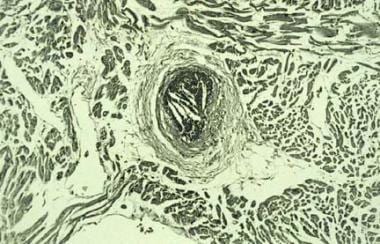
The actual cholesterol crystals are dissolved during fixation, leaving intra-arterial biconvex ghosts. Often, the crystals are missed because the depth of the tissue sample is inadequate. If these ghosts are absent, the diagnosis still may be inferred by fibrinoid necrosis (see Image 2) and a foreign-body reaction in tissues commonly involved by atheromatous emboli in a patient with consistent clinical findings. Exuberant adventitial fibrosis contributes to vessel lumen occlusion.


Medical Care

Medical management is supportive.

  • Hemodynamic monitoring, including pulmonary artery catheterization, may be helpful for fluid and vasopressor adjustments.
  • If ARDS occurs, mechanical ventilation may be required for a prolonged period.
  • Dialysis should be started when indicated because patients can recover limited renal function.
  • Aggressive nutritional and metabolic support is essential because these patients often lose considerable lean body mass to ongoing catabolism.
  • Further invasive vascular procedures and anticoagulant or thrombolytic therapies should be avoided. If they are unavoidable, downstream protection devices to trap atheromatous debris after stenting or angioplasty are suggested.

Surgical Care

  • Surgical therapy, such as aortic aneurysm resection, may be necessary to remove the source of atheroembolic material. Stent-grafting may be less invasive method to reduce risk of embolization.
  • Damaged tissue should be protected and allowed to demarcate for several months. Suprisingly, a majority of the damage may recover. Necrotic tissue should be debrided, and establishing vascular access for dialysis also may be necessary.
  • In severe cases, lumbar sympathetic block (rarely, surgical sympathectomy) has been used to avoid impending lower extremity tissue loss resulting from intense vasoconstriction.

Consultations

  • Nephrologist
  • Critical care specialist
  • Metabolic and nutritional support specialists
  • General and/or vascular surgeons


Medical therapy is not particularly successful in patients with cholesterol embolism syndrome. Vasodilator therapy with calcium channel blockers may help relieve the local ischemia resulting from vasospasm, but angiotensin-converting enzyme (ACE) inhibitors should not be used because of their negative effects on renal afferent arterioles and the glomerular filtration rate. Patients presumed to have vasculitis have been treated with high-dose steroids and antiinflammatory agents, with anecdotal reports of recovery. However, steroids may predispose patients to infectious, metabolic, and nutritional complications and difficulties with wound healing. The use of anticoagulants is controversial because anticoagulants and thrombolytics have been shown to induce atheroemboli. However, patients with atheroembolic ischemic events have been treated with anticoagulation, with some success. In over 1700 patients undergoing cardiac catheterization, anticoagulation did not prove to be a risk factor.


Deterrence/Prevention:

  • If an invasive radiologic procedure is necessary, the risk of inducing cholesterol embolism must be considered. If the patient is at high risk, with known or suspected severe aortic atherosclerosis or aortic aneurysm, the Judkins (ie, brachial) or a radial artery approach may be used for introducing the catheter into the aorta. However, some investigators found the approach made no difference, leading them to suspect the ascending aorta as a major source of atheroemboli.
  • Gentle handling of the severely diseased aorta during cardiac or aortic surgery can reduce the risk of cholesterol embolism. Careful clamping techniques and careful selection of aortotomy sites may minimize disruption of the atherosclerotic plaque.

Complications:

  • Cholesterol embolism can directly affect all organs except the lungs, resulting in complications that range from mild dysfunction to complete organ failure.
  • Supportive care of organ dysfunction may be necessary and may include hemodialysis, bowel resection, cholecystectomy, and pancreatitis management.

Prognosis:

  • Patients with multisystem cholesterol embolism syndrome have a poor prognosis. As many as 90% die within 3 months.
  • Cholesterol crystal showers can become stabilized, leaving patients with varying degrees of organ dysfunction. Renal function can recover if no further insults occur, even to the degree that dialysis can be discontinued. However, patients remain at risk for recurrence of emboli.

Patient Education:


Medical/Legal Pitfalls

  • As with most complications, a bad result may provoke legal action. Allegations of inappropriate, inadequate, or untimely management often cause liability. If an invasive arterial procedure is indicated and if a complication such as cholesterol embolism syndrome occurs, the physician must promptly recognize the problem and take appropriate action.


Media file 1:  Cholesterol crystal embolization from upstream coronary artery plaque after percutaneous transluminal coronary angioplasty.
Click to see larger pictureClick to see detailView Full Size Image
Media type:  Photo

Media file 2:  Necrosis of the abdominal wall in a patient with cholesterol embolism syndrome who received anticoagulation.
Click to see larger pictureClick to see detailView Full Size Image
Media type:  Photo


  1. Willens HJ, Kramer HJ, Kessler KM. Transesophageal echocardiographic findings in blue toe syndrome exacerbated by anticoagulation. J Am Soc Echocardiogr. Nov-Dec 1996;9(6):882-4. [Medline].
  2. Acarturk E, Ozeren A, Sarica Y. Detection of aortic plaques by transesophageal echocardiography in patients with ischemic stroke. Acta Neurol Scand. Aug 1995;92(2):170-2. [Medline].
  3. Adler Y, Shohat-Zabarski R, Vaturi M, Shapira Y, Ehrlich S, Jortner R. Association between mitral annular calcium and aortic atheroma as detected by transesophageal echocardiographic study. Am J Cardiol. Mar 15 1998;81(6):784-6. [Medline].
  4. Belenfant X, Meyrier A, Jacquot C. Supportive treatment improves survival in multivisceral cholesterol crystal embolism. Am J Kidney Dis. May 1999;33(5):840-50. [Medline].
  5. Carroccio A, Olin JW, Ellozy SH, Lookstein RA, Valenzuela R, Minor ME. The role of aortic stent grafting in the treatment of atheromatous embolization syndrome: results after a mean of 15 months follow-up. J Vasc Surg. Sep 2004;40(3):424-9. [Medline].
  6. Fukumoto Y, Tsutsui H, Tsuchihashi M, Masumoto A, Takeshita A,. The incidence and risk factors of cholesterol embolization syndrome, a complication of cardiac catheterization: a prospective study. J Am Coll Cardiol. Jul 16 2003;42(2):211-6. [Medline].
  7. Hasegawa M, Sugiyama S. Apheresis in the treatment of cholesterol embolic disease. Therap Apher Dial. Aug 2003;7(4):435-8. [Medline].
  8. Hirano Y, Ishikaw K. Cholesterol Embolization Syndrome: How to Recognize and Prevent This Potentially Catastrophic Iatrogenic Disease. Int Med. 2005;44:1209-1210.
  9. Jucgla A, Moreso F, Muniesa C. Cholesterol Embolism: Still an Unrecognized Entity with a High Mortality. J Am Acad Derm. 2006;55:786-793.
  10. Katz ES, Tunick PA, Rusinek H, Ribakove G, Spencer FC, Kronzon I. Protruding aortic atheromas predict stroke in elderly patients undergoing cardiopulmonary bypass: experience with intraoperative transesophageal echocardiography. J Am Coll Cardiol. Jul 1992;20(1):70-7. [Medline].
  11. Keen RR, McCarthy WJ, Shireman PK, Feinglass J, Pearce WH, Durham JR. Surgical management of atheroembolization. J Vasc Surg. May 1995;21(5):773-80; discussion 780-1. [Medline].
  12. Kirkland L. Cholesterol embolism in intensive care patients. J Intensive Care Med. 1993;7(3):12-21.
  13. Kolh PH, Torchiana DF, Buckley MJ. Atheroembolization in cardiac surgery. The need for preoperative diagnosis. J Cardiovasc Surg (Torino). Feb 1999;40(1):77-81. [Medline].
  14. Lowe HC, Houser SL, Aretz T, MacNeill BD, Oesterle SN, Palacios IF. Significant atheromatous debris following uncomplicated vein graft direct stenting: evidence supporting routine use of distal protection devices. J Invasive Cardiol. Oct 2002;14(10):636-9. [Medline].
  15. Manganoni AM, Venturini M, Scolari F, Tucci G, Facchetti F, Graifemberghi S. The importance of skin biopsy in the diverse clinical manifestations of cholesterol embolism. Br J Dermatol. Jun 2004;150(6):1230-1. [Medline].
  16. Resnik KS. Intravascular cholesterol clefts as an incidental finding: cholesterol embolism or not?. Am J Dermatopathol. Dec 2003;25(6):497-9. [Medline].
  17. Ribakove GH, Katz ES, Galloway AC, Grossi EA, Esposito RA, Baumann FG. Surgical implications of transesophageal echocardiography to grade the atheromatous aortic arch. Ann Thorac Surg. May 1992;53(5):758-61; discussion 762-3. [Medline].
  18. Tenenbaum A, Garniek A, Shemesh J, Fisman EZ, Stroh CI, Itzchak Y. Dual-helical CT for detecting aortic atheromas as a source of stroke: comparison with transesophageal echocardiography. Radiology. Jul 1998;208(1):153-8. [Medline].
  19. Vayssairat M, Chakkour K, Gouny P, Nussaume O. Atheromatous embolisms and cholesterol embolisms: medical treatment [French]. J Mal Vasc. 1996;21 Suppl A:97-9. [Medline].
  20. Verneuil L, Bekolo R, Dompmartin A. Efficiency of colchicine and corticosteroids in a leg ulceration with cholesterol embolism in a woman with rheumatoid arthritis. Rheumatology. 2003;42:1014-1016.

Cholesterol Embolism excerpt

Article Last Updated: Nov 9, 2007