Continually Updated Clinical Reference
 
 
  All Sources     eMedicine     Medscape     Drug Reference     MEDLINE
 
eMedicine - Erythema Toxicum Neonatorum : Article by

Quick Find
Authors & Editors
Introduction
Clinical
Differentials
Workup
Treatment
Medication
Follow-up
Miscellaneous
References

Related Articles
Candidiasis, Cutaneous

Chickenpox

Folliculitis

Herpes Simplex

Herpes Zoster

Incontinentia Pigmenti

Insect Bites

Milia

Miliaria

Transient Neonatal Pustular Melanosis


Patient Education
Click here for patient education.


Author: Trisha C Beute, MD, Staff Physician, Department of Dermatology, Naval Medical Center, Portsmouth

Trisha C Beute is a member of the following medical societies: Alpha Omega Alpha and American Academy of Dermatology

Coauthor(s): Neil F Gibbs, MD, Assistant Clinical Professor, Departments of Pediatrics and Medicine, University of California, San Diego School of Medicine; Assistant Chair, Program Director, Pediatric Dermatologist, Department of Dermatology, Naval Medical Center, San Diego; Eleanor E Sahn, MD, Director, Division of Pediatric Dermatology, Associate Professor, Departments of Dermatology and Pediatrics, Medical University of South Carolina; Robert Huff, MD, Dermatology, Inc

Editors: Eleanor E Sahn, MD, Director, Division of Pediatric Dermatology, Associate Professor, Departments of Dermatology and Pediatrics, Medical University of South Carolina; Michael J Wells, MD, Associate Professor, Department of Dermatology, Texas Tech University Health Sciences Center; Van Perry, MD, Assistant Professor, Department of Medicine, Division of Dermatology, University of Texas Health Science Center; Joel M Gelfand, MD, MSCE, Medical Director, Clinical Studies Unit, Assistant Professor, Department of Dermatology, Associate Scholar, Center for Clinical Epidemiology and Biostatistics, University of Pennsylvania; William D James, MD, Paul R Gross Professor of Dermatology, University of Pennsylvania School of Medicine; Vice-Chair, Program Director, Department of Dermatology, University of Pennsylvania Health System

Author and Editor Disclosure

Synonyms and related keywords: erythema neonatorum, toxic erythema, erythema neonatorum allergicum, erythema papulosum, urticaria neonatorum, erythema dyspepsicum

Background

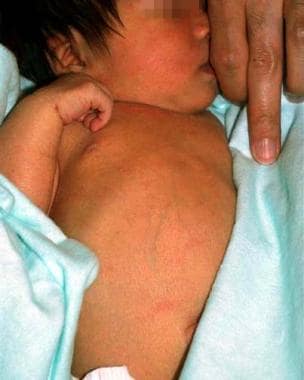
Erythema toxicum neonatorum (ETN) is a benign self-limited eruption occurring primarily in healthy newborns in the early neonatal period. ETN is characterized by macular erythema, papules, vesicles, and pustules, and it resolves without permanent sequelae.

Pathophysiology

Increased levels of immunological and inflammatory mediators (eg, interleukins 1 and 8, eotaxin, the adhesion molecule E-selectin, the water channel proteins aquaphorin 1 and aquaphorin 3, the chemotactic factor psoriasin, nitric oxide and its isoforms, and the antimicrobial peptide LL-37) suggest that ETN may be an immune system reaction. Its location to primarily hair-bearing areas suggests that the hair follicle may be involved.

The eosinophilic infiltrate of ETN suggests an allergic-related or hypersensitivity-related etiology, but no allergens have been identified. Similarly, contactants and mechanical irritation have been considered and rejected as etiologies. Newborn skin appears to respond to any injury with an eosinophilic infiltrate. Because ETN rarely is seen in premature infants, it is believed that mature newborn skin is required to produce this reaction pattern.

Frequency

International

ETN occurs in one third to one half of full-term infants and in 5% of premature infants.

Mortality/Morbidity

ETN is a self-limited eruption that resolves spontaneously. Although one study found that infants with ETN had an increased risk of atopy, subsequent studies have failed to support this finding.

Race

No racial or ethnic predisposition is known.

Sex

The prevalence is higher in males (55%) than in females (30%), except among females born of first pregnancies, who have a higher rate than males of first pregnancies.

Age

  • Erythema toxicum neonatorum presents within the first 4 days of life in full-term infants, with the peak onset occurring within the first 48 hours following birth. Rare cases have been reported at birth.
  • Incidence rises with increasing gestational age and birth weight.
  • Delayed onset rarely may occur in full-term and preterm infants up to age 14 days.


History

Focus the history on age at onset of the eruption, absence of systemic signs (eg, fever, irritability, lethargy, mucocutaneous involvement), or maternal history of herpes simplex/varicella viral infection, bacterial pyoderma, or candidiasis.

  • Infants with ETN otherwise are healthy and lack systemic symptoms.
  • The eruption is self-limited with most cases resolving within 5-14 days without residual sequelae.
  • Recurrences are uncommon but have been reported up to the sixth week of life. They tend to be mild in severity.

Physical

Focus the physical examination on location, size, and distribution of macules, wheals, papules, and pustules on the skin. Note the absence of mucosal, palmar, or plantar involvement. Signs of systemic toxicity, including hypothermia or hyperthermia, lethargy, and irritability, are not associated with ETN.

  • ETN most commonly presents with a blotchy, evanescent, macular erythema, often on the face or trunk.
  • The macules are irregular, blanchable, and vary in size.
  • In more severe cases, pale yellow or white wheals or papules on an erythematous base may follow. In approximately 10% of patients, 2-4 mm pustules develop.
  • Numbers and distribution of lesions vary from a few and widely scattered to numerous and extensive.
  • Sites of predilection include the forehead, face, trunk, and proximal extremities, but lesions may occur anywhere, including the genitalia. Involvement of the mucous membranes and palms and soles rarely occurs.

Causes

The cause of ETN is unknown. Multiple theories have been proposed to explain this common disorder.

  • Neonates have an increased number of hair follicles compared with adults, and the occurrence of ETN in non–hair-bearing areas such as palms and soles is rare. Inflammatory cells tend to concentrate around hair follicles, and coccilike microbes have been demonstrated in the follicular epithelium and inside the inflammatory cells. This suggests that ETN may be a response to microbes that have penetrated the hair follicle. This process may possibly be integral in developing the new immune system.
  • The high frequency of eosinophilia suggests an allergic basis, leading some authors to suggest that ETN may be an immediate hypersensitivity reaction to a substance passed from the mother transplacentally; however, convincing support is lacking for this theory.
  • No responsible exotoxin, allergen, component of sebum, or infectious agent has been linked credibly to ETN.
  • Medications administered to newborns and the mode of feeding have no effect on incidence.
  • Other proposed theories include a transient adjustment reaction of the skin to mechanical or thermal stimulation or an acute graft-versus-host reaction induced by the maternal-fetal transfer of lymphocytes before or during delivery.
  • Risk factors include birth in hot, wet climates, being fed on a mixed diet or milk powder substitute, and being born via vaginal delivery. A positive correlation has been recognized between the length of labor and both the incidence of ETN and the duration of the cutaneous manifestations.


Candidiasis, Cutaneous
Chickenpox
Folliculitis
Herpes Simplex
Herpes Zoster
Incontinentia Pigmenti
Insect Bites
Milia
Miliaria
Transient Neonatal Pustular Melanosis

Other Problems to be Considered

Bacterial pyoderma


Lab Studies

  • ETN is diagnosed clinically based on history, physical examination, and peripheral smear of intralesional contents.
  • On a CBC count, eosinophilia are noted in approximately 15% of patients as up to 18% of the total WBC count. Eosinophilia may be more pronounced when the eruption shows a marked pustular component.
  • A Tzanck smear or Gram stain performed on intralesional contents is essential for diagnosis. Inflammatory cells are present, with greater than 90% eosinophils and variable numbers of neutrophils.

Other Tests

  • Perform viral, bacterial, and fungal cultures to exclude herpes simplex virus, varicella, pathogenic bacterial, and yeast infections.
  • Perform potassium hydroxide preparation to exclude candidiasis.

Procedures

  • A skin biopsy is diagnostic but rarely is required for diagnosis.

Histologic Findings

Histologic examination of macules reveals mild dermal edema with a sparse predominantly perivascular inflammatory infiltrate composed primarily of eosinophils, with small numbers of neutrophils and monocytes. Papules have increased edema and inflammatory infiltrate with involvement of the superficial portion of the pilosebaceous unit. Eosinophilic invasion of the outer root sheath of the hair follicle is noted. Pustules are subcorneal or intraepidermal and are found associated with the pilosebaceous orifice. A variable infiltrate of eosinophils and monocytes may be seen with or without neutrophils in the surrounding dermis.


Medical Care

Diagnosis rests on recognizing the characteristic history and physical findings in an otherwise healthy newborn.

  • A complete history, physical examination, and Tzanck smear are required to differentiate between benign transient pustular eruptions of the newborn and life-threatening disease.
  • ETN is a benign self-limited disorder requiring no treatment. Reassure parents regarding the benign transitory nature of the condition.


No local or systemic treatment is required.


Further Outpatient Care

  • Most cases resolve within 3-4 days after onset without residua.
  • Rare recurrences are seen in a small number of patients up to age 6 weeks. In these instances, follow-up examination may be needed.

Complications

  • No complications of ETN have been reported.

Prognosis

  • Prognosis of ETN is excellent with spontaneous resolution.
  • ETN may recur in approximately 11% of patients up to age 6 weeks. Recurrences tend to be mild and resolve without sequelae.

Patient Education

  • Reassure parents that ETN is not inherited or infectious, has no complications, and has an excellent prognosis with spontaneous resolution.


Medical/Legal Pitfalls

  • Failure to differentiate ETN from severe life-threatening conditions, which may be difficult in some patients (maternal history, bedside tests such as Tzanck smear, Gram stain, and potassium hydroxide preparations, cultures, and skin biopsy, if necessary, should clarify the diagnosis)


  • Akoglu G, Ersoy Evans S, Akca T, Sahin S. An unusual presentation of erythema toxicum neonatorum: delayed onset in a preterm infant. Pediatr Dermatol. May-Jun 2006;23(3):301-2. [Medline].
  • Bassukas ID. Is erythema toxicum neonatorum a mild self-limited acute cutaneous graft-versus-host-reaction from maternal-to-fetal lymphocyte transfer?. Med Hypotheses. Aug 1992;38(4):334-8. [Medline].
  • Carr JA, Hodgman JE, Freedman RI, Levan NE. Relationship between toxic erythema and infant maturity. Am J Dis Child. Aug 1966;112(2):129-34. [Medline].
  • Chang MW, Jiang SB, Orlow SJ. Atypical erythema toxicum neonatorum of delayed onset in a term infant. Pediatr Dermatol. Mar-Apr 1999;16(2):137-41. [Medline].
  • Ferrandiz C, Coroleu W, Ribera M, et al. Sterile transient neonatal pustulosis is a precocious form of erythema toxicum neonatorum. Dermatology. 1992;185(1):18-22. [Medline].
  • Freeman RG, Spiller R, Knox JM. Histopathology of erythema toxicum neonatorum. Arch Dermatol. Oct 1960;82:586-9. [Medline].
  • Harris JR, Schick B. Erythema neonatorum. AMA J Dis Child. Jul 1956;92(1):27-33. [Medline].
  • Keitel HG, Yadav V. Etiology of toxic erythema. Erythema toxicum neonatorum. Am J Dis Child. Sep 1963;106:306-9. [Medline].
  • Levy HL, Cothran F. Erythema toxicum neonatorum present at birth. Am J Dis Child. Apr 1962;103:617-9. [Medline].
  • Liu C, Feng J, Qu R, et al. Epidemiologic study of the predisposing factors in erythema toxicum neonatorum. Dermatology. 2005;210(4):269-72. [Medline].
  • Luders D. Histologic observations in erythema toxicum neonatorum. Pediatrics. Aug 1960;26:219-24. [Medline].
  • Maffei FA, Michaels MG, Wald ER. An unusual presentation of erythema toxicum scrotal pustules present at birth. Arch Pediatr Adolesc Med. Jun 1996;150(6):649-50. [Medline].
  • Marchini G, Ulfgren AK, Loré K, et al. Erythema toxicum neonatorum: an immunohistochemical analysis. Pediatr Dermatol. May-Jun 2001;18(3):177-87. [Medline].
  • Marchini G, Lindow S, Brismar H, et al. The newborn infant is protected by an innate antimicrobial barrier: peptide antibiotics are present in the skin and vernix caseosa. Br J Dermatol. Dec 2002;147(6):1127-34. [Medline].
  • Marchini G, Nelson A, Edner J, et al. Erythema toxicum neonatorum is an innate immune response to commensal microbes penetrated into the skin of the newborn infant. Pediatr Res. Sep 2005;58(3):613-6. [Medline].
  • Marchini G, Stabi B, Kankes K, et al. AQP1 and AQP3, psoriasin, and nitric oxide synthases 1-3 are inflammatory mediators in erythema toxicum neonatorum. Pediatr Dermatol. Sep-Oct 2003;20(5):377-84. [Medline].
  • Marino LJ. Toxic erythema present at birth. Arch Dermatol. Oct 1965;92(4):402-3. [Medline].
  • Schwartz RA, Janniger CK. Erythema toxicum neonatorum. Cutis. Aug 1996;58(2):153-5. [Medline].
  • Singh M, Arora NK, Sroa HS. Urticaria neonatorum--an earliest marker of atopy. Indian J Med Res. Feb 1980;71:273-7. [Medline].
  • Van Praag MC, Van Rooij RW, Folkers E, et al. Diagnosis and treatment of pustular disorders in the neonate. Pediatr Dermatol. Mar-Apr 1997;14(2):131-43. [Medline].

Erythema Toxicum Neonatorum excerpt

Article Last Updated: Nov 8, 2006