Continually Updated Clinical Reference
 
 
  All Sources     eMedicine     Medscape     Drug Reference     MEDLINE
 
eMedicine - Ichthyosis, Lamellar : Article by

Quick Find
Authors & Editors
Introduction
Clinical
Differentials
Workup
Treatment
Medication
Follow-up
Miscellaneous
Multimedia
References

Related Articles
Ichthyosis Fetalis

Ichthyosis Vulgaris, Hereditary and Acquired

Ichthyosis, X-Linked

Rud Syndrome

Sjogren-Larsson Syndrome


Patient Education
Click here for patient education.


Author: Theresa Conologue, DO, Staff, Department of Dermatology, National Capital Consortium/Walter Reed Army Medical Center

Theresa Conologue is a member of the following medical societies: American Academy of Dermatology and Association of Military Dermatologists

Coauthor(s): Jeffrey Meffert, MD, Assistant Clinical Professor of Dermatology, University of Texas Health Science Center-San Antonio

Editors: Daniel J Hogan, MD, Director of Bay Pines Dermatology Residency Program, Bay Pines Veterans Affairs Healthcare System; David F Butler, MD, Professor of Dermatology, Texas A&M University College of Medicine; Director, Division of Dermatology, Scott and White Clinic; Director Dermatology Residency Training Program, Scott and White Clinic; Van Perry, MD, Assistant Professor, Department of Medicine, Division of Dermatology, University of Texas Health Science Center; Joel M Gelfand, MD, MSCE, Medical Director, Clinical Studies Unit, Assistant Professor, Department of Dermatology, Associate Scholar, Center for Clinical Epidemiology and Biostatistics, University of Pennsylvania; William D James, MD, Paul R Gross Professor of Dermatology, University of Pennsylvania School of Medicine; Vice-Chair, Program Director, Department of Dermatology, University of Pennsylvania Health System

Author and Editor Disclosure

Synonyms and related keywords: nonbullous congenital ichthyosiform erythroderma, non-bullous congenital ichthyosiform erythroderma, autosomal recessive ichthyosis, erythrodermic autosomal recessive lamellar ichthyosis, EARI, nonerythrodermic autosomal recessive lamellar ichthyosis, NEARLI, non-erythrodermic autosomal recessive lamellar ichthyosis, lamellar ichthyosis

Background

Lamellar ichthyosis is an autosomal recessive disorder that is apparent at birth and is present throughout life. The newborn is born encased in a collodion membrane that sheds within 10-14 days. The shedding of the membrane reveals generalized scaling with variable redness of the skin. The scaling may be fine or platelike, resembling fish skin. Although the disorder is not life threatening, it is quite disfiguring and causes considerable psychological stress to affected patients.

Pathophysiology

Patients with lamellar ichthyosis have accelerated epidermal turnover with proliferative hyperkeratosis, in contrast to retention hyperkeratosis. This involves a mutation in the gene for transglutaminase 1 (TGM1). The transglutaminase 1 enzyme is involved in the formation of the cornified cell envelope.

Frequency

United States

Prevalence is less than 1 case per 300,000 individuals.

Mortality/Morbidity

  • In the neonatal period, following the shedding of the collodion membrane, the newborn is at risk for secondary sepsis and hypernatremic dehydration.
  • As the child ages, the hyperkeratosis can interfere with normal sweat gland function, which can predispose to heat intolerance and possible heat shock. Ectropion may result in the inability to fully close the eyelids and can cause exposure keratitis.

Sex

  • Incidence in males and females is equal.

Age

  • The disease is present at birth and continues throughout life.
  • A rare phenotype of lamellar Ichthyosis has recently been described in South Africa. The term bathing-suit ichthyosis describes the characteristic distribution of the lesions, which involve the trunk, the proximal parts of the upper limbs, the scalp, and the neck, with sparing of the central face and extremities. This form of lamellar ichthyosis is caused by a homozygous missense mutation in TGM1.


Physical

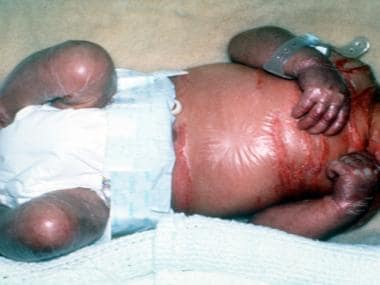
  • Newborn period: The newborn presents encased in a tough, filmlike membrane that fissures when stretched. This collodion membrane is shed by 10-14 days, revealing generalized erythema and scaling.
  • Childhood and adulthood
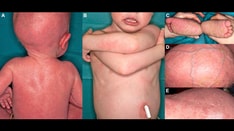
    • Skin: The disease is characterized by generalized scales, which range from fine and white to thick, dark, and platelike. The scales are arranged in a mosaic pattern resembling fish skin. The lesions involve the entire body and are increased in flexural surfaces such as the axilla, groin, antecubital fossa, and neck. The individual scales tend to be larger over the legs and, in some areas, are centrally attached and raised at the edges.
    • Nail abnormalities: These include secondary dystrophy with nail fold inflammation, subungual hyperkeratosis, and longitudinal or transverse stippling. The nails may grow 2-3 times the normal rate.
    • Scalp: Scarring alopecia can result from the overall tightness of skin and the thick stratum corneum entrapping hairs. The hair may be thin and fine but, similar to the nails, can grow at 2-3 times the normal rate.
    • Other findings: The lips and mucous membranes tend to be spared. Other associated features are ectropion, eclabium, bilateral conjunctivitis, small and deformed ears, and inflexible digits due to taut skin.

Causes

Lamellar ichthyosis is an autosomal recessive disorder in almost all cases. Genetic linkage studies have been performed on families with classic lamellar ichthyosis and show markers on band 14q11 in the region of the TGM1 gene locus. An autosomal dominant form of lamellar ichthyosis has been described.


Ichthyosis Fetalis
Ichthyosis Vulgaris, Hereditary and Acquired
Ichthyosis, X-Linked
Rud Syndrome
Sjogren-Larsson Syndrome

Other Problems to be Considered

Congenital ichthyosiform erythroderma
Conradi disease
Netherton syndrome
Trichothiodystrophy
Lamellar exfoliation of the newborn


Lab Studies

  • As a result of the abnormal skin barrier, neonatal sepsis is a significant risk in the newborn period. If sepsis is considered, perform a sepsis workup. Chemistries and fluids need to be monitored closely because of the high incidence of hypernatremia observed.

Procedures

  • Skin biopsies can aid in the diagnosis of lamellar ichthyosis and detection of transglutaminase-1 expression. At birth, electron microscopy can be used to differentiate a severe collodion baby affected by lamellar ichthyosis from a baby affected by harlequin ichthyosis by demonstrating the absence of the marginal band.

Histologic Findings

Skin biopsy results show a normal or thickened granular layer, mild-to-moderate hyperkeratosis with increased mitoses, and a perivascular lymphocytic infiltrate. In autosomal dominant lamellar ichthyosis, the stratum granulosum and stratum corneum are separated by a prominent transforming zone and scales contain elevated triglyceride and fatty acid levels, which aids in differentiation from autosomal recessive lamellar ichthyosis.


Medical Care

Transfer the newborn to the neonatal intensive care unit for close monitoring of fluids, electrolytes, and signs of sepsis and placement in a high-humidity incubator. Manual debridement of the collodion membrane is not recommended.

Surgical Care

Surgery is occasionally necessary for severe ectropion.

Consultations

Consult a dermatologist for the evaluation and treatment of the skin. Consult an ophthalmologist for the evaluation and management of ectropion from birth. Consult a genetics counselor for a discussion of the risks of subsequent children being affected.

Activity

A potential for heat intolerance and heat stroke is present; however, with proper counseling, activity does not need to be limited.


This disorder has no cure; therefore, treatment is directed at decreasing symptoms.

Emollients should be applied after showering or bathing. The stratum corneum can absorb 6 times its weight in water, and a heavy emollient, such as petrolatum jelly (Vaseline) or water-in-oil preparations (eg, Eucerin) should be applied while the skin is still wet. Alpha-hydroxy acids, such as lactic acid (eg, Lac-Hydrin), help reduce corneocyte adhesion and decrease the thickness of the epidermis. Urea creams can help soften scales. Salicylic acids in combination with propylene glycol help to remove dark scaling. Care must be taken when using topical salicylates over large areas, especially in children, because of reports of systemic salicylate intoxication. Topical retinoic acids (eg, Retin-A) decrease thickened scaling. Antiseptics and antimicrobials can be used topically to control odor. Because of the significant long-term adverse effects, reserve systemic retinoids for severe disease that is refractory to conventional therapy.

Newer therapies that have resulted in clinical improvement are Locobase fatty cream, which is 5% lactic acid and 20% propylene glycol in a lipophilic cream base; topical N-acetylcysteine, which has an antiproliferative effect; tazarotene topical 0.05%, a receptor-selective retinoid; and calcipotriol, a synthetic derivative of vitamin D-3.

Drug Category: Alpha-hydroxy acids

Decrease thickness of the epidermis and reduce corneocyte adhesion.

Drug NameLactic acid (Lac-Hydrin)
DescriptionRelieves itching and aids healing of skin in mild eczemas and dermatoses, itching skin, minor wounds, and minor skin irritations. Twelve percent ammonium lactate in base containing propylene glycol.
Adult DoseApply topically to affected areas bid after bathing
Pediatric Dose<12 years: Not established
>12 years: Administer as in adults
ContraindicationsDocumented hypersensitivity
InteractionsNone reported
PregnancyC - Safety for use during pregnancy has not been established.
PrecautionsMay cause stinging and burning at application site; caution when using on face (potential irritation)

Drug Category: Topical retinoids

Appear to decrease the cohesiveness of follicular epithelial cells and stimulate mitotic activity, resulting in an increase in turnover of follicular epithelial cells.

Drug NameTretinoin (Retin-A, Avita)
DescriptionInhibits microcomedo formation and eliminates lesions. Makes keratinocytes in sebaceous follicles less adherent and easier to remove. Use 0.01% gel.
Adult DoseApply topically to affected areas qhs
Pediatric Dose<12 years: Not established
>12 years: Administer as in adults
ContraindicationsDocumented hypersensitivity
InteractionsToxicity increases with coadministration of benzoyl peroxide, salicylic acid, or resorcinol; avoid topical sulfur, resorcinol, salicylic acid, other keratolytics, abrasives, astringents, spices, and lime
PregnancyC - Safety for use during pregnancy has not been established.
PrecautionsGels are flammable; photosensitivity may occur with excessive sunlight exposure; caution in eczema; do not apply to mucous membranes, mouth, and angles of nose

Drug NameTazarotene (Tazorac)
DescriptionTopical gel 0.05%. Retinoid prodrug whose active metabolite modulates differentiation and proliferation of epithelial tissue; may also have anti-inflammatory and immunomodulatory properties. Make sure skin is dry before applying gel
Adult DoseApply thin film qd to cover lesion (2 mg/cm2); not to exceed >20% of BSA
Pediatric Dose<12 years: Not established
>12 years: Administer as in adults
ContraindicationsDocumented hypersensitivity; pregnancy
InteractionsNone reported
PregnancyX - Contraindicated in pregnancy
PrecautionsMay cause burning or stinging; discontinue if excessive irritation; rinse thoroughly if contact with eyes, eyelids, or mouth; may cause severe irritation in eczematous skin; photosensitivity may occur

Drug Category: Systemic retinoids

Inhibit sebaceous gland function and keratinization.

Drug NameIsotretinoin (Accutane)
DescriptionOral agent that treats serious dermatologic conditions. Synthetic 13-cis isomer of naturally occurring tretinoin (trans-retinoic acid). Both agents are structurally related to vitamin A.
Decreases sebaceous gland size and sebum production. May inhibit sebaceous gland differentiation and abnormal keratinization.
Adult Dose0.5-2 mg/kg/d divided bid
Pediatric DoseNot established
ContraindicationsDocumented hypersensitivity; pregnant or planning to become pregnant while undergoing treatment
InteractionsToxicity may occur with vitamin A coadministration; pseudotumor cerebri or papilledema may occur when coadministered with tetracyclines; may reduce plasma levels of carbamazepine
PregnancyX - Contraindicated in pregnancy
PrecautionsDepression, psychosis, and (rarely) suicidal ideation have been reported but linkage is debatable; has been associated with cases of pseudotumor cerebri and physician should monitor for early signs of headache, papilledema, nausea, and vomiting; decreased night vision, cornea opacities, possible onset or exacerbation of inflammatory bowel disease, elevation of plasma triglyceride levels, hyperostosis, and hepatotoxicity may occur

Drug NameAcitretin (Soriatane)
DescriptionRetinoic acid analog, similar to etretinate and isotretinoin. Etretinate is main metabolite and has demonstrated clinical effects similar to those seen with etretinate. Mechanism of action is unknown.
Adult DoseInitial dose: 25 or 50 mg/d PO single dose with main meal
Maintenance dose: 25-50 mg/d PO after initial response to treatment; terminate therapy when lesions have resolved sufficiently
Pediatric DoseNot established
ContraindicationsDocumented hypersensitivity; pregnant or planning to become pregnant for 3 y following discontinuation of treatment
InteractionsIncreases toxicity of methotrexate (avoid concomitant use); interferes with effects of microdosed progestin "minipill"; coadministration with alcohol may enhance synthesis of etretinate, which has much longer half-life than acitretin (>120 d)
PregnancyX - Contraindicated in pregnancy
PrecautionsHepatotoxicity with elevation of AST, ALT, GGT, or LDH occurs in approximately 1 in 3 patients; lipid elevations occur in approximately 25-50% of patients and rarely result in pancreatitis; one case of fatal hemorrhagic pancreatitis has been reported; pseudotumor cerebri may occur; may experience dry eyes and loss of lashes; decreased night vision, blepharitis, Bell palsy, cortical cataract, photophobia, and posterior subcapsular cataract may occur; patients with visual changes should discontinue treatment; hyperostosis, elevation of triglyceride levels, and lowered HDL may occur


Further Outpatient Care

  • The family should be aware of these patient and family support groups:

Transfer

  • Transfer the newborn to the neonatal intensive care unit for close monitoring of fluids, electrolytes, and signs of sepsis. Manual debridement of the collodion membrane is not recommended.

Deterrence/Prevention

  • Prenatal diagnosis is controversial. A fetal skin biopsy at 22 weeks may aid in prenatal diagnosis. In patients with a known gene locus, DNA linkage analysis may be useful.

Prognosis

  • Patients with lamellar ichthyosis have normal life spans.

Patient Education

  • Educate patients on the potential for heat stress disorders. Access to support groups is critical for patients and their families. The following address is for the support group for lamellar ichthyosis: Foundation for Ichthyosis and Related Skin Types, PO Box 20921, Raleigh NC 27619, telephone: (800) 545-3286


Medical/Legal Pitfalls

  • As with most genetic testing, prenatal diagnosis is controversial and can be a potential area for medicolegal problems.
  • Many of the medications used for lamellar ichthyosis have a long list of potential adverse effects, and care must be taken to discuss the advantages and disadvantages of treatment. Salicylate toxicity has been reported with systemic absorption of topical salicylic acids in the treatment of children with ichthyosis. A case of lactic acidosis has been reported, with clinical signs of irritability, agitation, myoclonia, and difficulty walking, all which resolved upon discontinuation of the topical treatment.
  • Topical tacrolimus, a macrolide immunosuppressant, should be used with caution because significantly elevated systemic tacrolimus levels have been reported in a patient with lamellar ichthyosis.


Media file 1:  Collodion baby with translucent membrane of the body.
Click to see larger pictureClick to see detailView Full Size Image
Media type:  Photo

Media file 2:  Keratoderma of the palms in a patient with lamellar ichthyosis. Courtesy of Dirk Elston, MD.
Click to see larger pictureClick to see detailView Full Size Image
Media type:  Photo

Media file 3:  Inflexible fingers due to taut skin in a young patient with lamellar ichthyosis. Courtesy of Dirk Elston, MD.
Click to see larger pictureClick to see detailView Full Size Image
Media type:  Photo

Media file 4:  Nail dystrophy and inflammation of the nail folds. Courtesy of M. Bryan, MD.
Click to see larger pictureClick to see detailView Full Size Image
Media type:  Photo


  • Abdel-Magid EH, el-Awad Ahmed FR. Salicylate intoxication in an infant with ichthyosis transmitted through skin ointment--a case report. Pediatrics. Dec 1994;94(6 Pt 1):939-40. [Medline].
  • Allen DM, Esterly NB. Significant systemic absorption of tacrolimus after topical application in a patient with lamellar ichthyosis. Arch Dermatol. Sep 2002;138(9):1259-60. [Medline].
  • Arita K, Jacyk WK, Wessagowit V, et al. The South African "Bathing Suit Ichthyosis" Is a Form of Lamellar Ichthyosis Caused by a Homozygous Missense Mutation, p.R315L, in Transglutaminase 1. J Invest Dermatol. Sep 14 2006;[Medline].
  • DiGiovanna JJ. Ichthyosiform Dermatoses. In: Freedberg IM, Eisen AZ, Wolff K, Austen KF, Goldsmith LA, Katz SI, Fitzpatrick TB, eds. Fitzpatrick's Dermatology in General Medicine. Vol 1. 5th ed. New York, NY: McGraw-Hill; 1999:. 587-8.
  • Ganemo A, Virtanen M, Vahlquist A. Improved topical treatment of lamellar ichthyosis: a double-blind study of four different cream formulations. Br J Dermatol. Dec 1999;141(6):1027-32. [Medline].
  • Huber M, Rettler I, Bernasconi K, et al. Mutations of keratinocyte transglutaminase in lamellar ichthyosis. Science. Jan 27 1995;267(5197):525-8. [Medline].
  • Jacyk WK. Bathing-suit ichthyosis. A peculiar phenotype of lamellar ichthyosis in South African blacks. Eur J Dermatol. Nov-Dec 2005;15(6):433-6. [Medline].
  • Kragballe K, Steijlen PM, Ibsen HH, et al. Efficacy, tolerability, and safety of calcipotriol ointment in disorders of keratinization. Results of a randomized, double-blind, vehicle-controlled, right/left comparative study. Arch Dermatol. May 1995;131(5):556-60. [Medline].
  • Novice FM, Collison DW, Burgdorf WHC, Esterly N, eds. Lamellar ichthyosis. In: Handbook of Genetic Skin Disorders. Philadelphia, Pa: WB Saunders; 1994:. 9-12.
  • Ramírez ME, Youseef WF, Romero RG, et al. Acute percutaneous lactic acid poisoning in a child. Pediatr Dermatol. May-Jun 2006;23(3):282-5. [Medline].
  • Redondo P, Bauza A. Topical N-acetylcysteine for lamellar ichthyosis [letter]. Lancet. Nov 27 1999;354(9193):1880. [Medline].
  • Sandler B, Hashimoto K. Collodion baby and lamellar ichthyosis. J Cutan Pathol. Feb 1998;25(2):116-21. [Medline].
  • Spitz JL. Lamellar ichthyosis. In: Spitz JL, ed. Genodermatoses. Baltimore, Md: Williams & Wilkins; 1996:. 8-9.
  • Stege H, Hofmann B, Ruzicka T, Lehmann P. Topical application of tazarotene in the treatment of nonerythrodermic lamellar ichthyosis [letter]. Arch Dermatol. May 1998;134(5):640. [Medline].
  • Sybert VP. Lamellar Ichthyosis. In: Sybert VP, ed. Genetic Skin Disorders. 1st ed. New York, NY: Oxford University Press; 1997:. 27-30.

Ichthyosis, Lamellar excerpt

Article Last Updated: Oct 19, 2006