| Patient Education |
|
Click here for patient education.
|
|
You are in: eMedicine Specialties >
Dermatology > DISEASES OF PIGMENTATION
Idiopathic Guttate Hypomelanosis
Article Last Updated: Jan 12, 2007
AUTHOR AND EDITOR INFORMATION
Section 1 of 9
Author: Stephen W White, MD, Clinical Assistant Professor, Department of Dermatology, George Washington University Hospital
Stephen W White is a member of the following medical societies: American Academy of Dermatology, International Society of Dermatology, Society for Investigative Dermatology, and Society for Pediatric Dermatology
Coauthor(s):
Christopher R Gorman, MD, Resident Physician, Department of Dermatology, University of Virginia School of Medicine
Editors: Daniel Mark Siegel, MD, MS, Director, Procedural Dermatology Fellowship Program, Clinical Professor of Dermatology, Department of Dermatology, State University of New York Downstate; Richard P Vinson, MD, Assistant Clinical Professor, Department of Dermatology, Texas Tech University School of Medicine; Consulting Staff, Mountain View Dermatology, PA; Jeffrey Meffert, MD, Assistant Clinical Professor of Dermatology, University of Texas Health Science Center-San Antonio; Joel M Gelfand, MD, MSCE, Medical Director, Clinical Studies Unit, Assistant Professor, Department of Dermatology, Associate Scholar, Center for Clinical Epidemiology and Biostatistics, University of Pennsylvania; William D James, MD, Paul R Gross Professor of Dermatology, University of Pennsylvania School of Medicine; Vice-Chair, Program Director, Department of Dermatology, University of Pennsylvania Health System
Author and Editor Disclosure
Synonyms and related keywords:
IGH, hypomelanosis of Cummins and Cottel, hypomelanosis guttata idiopathica, leukodermia lenticular disseminata, leukopathia guttata et reticularis symmetrica idiopathic guttate, macular hypopigmentation of the legs of women, senile depigmented spots, symmetric progressive leukopathy of the extremities
Background
Idiopathic guttate hypomelanosis (IGH) is an acquired, benign leukoderma of unknown etiology. It is most commonly a complaint of middle-aged, light-skinned women, but it is increasingly seen in both sexes and older dark-skinned people with a history of long-term sun exposure.
IGH is a benign condition. The cause is not known, but it appears to be related to the effect of the sun on melanocytes, which makes them effete.
A variety of therapeutic methods, including topical steroids, topical retinoids, dermabrasion, cryotherapy, and minigrafting, have been used with variable success.
Pathophysiology
Because pigmentation of the skin is due to an integration of melanocyte and keratinocyte function, an acquired defect of the epidermal melanin unit results in the observed hypopigmentation.
Significantly fewer dopa oxidase-positive, KIT+, and melanocytes are seen in the lesions.
In 1967, Hamada and Saito found a 50% reduction in melanocytes.
Frequency
United States
IGH is a very common condition to the point of being almost universal in elderly fair-skinned individuals. In 2002, a case control study of 47 renal transplant patients demonstrated a significant positive association between HLA-DQ3 and the development of IGH and a significant negative association between HLA-DR8 and the development of IGH.
International
This disease is most common in countries with fair-skinned populations having a high degree of sun exposure.
Mortality/Morbidity
This condition is cosmetic alone, albeit, it is indicative of cumulative sun exposure.
Race
IGH affects fair-skinned people at an earlier age.
Sex
- This condition is seen far more frequently in women, beginning around the age of 30 years. However, with increasing age and sun exposure, it is found almost equally in elderly men and women.
- Why IGH occurs earlier in young women than in young men is unknown.
Age
- This condition is related to the lack of pigmentary protection from the sun and sun exposure rather than to age.
- Fair-skinned women develop this condition first; later, with increasing age and exposure to sun, both sexes seem to be equally affected.
History
- Typically, IGH develops first on the legs of fair-skinned women in early adult life. Later, it may spread to other sun-exposed areas, such as the arms and the upper part of the back.
- The face is inexplicably not involved early in the disease.
- A familial tendency to develop this condition has been noted.
Physical
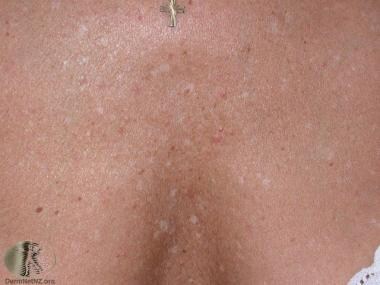
- This condition consists of discrete, angular or circular macules that are 1-3 mm in diameter. However, lesions may measure up to 10 mm in diameter.
- These lighter-than-normal skin macules are off white, hypopigmented, or achromic.
- They are often noted first on the anterior aspects of the legs. Later, they appear on the forearms.
- The distribution seems to be photo related, except for the face, which is affected later than the limbs.
Causes
The exact cause is not agreed upon; however, it is hypothesized that ultraviolet light plays an important role.
Pityriasis Alba
Vitiligo
Warts, Nongenital
Other Problems to be Considered
Hypomelanosis after insect bites
Lichenoid eruptions
Scars
Pinta
Hyperkeratotic confetti leucoderma (Loquai, 2005)
Lab Studies
- This condition should be diagnosed on clinical grounds.
- A Wood light examination could be helpful in revealing unsuspected involvement.
- Dopa staining can be useful because dopa-positive melanocytes are decreased.
Procedures
- In atypical cases, a biopsy may be indicated.
Histologic Findings
Several light and electron microscopic studies have revealed a characteristic pathologic picture. Typical histologic findings are epidermal atrophy of the actinic type, a patchy decrease or absence of melanocytes and melanin, flat rete ridges, and basket weave hyperkeratosis.
Medical Care
Medical therapy includes corticosteroids, either topical or intralesional, and retinoids, typically topical tretinoin.
Surgical Care
Surgical techniques from cryosurgery to dermabrasion have been tried with some success. Theoretically, cryotherapy would remove the damaged melanocytes, which would encourage normal melanocytes to replace them.
Consultations
In doubtful cases, a consultation with a dermatologist would precede any laboratory or biopsy studies.
The goals of pharmacotherapy are to reduce morbidity and to prevent complications.
Drug Category: Retinoids
Although tretinoin has been used with some success, avoiding ultraviolet-induced pigmentation and an artificial coloration of the area is recommended as first-line therapy.
This drug is chosen perhaps because of its action in other actinic conditions.
| Drug Name | Tretinoin (Avita, Retin-A) |
| Description | Tretinoin has been shown to reverse some aspects of sun damage. Available as 0.025%, 0.05%, and 0.1% creams. Also available as 0.01% and 0.025% gels. |
| Adult Dose | Begin with lowest tretinoin formulation and increase as tolerated; apply hs or qod; decrease frequency of application if irritation develops |
| Pediatric Dose | <12 years: Not established >12 years: Apply as in adults |
| Contraindications | Documented hypersensitivity |
| Interactions | Irritation may increase with coadministration of topical benzoyl peroxide, salicylic acid, and resorcinol; avoid topical sulfur, resorcinol, salicylic acid, other keratolytics, abrasives, astringents, spices, and lime |
| Pregnancy | C - Safety for use during pregnancy has not been established.
|
| Precautions | Photosensitivity may occur with excessive sunlight exposure; caution in eczema; do not apply to mucous membranes, mouth, and angles of nose; caution in pregnancy; off-label use (might not be covered by some pharmacy plans) |
Further Outpatient Care
- Sunscreens are advised because IGH is a marker of sun damage.
Deterrence/Prevention
- This condition may be avoided, at least until late in life, by protection against sun damage.
- Avoiding sun tanning is an important adjunct because tanning accentuates the process and intensifies the pigmentary contrast. Artificial tanning using dihydroxyacetone-containing topical agents is a good alternative.
Prognosis
- This condition progresses with increasing sun exposure and, to a lesser degree, with age.
Patient Education
- Progress in preventing IGH can be made by educating young women not to tan their legs.
- Arrunategui A, Trujillo RA, Marulanda MP, et al. HLA-DQ3 is associated with idiopathic guttate hypomelanosis, whereas HLA-DR8 is not, in a group of renal transplant patients. Int J Dermatol. Nov 2002;41(11):744-7. [Medline].
- Falabella R, Escobar C, Giraldo N, et al. On the pathogenesis of idiopathic guttate hypomelanosis. J Am Acad Dermatol. Jan 1987;16(1 Pt 1):35-44. [Medline].
- Kaya TI, Yazici AC, Tursen U, Ikizoglu G. Idiopathic guttate hypomelanosis: idiopathic or ultraviolet induced?. Photodermatol Photoimmunol Photomed. Oct 2005;21(5):270-1. [Medline].
- Loquai C, Metze D, Nashan D, et al. Confetti-like lesions with hyperkeratosis: a novel ultraviolet-induced hypomelanotic disorder?. Br J Dermatol. Jul 2005;153(1):190-3. [Medline].
- Ortonne JP, Perrot H. Idiopathic guttate hypomelanosis. Ultrastructural study. Arch Dermatol. Jun 1980;116(6):664-8. [Medline].
- Pagnoni A, Kligman AM, Sadiq I, Stoudemayer T. Hypopigmented macules of photodamaged skin and their treatment with topical tretinoin. Acta Derm Venereol. Jul 1999;79(4):305-10. [Medline].
- Ploysangam T, Dee-Ananlap S, Suvanprakorn P. Treatment of idiopathic guttate hypomelanosis with liquid nitrogen: light and electron microscopic studies. J Am Acad Dermatol. Oct 1990;23(4 Pt 1):681-4. [Medline].
- Wallace ML, Grichnik JM, Prieto VG, Shea CR. Numbers and differentiation status of melanocytes in idiopathic guttatehypomelanosis. J Cutan Pathol. Aug 1998;25(7):375-9. [Medline].
Idiopathic Guttate Hypomelanosis excerpt Article Last Updated: Jan 12, 2007
|