Continually Updated Clinical Reference
 
 
  All Sources     eMedicine     Medscape     Drug Reference     MEDLINE
 
eMedicine - Intertrigo : Article by

Quick Find
Authors & Editors
Introduction
Clinical
Differentials
Workup
Treatment
Medication
Follow-up
Miscellaneous
References

Related Articles
Acanthosis Nigricans

Acrodermatitis Enteropathica

Bowen Disease

Candidiasis, Mucosal

Cellulitis

Contact Dermatitis, Allergic

Contact Dermatitis, Irritant

Erythrasma

Familial Benign Pemphigus (Hailey-Hailey Disease)

Granuloma Gluteale Infantum

Granuloma Inguinale (Donovanosis)

Impetigo

Lymphogranuloma Venereum

Paget Disease, Mammary

Scabies

Seborrheic Dermatitis

Syphilis


Patient Education
Click here for patient education.


Author: Samuel Selden, MD, Assistant Professor, Department of Dermatology, Eastern Virginia Medical School

Samuel T Selden is a member of the following medical societies: American Academy of Dermatology

Editors: Franklin Flowers, MD, Chief, Division of Dermatology, Professor, Department of Medicine and Otolaryngology, University of Florida College of Medicine; Richard P Vinson, MD, Assistant Clinical Professor, Department of Dermatology, Texas Tech University School of Medicine; Consulting Staff, Mountain View Dermatology, PA; Paul Krusinski, MD, Director of Dermatology, Professor, Department of Internal Medicine, Fletcher Allen Health Care, University of Vermont; Catherine Quirk, MD, Clinical Assistant Professor, Department of Dermatology, Brown University; Dirk M Elston, MD, Director, Department of Dermatology, Geisinger Medical Center

Author and Editor Disclosure

Synonyms and related keywords: skin inflammation, obesity, diabetes, heat rash, friction rash, diaper dermatitis, maceration rash

Background

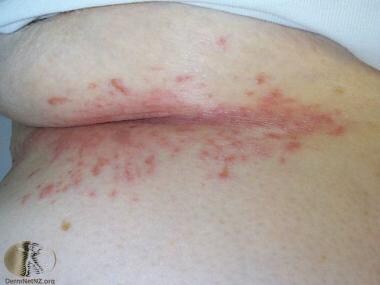
Intertrigo is an inflammatory condition of skin folds, induced or aggravated by heat, moisture, maceration, friction, and lack of air circulation. The condition frequently is worsened or colonized by infection, which most commonly is candidal but also may be bacterial, fungal, or viral. Intertrigo commonly affects the axilla, perineum, inframammary creases, and abdominal folds. Diaper dermatitis shows significant overlap with intertrigo. Intertrigo is a common complication of obesity and diabetes.

Pathophysiology

Intertrigo develops from mechanical factors and secondary infection. Heat and maceration are central to the process. Opposing skin surfaces rub against each other, causing erosions that become inflamed. Sweat, feces, urine, and vaginal discharge may aggravate intertrigo in both adults and infants.

Frequency

International

Intertrigo is common, especially in hot humid environments. The condition is a common complication of diabetes, and it affects most infants as a component of diaper dermatitis.

Mortality/Morbidity

As a complication of more serious disease, intertrigo should be considered a comorbidity. Intertrigo becomes most serious as a source of secondary infection.

Race

Intertrigo has no racial predilection.

Sex

Intertrigo has no sex predilection, other than that from anatomic differences.

Age

Intertrigo affects people who are very old and very young because of reduced immunity, immobilization, and incontinence.


History

  • Intertrigo usually is chronic with insidious onset of itching, burning, and stinging in skin folds.
  • When acute discomfort is noted, consider secondary infection.
  • Intertrigo commonly is seasonal, associated with heat and humidity or strenuous activity in which chafing occurs.
  • In addition to obesity and diabetes, hyperhidrosis may be a risk factor.
  • Additional factors that predispose individuals to perineal intertrigo include urinary or fecal incontinence, vaginal discharge, or a draining wound.

Physical

  • The appearance of intertrigo is dependent on the skin area involved and the duration of inflammation. Erythema and weeping may progress to maceration and crusting. Fissuring may follow erosion. Pustules or vesicles may herald infection. In the perineum, depths of the skin folds are involved compared to purely irritant diaper dermatitis in which only convex surfaces are involved.
  • Any skin fold may be involved with intertrigo. In adults or infants who are obese, skin folds are accentuated, and inflammation may occur under pendulous abdominal folds, in neck creases, or in popliteal or antecubital fossae.
  • As the mandible shrinks in elderly persons and the vertical dimensions decrease around the mouth, inflammation and candidiasis can occur under the accentuated nasolabial fold that develops.

Causes

  • Initiating factors include friction, perspiration, maceration, or irritation from stool, urine, drainage, or topical agents.
  • Autoeczematization and infection also may be factors.
  • Whether infectious agents play a primary role or simply are common secondary agents is controversial.


Acanthosis Nigricans
Acrodermatitis Enteropathica
Bowen Disease
Candidiasis, Mucosal
Cellulitis
Contact Dermatitis, Allergic
Contact Dermatitis, Irritant
Erythrasma
Familial Benign Pemphigus (Hailey-Hailey Disease)
Granuloma Gluteale Infantum
Granuloma Inguinale (Donovanosis)
Impetigo
Lymphogranuloma Venereum
Paget Disease, Mammary
Scabies
Seborrheic Dermatitis
Syphilis

Other Problems to be Considered

Differential diagnoses:

In the adult, consider inflammatory diseases (common or rare) including contact dermatitis, inverse psoriasis, seborrheic dermatitis, pemphigus, metabolic diseases, and malignancies.

Primary or secondary infections may be related to dermatophytes, candidal organisms, bacteria, or viruses. Possibilities involving bacteria include infection by Streptococcus and Staphylococcus species and lymphogranuloma venereum and granuloma inguinale infections.

Metabolic disorders include toxic epidermal necrolysis, acrodermatitis enteropathica, acanthosis nigricans, and migratory epidermal necrolysis.

Malignancies include metastatic carcinoma, Paget disease, or Bowen disease.

Differential diagnosis by body site:

Toe and finger web spaces: Consider mycotic infections, termed erosio interdigitalis blastomycetica between fingers and dermatophytosis complex between toes. Exclude interdigital hair sinuses, gram-negative infection, or erythrasma.

Vulva: Vulvitis can occur from erythrasma, plasma cell vulvitis, adult diaper dermatitis, candidal infection, seborrheic dermatitis, psoriasis, or contact dermatitis.

Umbilicus: Inflammation in this location is termed navelitis. Exclude seborrheic dermatitis, psoriasis, endometriosis, scabies, or the ominous Sister Mary Joseph sign (umbilical metastasis), especially if associated with blue-black induration.

Postauricular fold: Consider infectious eczematoid dermatitis, sebopsoriasis, allergic contact dermatitis, or trauma resulting from wearing glasses (granuloma fissuratum).

Axillae: Consider inverse psoriasis, erythrasma, seborrheic dermatitis, irritant or allergic contact dermatitis from deodorants or shaving, or benign familial pemphigus (Hailey-Hailey disease).

Lips: Synonyms include angular stomatitis and perlèche. Consider seborrheic dermatitis; candidal infection; perioral dermatitis; irritation or allergic dermatitis from dentifrice, gum, or mouthwash; lip licker's eczema; excessive salivation from orthodontic devices; or herpes simplex labialis.

Perianal/natal cleft: Consider pruritus ani, candidal infection, contact dermatitis, anal fissures, essential fatty acid deficiency, acrodermatitis enteropathica, extramammary Paget disease, psoriasis, pilonidal cyst, decubitus dermatitis, or baboon syndrome from contact allergy or systemic antibiotics.

Crural fold: Alternative diagnoses include inverse psoriasis, candidal infection, adult diaper dermatitis, granuloma inguinale, pemphigus vegetans, benign familial pemphigus (Hailey-Hailey disease), toxic epidermal necrolysis, and extramammary Paget disease. A form of extensive papulonodular and eroded dermatitis in women appears to be related to overuse of topical preparations such as Vagisil.

Inframammilae: Consider inverse psoriasis, candidal infection, inflammatory metastatic breast cancer, Paget disease, or benign familial pemphigus (Hailey-Hailey disease).

Infantile intertrigo: Intertrigo in infants often is synonymous with diaper dermatitis. Exclude seborrheic dermatitis, candidal infection, psoriasis, nutritional abnormalities (biotin deficiency, acrodermatitis enteropathica from zinc deficiency, aminoaciduria related), Letterer-Siwe disease (especially if papular, eroded, or purpuric), granuloma gluteal infantum (from topical corticosteroids), impetigo, cellulitis, cystic fibrosis, congential syphilis, or hereditary neuroepithelial dysplasia.


Lab Studies

  • Potassium hydroxide (KOH) test, Gram stain, or culture is useful to exclude primary or secondary infection and to guide therapy.
  • Wood lamp examination can exclude erythrasma.
  • Perform appropriate workup if systemic disease is suspected along with the intertrigo (diabetes, acrodermatitis enteropathica, necrolytic migratory erythema secondary to glucagonoma) or if intertrigo responds poorly to treatment.

Procedures

  • Skin biopsy may help exclude inverse psoriasis, Bowen disease, Paget disease, or metastatic carcinoma.


Medical Care

Correcting the causative factors is critical.

  • Take steps to eliminate friction, heat, and maceration by keeping folds cool and dry.

    • These steps can be accomplished by using air conditioning and absorbent powders and by exposing skin folds to the air.

    • Compresses with Burow solution 1:40, dilute vinegar, or wet tea bags often are effective, especially if followed by fanning or cool blow-drying.

    • Skin surfaces in deep folds can be kept separated with cotton or linen cloth; however, be sure to avoid tight, occlusive, or chafing clothing or dressings.

    • Where appropriate, antimycotic agents (miconazole, clotrimazole) are helpful, especially if used with a mild (class IV-VI) steroid for a short duration. Avoid using stronger topical steroids because the occlusive effect of skin folds can accelerate the development of skin atrophy and striae.

    • Castellani paint (carbol-fuchsin paint) also can be helpful.
  • Formulations combining protective agents, antimicrobials, and topical steroids may be helpful including the following:

    • Triple Paste comprises petrolatum, zinc oxide paste, and aluminum acetate (Burow) solution applied qs ad (in a sufficient quantity).

    • Greer goo is composed of nystatin (Mycostatin) powder 4 million U, hydrocortisone powder 1.2 g, and zinc oxide paste 4 oz applied qs ad (in a sufficient quantity).

    • A thick coat of these protective barrier creams should be applied.

    • Commercially available barrier pastes sold for diaper dermatitis (eg, Desitin) can be helpful, as can absorbent diapers.
  • Open-toed shoes or sandals may help reduce toe web-space moisture.


The goals of pharmacotherapy are to reduce morbidity and to prevent complications.

Drug Category: Protective agents

Used to protect skin against contact irritants.

Drug NamePetrolatum, zinc oxide, and aluminum acetate (Triple Paste)
DescriptionConsists of petrolatum, zinc oxide paste, and aluminum acetate solution.
Adult DoseApply thick coat as a protective barrier prn
Pediatric DoseApply as in adults
ContraindicationsDocumented hypersensitivity
InteractionsNone reported
PregnancyC - Safety for use during pregnancy has not been established.
PrecautionsDiscontinue if irritation develops; for external use only

Drug NameMycostatin, hydrocortisone, zinc oxide (Greer goo)
DescriptionConsists of nystatin (Mycostatin) powder, 4 million U, hydrocortisone powder, 1.2 g, and zinc oxide paste, 4 oz qs ad (in a sufficient quantity).
Adult DoseApply thick coat as a protective barrier prn
Pediatric DoseApply as in adults
ContraindicationsDocumented hypersensitivity
InteractionsNone reported
PregnancyC - Safety for use during pregnancy has not been established.
PrecautionsDiscontinue if irritation develops; for external use only

Drug NameZinc oxide, cod liver oil, and talc (Desitin)
DescriptionFor relief of rash, superficial wounds, and burns.
Adult DoseApply thick coat as a protective barrier prn
Pediatric DoseApply as in adults
ContraindicationsDocumented hypersensitivity
InteractionsNone reported
PregnancyA - Safe in pregnancy
PrecautionsDiscontinue if irritation develops; for external use only

Drug NameDimethicone (ProShield Plus)
DescriptionHydrophobic barrier cream.
Adult DoseApply a thick coat as a protective barrier prn
Pediatric DoseApply as in adults
ContraindicationsDocumented hypersensitivity
InteractionsNone reported
PregnancyA - Safe in pregnancy
PrecautionsDiscontinue if irritation develops; for external use only

Drug Category: Antifungal agents

Exert fungicidal effect by altering permeability of fungal cell membrane. Mechanism of action may also involve an alteration of RNA and DNA metabolism or an intracellular accumulation of peroxide toxic to fungal cells.

Drug NameCarbol-Fuchsin (Castellani Paint)
DescriptionFirst aid antiseptic and drying agent. Active ingredient is phenol 1.5%. Inactive ingredients are water, SD alcohol 40B (13%), resorcinol, acetone, and basic fuchsin.
Adult DoseApply qd or bid as drying agent
Pediatric DoseApply qd or bid as drying agent
ContraindicationsDocumented hypersensitivity
InteractionsNone reported
PregnancyC - Safety for use during pregnancy has not been established.
PrecautionsAvoid getting on clothes; stain will slowly wear off skin

Drug NameMiconazole (Micatin, Monistat-Derm, Monistat) cream
DescriptionDamages fungal cell wall membrane by inhibiting biosynthesis of ergosterol. Membrane permeability is increased, causing nutrients to leak out, resulting in fungal cell death.
Lotion is preferred in intertriginous areas. If cream is used, apply sparingly to avoid maceration effects.
Adult DoseApply to affected areas bid for 2-6 wk
Pediatric DoseApply as in adults
ContraindicationsDocumented hypersensitivity; not recommended in first trimester of pregnancy
InteractionsNone reported
PregnancyC - Safety for use during pregnancy has not been established.
PrecautionsDiscontinue if sensitivity or chemical irritation occurs; for external use only; avoid contact with eyes; local reactions 0.5-1.5% include dyspareunia, mild vaginal or vulvar erythema, burning, pruritus, urticaria, and rash

Drug NameClotrimazole (Lotrimin, Mycelex, Gyne-Lotrimin)
DescriptionBroad-spectrum antifungal agent that inhibits yeast growth by altering cell membrane permeability, causing death of fungal cells.
Adult DoseGently massage into affected area and surrounding skin areas bid for 2-6 wk
Pediatric DoseChildren: Not established
Adolescents: Administer as in adults
ContraindicationsDocumented hypersensitivity, not recommended in first trimester of pregnancy
InteractionsNone reported
PregnancyB - Usually safe but benefits must outweigh the risks.
PrecautionsFor external use only; avoid contact with eyes; if irritation or sensitivity develops, discontinue use; local reactions 0.5-1.5% include dyspareunia, mild vaginal or vulvar erythema, burning, pruritus, urticaria, and rash

Drug Category: Immunosuppressant agents

These agents exert anti-inflammatory effect by inhibiting T-lymphocyte activation. Safer than topical steroids for prolonged use or in skin folds.

Drug NameTacrolimus ointment (Protopic)
DescriptionNonsteroidal anti-inflammatory agent. Should not cause steroid-type skin atrophy.
Currently indicated only for atopic dermatitis in nonimmunocompromised patients >2 y.
Adult Dose0.1% ointment: Apply to affected areas bid for 2-6 wk
Pediatric Dose0.03% ointment: Apply as in adults
ContraindicationsDocumented hypersensitivity; not recommended in immunocompromised persons
InteractionsNone reported; use caution if using oral treatments with CYP3A4 inhibitors
PregnancyC - Safety for use during pregnancy has not been established.
PrecautionsOintments can lead to maceration in skin folds, use with caution; may aggravate superficial bacterial, fungal, or viral infections; monitor for localized lymphadenopathy; local reactions include itch or burning sensation of short duration the first 1-3 d of use

Drug NamePimecrolimus (Elidel cream 1%)
DescriptionNonsteroidal anti-inflammatory agent. Should not cause steroid-type skin atrophy. Currently indicated only for atopic dermatitis in nonimmunocompromised patients >2 y. Use cream sparingly to avoid maceration in skin folds.
Adult DoseApply to affected areas bid for 2-6 wk
Pediatric DoseApply as in adults; indicated for >2 y
ContraindicationsDocumented hypersensitivity; not indicated in immunocompromised patients; efficacy and safety in geriatric patients not tested
InteractionsNone reported; use caution if using oral treatments with CYP3A4 inhibitors
PregnancyC - Safety for use during pregnancy has not been established.
PrecautionsDiscontinue if sensitivity or chemical irritation occurs; for external use only; use may aggravate superficial bacterial, fungal, or viral infections; monitor for localized lymphadenopathy; local reactions include itch or burning sensation of short duration first 1-3 d of use


Complications

  • Since intertrigo frequently is colonized or secondarily infected, acute cellulitis is a threat.
  • Potential complications of therapy include contact dermatitis from topical agents and striae from topical steroids.

Prognosis

  • With therapy, the prognosis for each episode of simple intertrigo is excellent. Recurrence is common.

Patient Education

  • During patient instruction, emphasize topics such as weight loss, glucose control (in patients with diabetes), good hygiene, and the need for daily care and monitoring.


Medical/Legal Pitfalls

  • Failure to recognize and diagnose an infectious intertrigo may result in serious cellulitis, especially in patients who are diabetic
  • Failure to monitor patients closely for the development of striae or a hidden infection if topical steroids are needed to control an inflammatory intertrigo
  • Failure to consider biopsy if the intertrigo fails to respond to treatment or if severe skin or systemic disorders must be excluded, although skin biopsies are not necessary to diagnose uncomplicated intertrigo
  • Failure to notice skin fissuring and breakdown/ulcers possibly hidden in the deep skin folds of persons who are obese, which can lead to pain, disability, and, potentially, sepsis

Special Concerns

  • Intertrigo most often involves persons who are helpless or dependent on others, ie, older persons and infants. Since intertrigo in the perineum often is complicated by incontinence, new breakthroughs in absorbent diapers have made diaper dermatitis easier to avoid. However, contact dermatitis in reaction to these diapers, whether irritant or allergic, can occur; therefore, monitor waistlines and leg openings for intertrigo.


  • American Academy of Family Physicians. Information from your family doctor. Intertrigo: what you should know. Am Fam Physician. Sep 1 2005;72(5):840. [Medline].
  • Arnold HL, Odom RB, James WD. Intertrigo. In: Andrew's Diseases of the Skin: Clinical Dermatology. 8th ed. Philadelphia, Pa: WB Saunders; 1990:285.
  • Björnsdóttir S, Gottfredsson M, Thórisdóttir AS, Gunnarsson GB, Ríkardsdóttir H, Kristjánsson M, et al. Risk factors for acute cellulitis of the lower limb: a prospective case-control study. Clin Infect Dis. Nov 15 2005;41(10):1416-22. [Medline].
  • Clark RA, Hopkins TT. Dermatology. 3rd ed. Philadelphia, Pa: WB Saunders; 1992:485-89.
  • Hahler B. An overview of dermatological conditions commonly associated with the obese patient. Ostomy Wound Manage. Jun 2006;52(6):34-6, 38, 40 passim. [Medline].
  • Honig PJ, Frieden IJ, Kim HJ, Yan AC. Streptococcal intertrigo: an underrecognized condition in children. Pediatrics. Dec 2003;112(6 Pt 1):1427-9. [Medline].
  • Jansen GT, Dillaha CJ, Honeycutt WM. Intertrigo. In: Clinical Dermatology. Hagerstown, Md: Harper & Row; 1979.
  • Kaya TI, Delialioglu N, Yazici AC, Tursen U, Ikizoglu G. Medical pearl: Blue underpants sign--a diagnostic clue for Pseudomonas aeruginosa intertrigo of the groin. J Am Acad Dermatol. Nov 2005;53(5):869-71. [Medline].
  • Martín Ezquerra G, Sánchez Regaña M, Herrera Acosta E, Umbert Millet P. Topical tacrolimus for the treatment of psoriasis on the face, genitalia, intertriginous areas and corporal plaques. J Drugs Dermatol. Apr 2006;5(4):334-6. [Medline].
  • Mistiaen P, Poot E, Hickox S, Jochems C, Wagner C. Preventing and treating intertrigo in the large skin folds of adults: a literature overview. Dermatol Nurs. Feb 2004;16(1):43-6, 49-57. [Medline].
  • Weston WL, Lane AT, Weston JA. Diaper dermatitis: current concepts. Pediatrics. Oct 1980;66(4):532-6. [Medline].
  • White GM. Regional Dermatology. Chicago, Ill: Mosby-Wolfe; 1994.

Intertrigo excerpt

Article Last Updated: Mar 9, 2007