| Patient Education |
|
Click here for patient education.
|
|
You are in: eMedicine Specialties >
Dermatology > PAPULOSQUAMOUS DISEASES
Keratosis Follicularis (Darier Disease)
Article Last Updated: Feb 28, 2007
AUTHOR AND EDITOR INFORMATION
Section 1 of 9
Author: Pui-Yan Kwok, MD, PhD, Henry Bachrach Distinguished Professor, Department of Dermatology and Cardiovascular Research Institute, University of California, San Francisco
Pui-Yan Kwok is a member of the following medical societies: American Association for the Advancement of Science, American Society of Human Genetics, and Society for Investigative Dermatology
Coauthor(s):
Wilson Liao, MD, Department of Dermatology, University of California at San Francisco
Editors: James W Patterson, MD, Director of Dermatopathology, Professor of Pathology and Dermatology, Departments of Pathology and Dermatology, University of Virginia Medical Center; Michael J Wells, MD, Associate Professor, Department of Dermatology, Texas Tech University Health Sciences Center; Rosalie Elenitsas, MD, Associate Professor of Dermatology, University of Pennsylvania School of Medicine; Director, Penn Cutaneous Pathology Services, Department of Dermatology, University of Pennsylvania Health System; Joel M Gelfand, MD, MSCE, Medical Director, Clinical Studies Unit, Assistant Professor, Department of Dermatology, Associate Scholar, Center for Clinical Epidemiology and Biostatistics, University of Pennsylvania; Dirk M Elston, MD, Director, Department of Dermatology, Geisinger Medical Center
Author and Editor Disclosure
Synonyms and related keywords:
Darier-White disease, DD, Darier's disease, warty plaques, malodorous plaques, hypertrophic DD, hypertrophic Darier disease, vesicobullous DD, vesiculobullous Darier disease, linear DD, linear Darier disease, segmental DD, segmental Darier disease
Background
Keratosis follicularis, also known as Darier disease (DD) or Darier-White disease, is an autosomal dominantly inherited genodermatosis characterized by greasy hyperkeratotic papules in seborrheic regions, nail abnormalities, and mucous membrane changes. The disease was first reported independently by Darier and White in 1889. White was first to recognize the genetic nature of DD by noticing that a mother and her daughter were affected.
Pathophysiology
Mutations in the gene ATP2A2 cause DD. ATP2A2, located on 12q23-24.1, encodes the sarcoplasmic/endoplasmic reticulum Ca2+-ATP isoform 2 protein (SERCA2), which is a calcium pump.1 This pump maintains a low cytoplasmic Ca2+ level by actively transporting calcium ions from the cytosol into the lumen of the endoplasmic reticulum. Although more than 113 familial and sporadic mutations in ATP2A2 have been identified in DD patients, attempts at genotype-phenotype correlation have not been successful. Family members with confirmed identical ATP2A2 mutations can exhibit differences in the clinical severity of disease, suggesting that other genes or environmental factors affect the expression of DD.2 The mechanisms by which specific ATP2A2 mutations impact the function of the ATP2A2 protein have been investigated using an in vitro model.3 Investigators transfected a fibroblast cell line with 51 different mutations seen in DD pedigrees. The investigators found that the resultant transfected cells showed defects in ATP2A2 protein expression (15 mutants), ATP hydrolysis (29 mutants), calcium transport (4 mutants), and calcium binding and kinetics (3 mutants). Thus, diverse biochemical mechanisms are responsible for altered protein function. Although expressivity is variable, penetrance of DD is high, estimated at 95%. Because the disease-causing mutations in ATP2A2 affect functional domains of the gene, the mechanism of autosomal dominant transmission is believed to be haploinsufficiency, in which a single wild-type functioning ATP2A2 is insufficient to prevent disease. No unique phenotype for genetic homozygotes has been reported. Abnormal keratinocyte-keratinocyte adhesion and aberrant epidermal keratinization are the primary histologic features of DD. Electron microscopy reveals loss of desmosomes (epithelial intercellular junctions formed by membrane and submembrane protein complexes), breakdown of desmosome-keratin intermediate filament attachment, and perinuclear aggregates of keratin intermediate filaments. The mechanism by which decreased activity of the SERCA2 calcium pump leads to these changes is still under investigation.4 Some preliminary studies have suggested that alterations in calcium regulation may affect the synthesis, folding, or trafficking of desmosomal proteins.5 In particular, one study revealed that DD keratinocytes displayed abnormal trafficking of the desmosomal protein desmoplakin.6 Alternatively, another hypothesis, based on a canine model of DD, is that DD calcium dysregulation leads to impaired control of cell cycle checkpoints, leading to increased epidermal sensitivity to skin trauma and subsequent keratinocyte apoptosis.
Frequency
International
DD occurs worldwide. The prevalence of DD has been estimated to range from 1 case in 30,000 population in Scotland to 1 case in 100,000 population in Denmark.
Mortality/Morbidity
Patients with DD experience pruritus and sometimes pain in the affected skin areas. Psychosocial consequences from the appearance and odor of the lesions also constitute the major morbidity of this condition. A serious complication associated with DD is increased susceptibility to cutaneous bacterial and viral infections, in particular herpes simplex virus and poxvirus infections. Overall, patients with DD have a life expectancy similar to that of the general population.
Sex
Males and females are equally affected.
Age
DD most commonly manifests from age 6-20 years; however, a patient may first present as early as age 4 years or as late as age 70 years.
History
- Most patients with DD have a family history of the disease. The pattern of inheritance is autosomal dominant. However, some patients, up to 47% in one series, have no clear family history. These cases may represent sporadic mutations, or these patients may have family members with mild disease that was not recognized.
- The first skin lesions typically occur in the teenage years and are frequently associated with pruritus.
- Heat, sweat, humidity, sunlight, UVB exposure,7 lithium, oral corticosteroids, and mechanical trauma have been reported to exacerbate this condition. Some females report flares around menstruation.
- Even though the severity of DD fluctuates over time, DD is a chronic, unremitting condition. In one study, one third of patients noted improvement of the condition with age; however, another one third of patients showed worsening of the disease with age.
- Although neuropsychiatric abnormalities such as epilepsy, mental impairment, and mood disorders have been associated with DD, no evidence indicates that mutations in ATP2A2 are associated with these disorders.8 One study9 suggests that a susceptibility locus for bipolar disorder co-segregates with the DD region, but it is distinct from the DD-causing mutation.
Physical
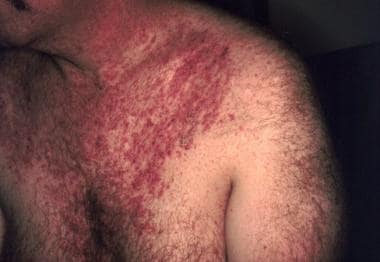
- The lesions may first appear as skin-colored or yellow-brown papules with a greasy, warty texture. These lesions are especially common in seborrheic areas such as the forehead, scalp, margin of the scalp, nasolabial folds, ears, chest, and back (see Media File 1). Approximately 80% of patients have mild flexural involvement with scattered papules in the groin, axillae, or, in women, submammary skin. In less than 10% of patients, flexural disease predominates, with large, warty, vegetative plaques in the axillae, groin, or perineum. These large flexural lesions are especially bothersome to patients because of their malodor.
- Involvement of the hands is very common (approximately 95%). Lesions on the palms include punctate keratoses (80%), palmar pits (80%), and hemorrhagic macules (<10%). Acrokeratosis verruciformis–like lesions (warty flat-topped papules on the dorsal hands) are present in approximately half the patients. Interestingly, several patients with acrokeratosis verruciformis of Hopf (who have dorsal hand lesions only) have been found to harbor mutations in ATP2A2, suggesting this condition may actually be a localized form of DD.
- Nail changes provide important diagnostic clues (see Media File 2). White and red longitudinal bands, longitudinal nail ridges, longitudinal splitting, and subungual hyperkeratosis are frequently found. A sandwich of red and white longitudinal bands, often with a V-shaped nick at the free margin of the nail, is the most pathognomonic nail finding in persons with DD. These changes on the hands can also occur on the feet, albeit less commonly.
- Mucosal lesions are detected in approximately 15% of patients, and they appear as white papules with a central depression. These cobblestone lesions are most commonly found in the mouth, but they also may occur on the anogenital mucosa. At times, oral lesions may affect the salivary glands and cause obstruction.
- Clinical variants of DD include hypertrophic and vesicobullous types. Linear or segmental DD has been shown in some cases to result from genetic mosaicism of ATP2A2.
Acrokeratosis Verruciformis of Hopf
Familial Benign Pemphigus (Hailey-Hailey Disease)
Seborrheic Dermatitis
Transient Acantholytic Dermatosis
Other Tests
With the discovery that mutations in ATP2A2 cause DD, gene sequencing can be used to confirm the diagnosis.
Procedures
A skin biopsy is helpful in confirming the diagnosis of DD.
Histologic Findings
Acantholysis (loss of epidermal adhesions) and dyskeratosis (abnormal premature keratinization) are the 2 main features of DD. Acantholysis frequently results in the formation of characteristic suprabasal clefts (see Media File 3). The underlying dermal papillae, covered by a single layer of epithelium (stratum basale), project into these clefts and form villuslike structures. A large keratin plug, often showing focal parakeratosis, overlies each lesion. Hyperkeratosis is also common. Two types of dyskeratotic cells are present: corps ronds and grains. Corps ronds are predominantly located in the stratum spinosum and the stratum granulosum. Corps ronds are characterized by an irregular eccentric and sometimes pyknotic nucleus, a clear perinuclear halo, and a brightly eosinophilic cytoplasm. Grains are mostly located in the stratum corneum, and they consist of oval cells with elongated cigar-shaped nuclei and abundant keratohyalin granules.
Medical Care
- Basic measures
- Sunscreen, cool cotton clothing, and avoidance of hot environments can help prevent flares, especially during the summer.
- Moisturizers with urea or lactic acid can reduce scaling and hyperkeratosis.
- A low- or mid-potency topical steroid is sometimes useful for inflammation.
- When bacterial overgrowth is suspected or crusting is prominent, application of antiseptics such as triclosan or soaks in astringents such as Burrow or Domeboro solution can be helpful.
- Topical medications
- Case reports have shown that topical retinoids (adapalene, tazarotene gel 0.01%,10, 11 tretinoin12) can reduce hyperkeratosis in 3 months. However, irritation is a limiting factor.
- Emollients and topical corticosteroids can be used in combination with topical retinoids to reduce irritation.
- Topical 5-fluorouracil has been used effectively in a few patients.13
- Systemic medications
- Oral retinoids (eg, acitretin, isotretinoin,12 etretinate) have been the most effective medical treatment for DD, achieving some reduction of symptoms in 90% of patients. They reduce hyperkeratosis, smoothen papules, and reduce odor. In a study of 11 patients, 5 with DD and 6 with pityriasis rubra pilaris, significant improvement occurred with isotretinoin therapy. All 11 patients received isotretinoin at 0.5 mg/kg/d, increasing to a maximum dose of 4 mg/kg/d, for a period of 16 weeks. Greater than 50% improvement occurred in all 5 patients with DD and in 5 of 6 patients with pityriasis rubra pilaris. One patient showed no clinical improvement. Upon discontinuation of therapy, relapse occurred in all but 1 patient with pityriasis rubra pilaris.14
- Acitretin is effective at 0.6 mg/kg/d. The starting dose is 10-25 mg/d, which is gradually increased as tolerated.
- Isotretinoin at 0.5-1.0 mg/kg/d is especially useful in females of childbearing age because pregnancy need only be avoided for 1 month after stopping treatment. Unfortunately, prolonged remissions, such as those noted with isotretinoin for severe acne, are not seen in DD.
- Etretinate has been reported useful if acitretin fails.15
- Prolonged use of oral retinoids is limited by their significant adverse effects, including mucosal dryness, photosensitivity, hyperlipidemia, transaminitis, and skeletal hyperostosis. Oral retinoids are teratogenic, and appropriate counseling and contraception must be given.
- Oral antibiotics are often necessary to clear secondary bacterial superinfection. They may also be used as prophylaxis to prevent infection.
- Oral acyclovir may be used to treat or suppress herpes simplex virus infection.
- Oral contraceptives have been reported to help with perimenstrual DD flares.
Surgical Care
- Dermabrasion has been used to smooth the hyperkeratotic lesions of DD, with acceptable results.16
- Electrosurgery17 and Mohs micrographic surgery have been used to treat localized DD areas, with good results.
- Amongst newer modalities, carbon dioxide laser ablation of recalcitrant plaques has been reported in 2 patients. The Er:YAG laser, which in contrast to the carbon dioxide laser has decreased risk of thermal injury, was used in 2 DD patients. In those cases, remission of the treated lesions and alleviation of pruritus lasted at least 11 and 20 months.18
- Photodynamic therapy with 5-aminolevulinic acid was used to treat DD lesions in 6 patients, with 4 patients showing sustained improvement or clearance for a follow-up period of 6 months to 3 years.19
The goals of pharmacotherapy are to reduce morbidity and prevent complications.
Drug Category: Retinoids
These agents decrease cohesiveness of abnormal hyperproliferative keratinocytes and may reduce potential for malignant degeneration. They also modulate keratinocyte differentiation.
| Drug Name | Adapalene (Differin) |
| Description | Modulates cellular differentiation, inflammation, and keratinization. May be tolerated by individuals who cannot tolerate tretinoin creams. Available as 0.1% gel or solution. |
| Adult Dose | Apply hs; some patients may tolerate bid dosing |
| Pediatric Dose | Not established |
| Contraindications | Documented hypersensitivity |
| Interactions | None reported |
| Pregnancy | C - Fetal risk revealed in studies in animals but not established or not studied in humans; may use if benefits outweigh risk to fetus
|
| Precautions | Avoid contact with mucous membranes, eyes, mouth, and nostrils; avoid exposure to sunlight and sunlamps; dryness of skin, scaling, erythema, burning, and pruritus may occur |
| Drug Name | Tazarotene (Avage, Tazorac) |
| Description | Retinoid prodrug whose active metabolite modulates differentiation and proliferation of epithelial tissue; may also have anti-inflammatory and immunomodulatory properties. |
| Adult Dose | Apply thin film (ie, 2 mg/cm2) hs to clean, dry skin where lesions appear |
| Pediatric Dose | Children: Not established Adolescents: Administer as in adults |
| Contraindications | Documented hypersensitivity |
| Interactions | Do not use concomitantly with dermatologic drugs or cosmetics that have a strong drying effect on the skin (eg, salicylic acid, benzoyl peroxide, astringents) |
| Pregnancy | X - Contraindicated; benefit does not outweigh risk
|
| Precautions | May cause burning or stinging sensations; discontinue if excessive irritation occurs; rinse thoroughly if contact with eyes, eyelids, or mouth; may cause severe irritation in eczematous skin; photosensitivity may occur |
| Drug Name | Tretinoin (Avita, Altinac, Renova, Retin-A) |
| Description | Inhibits microcomedo formation and eliminates lesions present. Makes keratinocytes in sebaceous follicles less adherent and easier to remove. Available as 0.025, 0.05, and 0.1% creams or 0.01 and 0.025% gels. |
| Adult Dose | Begin with lowest concentration of tretinoin formulation and increase as tolerated; apply hs or qod; lower frequency of application if irritation develops |
| Pediatric Dose | <12 years: Not established >12 years: Administer as in adults |
| Contraindications | Documented hypersensitivity |
| Interactions | Other skin irritants (ie, astringents, benzoyl peroxide, salicylic acid, resorcinol, topical sulfur, other keratolytics, abrasives, astringents, spices, lime) may exacerbate irritation; coadministration with other drugs causing photosensitivity (eg, tetracycline, sulfonamides) may increase risk of sunburn |
| Pregnancy | C - Fetal risk revealed in studies in animals but not established or not studied in humans; may use if benefits outweigh risk to fetus
|
| Precautions | Photosensitivity may occur with excessive sunlight exposure; burning, stinging, peeling, pruritus, or erythema has been reported at site of application; caution with eczema (may cause severe irritation); avoid contact with mucous membranes, mouth, and angles of nose |
| Drug Name | Acitretin (Soriatane) |
| Description | Metabolite of etretinate and related to both retinoic acid and retinol (vitamin A). Mechanism of action unknown. |
| Adult Dose | 0.5-0.75 mg/kg/d PO; alternatively, 10-25 mg/d PO gradually increased to 35 mg/d as tolerated |
| Pediatric Dose | 1 mg/kg/d PO; quickly reduce to minimal effective dose |
| Contraindications | Documented hypersensitivity; intention of pregnancy during or within 3 y of therapy; severely impaired liver/kidney function; chronic abnormal elevated lipid levels; concomitant use of methotrexate; concomitant use of tetracyclines; ingestion of alcohol (in females of reproductive potential) |
| Interactions | Increases toxicity of methotrexate (avoid concomitant use); interferes with effects of microdose progestin minipill; coadministration with alcohol may result in formation of etretinate, which has much longer half-life than acitretin (>120 d); may increase toxicity of phenytoin; toxicity may occur with vitamin A coadministration |
| Pregnancy | X - Contraindicated; benefit does not outweigh risk
|
| Precautions | Do not use in severe obesity; women of childbearing age must be capable of complying with effective contraceptive measures; recommended that contraception be continued for at least 3 y after stopping treatment; etretinate may form from acitretin, which takes approximately 2-3 y to clear from body; caution if impaired renal or liver function; perform AST, ALT, and LDH tests prior to initiation of therapy at 1- to 2-wk intervals until stable and thereafter at intervals as clinically indicated |
| Drug Name | Isotretinoin (Accutane, Amnesteem, Claravis, Sotret) |
| Description | Oral agent that treats serious dermatologic conditions. Synthetic 13-cis isomer of the naturally occurring tretinoin (trans-retinoic acid). Both agents are structurally related to vitamin A. Decreases sebaceous gland size and sebum production. May inhibit sebaceous gland differentiation and abnormal keratinization. |
| Adult Dose | Initial dose: 0.5 mg/kg/d Maintenance dose: 1.8 mg/kg/d for 16 wk, followed by a rest period of at least 8 wk; drug treatment restarted if significant flare of disease |
| Pediatric Dose | Not established |
| Contraindications | Documented hypersensitivity |
| Interactions | Toxicity may occur with vitamin A coadministration; pseudotumor cerebri or papilledema may occur when coadministered with tetracyclines; may reduce plasma levels of carbamazepine Increases toxicity of methotrexate (avoid concomitant use); interferes with effects of microdose progestin minipill; coadministration with alcohol may result in formation of etretinate, which has much longer half-life than acitretin (>120 d); may increase toxicity of phenytoin |
| Pregnancy | X - Contraindicated; benefit does not outweigh risk
|
| Precautions | May decrease night vision; inflammatory bowel disease may occur; may be associated with development of hepatitis and pancreatitis; diabetes patients may experience problems in controlling blood glucose while on isotretinoin; avoid exposure to UV light or sunlight until tolerance achieved; discontinue treatment if rectal bleeding, abdominal pain, or severe diarrhea occurs; mood swings or depression may occur; caution in history of depression |
| Drug Name | Etretinate (Tegison) |
| Description | Not available in the United States. Retinoic acid analog. Mechanism of action unknown. |
| Adult Dose | 25-75 mg/d PO |
| Pediatric Dose | Not established |
| Contraindications | Documented hypersensitivity; severe obesity |
| Interactions | Do not use in severe obesity; toxicity may occur with vitamin A coadministration; absorption increased with milk; increases toxicity of methotrexate (avoid concomitant use); interferes with effects of microdose progestin minipill |
| Pregnancy | X - Contraindicated; benefit does not outweigh risk
|
| Precautions | Women of childbearing age must be capable of using effective contraceptive measures; perform AST, ALT, and LDH tests prior to therapy at 1- to 2-wk intervals until levels stabilize and thereafter at intervals as clinically indicated |
| Media file 1:
Typical distribution of keratotic papules in the seborrheic regions. Courtesy of Susan Mallory, MD, Director of Pediatric Dermatology, Washington University School of Medicine. |
 | View Full Size Image | |
Media type: Photo
|
| Media file 2:
Longitudinal ridges, red and white lines, and V-shaped nicks. Courtesy of Susan Mallory, MD, Director of Pediatric Dermatology, Washington University School of Medicine. |
 | View Full Size Image | |
Media type: Photo
|
| Media file 3:
Acantholysis and dyskeratosis (abnormal keratinization) are the 2 main features of Darier disease. Loss of epidermal adhesion with acantholysis frequently results in the formation of suprabasal clefts (lacunae). |

 | View Full Size Image | |
Media type: Photo
|
- Sakuntabhai A, Ruiz-Perez V, Carter S, Jacobsen N, Burge S, Monk S, et al. Mutations in ATP2A2, encoding a Ca2+ pump, cause Darier disease. Nat Genet. Mar 1999;21(3):271-7. [Medline].
- Onozuka T, Sawamura D, Yokota K, Shimizu H. Mutational analysis of the ATP2A2 gene in two Darier disease families with intrafamilial variability. Br J Dermatol. Apr 2004;150(4):652-7. [Medline].
- Miyauchi Y, Daiho T, Yamasaki K, Takahashi H, Ishida-Yamamoto A, Danko S, et al. Comprehensive analysis of expression and function of 51 sarco(endo)plasmic reticulum Ca2+-ATPase mutants associated with Darier disease. J Biol Chem. Aug 11 2006;281(32):22882-95. [Medline].
- Müller EJ, Caldelari R, Kolly C, Williamson L, Baumann D, Richard G, et al. Consequences of depleted SERCA2-gated calcium stores in the skin. J Invest Dermatol. Apr 2006;126(4):721-31. [Medline].
- Dhitavat J, Fairclough RJ, Hovnanian A, Burge SM. Calcium pumps and keratinocytes: lessons from Darier's disease and Hailey-Hailey disease. Br J Dermatol. May 2004;150(5):821-8. [Medline].
- Dhitavat J, Cobbold C, Leslie N, Burge S, Hovnanian A. Impaired trafficking of the desmoplakins in cultured Darier's disease keratinocytes. J Invest Dermatol. Dec 2003;121(6):1349-55. [Medline].
- Otley CC, Momtaz K. Induction of Darier-White disease with UVB radiation in a clinically photo-insensitive patient. J Am Acad Dermatol. May 1996;34(5 Pt 2):931-4. [Medline].
- Jacobsen NJ, Lyons I, Hoogendoorn B, Burge S, Kwok PY, O'Donovan MC, et al. ATP2A2 mutations in Darier's disease and their relationship to neuropsychiatric phenotypes. Hum Mol Genet. Sep 1999;8(9):1631-6. [Medline].
- Jones I, Jacobsen N, Green EK, Elvidge GP, Owen MJ, Craddock N. Evidence for familial cosegregation of major affective disorder and genetic markers flanking the gene for Darier's disease. Mol Psychiatry. 2002;7(4):424-7. [Medline].
- Burkhart CG, Burkhart CN. Tazarotene gel for Darier's disease. J Am Acad Dermatol. Jun 1998;38(6 Pt 1):1001-2. [Medline].
- Oster-Schmidt C. The treatment of Darier's disease with topical tazarotene. Br J Dermatol. Sep 1999;141(3):603-4. [Medline].
- Dicken CH, Bauer EA, Hazen PG, Krueger GG, Marks JG Jr, McGuire JS. Isotretinoin treatment of Darier's disease. J Am Acad Dermatol. Apr 1982;6(4 Pt 2 Suppl):721-6. [Medline].
- Yoon TY, Kim JW, Kim MK. Successful treatment of Darier disease with topical 5-fluorouracil. Br J Dermatol. Jun 2006;154(6):1210-2. [Medline].
- Farb RM, Lazarus GS, Chiaramonti A, Goldsmith LA, Gilgor RS, Balakrishnan CV. The effect of 13-cis retinoic acid on epidermal lysosomal hydrolase activity in Darier's disease and pityriasis rubra pilaris. J Invest Dermatol. Aug 1980;75(2):133-5. [Medline].
- Suzuki K, Aoki M, Kawana S. Localized Darier's disease of the scalp: successful treatment with oral etretinate. Dermatology. 2004;208(1):83-4. [Medline].
- Wheeland RG, Gilmore WA. The surgical treatment of hypertrophic Darier's disease. J Dermatol Surg Oncol. Apr 1985;11(4):420-3. [Medline].
- Toombs EL, Peck GL. Electrosurgical treatment of etretinate-resistant Darier's disease. J Dermatol Surg Oncol. Dec 1989;15(12):1277-80. [Medline].
- Beier C, Kaufmann R. Efficacy of erbium:YAG laser ablation in Darier disease and Hailey-Hailey disease. Arch Dermatol. Apr 1999;135(4):423-7. [Medline].
- Exadaktylou D, Kurwa HA, Calonje E, Barlow RJ. Treatment of Darier's disease with photodynamic therapy. Br J Dermatol. Sep 2003;149(3):606-10. [Medline].
- Burge S. Management of Darier's disease. Clin Exp Dermatol. Mar 1999;24(2):53-6. [Medline].
- Burge SM, Wilkinson JD. Darier-White disease: a review of the clinical features in 163 patients. J Am Acad Dermatol. Jul 1992;27(1):40-50. [Medline].
- Sehgal VN, Srivastava G. Darier's (Darier-White) disease/keratosis follicularis. Int J Dermatol. Mar 2005;44(3):184-92. [Medline].
- Szigeti R, Kellermayer R. Autosomal-dominant calcium ATPase disorders. J Invest Dermatol. Nov 2006;126(11):2370-6. [Medline].
Keratosis Follicularis (Darier Disease) excerpt Article Last Updated: Feb 28, 2007
|