Continually Updated Clinical Reference
 
 
  All Sources     eMedicine     Medscape     Drug Reference     MEDLINE
 
eMedicine - Melasma : Article by

Quick Find
Authors & Editors
Introduction
Clinical
Differentials
Workup
Treatment
Medication
Follow-up
Multimedia
References

Related Articles
Addison Disease

Drug-Induced Photosensitivity

Lupus Erythematosus, Discoid

Mastocytosis

Poikiloderma of Civatte


Patient Education
Click here for patient education.


Author: Andrew D Montemarano, DO, Consulting Staff, The Skin Cancer Surgery Center

Editors: James Fulton Jr, MD, PhD, Medical Director, Fulton Skin Institute; Richard P Vinson, MD, Assistant Clinical Professor, Department of Dermatology, Texas Tech University School of Medicine; Consulting Staff, Mountain View Dermatology, PA; John G Albertini, MD, Consulting Staff, Dermatologic Surgery, The Skin Surgery Center; Joel M Gelfand, MD, MSCE, Medical Director, Clinical Studies Unit, Assistant Professor, Department of Dermatology, Associate Scholar, Center for Clinical Epidemiology and Biostatistics, University of Pennsylvania; William D James, MD, Paul R Gross Professor of Dermatology, University of Pennsylvania School of Medicine; Vice-Chair, Program Director, Department of Dermatology, University of Pennsylvania Health System

Author and Editor Disclosure

Synonyms and related keywords: chloasma, the mask of pregnancy, hypermelanosis

Background

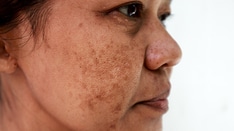
Melasma is an acquired hypermelanosis of sun-exposed areas. It presents as symmetric hyperpigmented macules, which can be confluent or punctate. The cheeks, the upper lip, the chin, and the forehead are the most common locations, but it can occasionally occur in other sun-exposed locations. Chloasma is a synonymous term sometimes used to describe the occurrence of melasma during pregnancy. Chloasma is derived from the Greek word chloazein, meaning "to be green." Melas, also Greek, means "black." Since the pigmentation is never green in appearance, melasma is the preferred term.

Pathophysiology

The pathophysiology of melasma is uncertain. In many cases, a direct relationship with female hormonal activity appears to be present because it occurs with pregnancy and with the use of oral contraceptive pills. Other factors implicated in the etiopathogenesis of melasma are photosensitizing medications, mild ovarian or thyroid dysfunction, and certain cosmetics.

The most important factor in the development of melasma is exposure to sunlight. Without the strict avoidance of sunlight, potentially successful treatments for melasma are doomed to fail.

Race

Persons of any race can be affected. However, it is much more common in constitutionally darker skin types than in lighter skin types, and it may be more common in light brown skin types, especially Hispanics and Asians, from areas of the world with intense sun exposure.

Sex

Melasma is much more common in women than in men. Women are affected in 90% of cases. When men are affected, the clinical and histologic picture is identical.

Age

Melasma is rare before puberty and most commonly occurs in women during their reproductive years.


History

  • Patients may inquire about progressive hyperpigmentation of the face, which may be temporally related to pregnancy or to the use of oral contraceptive pills.
  • Intense or chronic exposure to sunlight worsens the condition and may precipitate melasma, but because the development of pigmentation is often insidious, patients may not recognize the association.

Physical

  • The macular hyperpigmentation of melasma is commonly tan to brown. Blue or black may be evident in patients with dermal melasma. The distribution is 1 of 3 patterns: centrofacial, malar, or mandibular. A rare pattern confined to the forearms is seen in women receiving exogenous progesterone and in Native American Indians.
  • The excess melanin can be visually localized to the epidermis or the dermis by use of a Wood lamp (wavelength, 340-400 nm).
    • Epidermal pigment is enhanced during examination with a Wood light, whereas, dermal pigment is not.
    • Clinically, a large amount of dermal melanin is suspected if the hyperpigmentation is bluish black.
    • In individuals with dark-brown skin, examination with a Wood light does not localize pigment, and these patients are thus classified as indeterminate.

Causes

A genetic predisposition is a major factor in the development of melasma. It is much more common in women than in men. Persons with light brown skin types from regions of the world with intense sun exposure are much more prone to the development of melasma. More than 30% of patients have a family history of melasma. Identical twins have been reported to develop melasma,1 while other siblings under similar conditions did not.

Another major factor is exposure to sunlight. Ultraviolet radiation can cause peroxidation of lipids in cellular membranes, leading to generation of free radicals, which could stimulate melanocytes to produce excess melanin. Sunscreens that primarily block UV-B radiation (290-320 nm) are unsatisfactory because longer wavelengths (UV-A and visible radiation, 320-700 nm) also stimulate melanocytes to produce melanin.

Hormonal influences play a role in some individuals. The mask of pregnancy is well known to obstetric patients. The exact mechanism by which pregnancy affects melasma is unknown. Estrogen, progesterone, and melanocyte-stimulating hormone (MSH) levels are normally increased during the third trimester of pregnancy. However, nulliparous patients with melasma have no increased levels of estrogen or MSH. In addition, the occurrence of melasma with estrogen- and progesterone-containing oral contraceptive pills and diethylstilbestrol treatment for prostate cancer has been reported.2 The observation that postmenopausal woman who are given progesterone develop melasma, while those who are given only estrogen do not, implicates progesterone as playing a critical role in the development of melasma.

One study found a 4-fold increase in thyroid disease in patients with melasma when compared with matched controls. A case report of 2 women who developed melasma after sudden and profound emotional stress implicated the release of MSH by the hypothalamus as a cause. Exactly which hormones and what mechanisms are involved in the development of melasma are yet to be determined. Genetic and hormonal influences in combination with ultraviolet radiation are the 2 most important causes of melasma, yet phototoxic and photoallergic medications and certain cosmetics have been reported to cause melasma in rare instances.


Addison Disease
Drug-Induced Photosensitivity
Lupus Erythematosus, Discoid
Mastocytosis
Poikiloderma of Civatte

Other Problems to be Considered

Actinic lichen planus3
Linear morphea4


Lab Studies

  • Usually, no laboratory tests are indicated.
  • Consider checking thyroid function test results.
  • Wood light examination usually helps to localize the pigment to the epidermis or the dermis. Note that in many cases, the pigment is found in both locations.

Histologic Findings

Melanin is increased in the epidermis, in the dermis, or (most commonly) in both locations. Epidermal melanin is found in keratinocytes in the basal and suprabasal area. In most cases, the number of melanocytes is not increased, yet the melanocytes that are present are larger, more dendritic, and more active. Dermal melanin is found in the superficial and mid dermis within macrophages, which often congregate around small, dilated vessels. Inflammation is sparse or absent.


Medical Care

Melasma can be difficult to treat. The pigment of melasma develops gradually, and resolution is also gradual. Resistant cases or recurrences occur often and are certain if strict avoidance of sunlight is not rigidly heeded. All wavelengths of sunlight, including the visible spectrum, are capable of inducing melasma.

Quick fixes with destructive modalities (eg, cryotherapy, medium-depth chemical peels, lasers) yield unpredictable results and are associated with a number of potential adverse effects, including epidermal necrosis, postinflammatory hyperpigmentation, and hypertrophic scars.5, 6 The precise manner in which these modalities can be used has not been fully delineated. However, in some experienced hands, they have been anecdotally reported to be safe, effective, and produce results much quicker than topical medications.7 More careful study is needed before they can be recommended as a standard treatment.

In an attempt to hasten resolution, many practitioners attempt mild exfoliation with superficial chemical peels. The rational is that if melanogenesis is inhibited with bleaching agents and keratinocyte turnover is increased, the time to resolution can be reduced. A number of studies have shown that treating melasma with superficial chemical peels and a bleaching agent is safe and effective. Whether superficial chemical peels versus bleaching agents alone actually hasten the resolution of pigment is debated. Studies comparing bleaching agents alone to the combination of bleaching agents and superficial chemical peels are ongoing and may help to resolve the debate.

  • The mainstay of treatment remains topical depigmenting agents. Hydroquinone (HQ) is most commonly used.
    • It is a hydroxyphenolic chemical that inhibits tyrosinase, leading to the decreased production of melanin. Additionally, cytotoxic metabolites may cause interference with melanocyte function and viability.
    • HQ can be applied in cream form or as an alcohol-based solution. Concentrations vary from a 2% concentration available in the United States without a prescription to a standard 4% concentration and even higher when compounded.
    • Efficacy is directly linked to concentration, but the incidence of adverse effects also increases with concentration. All concentrations can lead to skin irritation, phototoxic reactions with secondary postinflammatory hyperpigmentation, and irreversible exogenous ochronosis (reported even with long-term use of 2% HQ).
    • Special care must be taken not to prescribe the monobenzyl ether of HQ (Benoquin), which causes an irreversible localized and generalized vitiligolike leukoderma.
  • The use of tretinoin (trans-retinoic-acid) can be effective as monotherapy.8 However, the response to treatment is less than with HQ and can be slow, with improvement taking 6 months or longer. As such, combinations of tretinoin with HQ, with or without a topical corticosteroid, have been promoted. The retinoid is believed to work by increasing keratinocyte turnover and thus limiting the transfer of melanosomes to keratinocytes. The major adverse effect is skin irritation, especially when the more effective, higher concentrations are used. Temporary photosensitivity and paradoxical hyperpigmentation can also occur.
  • Azelaic acid, available as a 20% cream-based formulation, appears to be as effective as 4% HQ and superior to 2% HQ in the treatment of melasma.9, 10 The mechanism of action is not fully understood. DNA synthesis is reduced, and mitochondrial cellular energy products are inhibited in melanocytes. Unlike HQ, azelaic acid seems to target only hyperactive melanocytes and thus will not lighten skin with normally functioning melanocytes. The primary adverse effect is skin irritation. No phototoxic or photoallergic reactions have been reported.
  • Other depigmenting agents that have been studied in the treatment of melasma are 4-N-butylresorcinol, phenolic-thioether, 4-isopropylcatechol, kojic acid, and ascorbic acid.11

Activity

Regardless of the treatments used, all will fail if sunlight is not strictly avoided. Prudent measures to avoid sun exposure include hats and other forms of shade combined with the application of a broad-spectrum sunscreen at least daily. Sunscreens containing physical blockers, such as titanium dioxide and zinc oxide, are preferred over chemical blockers because of their broader protection. UV-B, UV-A, and visible light are all capable of stimulating melanogenesis. In addition, patients should be forewarned that resolution is gradual and may take many months.


The goals of pharmacotherapy are to reduce morbidity and prevent complications.

Drug Category: Depigmenting agents

These agents inhibit key enzymes involved in melanin synthesis.

Drug NameHydroquinone USP 4% (Claripel cream with sunscreens)
DescriptionProduces reversible depigmentation of skin by inhibiting enzymatic oxidation of tyrosine to 3-(3,4-dihydroxyphenyl-alanine [dopa]) and suppression of other melanocyte metabolic processes. Exposure to sunlight or UV light causes repigmentation, which may be prevented by the broad-spectrum sunscreen agents contained in this product.
Adult DoseApply to affected areas bid
Pediatric Dose<12 years: Not established
>12 years: Administer as in adults
ContraindicationsDocumented hypersensitivity
InteractionsNone reported
PregnancyC - Fetal risk revealed in studies in animals but not established or not studied in humans; may use if benefits outweigh risk to fetus
PrecautionsMay produce unwanted cosmetic effects if not used as directed; physician should be familiar with contents of prescribing insert before prescribing or dispensing medication; test for skin sensitivity before using product by applying to small area of unbroken skin (minor redness is not a contraindication, but discontinue if itching, vesicle formation, or excessive inflammatory response occurs); avoid contact with eyes; do not use for prevention of sunburn; discontinue use if no lightening effect is noted after 2 mo of treatment; on rare occasions, a gradual blue-black darkening of the skin may occur (discontinue if it occurs)

Drug NameHydroquinone (Alphaquin HP, Alustra, Eldopaque, Eldopaque Forte, Eldoquin, Eldoquin Forte, Esoterica, Esoterica Sensitive Skin, Glyquin, Glyquin-XM, Lustra, Melanex, Melanol, Melpaque HP, Melquin HP, Melquin-3, Nuquin HP, Solaquin, Solaquin Forte, Viquin Forte)
DescriptionSuppresses melanocyte metabolic processes, especially enzymatic oxidation of tyrosine to 3,4-dihydroxyphenylamine. Exposure to sun reverses effects and causes repigmentation. Lightens healthy and hyperpigmented skin.
Adult DoseApply sparingly and rub bid
Pediatric Dose<12 years: Not established
>12 years: Administer as in adults
ContraindicationsDocumented hypersensitivity; sunburns
InteractionsNone reported
PregnancyC - Fetal risk revealed in studies in animals but not established or not studied in humans; may use if benefits outweigh risk to fetus
PrecautionsAdverse effects include allergic and irritant contact dermatitis, phototoxic reactions, and exogenous ochronosis (rare); application area should not exceed that of face, neck, hands, or arms

Drug Category: Antibiotic agents

These agents inhibit DNA synthesis and mitochondrial enzymes to interrupt hyperactive melanocytes. Normally functioning melanocytes are not inhibited.

Drug NameAzelaic acid (Azelex)
DescriptionMay decrease microcomedo formation. May have bleaching effect on skin. May also have antimicrobial effect.
Adult DoseWash area and apply sparingly bid
Pediatric DoseNot established
ContraindicationsDocumented hypersensitivity
InteractionsNone reported
PregnancyB - Fetal risk not confirmed in studies in humans but has been shown in some studies in animals
PrecautionsAvoid contact with eyes; discontinue use if severe irritation develops; adverse effects include erythema, stinging or burning sensation, pruritus, and scaling

Drug Category: Retinoids

These agents regulate cell growth and proliferation.

Drug NameTretinoin (Avita, Retin-A)
DescriptionInhibits microcomedo formation and eliminates lesions. Makes keratinocytes in sebaceous follicles less adherent and easier to remove. Dosage formulations include 0.025%, 0.05%, and 0.1% cream; 0.01%, 0.025%, and 0.1% gel; and 0.05% solution.
Adult DoseBegin with lowest tretinoin formulation and increase as tolerated; apply hs or qod; lower frequency of application if irritation develops
Pediatric Dose<12 years: Not established
>12 years: Administer as in adults
ContraindicationsDocumented hypersensitivity
InteractionsToxicity increases with coadministration of benzoyl peroxide, salicylic acid, and resorcinol; avoid topical sulfur, resorcinol, salicylic acid, other keratolytics, abrasives, astringents, spices, and lime
PregnancyC - Fetal risk revealed in studies in animals but not established or not studied in humans; may use if benefits outweigh risk to fetus
PrecautionsApply sparingly to completely dry skin; adverse effects include erythema, stinging or burning, scaling, and hypopigmentation or hyperpigmentation, especially with increasing concentration; additionally, cream forms are generally less irritating than gels and solution; photosensitivity may occur with excessive sunlight exposure; caution in eczema; do not apply to mucous membranes, mouth, and angles of nose


Prognosis

  • Dermal pigment may take longer to resolve than epidermal pigment because no effective therapy is capable of removing dermal pigment. However, treatment should not be withheld simply because of a preponderance of dermal pigment. The source of the dermal pigment is the epidermis, and, if epidermal melanogenesis can be inhibited for long periods, the dermal pigment will not replenish and will slowly resolve.
  • Resistant cases or recurrences occur often and are certain if strict avoidance of sunlight is not rigidly heeded.

Patient Education

  • Strict sun avoidance is essential for resolution and to prevent recurrence.
  • Patients should apply bleaching creams to areas of darkening only.
  • Resolution with strict sun avoidance and topical bleaching creams can take months; caution patients to expect slow but gradual lightening.


Media file 1:  Confluent hyperpigmented macules in a malar distribution.
Click to see larger pictureClick to see detailView Full Size Image
Media type:  Photo

Media file 2:  Melasma in a man.
Click to see larger pictureClick to see detailView Full Size Image
Media type:  Photo


  1. Hughes BR. Melasma occurring in twin sisters. J Am Acad Dermatol. Nov 1987;17(5 Pt 1):841. [Medline].
  2. Resnik S. Melasma induced by oral contraceptive drugs. JAMA. Feb 27 1967;199(9):601-5. [Medline].
  3. Aloi F, Solaroli C, Giovannini E. Actinic lichen planus simulating melasma. Dermatology. 1997;195(1):69-70. [Medline].
  4. Tabata H, Yamakage A, Yamazaki S. Bandlike melasma mimicking linear morphea ("en coup de sabre" type). Cutis. Apr 1998;61(4):225-6. [Medline].
  5. Kopera D, Hohenleutner U. Ruby laser treatment of melasma and postinflammatory hyperpigmentation. Dermatol Surg. Nov 1995;21(11):994. [Medline].
  6. Taylor CR, Anderson RR. Ineffective treatment of refractory melasma and postinflammatory hyperpigmentation by Q-switched ruby laser. J Dermatol Surg Oncol. Sep 1994;20(9):592-7. [Medline].
  7. Nouri K, Bowes L, Chartier T, Romagosa R, Spencer J. Combination treatment of melasma with pulsed CO2 laser followed by Q-switched alexandrite laser: a pilot study. Dermatol Surg. Jun 1999;25(6):494-7. [Medline].
  8. Burke H, Carmichael AJ. Reversible melasma associated with tretinoin. Br J Dermatol. Nov 1996;135(5):862. [Medline].
  9. Baliña LM, Graupe K. The treatment of melasma. 20% azelaic acid versus 4% hydroquinone cream. Int J Dermatol. Dec 1991;30(12):893-5. [Medline].
  10. Breathnach AS. Melanin hyperpigmentation of skin: melasma, topical treatment with azelaic acid, and other therapies. Cutis. Jan 1996;57(1 Suppl):36-45. [Medline].
  11. Garcia A, Fulton JE Jr. The combination of glycolic acid and hydroquinone or kojic acid for the treatment of melasma and related conditions. Dermatol Surg. May 1996;22(5):443-7. [Medline].
  12. Grimes PE. Melasma. Etiologic and therapeutic considerations. Arch Dermatol. Dec 1995;131(12):1453-7. [Medline].
  13. Grimes PE, Stockton T. Pigmentary disorders in blacks. Dermatol Clin. Apr 1988;6(2):271-81. [Medline].
  14. Hassan I, Kaur I, Sialy R, Dash RJ. Hormonal milieu in the maintenance of melasma in fertile women. J Dermatol. Aug 1998;25(8):510-2. [Medline].
  15. Kang WH, Chun SC, Lee S. Intermittent therapy for melasma in Asian patients with combined topical agents (retinoic acid, hydroquinone and hydrocortisone): clinical and histological studies. J Dermatol. Sep 1998;25(9):587-96. [Medline].
  16. Kanwar AJ, Dhar S, Kaur S. Treatment of melasma with potent topical corticosteroids. Dermatology. 1994;188(2):170. [Medline].
  17. Kimbrough-Green CK, Griffiths CE, Finkel LJ, Hamilton TA, Bulengo-Ransby SM, Ellis CN, et al. Topical retinoic acid (tretinoin) for melasma in black patients. A vehicle-controlled clinical trial. Arch Dermatol. Jun 1994;130(6):727-33. [Medline].
  18. Lawrence N, Cox SE, Brody HJ. Treatment of melasma with Jessner's solution versus glycolic acid: a comparison of clinical efficacy and evaluation of the predictive ability of Wood's light examination. J Am Acad Dermatol. Apr 1997;36(4):589-93. [Medline].
  19. Ortonne JP, Passeron T. Melanin pigmentary disorders: treatment update. Dermatol Clin. Apr 2005;23(2):209-26. [Medline].
  20. Pathak MA, Fitzpatrick TB, Kraus EW. Usefulness of retinoic acid in the treatment of melasma. J Am Acad Dermatol. Oct 1986;15(4 Pt 2):894-9. [Medline].
  21. Pérez M, Sánchez JL, Aguiló F. Endocrinologic profile of patients with idiopathic melasma. J Invest Dermatol. Dec 1983;81(6):543-5. [Medline].
  22. Sialy R, Hassan I, Kaur I, Dash RJ. Melasma in men: a hormonal profile. J Dermatol. Jan 2000;27(1):64-5. [Medline].
  23. Wolf R, Wolf D, Tamir A, Politi Y. Melasma: a mask of stress. Br J Dermatol. Aug 1991;125(2):192-3. [Medline].

Melasma excerpt

Article Last Updated: Jan 9, 2008