You are in: eMedicine Specialties >
Dermatology > MALIGNANT NEOPLASMS
Merkel Cell Carcinoma
Article Last Updated: Jun 21, 2007
AUTHOR AND EDITOR INFORMATION
Section 1 of 10
Author: Christopher R Shea, MD, Professor and Chief, Section of Dermatology, Department of Medicine, University of Chicago
Christopher R Shea is a member of the following medical societies: Alpha Omega Alpha, American Academy of Dermatology, American Society of Clinical Pathologists, American Society of Dermatopathology, Arthur Purdy Stout Society, Association of Professors of Dermatology, Chicago Dermatological Society, Dermatology Foundation, Illinois Dermatological Society, International Society of Dermatopathology, Society for Investigative Dermatology, and United States and Canadian Academy of Pathology
Coauthor(s):
Victor G Prieto, MD, PhD, Director of Dermatopathology, Professor, Departments of Pathology and Dermatology, University of Texas - MD Anderson Cancer Center
Editors: Susan M Swetter, MD, Director, Pigmented Lesion and Cutaneous Melanoma Clinic, Associate Professor, Department of Dermatology, Stanford University Medical Center/VA Palo Alto Health Care System; Richard P Vinson, MD, Assistant Clinical Professor, Department of Dermatology, Texas Tech University School of Medicine; Consulting Staff, Mountain View Dermatology, PA; John G Albertini, MD, Dermatologic Surgery, The Skin Surgery Center; Joel M Gelfand, MD, MSCE, Medical Director, Clinical Studies Unit, Assistant Professor, Department of Dermatology, Associate Scholar, Center for Clinical Epidemiology and Biostatistics, University of Pennsylvania; William D James, MD, Paul R Gross Professor of Dermatology, University of Pennsylvania School of Medicine; Vice-Chair, Program Director, Department of Dermatology, University of Pennsylvania Health System
Author and Editor Disclosure
Synonyms and related keywords:
MCC, trabecular carcinoma, Toker tumor, small cell carcinoma of the skin, primary cutaneous neuroendocrine carcinoma
Background
Merkel cell carcinoma (MCC) is a rare, aggressive, primary skin cancer exhibiting neuroendocrine differentiation. Several synonyms exist; however, the term MCC is still most commonly used in view of the many similarities of the constituent tumor cell to the normal Merkel cell (MC) of the skin. In 1875, Friedrich Sigmund Merkel described tastzellen (touch cells) in the skin of the snouts of moles and pigs and proposed that they had a mechanoreceptor function.
In human development, MCs appear by the eighth gestational week, possibly being derived from a primitive epidermal stem cell. MCs are present in high numbers on the lip, the hard palate, the palms, the finger pads, the proximal nail folds, and the dorsa of the feet. MCs have a predilection for perifollicular areas in the skin; confirmed reports exist of MCs free in the dermis, but they are most easily identified in the basal layer of the epidermis. Normal MCs in skin have several proposed functions, including induction or stimulation of perifollicular or dermal nerve plexuses via a direct complex, stimulation of keratinocyte proliferation and maintenance of their differentiation, histogenesis of the nail, and release of various bioactive substances to the dermis. Recent studies documenting marked cyclical changes in the number of dendritic-type Merkel cells in rat skin suggest a secretory function related to the hair cycle.
Pathophysiology
The histogenesis of MCC is controversial. Possible cells of origin include the epidermal MC, a dermal MC equivalent, a neural-crest–derived cell of the amine precursor uptake and decarboxylation (APUD) system, and a residual epidermal stem cell.
Cytogenetic abnormalities are present in 30-47% of MCCs. The most frequent change is loss of heterozygosity due to translocations or deletions of chromosome 1; specifically, 2 distinct regions in the most distal band 1p36 on the short arm of chromosome 1 are implicated in MCC. Similar abnormalities near this site occur in several neurocristic tumors, including melanoma, neuroblastoma, and pheochromocytoma. Other abnormalities described in MCC include losses at chromosomes 3, 13, and 22 and partial trisomy of chromosomes 1, 11, 18, and X. Unlike neuroendocrine (small cell) carcinoma of the lung, gene amplifications are rare in cutaneous MCC.
Frequency
United States
MCC is a rare tumor, accounting for less than 1% of cutaneous malignancies. In Rochester, Minnesota, the annual incidence of MCC was reported to be 0.2 case per 100,000 residents. In a study of 1,124 cases of MCC identified in the Surveillance, Epidemiology, and End Results (SEER) database, the incidence increased over a 15-year period (from 0.15 case per 100,000 in 1986 to 0.44 case per 100,000 in 2001).
Mortality/Morbidity
Overall, the 2-year survival rate is 50-70%.
Race
Whites have a 20-fold increased age-adjusted relative risk of developing MCC compared with blacks.
Sex
The incidence reported in most studies is approximately equal for males and females, although some authors report an elevated female-to-male ratio of up to 4:1. Survival is greater in women.
Age
The mean patient age at diagnosis is about 75 years; only 5% of cases occur before age 50 years.
History
MCC generally presents as cutaneous disease only, but some patients present with evidence of regional or distant metastasis.
- The primary skin lesion is generally asymptomatic.
-
- Patients with disseminated disease may have constitutional symptoms (eg, fatigue), localizing signs (eg, hemoptysis, neurologic defect, adenopathy secondary to metastasis), or both.
-
Physical
- Skin/primary lesion
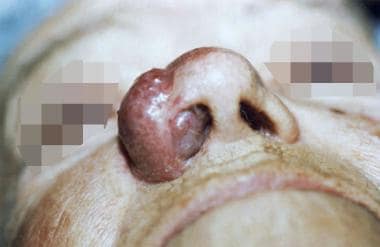
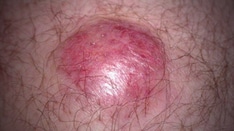
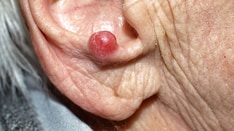
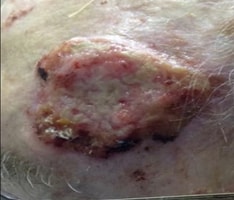
- MCC usually presents as a solitary, dome-shaped nodule or firm plaque (see Media File 1).
- Lesions are most often smaller than 2 cm in greatest dimension, but may exceed 15 cm in diameter.
- They are typically red, violaceous, or purple.
- The epidermal surface is often shiny, and telangiectases may be seen, suggesting atrophy.
- Ulceration is uncommon.
- Skin/distribution
- Lesions characteristically appear on the head or the neck (about half of cases).
- Any mucosal or cutaneous site may be affected.
- Metastases
- Regional nodal metastases are usually the first site of dissemination.
- They may be detectable by palpation. Sentinel lymph node biopsy is effective in predicting the risk of regional recurrence; however, lymph node dissection does not appear to convey a survival advantage.
- Cutaneous metastatic deposits also occur.
Causes
An etiologic role for chronic exposure to solar ultraviolet radiation (UVR) is proposed, mainly due to the markedly increased risk for white patients versus black patients and the predominant location of MCC on sites of maximal cumulative UVR exposure (head and neck). The regional incidence rate of MCC increases with increasing sun exposure, measured by the UVB solar index. Both the frequency and the aggressiveness of MCC increase after immunosuppression, organ transplantation, and B-cell neoplasia. Other potential risk factors for MCC include erythema ab igne and congenital ectodermal dysplasia. MCC is not associated with infection by Epstein-Barr virus or human papillomavirus.
Basal Cell Carcinoma
Dermatofibroma
Kaposi Sarcoma
Keratoacanthoma
Malignant Melanoma
Metastatic Carcinoma of the Skin
Squamous Cell Carcinoma
Other Problems to be Considered
B-cell lymphoma
Adnexal neoplasm
Imaging Studies
- Radiography of the chest is indicated to rule out the alternative diagnosis of cutaneous metastasis from a primary small cell neuroendocrine carcinoma (oat cell carcinoma) of the lung.
-
- Staging CT or MRI studies are needed to assess the possibility of dissemination of primary MCC to the lymph nodes or the viscera.
-
Procedures
- Fine needle aspiration may be helpful to assess recurrence or metastatic spread.
-
Histologic Findings
Tumors cells are usually located intradermally; an intraepidermal component may also be present, and a purely intraepidermal (in situ) MCC rarely may be encountered. Reactive epidermal hyperplasia is frequent.
Several architectural patterns of intradermal tumor are recognized. The classic trabecular pattern consists of interconnecting strands of tumor cells in the dermis, with formation of cellular aggregates resembling glands or neural rosettes. The intermediate pattern is the most common, and it exhibits large, solid nests of neoplastic cells. The least common, diffuse pattern consists of an infiltration of tumor cells among dermal collagen bundles, without the more distinctive organoid appearance of the trabecular pattern. A particular tumor often contains elements of all architectural patterns, with individual variation in the proportions represented.
The tumor is composed of round, small, dark cells within conspicuous nucleoli and a generally open chromatin with peripheral heterochromatin (salt-and-pepper pattern). Mitotic figures and apoptotic bodies are often numerous. Vascular or lymphatic invasion is not uncommon. Histologic variants of MCC include the desmoplastic, epidermotropic (resembling mycosis fungoides), and pagetoid (resembling Paget disease or melanoma) types, and tumors with focal true glandular or squamous differentiation. Cases of MCC have been associated with squamous cell carcinoma, basal cell carcinoma, and trichilemmal cyst.
Immunohistochemistry is very helpful. Cytokeratin 20 is expressed in a dotlike paranuclear or crescentic pattern; other low molecular weight (MW) cytokeratin antibodies (eg, CAM5.2, MNF116), while less specific, react in a similar localization pattern. Neurofilament is also expressed in the cytoplasm of most MCC. The above findings support the diagnosis of primary MCC of the skin and tend to rule out metastatic neuroendocrine carcinoma, as from a pulmonary primary. The CK20 expression is so sensitive and specific that it has largely replaced traditional markers of neuroendocrine differentiation (ie, synaptophysin, chromogranin) as the initial antibody panel of choice; however, the latter may be helpful adjuncts in difficult cases.
Electron microscopic findings are characteristic, revealing a lobulated nucleus that may contain rodlets. The cytoplasm is electron-lucent and contains a prominent Golgi apparatus and numerous ribosomes. Intermediate filaments are numerous and often assume a parallel or whorled arrangement near the nucleus, accounting for the dotlike pattern of cytokeratin distribution visualized by immunohistochemistry. Desmosomes may be present. Most diagnostic is the dense core granule (80-120 nm in diameter), the source and the locus of the neuroendocrine peptides.
Cytologic preparations from fine-needle aspirates (FNAs) demonstrate a loosely cohesive pattern of small- to intermediate-sized cells with round nuclei, finely granular chromatin, a thin rim of cytoplasm, and (infrequently) pseudorosette formation. Immunocytochemistry may be helpful.
Staging
According to the American Joint Committee on Cancer guidelines, carcinoma of the skin is staged by the status of T (primary tumor), N (lymph node), and M (metastasis). The definitions are as follows: Table 1. Tumor Status | TX | Primary tumor cannot be assessed | | T0 | No evidence of primary tumor | | Tis | Carcinoma in situ | | T1 | Tumor 2 cm or less in greatest dimension | | T2 | Tumor >2 cm but not >5 cm in greatest dimension | | T3 | Tumor >5 cm in greatest dimension | | T4 | Tumor invades deep extradermal structures (ie, cartilage, skeletal muscle, bone) | Note: In the case of multiple simultaneous tumors, the tumor with the highest T category is classified and the number of separate tumors is indicated in parentheses, such as T2 (5). Table 2. Node and Metastasis Status | | NX | Regional lymph nodes cannot be assessed | | N0 | No regional lymph node metastasis | | N1 | Regional lymph metastasis | | MX | Distant metastasis cannot be assessed | | M0 | No distant metastasis | | M1 | Distant metastasis |
Table 3. Stage Grouping | Stage 0 | Tis | N0 | M0 | | Stage I | T1 | N0 | M0 | | Stage II | T2 | N0 | M0 | | (or) | T3 | N0 | M0 | | Stage III | T4 | N0 | M0 | | (or) | Any T | N1 | M0 | | Stage IV | Any T | Any N | M1 |
Sentinel lymph nodes may be examined by breadloafing and subsequent analysis of keratin expression with an antikeratin cocktail. Because dendritic cells in the lymph nodes may express keratin, in case of doubt anti-CK20 antibodies may be useful to rule out metastatic MCC.
Medical Care
- Various chemotherapeutic regimens have been used, but none has been proven to result in improved survival; the role of chemotherapy in the management of MCC remains unclear. MCC is chemosensitive but only rarely chemocurable in patients with metastasis or locally advanced tumors. Moreover, a high incidence of toxic death occurs due to chemotherapy.
-
- The role of radiation therapy (RT) in managing MCC remains controversial. RT may help control unresectable primary or metastatic lesions, and it may also be useful for local control when administered postoperatively to the primary site and the regional draining lymph node basin. Adjuvant RT reportedly reduces the local and regional recurrence rate but may not lead to improved overall survival.
-
Surgical Care
- Wide local excision (eg, with margins of 3 cm) is usually indicated if clinically feasible. Some have recommended Mohs micrographic surgery for its tissue-sparing effects and possible superior control of local disease; however, tumor deposits may be noncontiguous histologically, rendering this modality less effective in such cases.
-
- Selective lymphadenectomy (sentinel lymph node procedure) has reportedly been feasible in small series of patients with MCC, but any effect on survival is unclear. Prophylactic complete lymph node dissection, combined with wide local excision and adjuvant radiotherapy, reportedly may improve survival.
-
Consultations
Early referral to a surgical oncologist, a medical oncologist, and a radiation therapist is indicated.
Deterrence/Prevention:
- Photoprotection (eg, sunscreen, behavioral prevention) may help prevent MCC, but this is not proven.
-
Complications:
- Complications secondary to metastasis depend on the anatomic sites of involvement.
-
Prognosis:
- Partial or complete spontaneous regression (reminiscent of that sometimes seen in melanoma) is a well documented but rare phenomenon in MCC and may be more common in women than in men. Even some metastases may remit spontaneously. Regression is accompanied by dense lymphocytic infiltrates, primarily of the CD8 phenotype, and proceeds via apoptosis (as documented ultrastructurally and by the in situ DNA nick end labeling [TUNEL] technique).
-
- Local cutaneous recurrence occurs after wide excision in 30-40% of patients with clinical stage I MCC; local invasion of contiguous organs (eg, intracranial) is also possible. Regional lymph node metastasis occurs in 50-79% of patients, and distant metastasis occurs in more than 30% of patients; major sites include liver, bone, central nervous system, lung, and skin.
-
- Overall, the mortality rate is 30-50% in 2 years; few studies include longer-term follow-up. Women appear to have a better survival rate than men. Histopathologic features associated with a lower survival rate include small cell size, high mitotic rate, subcutaneous invasion, diffuse growth pattern, heavy lymphocytic infiltrates, and tumor size greater than 5 mm.
-
Patient Education:
Medical/Legal Pitfalls
- Misdiagnosis of MCC pathologically as basal cell carcinoma is a pitfall; adjunctive techniques, including immunohistochemistry and electron microscopy, can be helpful in questionable cases.
-
| Media file 1:
Large, violaceous nodule of Merkel cell carcinoma on the antecubital fossa. Courtesy of Dr. Jonathan Cook. |
 | View Full Size Image | |
Media type: Photo
|
| Media file 2:
Histologic appearance of nodular Merkel cell carcinoma. Dermal nodule with a cohesive, expansile growth of basophilic cells. |
 | View Full Size Image | |
Media type: Photo
|
| Media file 3:
High-power view demonstrates an open chromatin pattern and a high mitotic index. |
 | View Full Size Image | |
Media type: Photo
|
| Media file 4:
Pseudorosette formation in Merkel cell carcinoma. |
 | View Full Size Image | |
Media type: Photo
|
| Media file 5:
Merkel cell carcinoma with a focus of squamous differentiation. |
 | View Full Size Image | |
Media type: Photo
|
| Media file 6:
Prominent in situ nested component of Merkel cell carcinoma, simulating malignant melanoma. |
 | View Full Size Image | |
Media type: Photo
|
| Media file 7:
Electron micrograph of Merkel cell carcinoma showing a dense core granule (arrow). |
 | View Full Size Image | |
Media type: Photo
|
| Media file 8:
Electron micrograph of Merkel cell carcinoma showing whorled bundles of intermediate filaments (arrow) near nucleus in Merkel cell carcinoma. |
 | View Full Size Image | |
Media type: Photo
|
| Media file 9:
Dotlike paranuclear pattern of cytokeratin immunolocalization. |
 | View Full Size Image | |
Media type:
|
- Amato M, Esmaeli B, Ahmadi MA, Tehrani MH, Gershenwald J, Ross M, et al. Feasibility of preoperative lymphoscintigraphy for identification of sentinel lymph nodes in patients with conjunctival and periocular skin malignancies. Ophthal Plast Reconstr Surg. Mar 2003;19(2):102-6. [Medline].
- Amo-Takyi BK, Tietze L, Tory K, Guerreiro P, Günther K, Bhardwaj RS, et al. Diagnostic relevance of chromosomal in-situ hybridization in Merkel cell carcinoma: targeted interphase cytogenetic tumour analyses. Histopathology. Feb 1999;34(2):163-9. [Medline].
- Amo-Takyi BK, Tietze L, Tory K, Guerreiro P, Günther K, Bhardwaj RS, et al. Fine-needle aspiration of Merkel cell carcinoma of the skin with cytomorphology and immunocytochemical correlation. Diagn Cytopathol. Feb 1999;18(4):251-7. [Medline].
- Decker RH, Wilson LD. Role of radiotherapy in the management of merkel cell carcinoma of the skin. J Natl Compr Canc Netw. Aug 2006;4(7):713-8. [Medline].
- Drabkin HA, Mendez MJ, Rabbitts PH, Varkony T, Bergh J, Schlessinger J, et al. Characterization of the submicroscopic deletion in the small-cell lung carcinoma (SCLC) cell line U2020. Genes Chromosomes Cancer. Jul 1992;5(1):67-74. [Medline].
- Gipponi M. Clinical applications of sentinel lymph-node biopsy for the staging and treatment of solid neoplasms. Minerva Chir. Aug 2005;60(4):217-33. [Medline].
- Gooptu C, Woollons A, Ross J, Price M, Wojnarowska F, Morris PJ, et al. Merkel cell carcinoma arising after therapeutic immunosuppression. Br J Dermatol. Oct 1997;137(4):637-41. [Medline].
- Gould E, Albores-Saavedra J, Dubner B, Smith W, Payne CM. Eccrine and squamous differentiation in Merkel cell carcinoma. An immunohistochemical study. Am J Surg Pathol. Oct 1988;12(10):768-72. [Medline].
- Haag ML, Glass LF, Fenske NA. Merkel cell carcinoma. Diagnosis and treatment. Dermatol Surg. Aug 1995;21(8):669-83. [Medline].
- Hashimoto K, Lee MW, D'Annunzio DR, Balle MR, Narisawa Y. Pagetoid Merkel cell carcinoma: epidermal origin of the tumor. J Cutan Pathol. Nov 1998;25(10):572-9. [Medline].
- Hill AD, Brady MS, Coit DG. Intraoperative lymphatic mapping and sentinel lymph node biopsy for Merkel cell carcinoma. Br J Surg. Apr 1999;86(4):518-21. [Medline].
- Hodgson NC. Merkel cell carcinoma: changing incidence trends. J Surg Oncol. Jan 1 2005;89(1):1-4. [Medline].
- Iacocca MV, Abernethy JL, Stefanato CM, Allan AE, Bhawan J. Mixed Merkel cell carcinoma and squamous cell carcinoma of the skin. J Am Acad Dermatol. Nov 1998;39(5 Pt 2):882-7. [Medline].
- Kanitakis J, Joly MO, Chouvet B, Euvrard S, Claudy A. Merkel cell carcinoma in immunocompetent and organ-transplant recipients do not harbor HPV. Eur J Dermatol. Sep 2006;16(4):445-6. [Medline].
- Kokoska ER, Kokoska MS, Collins BT, Stapleton DR, Wade TP. Early aggressive treatment for Merkel cell carcinoma improves outcome. Am J Surg. Dec 1997;174(6):688-93. [Medline].
- Leonard JH, Hayard N. Loss of heterozygosity of chromosome 13 in Merkel cell carcinoma. Genes Chromosomes Cancer. Sep 1997;20(1):93-7. [Medline].
- Leonard JH, Williams G, Walters MK, Nancarrow DJ, Rabbitts PH. Deletion mapping of the short arm of chromosome 3 in Merkel cell carcinoma. Genes Chromosomes Cancer. Feb 1996;15(2):102-7. [Medline].
- Leong SP. Selective sentinel lymphadenectomy for malignant melanoma, Merkel cell carcinoma, and squamous cell carcinoma. Cancer Treat Res. 2005;127:39-76. [Medline].
- Meeuwissen JA, Bourne RG, Kearsley JH. The importance of postoperative radiation therapy in the treatment of Merkel cell carcinoma. Int J Radiat Oncol Biol Phys. Jan 15 1995;31(2):325-31. [Medline].
- Miettinen M. Keratin 20: immunohistochemical marker for gastrointestinal, urothelial, and Merkel cell carcinomas. Mod Pathol. May 1995;8(4):384-8. [Medline].
- Miettinen M, Lasota J. Cutaneous lymphoma-simulating Merkel cell carcinoma-molecular genetic demonstration of a clonal disease with divergent immunophenotypes. Mod Pathol. Sep 1995;8(7):769-74. [Medline].
- Miller RW, Rabkin CS. Merkel cell carcinoma and melanoma: etiological similarities and differences. Cancer Epidemiol Biomarkers Prev. Feb 1999;8(2):153-8. [Medline].
- Moll I, Moll R. Early development of human Merkel cells. Exp Dermatol. Nov 1992;1(4):180-4. [Medline].
- Mott RT, Smoller BR, Morgan MB. Merkel cell carcinoma: a clinicopathologic study with prognostic implications. J Cutan Pathol. Mar 2004;31(3):217-23. [Medline].
- Nakafusa J, Narisawa Y, Shinogi T, Taira K, Tanaka T, Inoue T, et al. Changes in the number of Merkel cells with the hair cycle in hair discs on rat back skin. Br J Dermatol. Nov 2006;155(5):883-9. [Medline].
- O'Connor WJ, Roenigk RK, Brodland DG. Merkel cell carcinoma. Comparison of Mohs micrographic surgery and wide excision in eighty-six patients. Dermatol Surg. Oct 1997;23(10):929-33. [Medline].
- Pilotti S, Rilke F, Bartoli C, Grisotti A. Clinicopathologic correlations of cutaneous neuroendocrine Merkel cell carcinoma. J Clin Oncol. Dec 1988;6(12):1863-73. [Medline].
- Pitale M, Sessions RB, Husain S. An analysis of prognostic factors in cutaneous neuroendocrine carcinoma. Laryngoscope. Mar 1992;102(3):244-9. [Medline].
- Plaza JA, Suster S. The Toker tumor: spectrum of morphologic features in primary neuroendocrine carcinomas of the skin (Merkel cell carcinoma). Ann Diagn Pathol. Dec 2006;10(6):376-85. [Medline].
- Ratner D, Nelson BR, Brown MD, Johnson TM. Merkel cell carcinoma. J Am Acad Dermatol. Aug 1993;29(2 Pt 1):143-56. [Medline].
- Savage P, Constenla D, Fisher C, Thomas JM, Gore ME. The natural history and management of Merkel cell carcinoma of the skin: a review of 22 patients treated at the Royal Marsden Hospital. Clin Oncol (R Coll Radiol). 1997;9(3):164-7. [Medline].
- Schmalbach CE, Lowe L, Teknos TN, Johnson TM, Bradford CR. Reliability of sentinel lymph node biopsy for regional staging of head and neck Merkel cell carcinoma. Arch Otolaryngol Head Neck Surg. Jul 2005;131(7):610-4. [Medline].
- Senchenkov A, Barnes SA, Moran SL. Predictors of survival and recurrence in the surgical treatment of merkel cell carcinoma of the extremities. J Surg Oncol. Mar 1 2007;95(3):229-34. [Medline].
- Shah IA, Netto D, Schlageter MO, Muth C, Fox I, Manne RK. Neurofilament immunoreactivity in Merkel-cell tumors: a differentiating feature from small-cell carcinoma. Mod Pathol. Jan 1993;6(1):3-9. [Medline].
- Shaw M, Warren S, Groben P, Gulley ML. No evidence of Epstein-Barr virus association with Merkel cell carcinoma. J Cutan Pathol. Sep 2006;33(9):624-8. [Medline].
- Skelton HG, Smith KJ, Hitchcock CL, McCarthy WF, Lupton GP, Graham JH. Merkel cell carcinoma: analysis of clinical, histologic, and immunohistologic features of 132 cases with relation to survival. J Am Acad Dermatol. Nov 1997;37(5 Pt 1):734-9. [Medline].
- Smith DE, Bielamowicz S, Kagan AR, Anderson PJ, Peddada AV. Cutaneous neuroendocrine (Merkel cell) carcinoma. A report of 35 cases. Am J Clin Oncol. Jun 1995;18(3):199-203. [Medline].
- Suárez C, Rodrigo JP, Ferlito A, Devaney KO, Rinaldo A. Merkel cell carcinoma of the head and neck. Oral Oncol. Sep 2004;40(8):773-9. [Medline].
- Tai PT, Yu E, Winquist E, Hammond A, Stitt L, Tonita J, et al. Chemotherapy in neuroendocrine/Merkel cell carcinoma of the skin: case series and review of 204 cases. J Clin Oncol. Jun 2000;18(12):2493-9. [Medline].
- Takenaka H, Kishimoto S, Shibagaki R, Nagata M, Yasuno H. Merkel cell carcinoma with partial spontaneous regression: an immunohistochemical, ultrastructural, and TUNEL labeling study. Am J Dermatopathol. Dec 1997;19(6):614-8. [Medline].
- Toker C. Trabecular carcinoma of the skin. Arch Dermatol. Jan 1972;105(1):107-10. [Medline].
- Van Gele M, Speleman F, Vandesompele J, Van Roy N, Leonard JH, et al. Characteristic pattern of chromosomal gains and losses in Merkel cell carcinoma detected by comparative genomic hybridization. Cancer Res. Apr 1 1998;58(7):1503-8. [Medline].
- Van Gele M, Van Roy N, Ronan SG, Messiaen L, Vandesompele J, Geerts ML, et al. Molecular analysis of 1p36 breakpoints in two Merkel cell carcinomas. Genes Chromosomes Cancer. Sep 1998;23(1):67-71. [Medline].
- Veness MJ, Perera L, McCourt J, Shannon J, Hughes TM, Morgan GJ, et al. Merkel cell carcinoma: improved outcome with adjuvant radiotherapy. ANZ J Surg. May 2005;75(5):275-81. [Medline].
- Voog E, Biron P, Martin JP, Blay JY. Chemotherapy for patients with locally advanced or metastatic Merkel cell carcinoma. Cancer. Jun 15 1999;85(12):2589-95. [Medline].
- Vortmeyer AO, Merino MJ, Boni R, Liotta LA, Cavazzana A, Zhuang Z. Genetic changes associated with primary Merkel cell carcinoma. Am J Clin Pathol. May 1998;109(5):565-70. [Medline].
- Wasserberg N, Schachter J, Fenig E, Feinmesser M, Gutman H. Applicability of the sentinel node technique to Merkel cell carcinoma. Dermatol Surg. Feb 2000;26(2):138-41. [Medline].
- Weissmann A, Camisa C. Friedrich Sigmund Merkel. Part I. The man. Am J Dermatopathol. Dec 1982;4(6):521-6. [Medline].
- Wilder RB, Harari PM, Graham AR, Shimm DS, Cassady JR. Merkel cell carcinoma. Improved locoregional control with postoperative radiation therapy. Cancer. Sep 1 1991;68(5):1004-8. [Medline].
- Yiengpruksawan A, Coit DG, Thaler HT, Urmacher C, Knapper WK. Merkel cell carcinoma. Prognosis and management. Arch Surg. Dec 1991;126(12):1514-9. [Medline].
Merkel Cell Carcinoma excerpt Article Last Updated: Jun 21, 2007
|