| Patient Education |
|
Click here for patient education.
|
|
You are in: eMedicine Specialties >
Dermatology > BENIGN NEOPLASMS
Pearly Penile Papules
Article Last Updated: Apr 25, 2008
AUTHOR AND EDITOR INFORMATION
Section 1 of 11
Author: Clarence William Brown Jr, MD, Assistant Professor of Dermatology, Director of Mohs Micrographic and Dermatological Surgery, Rush University Medical Center
Clarence William Brown, Jr, is a member of the following medical societies: American Academy of Dermatology and American College of Mohs Micrographic Surgery and Cutaneous Oncology
Editors: James Fulton Jr, MD, PhD, Medical Director, Fulton Skin Institute; Michael J Wells, MD, Associate Professor, Department of Dermatology, Texas Tech University Health Sciences Center; Lester F Libow, MD, Dermatopathologist, South Texas Dermatopathology Laboratory; Joel M Gelfand, MD, MSCE, Medical Director, Clinical Studies Unit, Assistant Professor, Department of Dermatology, Associate Scholar, Center for Clinical Epidemiology and Biostatistics, University of Pennsylvania; Dirk M Elston, MD, Director, Department of Dermatology, Geisinger Medical Center
Author and Editor Disclosure
Synonyms and related keywords:
angiofibromas, hirsute papillary corona of the penis, hirsutoid papillomas, papillae of the corona of the glans, papillae of the corona of the glans penis, papillomatosis corona penis, Tyson glands, Tyson's glands, uncircumcised males, lesions of the sulcus of the glans penis, lesions of the corona of the glans penis
Background
Pearly penile papules are small dome-shaped to filiform skin-colored papules that typically are located on the sulcus or corona of the glans penis. Commonly, lesions are arranged circumferentially in one or several rows and often are assumed wrongly to be transmitted sexually.
The following 2 related eMedicine articles may be of interest:
Pathophysiology
Pearly penile papules are considered a normal variant and harbor no malignant potential. They are not contracted or spread through sexual activity.
Lesions are observed more frequently in uncircumcised males; however, the mechanisms underlying their development remain unknown.
Frequency
United States
The incidence of pearly penile papules reportedly ranges from 8-48%.1 Several reports suggest an increased incidence in uncircumcised versus circumcised men (22% vs 12%, respectively). One study found an increase in frequency in black versus white men, in those circumcised (21% vs 7%, respectively) and uncircumcised (44% vs 33%, respectively).
International
No geographic variation in prevalence has been noted.
Mortality/Morbidity
Lesions are considered to be a normal variant and are unrelated to sexual activity. Often, lesions cause great anxiety to patients until their benign nature is clarified.
Race
No racial predilection has been confirmed.
- Reports suggesting an increased incidence in African American males may reflect an increase in uncircumcised men in that population.
- Rehbein2 studied 840 men aged 10-66 years and found an overall incidence of pearly penile papules of 30.1% in this group. Black men in the study demonstrated a rate of pearly penile papules of 32.7% (44% in uncircumcised, 20.8% in circumcised black males). White men in the study demonstrated a rate of 13.9% (33.3% in uncircumcised, 7.1% in circumcised white males).
Sex
Because of their anatomic distribution, pearly penile papules are noted only in men.
Age
Pearly penile papules are noted most commonly in males in their second or third decades of life, with a gradual decrease in frequency with aging.
History
- Most patients with pearly penile papules seek dermatologic consultation because they are concerned about a sexually transmitted disease.
- Pearly penile papules most commonly are confused with condyloma acuminatum (genital warts) or less often, with molluscum contagiosum.
Physical
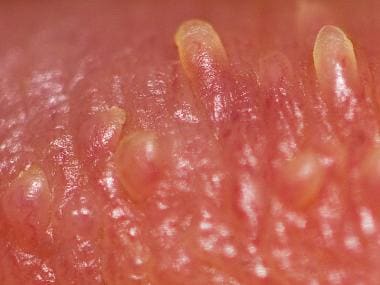
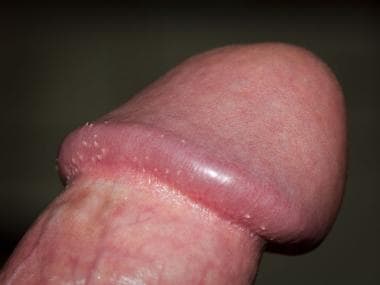
- On physical examination, pearly penile papules appear as one or several rows of small, flesh-colored, smooth, dome-topped to filiform papules situated circumferentially around the corona or sulcus of the glans penis (Media File 1). Uncommonly, lesions may extend onto the glans penis.
- Lesions typically are asymptomatic and persist throughout life; however, they gradually may become less noticeable with increased age.
Causes
- Some evidence suggests that pearly penile papules may be observed more frequently in uncircumcised men (22%) than in circumcised men (12%).
- In the past, pearly penile papules were believed to contribute to the accumulation of smegma in uncircumcised men; currently however, this is known to be not true.
Molluscum Contagiosum
Warts, Genital
Other Problems to be Considered
Condyloma acuminatum
Ectopic sebaceous glands
Lab Studies
Laboratory studies are not indicated.
Imaging Studies
Imaging studies are not indicated.
Other Tests
No other tests are indicated, although dermascope findings have been documented.3
Procedures
Confirmation of this diagnosis may be obtained by obtaining a biopsy specimen of a lesion for histopathologic analysis.
Histologic Findings
Histopathologic analysis of lesions demonstrates a variable number of thin-walled ectatic vessels in the dermis in association with a fibroblastic proliferation. Lesional fibroblasts may appear stellate or multinucleated. Concentric fibrosis surrounding adnexal structures is an additional characteristic.
These features indicate angiofibroma and are not specific for pearly penile papules. Angiofibromas associated with tuberous sclerosis (adenoma sebaceum) and fibrous papule may show identical histologic findings. Clinical history or recognition of genital skin (in adequate biopsy sample) may provide a specific diagnosis.
Medical Care
Lesions typically are asymptomatic and require no therapy.
Surgical Care
- Some patients may request therapy to alleviate anxiety.
- Ablation using carbon dioxide laser,4, 5 electrodesiccation with curettage, and excisional surgery reportedly have successfully eliminated lesions.
- Mixed results have been noted with cryotherapy.6
- Topical application of podophyllin largely has been ineffective.
Consultations
- Dermatologist: Consultation may prove useful when the diagnosis is not obvious.
Diet
Diet is not known to be a factor influencing the development or course.
Activity
Pearly penile papules are not associated with personal hygiene or sexual activity.
No effective topical or oral medical therapies are known for the treatment of pearly penile papules.
Further Outpatient Care
Most patients accept that treatment is not necessary once the benign nature of the lesions is explained. Patients who insist on treatment may elect to undergo ablative therapy with conventional surgical excision or carbon dioxide laser resurfacing.
Deterrence/Prevention
Circumcision at birth may decrease the incidence of pearly penile papules, since the frequency of lesions is fewer in circumcised males (12%) versus uncircumcised males (22%).
Complications
No complications are noted.
Prognosis
Pearly penile papules typically are asymptomatic and persist throughout life, although lesions gradually may become less noticeable with advancing age.
Patient Education
- Educate patients about the benign nature of the lesions.
- Inform patients that lesions are not transmitted through sexual activity.
- Consider counseling for the patient's sexual partner, which often helps alleviate anxiety.
Medical/Legal Pitfalls
- Failure to consider a diagnosis of pearly penile papules in patients with multiple lesions on the corona or sulcus of the glans penis that are believed to be genital warts but are unresponsive to conventional ablative therapy with topical podophyllin have mixed results reported with cryosurgery
- Failure to consider biopsy and consultation with a dermatologist when the diagnosis is unclear
| Media file 1:
Pearly penile papules are seen clinically as multiple, glistening, flesh-colored, dome-topped papules arranged circumferentially in 2 rows along the corona of the glans penis. |
 | View Full Size Image | |
Media type: Photo
|
- Sonnex C, Dockerty WG. Pearly penile papules: a common cause of concern. Int J STD AIDS. Nov 1999;10(11):726-7. [Medline].
- Rehbein HM. Pearly penile papules: incidence. Cutis. Jan 1977;19(1):54-7. [Medline].
- Ozeki M, Saito R, Tanaka M. Dermoscopic Features of Pearly Penile Papules. Dermatology. Feb 29 2008;217(1):21-22. [Medline].
- Lane JE, Peterson CM, Ratz JL. Treatment of pearly penile papules with CO2 laser. Dermatol Surg. Jul 2002;28(7):617-8. [Medline].
- Magid M, Garden JM. Pearly penile papules: treatment with the carbon dioxide laser. J Dermatol Surg Oncol. May 1989;15(5):552-4. [Medline].
- Ocampo-Candiani J, Cueva-Rodriguez JA. Cryosurgical treatment of pearly penile papules. J Am Acad Dermatol. Sep 1996;35(3 Pt 1):486-7. [Medline].
- Ackerman AB, Kronberg R. Pearly penile papules. Acral angiofibromas. Arch Dermatol. Nov 1973;108(5):673-5. [Medline].
- Agrawal SK, Bhattacharya SN, Singh N. Pearly penile papules: a review. Int J Dermatol. Mar 2004;43(3):199-201. [Medline].
- Glicksman JM, Freeman RG. Pearly penile papules. A statistical study of incidence. Arch Dermatol. Jan 1966;93(1):56-9. [Medline].
- Hogewoning CJ, Bleeker MC, van den Brule AJ, Voorhorst FJ, van Andel RE, Risse EK, et al. Pearly penile papules: still no reason for uneasiness. J Am Acad Dermatol. Jul 2003;49(1):50-4. [Medline].
Pearly Penile Papules excerpt Article Last Updated: Apr 25, 2008
|