| Patient Education |
|
Click here for patient education.
|
|
You are in: eMedicine Specialties >
Dermatology > DISEASES OF THE ADNEXA
Perioral Dermatitis
Article Last Updated: May 6, 2008
AUTHOR AND EDITOR INFORMATION
Section 1 of 10
Author: Hans J Kammler, MD, PhD, Head of Unit for Dermatology, ENT, Ophthalmology, and Respiratory Diseases, German Federal Institute for Drugs and Medical Devices (BfArM)
Editors: James Fulton Jr, MD, PhD, Medical Director, Fulton Skin Institute; Richard P Vinson, MD, Assistant Clinical Professor, Department of Dermatology, Texas Tech University School of Medicine; Consulting Staff, Mountain View Dermatology, PA; Jeffrey Meffert, MD, Assistant Clinical Professor of Dermatology, University of Texas Health Science Center-San Antonio; Catherine Quirk, MD, Clinical Assistant Professor, Department of Dermatology, Brown University; Dirk M Elston, MD, Director, Department of Dermatology, Geisinger Medical Center
Author and Editor Disclosure
Synonyms and related keywords:
POD, rosacealike dermatitis, periorificial dermatitis, light-sensitive seborrheid, chronic papulopustular facial dermatitis, papulopustular facial dermatitis, granulomatous perioral dermatitis, lupuslike perioral dermatitis
Background
Perioral dermatitis (POD) is a chronic papulopustular and eczematous facial dermatitis. It mostly occurs in women, although a distinct papular variant occurs in children. The clinical and histologic features of the lesions resemble those of rosacea. Patients require systemic and/or topical treatment, an evaluation of the underlying factors, and reassurance.
Pathophysiology
The etiology of perioral dermatitis is unknown; however, the uncritical use of topical steroids for minor skin alterations of the face often precedes the manifestation of the disease. Recently, neurogenic inflammation has been proposed as a pathogenic mechanism.1 POD is limited to the skin.
Frequency
United States
The incidence is estimated to be 0.5-1% in industrialized countries, independent of geographic factors.
International
The incidence seems to be lower in less developed countries, but no statistics are available.
Mortality/Morbidity
POD is limited to the skin and is not life threatening. Emotional complications may develop because of the nature and chronic course of the disease (see Complications).
Sex
- POD predominantly affects women, who account for an estimated 90% of the cases.
- The number of male patients is assumed to be increasing because of changes in their cosmetic habits.
Age
- Perioral dermatitis can occur in children, but it is seldom diagnosed.
- The vast majority of patients are women aged 20-45 years.
History
- Subjective symptoms consist of a sensation of burning and tension.
- Itching is rare.
- Often, an uncritical use of topical steroids for minor or even undiagnosed skin alterations precedes the development of POD.
- Perioral dermatitis tends to be chronic.
- Patients may have marked lifestyle restrictions due to the disfiguring facial lesions.
Physical
- The disease is limited to the skin.
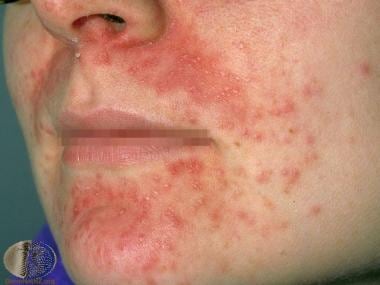
- Skin lesions occur as grouped follicular reddish papules, papulovesicles, and papulopustules on an erythematous base with a possible confluent aspect.
- The papules and pustules have mainly perioral locations.
- The predominant locations of POD lesions are the perioral area, nasolabial fold, and lateral portions of the lower eyelids.
- In an extreme variant of the disease called lupuslike POD granulomatous infiltrates have a yellowish aspect at diascopy.
Causes
An underlying cause cannot be detected in all patients. The etiology of perioral dermatitis is unknown; however, the uncritical use of topical steroids for minor skin alterations of the face often precedes the manifestation of the disease.
- Drugs: Many patients abuse topical steroid preparations. No clear correlation exists between the risk of POD and strength of the steroid or the duration of the abuse.
- Cosmetics: Fluorinated toothpaste2, 3; skin care ointments and creams, especially those with a petrolatum or paraffin base, and the vehicle isopropyl myristate are suggested to be causative factors. In an Australian study, applying foundation in addition to moisturizer and night cream resulted in a 13-fold increased risk for POD. The combination of moisturizer and foundation was associated with a lesser but significantly increased risk for POD, whereas moisturizer alone was not associated with an increased risk.
- Physical factors: UV light, heat, and wind worsen POD.
- Microbiologic factors: Fusiform spirilla bacteria, Candida species, and other fungi have been cultured from lesions. Their presence has no clear clinical relevance. In addition, candidiasis is suggested to provoke POD.
- Miscellaneous factors: Hormonal factors are suspected because of an observed premenstrual deterioration. Oral contraceptives may be a factor. Gastrointestinal disturbances, such as malabsorption, have been considered as well.
Acne Vulgaris
Contact Dermatitis, Allergic
Contact Dermatitis, Irritant
Lupus Miliaris Disseminatus Faciei
Rosacea
Other Problems to be Considered
Facial demodicosis (infestation with Demodex follicularis) clinically resembles POD and should be excluded, especially when anti-inflammatory therapies fail.4 Patients who are prone to acne or rosacea may experience worsening while undergoing topical immunomodulating therapy (eg, with tacrolimus ointment).5 Haber syndrome, or familial rosacealike dermatosis with intra-epidermal epitheliomas, keratotic plaques, and scars, is a rare genodermatosis that begins in childhood. Granulomatous periorificial dermatitis manifests most commonly in prepubertal children as yellow-brown papules limited to the perioral, perinasal, and periocular regions. The condition is self-limited and is not associated with systemic involvement.
Lab Studies
The diagnosis is made clinically. No laboratory abnormalities can be expected.
Other Tests
Clinical criteria, prick tests, and specific IgE testing against a mixture of aeroallergens has been used to test for skin barrier disfunction. In a German study,6 POD patients experienced significantly increased transepidermal water loss compared with rosacea patients and a control group, which indicated a skin barrier function disorder. This type of testing is not routinely used.
Histologic Findings
Histologic findings are similar to those of rosacea, but the signs of actinic skin damage are generally less intense and vary according to the patient's age. Thus, a lymphohistiocytic infiltrate with perifollicular localization can be expected in all stages. A marked granulomatous inflammation and, occasionally, perifollicular abscesses may be present when pustules and papules are the dominant clinical findings. Caseating granulomata are characteristic features of granulomatous POD.
Medical Care
- Anti-inflammatory systemic and/or topical therapy is required. Recently, photodynamic therapy (PDT) has been reported to be helpful,7 although large studies have not yet been performed.
- Treatment should be adapted to the severity and extension of the disease.
- Reassurance and education about possible underlying factors and the time course of the disease are critical. These measures help the patient to cope with the disfiguring character of the disease and help to minimize the risk of recurrences.
Consultations
Consult a dermatologist to evaluate provoking factors and to determine the individualized treatment.
Diet
As with all inflammatory skin conditions and rosacea, substances that dilate dermal blood vessels should be avoided. Examples include alcohol and hot foods.
Activity
In general, physical activity is not restricted; however, vasodilation of dermal vessels due to strenuous physical exercise may worsen subjective symptoms.
In severe forms of POD, systemic treatment with antiacne drugs is required. The drugs of choice are doxycycline (or tetracycline) and minocycline. In unresponsive and granulomatous forms, oral isotretinoin8 may be considered. In cases with minor presentations, as well as in children and pregnant women, individualized topical therapy is generally recommended. Anti-inflammatory agents (eg, metronidazole9, 10, 11 and erythromycin) are administered in a nongreasy base (eg, gel, lotion, cream). Pimecrolimus cream significantly reduced the novel Perioral Dermatitis Severity Index12 (PODSI) compared with vehicle in a randomized, double-blind study.13 Topical antiacne medications such as adapalene14 and azelaic acid15 have been used in open studies. Ointments should be avoided. Zero-therapy is based on the idea that by ceasing use all topical medications and cosmetics, the underlying causative factor for POD is eliminated. This form of therapy is appropriate in very compliant patients. So-called zero-therapy may be effective in cases associated with steroid abuse or when intolerance to cosmetics is suspected. This therapeutic option is often limited because of the patient's tendency to overtreat his or her condition. In every case, an initial worsening of the symptoms may occur with treatment, especially if topical steroids are withdrawn. The patient should be made aware of this complication. In cases of preceding long-term abuse of topical steroids, steroid weaning with low-dose 0.1-0.5% hydrocortisone cream can be tried initially.
Drug Category: Systemic antibiotics
These drugs may have antibacterial and/or anti-inflammatory effects that are responsible for their effectiveness in perioral dermatitis.
| Drug Name | Doxycycline (Bio-Tab, Doryx, Vibramycin) |
| Description | DOC in nonpregnant women. Inhibits protein synthesis and thus bacterial growth by binding to 30S and possibly 50S ribosomal subunits of susceptible bacteria. Alternatively, may use tetracycline in adapted dose. |
| Adult Dose | 100 mg PO bid initially; reduce to 50 mg bid or 100 mg qd after significant clinical improvement |
| Pediatric Dose | <8 years: Not recommended >8 years: 0.5 mg/kg PO bid; not to exceed 100 mg bid |
| Contraindications | Documented hypersensitivity; severe hepatic dysfunction |
| Interactions | Bioavailability decreases with antacids containing aluminum, calcium, magnesium, iron, or bismuth subsalicylate; tetracyclines can increase hypoprothrombinemic effects of anticoagulants; tetracyclines can decrease effects of oral contraceptives, causing breakthrough bleeding and increasing risk of pregnancy |
| Pregnancy | D - Fetal risk shown in humans; use only if benefits outweigh risk to fetus
|
| Precautions | Photosensitivity may occur with prolonged exposure to sunlight or tanning equipment; reduce dose in renal impairment; consider drug serum level determinations in prolonged therapy; tetracycline use during tooth development (last half of pregnancy through age 8 y) can cause permanent discoloration of teeth; Fanconi-like syndrome may occur with outdated tetracyclines; overgrowth of nonsusceptible organisms, including fungi, may occur; discontinue use if superinfection occurs; pseudotumor cerebri (benign intracranial hypertension) associated with tetracycline use in adults (usual clinical manifestations are headache and blurred vision); bulging fontanels associated with use of tetracycline use in infants; although conditions and related symptoms usually resolve soon after discontinuation, permanent sequelae possible |
| Drug Name | Minocycline (Dynacin, Minocin) |
| Description | Believed to be most efficacious tetracycline in dermatoses of sebaceous glands. Used to treat infections caused by susceptible gram-negative and gram-positive organisms, in addition to infections caused by susceptible Chlamydia, Rickettsia, and Mycoplasma species. |
| Adult Dose | 50-100 mg PO bid initially; reduce frequency to qd after notable clinical improvement |
| Pediatric Dose | <8 years: Not recommended >8 years: 1 mg/kg PO bid; not to exceed 100 mg PO bid |
| Contraindications | Documented hypersensitivity; severe hepatic dysfunction |
| Interactions | Bioavailability decreases with antacids containing aluminum, calcium, magnesium, iron, or bismuth subsalicylate; can decrease effects of oral contraceptives, causing breakthrough bleeding and increased risk of pregnancy; tetracyclines can increase hypoprothrombinemic effects of anticoagulants |
| Pregnancy | D - Fetal risk shown in humans; use only if benefits outweigh risk to fetus
|
| Precautions | Associated with drug-induced lupus syndrome and hepatitis; overgrowth of nonsusceptible organisms, including fungi, may occur; discontinue use if superinfection occurs; pseudotumor cerebri (benign intracranial hypertension) in adults associated with tetracycline use (usual clinical manifestations are headache and blurred vision); bulging fontanels associated with use of tetracyclines in infants; although conditions and related symptoms usually resolve soon after discontinuation, sequelae possible; photosensitivity may occur with prolonged exposure to sunlight or tanning equipment; reduce dose in renal impairment; consider drug serum level determinations in prolonged therapy; tetracycline use during tooth development (last half of pregnancy through age 8 y) can cause permanent discoloration of teeth; Fanconi-like syndrome may occur with outdated tetracyclines; hepatitis or lupuslike syndromes may occur. |
| Drug Name | Tetracycline (Sumycin) |
| Description | Inhibits bacterial protein synthesis by binding with 30S and possibly 50S ribosomal subunits. Has anti-inflammatory activity. |
| Adult Dose | 500 mg PO tid during wk 1; 500 mg PO bid during wk 2; 250-500 mg PO qd for as long as 6 wk |
| Pediatric Dose | <8 years: Not recommended >8 years: 10 mg/kg PO tid initially; not to exceed 500 mg PO tid |
| Contraindications | Documented hypersensitivity; severe hepatic dysfunction |
| Interactions | Bioavailability decreases with antacids containing aluminum, calcium, magnesium, iron, or bismuth subsalicylate; can decrease effects of oral contraceptives, causing breakthrough bleeding and increased risk of pregnancy; tetracyclines can increase hypoprothrombinemic effects of anticoagulants |
| Pregnancy | D - Fetal risk shown in humans; use only if benefits outweigh risk to fetus
|
| Precautions | Photosensitivity may occur with prolonged exposure to sunlight or tanning equipment; reduce dose in renal impairment; consider drug serum level determinations in prolonged therapy; tetracycline use during tooth development (last half of pregnancy through age 8 y) can cause permanent discoloration of teeth; Fanconi-like syndrome may occur with outdated tetracyclines |
| Drug Name | Metronidazole (Flagyl) |
| Description | Imidazole ring-based antibiotic active against various anaerobic bacteria and protozoa. In concentrations of 0.75-2%, considered to be DOC in topical treatment of POD. Available in a gel, lotion, or cream. Oral metronidazole has also been used in treatment of perioral dermatitis. |
| Adult Dose | Topical: Apply to affected areas bid after washing Oral: 250-500 mg PO bid |
| Pediatric Dose | Not established |
| Contraindications | Documented hypersensitivity |
| Interactions | Cimetidine may increase toxicity; may increase effects of anticoagulants; may increase toxicity of lithium and phenytoin; disulfiramlike reaction may occur with oral ingestion of alcohol |
| Pregnancy | B - Fetal risk not confirmed in studies in humans but has been shown in some studies in animals
|
| Precautions | Topical metronidazole may cause tearing of eyes; contact with eyes should be avoided; if reaction suggesting local irritation occurs, use medication less frequently or discontinue; drug is a nitroimidazole and should be used with care in patients with evidence of or history of blood dyscrasia; alcoholic beverages should be avoided during and for at least 3 d afterward oral treatment; PO metronidazole should not be given to patients who have taken disulfiram within previous 2 wk |
| Drug Name | Erythromycin (E.E.S., E-Mycin, Ery-Tab) |
| Description | Topical erythromycin in concentrations of 2-4% as a gel or cream is an alternative to metronidazole in topical treatment. Inhibits bacterial growth, possibly by blocking dissociation of peptidyl t-RNA from ribosomes, causing RNA-dependent protein synthesis to arrest. Used to treat staphylococcal and streptococcal infections. |
| Adult Dose | Apply to affected areas bid after washing |
| Pediatric Dose | Apply as in adults |
| Contraindications | Documented hypersensitivity; hepatic impairment |
| Interactions | Coadministration may increase toxicity of theophylline, digoxin, carbamazepine, and cyclosporine; may potentiate anticoagulant effects of warfarin; coadministration with lovastatin and simvastatin increases risk of rhabdomyolysis |
| Pregnancy | B - Fetal risk not confirmed in studies in humans but has been shown in some studies in animals
|
| Precautions | Avoid contact with eyes and all mucous membranes; antibiotic agents may be associated with overgrowth of antibiotic-resistant organisms; discontinue use if superinfection occurs |
Drug Category: Retinoids
These agents reduce the size of the sebaceous glands, decrease sebum secretion, and inhibit keratinization.
| Drug Name | Isotretinoin (Accutane) |
| Description | Oral agent used to treat serious dermatologic conditions. Synthetic 13-cis isomer of naturally occurring tretinoin (trans-retinoic acid). Both agents are structurally related to vitamin A. Decreases sebaceous gland size and sebum production. May inhibit sebaceous gland differentiation and abnormal keratinization. Indicated for long-standing and refractory forms of POD. Because of adverse effects, therapy should be prescribed only by physician familiar with this drug (ie, dermatologist). |
| Adult Dose | 0.2 mg/kg PO qd initially; reduce to 0.1 mg/kg or 0.05 mg/kg upon notable clinical improvement |
| Pediatric Dose | Not established |
| Contraindications | Documented hypersensitivity |
| Interactions | Toxicity may occur with vitamin A coadministration; pseudotumor cerebri or papilledema may occur when coadministered with tetracyclines; avoid alcohol consumption (possible potentiation of increase in serum triglyceride levels); may reduce plasma levels of carbamazepine |
| Pregnancy | X - Contraindicated; benefit does not outweigh risk
|
| Precautions | Women of childbearing age must not become pregnant during therapy; decreased tolerance to contact lenses may occur during and after therapy; may decrease night vision; patients should not donate blood during therapy and for 1 mo afterward; female patients should use 2 forms of effective contraception during and for 1 mo after treatment; patients should sign a consent form prior to therapy; use during breastfeeding and in children not recommended; inflammatory bowel disease may occur; may be associated with hepatitis; occasional exaggerated healing response of acne lesions (excessive granulation with crusting) may occur; patients with diabetes may have problems in controlling their blood sugar during treatment; patient should avoid exposure to UV light or sunlight until tolerance achieved; discontinue treatment if rectal bleeding, abdominal pain, or severe diarrhea occur; mood swings or depression may occur; caution with history of depression. |
Drug Category: Immune Modulator
Pimecrolimus cream controls atopic dermatitis.
| Drug Name | Pimecrolimus (Elidel) |
| Description | First nonsteroid cream approved in the United States for mild-to-moderate atopic dermatitis. Derived from ascomycin, a natural substance produced by fungus Streptomyces hygroscopicus var ascomyceticus. Selectively inhibits production and release of inflammatory cytokines from activated T-cells by binding to cytosolic immunophilin receptor macrophilin-12. Resulting complex inhibits phosphatase calcineurin, thus blocking T-cell activation and cytokine release. Cutaneous atrophy not observed in clinical trials, a potential advantage over topical corticosteroids. Indicated only after other treatment options have failed. |
| Adult Dose | Apply topically to affected areas bid (short-term and intermittent use only) |
| Pediatric Dose | <2 years: Not established >2 years: Administer as in adults (short-term and intermittent use only) |
| Contraindications | Documented hypersensitivity |
| Interactions | None reported |
| Pregnancy | C - Fetal risk revealed in studies in animals but not established or not studied in humans; may use if benefits outweigh risk to fetus
|
| Precautions | Potential exacerbation of existing infection at site of application; may cause burning and irritation; caution with conditions that suppress the immune system (eg, AIDS, cancer); may increase risk of viral infections; other adverse effects include headache, sore throat, flulike symptoms, fever, and cough |
Further Inpatient Care
- Perioral dermatitis is almost exclusively treated on an outpatient basis.
Further Outpatient Care
- Care includes an assessment of the effectiveness of systemic therapy.
- Topical therapy should be adapted in accordance to the condition of the skin and the severity of the disease.
In/Out Patient Meds
- Systemic treatment includes antiacne medications such as doxycycline, tetracycline, minocycline, and isotretinoin.
- Topical treatment includes antibiotics such as metronidazole and erythromycin. Antiacne drugs such as adapalene14 and azelaic acid15 have been used in noncontrolled studies.
- The use of potent topical steroids is strictly contraindicated. However, in some cases, the initial use of a low-potency corticosteroid (eg, hydrocortisone cream) may be appropriate.
- The use of cosmetics, cleansers, and moisturizers should be avoided during treatment.
Deterrence/Prevention
- If provoking factors can be determined, they should be avoided.
Complications
- Although POD is limited to the skin and not life threatening, emotional problems may occur because of the disfiguring character of the facial lesions and the possibly prolonged course of the disease.
- An initial rebound effect frequently occurs during the weaning of the steroid. This phenomenon is rare when no underlying cause can be evaluated.
- A chronic course is not uncommon.
- The development of a lupoid dermal infiltrate is considered to be a feature of the maximal variant of the disease.
- The diagnosis is made on the basis of the yellowish discoloration after diascopy.
- This entity is called lupuslike perioral dermatitis.
- Scarring may be a problem with the lupoid form of POD.
Prognosis
- POD is not a life-threatening disease.
- However, unexpectedly long period of treatment may be required to achieve a cosmetically satisfactory skin condition.
Patient Education
- Reassurance and education about possible underlying factors and the time course of the disease are critical. These measures help the patient to cope with the disfiguring character of the disease and help to minimize the risk of recurrences.
- Patients have to be aware that initial deterioration may occur, especially if they previously used a topical steroid.
- The use of all topical preparations, including cosmetics, should be avoided except the prescribed medication.
- The patient should be advised that remission might not occur for weeks, despite correct treatment.
Medical/Legal Pitfalls
- Failure to inform the patient about a possible rebound at the initiation of therapy
- Prescribing potent topical steroids
Special Concerns
- In pediatric patients, as well as pregnant women, only topical therapy should be administered because systemic drugs may be contraindicated.
- Guarneri F, Marini H. An unusual case of perioral dermatitis: possible pathogenic role of neurogenic inflammation. J Eur Acad Dermatol Venereol. March 2007;21(3):410-2. [Medline].
- Beacham BE, Kurgansky D, Gould WM. Circumoral dermatitis and cheilitis caused by tartar control dentifrices. J Am Acad Dermatol. Jun 1990;22(6 Pt 1):1029-32. [Medline].
- Ferlito TA. Tartar-control toothpaste and perioral dermatitis. J Clin Orthod. Jan 1992;26(1):43-4. [Medline].
- Karincaoglu Y, Bayram N, Aycan O, Esrefoglu M. The clinical importance of demodex folliculorum presenting with nonspecific facial signs and symptoms. J Dermatol. Aug 2004;31(8):618-26. [Medline].
- Antille C, Saurat JH, Lübbe J. Induction of rosaceiform dermatitis during treatment of facial inflammatory dermatoses with tacrolimus ointment. Arch Dermatol. Apr 2004;140(4):457-60. [Medline].
- Dirschka T, Tronnier H, Fölster-Holst R. Epithelial barrier function and atopic diathesis in rosacea and perioral dermatitis. Br J Dermatol. Jun 2004;150(6):1136-41. [Medline].
- Richey DF, Hopson B. Photodynamic therapy for perioral dermatitis. J Drugs Dermatol. Feb 2006;5(2 Suppl):12-6. [Medline].
- Smith KW. Perioral dermatitis with histopathologic features of granulomatous rosacea: successful treatment with isotretinoin. Cutis. Nov 1990;46(5):413-5. [Medline].
- Boeck K, Abeck D, Werfel S, Ring J. Perioral dermatitis in children--clinical presentation, pathogenesis-related factors and response to topical metronidazole. Dermatology. 1997;195(3):235-8. [Medline].
- Miller SR, Shalita AR. Topical metronidazole gel (0.75%) for the treatment of perioral dermatitis in children. J Am Acad Dermatol. Nov 1994;31(5 Pt 2):847-8. [Medline].
- Veien NK, Munkvad JM, Nielsen AO, Niordson AM, Stahl D, Thormann J. Topical metronidazole in the treatment of perioral dermatitis. J Am Acad Dermatol. Feb 1991;24(2 Pt 1):258-60. [Medline].
- Wollenberg A, Oppel T. Scoring of skin lesions with the perioral dermatitis severity index (PODSI). Acta Derm Venereol. 2006;86(3):251-2. [Medline].
- Oppel T, Pavicic T, Damann S, Bräutigam M, Wollenberg A. Pimecrolimus cream (1%) efficacy in perioral dermatitis- results of a randomize, double-blind, vehicle-controlled study in 40 patients. J Eur Acad Dermatol Venereol. October 2007;21(9):1175-80. [Medline].
- Jansen T. Perioral dermatitis successfully treated with topical adapalene. J Eur Acad Dermatol Venereol. Mar 2002;16(2):175-7. [Medline].
- Jansen T. Azelaic acid as a new treatment for perioral dermatitis: results from an open study. Br J Dermatol. Oct 2004;151(4):933-4. [Medline].
- Bielan B. What is your assessment? Perioral dermatitis. Dermatol Nurs. Aug 1998;10(4):282-3. [Medline].
- Del Rosso JQ. The use of topical azelaic acid for common skin disorders other than inflammatory rosacea. Cutis. Feb 2006;77(2 Suppl):22-4. [Medline].
- Frieden IJ, Prose NS, Fletcher V, Turner ML. Granulomatous perioral dermatitis in children. Arch Dermatol. Mar 1989;125(3):369-73. [Medline].
- Hafeez ZH. Perioral dermatitis: an update. Int J Dermatol. Jul 2003;42(7):514-7. [Medline].
- Hengge UR, Ruzicka T, Schwartz RA, Cork MJ. Adverse effects of topical glucocorticosteroids. J Am Acad Dermatol. Jan 2006;54(1):1-15; quiz 16-8. [Medline].
- Katsambas AD, Nicolaidou E. Acne, perioral dermatitis, flushing, and rosacea: unapproved treatments or indications. Clin Dermatol. Mar-Apr 2000;18(2):171-6. [Medline].
- Knautz MA, Lesher JL Jr. Childhood granulomatous periorificial dermatitis. Pediatr Dermatol. Mar-Apr 1996;13(2):131-4. [Medline].
- Kuflik JH, Janniger CK, Piela Z. Perioral dermatitis: an acneiform eruption. Cutis. Jan 2001;67(1):21-2. [Medline].
- Landow K. Relief from perioral dermatitis. Postgrad Med. Sep 1998;104(3):34-5. [Medline].
- Laude TA, Salvemini JN. Perioral dermatitis in children. Semin Cutan Med Surg. Sep 1999;18(3):206-9. [Medline].
- Malik R, Quirk CJ. Topical applications and perioral dermatitis. Australas J Dermatol. Feb 2000;41(1):34-8. [Medline].
- Manders SM, Lucky AW. Perioral dermatitis in childhood. J Am Acad Dermatol. Nov 1992;27(5 Pt 1):688-92. [Medline].
- Nguyen V, Eichenfield LF. Periorificial dermatitis in children and adolescents. J Am Acad Dermatol. Nov 2006;55(5):781-5. [Medline].
- Takiwaki H, Tsuda H, Arase S, Takeichi H. Differences between intrafollicular microorganism profiles in perioral and seborrhoeic dermatitis. Clin Exp Dermatol. Sep 2003;28(5):531-4. [Medline].
- Tarm K, Creel NB, Krivda SJ, Turiansky GW. Granulomatous periorificial dermatitis. Cutis. Jun 2004;73(6):399-402. [Medline].
- Urbatsch AJ, Frieden I, Williams ML, Elewski BE, Mancini AJ, Paller AS. Extrafacial and generalized granulomatous periorificial dermatitis. Arch Dermatol. Oct 2002;138(10):1354-8. [Medline].
Perioral Dermatitis excerpt Article Last Updated: May 6, 2008
|