You are in: eMedicine Specialties > Dermatology > ENVIRONMENTAL Prurigo NodularisArticle Last Updated: May 2, 2006AUTHOR AND EDITOR INFORMATIONAuthor: Daniel Hogan, MD, Chief of Dermatology, Professor, Departments of Internal Medicine and Pediatrics, Louisiana State University Medical Center Daniel Hogan is a member of the following medical societies: American Academy of Dermatology Coauthor(s): Siobahn Bower, BS, Creighton University School of Medicine; Sharron M Mason, MD, BS, Staff Physician, Department of Intrernal Medicine, University of Kansas School of Medicine; Stephen H Mason, MD, Assistant Professor of Dermatology, Department of Internal Medicine, University of Kansas Medical Center Editors: Franklin Flowers, MD, Chief, Division of Dermatology, Professor, Department of Medicine and Otolaryngology, University of Florida College of Medicine; Michael J Wells, MD, Associate Professor, Department of Dermatology, Texas Tech University Health Sciences Center; Jeffrey Meffert, MD, Assistant Clinical Professor of Dermatology, Medicine, University of Texas Health Science Center-San Antonio; Catherine Quirk, MD, Clinical Assistant Professor, Department of Dermatology, Brown University; Dirk M Elston, MD, Director, Department of Dermatology, Geisinger Medical Center Author and Editor Disclosure Synonyms and related keywords: Hyde prurigo nodularis, Picker nodules, lichen simplex chronicus, prurigo nodularis type, atypical nodular form of neurodermatitis circumscripta, lichen corneus obtusus, PN INTRODUCTIONBackgroundIn 1909, Hyde and Montgomery first described prurigo nodularis (PN) as pruritic nodules on the extensor surfaces of the lower extremities in middle-aged women. PN can be a bothersome-to-debilitating disease, usually seen as multiple, intensely pruritic, excoriated nodules erupting on the extensor surfaces of the limbs secondary to itching or rubbing. Today, PN is still a condition of unknown etiology. Many conditions have been reported to induce PN, from internal malignancy to renal failure to psychiatric conditions. PathophysiologyChronic mechanical trauma to the skin causes thickening of the skin proportionate to the trauma. Repetitive rubbing, scratching, and touching (induced by a foreign body or self-induced) results in plaque or nodular lichenification and hyperkeratosis. Pigmentary changes often result from such repetitive trauma to the skin. With PN, a person feels intense pruritus at discrete points and cannot control the urge to rub or scratch these points on the body. Any abnormality or explanation for the pruritus is unknown; scratching by the individuals who are affected is obvious. The results are discrete, nodular, hyperpigmented/purpuric lesions with surfaces that are scaly, excoriated, and possibly crusted. Mortality/MorbidityPN is benign and does not increase mortality; however, severe morbidity can occur in untreated and even in some treated persons who are affected. Pruritus and the extent of body surface area involved become so great for some patients that they no longer feel functional for work or other everyday activities. Some conditions associated with PN may cause mortality. PN has been documented to be much more common in immunocompromised and HIV populations. Some associations have been made of PN with internal malignancy and severely decreased kidney function. RaceNo racial disparity is known. SexWomen were formerly believed to have a disproportionate amount of PN compared to men; however, no documented difference exists in frequency between the sexes. AgePN can occur at any age, but it most often occurs in middle-aged and older persons. CLINICALHistory
Physical
CausesThe cause of PN is still unknown. Many associated conditions are known, but their roles as coexisting or preexisting conditions have not been established in causing PN. Notable changes in papules and nodules are increased in certain inflammatory cell types, inflammatory products, and neural hyperplasia.
DIFFERENTIALSAcne Keloidalis Nuchae Actinic Keratosis Amyloidosis, Nodular Localized Cutaneous Atypical Fibroxanthoma Chondrodermatitis Nodularis Helicis Cutaneous Horn Cutaneous T-Cell Lymphoma Dermatofibroma Dermatologic Manifestations of Gastrointestinal Disease Dermatologic Manifestations of Hematologic Disease Dermatologic Manifestations of Renal Disease Hyperkeratosis Lenticularis Perstans (Flegel Disease) Insect Bites Keratoacanthoma Knuckle Pads Lymphocytoma Cutis Lymphomatoid Papulosis Mastocytosis Milker's Nodules Molluscum Contagiosum Multicentric Reticulohistiocytosis Mycobacterium Marinum Infection of the Skin Papulonecrotic Tuberculids Pilomatrixoma Pretibial Myxedema Sarcoidosis Squamous Cell Carcinoma Xanthomas
| ||||||||||||||||||||||||||||||||||||||||||||||||||||||||||||||||||||||||||||||||||||||||||||||||||||||||||||||||||||||||||||||||||||||||||||||||||||||||||||||||||||||||||||||||||||||||||||||||||||||||||||||
| Drug Name | Pramoxine (Itch-X) |
|---|---|
| Description | Blocks nerve conduction and impulses by inhibiting depolarization of neurons. |
| Adult Dose | Apply to affected area q3-4h; not to exceed 200 mg |
| Pediatric Dose | Not established |
| Contraindications | Documented hypersensitivity |
| Interactions | None reported |
| Pregnancy | C - Safety for use during pregnancy has not been established. |
| Precautions | Caution in patients with trauma in area to be treated; do not apply over large areas; avoid contact with eyes and nose |
| Drug Name | Capsaicin (Dolorac, Capsin, Zostrix) |
|---|---|
| Description | Derived from plants of Solanaceae family. May render skin and joints insensitive to pain by depleting substance P in peripheral sensory neurons. |
| Adult Dose | Apply to skin tid/qid for 3-4 consecutive wk and evaluate efficacy; not to exceed 4 applications/d |
| Pediatric Dose | Apply as in adults |
| Contraindications | Documented hypersensitivity; broken or irritated skin |
| Interactions | Concurrent use with antiplatelet agents, thrombolytics, and heparin, including low molecular weight heparins, may increase risk of bleeding; may cause or exacerbate coughing associated with ACEI treatment; acute use may cause inhibition of cytochrome P450 enzymes; chronic use may cause induction of cytochrome P450 enzymes (avoid concomitant use of capsaicin and barbiturates until clinical significance of interaction defined); may increase mesenteric blood flow due to cholinergic action and thereby increase bioavailability of theophylline (monitor theophylline levels and signs and symptoms of theophylline toxicity) |
| Pregnancy | C - Safety for use during pregnancy has not been established. |
| Precautions | For external use only; avoid contact with eyes; do not use tight bandage; discontinue use if condition worsens or symptoms persist for 14-28 d |
These agents regulate skin cell production and development.
| Drug Name | Calcipotriene (Dovonex) |
|---|---|
| Description | Synthetic vitamin D-3 analog. Used in the treatment of moderate plaque psoriasis. |
| Adult Dose | Apply thin film to affected skin bid to response; 120 g/wk (if greater doses used, monitor 24 h urinary calcium excretion and serum calcium levels; urinary calcium is more sensitive parameter) |
| Pediatric Dose | Not established |
| Contraindications | Documented hypersensitivity; hypercalcemia; vitamin D toxicity |
| Interactions | None reported |
| Pregnancy | C - Safety for use during pregnancy has not been established. |
| Precautions | Discontinue treatment if skin becomes irritated; discontinue if serum calcium level is increased outside reference range; avoid applying over >10% of TBSA |
These agents may be beneficial for patients with severe pruritus.
| Drug Name | Methoxsalen (8-MOP, Oxsoralen) |
|---|---|
| Description | Inhibits mitosis by binding covalently to pyrimidine bases in DNA when photoactivated by UV-A. |
| Adult Dose | 0.57 mg/kg PO or 10-70 mg PO 1.5-2 h before exposure to UV light bid/tid at least 48 h apart |
| Pediatric Dose | Not established |
| Contraindications | Documented hypersensitivity; squamous cell cancer; cataract; light sensitive diseases (eg, lupus erythematosus, porphyria cutanea tarda, erythropoietic protoporphyria, variegate porphyria, xeroderma pigmentosum, albinism); history of melanoma; invasive squamous cell carcinoma; ingestion of photosensitizing drugs; hepatitic disease; arsenic therapy; patients with aphakia (increase risk of retinal damage due to the absence of lenses) |
| Interactions | Toxicity increases with phenothiazines, griseofulvin, nalidixic acid, tetracyclines, thiazides, and sulfanilamide; fosphenytoin, and phenytoin may decrease methoxsalen effectiveness; furocoumarin-containing food increases UV sensitivity |
| Pregnancy | C - Safety for use during pregnancy has not been established. |
| Precautions | Severe burns may occur from sunlight or UV-A if dose or treatment frequency is exceeded; breast feeding; observe patients, with previous history of arsenic exposure, for signs of carcinoma; observe patients, with previous history of radiation therapy or Grenz ray therapy, for signs of carcinoma; special care needed with concomitant administration of photosensitizing agents; use only if response to other forms of therapy is inadequate |
| Drug Name | Trioxsalen (Trisoralen) |
|---|---|
| Description | Inhibits mitosis by covalently binding, in presence of UV-A radiation, to pyrimidine bases in DNA. |
| Adult Dose | 10 mg/d PO once 2-4 h before controlled exposure to UV-A or sunlight; not to exceed 14 d |
| Pediatric Dose | <12 years: Not established >12 years: Administer as in adults |
| Contraindications | Documented hypersensitivity; squamous cell cancer; cataract; light sensitive diseases (eg, lupus erythematosus, porphyria cutanea tarda, erythropoietic protoporphyria, variegate porphyria, xeroderma pigmentosum, albinism); history of melanoma; invasive squamous cell carcinoma; ingestion of photosensitizing drugs; hepatitic disease; arsenic therapy; patients with aphakia (increase risk of retinal damage due to the absence of lenses) |
| Interactions | Furocoumarin-containing food increases UV sensitivity |
| Pregnancy | C - Safety for use during pregnancy has not been established. |
| Precautions | Severe burns may occur from sunlight or UV-A exposure if dose or frequency is exceeded; observe patients, with previous history of arsenic exposure, for signs of carcinoma; observe patients, with previous history of radiation therapy or Grenz ray therapy, for signs of carcinoma; special care needed with concomitant administration of photosensitizing agents; use only if response to other forms of therapy is inadequate |
These agents may control itching by blocking effects of endogenously released histamine but probably best used as a sedative to control pruritus, especially at night.
| Drug Name | Diphenhydramine (Benadryl, Belix Oral) |
|---|---|
| Description | First-line treatment. For symptomatic relief of pruritus caused by release of histamine. |
| Adult Dose | 25-50 mg PO q6-8h prn; not to exceed 400 mg/d 10-50 mg IV/IM q6-8h prn; not to exceed 400 mg/d |
| Pediatric Dose | 12.5-25 mg PO tid/qid or 5 mg/kg/d PO/IV/IM or 150 mg/m2/d PO/IV/IM divided tid/qid; not to exceed 300 mg/d |
| Contraindications | Documented hypersensitivity; MAOIs |
| Interactions | Potentiates effect of CNS depressants; because of alcohol content, do not give syr dosage form to patient taking medications that can cause disulfiramlike reactions |
| Pregnancy | B - Usually safe but benefits must outweigh the risks. |
| Precautions | Avoid use in newborns, premature infants, and nursing mothers; may exacerbate narrow-angle closure glaucoma, hyperthyroidism, peptic ulcer, and urinary tract obstruction; avoid concurrent MAOI therapy and/or CNS depressants; decreases mental alertness and psychomotor performance; topical form, nor for use on eyes or eye lids; elderly persons more susceptible to adverse effects; caution in history of bronchial asthma, increased intraocular pressure, cardiovascular disease or hypertension; may cause excitation in young children; caution in pyloroduodenal obstruction, stenosing peptic ulcer, symptomatic prostatic hypertrophy; Raynaud phenomenon (administered as local anesthetic in digits of hand, has induced gangrene secondary to severe vasoconstriction) |
| Drug Name | Chlorpheniramine (Chlor-Trimeton) |
|---|---|
| Description | First-line treatment. Competes with histamine or H1 receptor sites on effector cells in blood vessels and respiratory tract. |
| Adult Dose | 4 mg PO q4-6h; not to exceed 24 mg/d 8-12 mg SR q8-12h; not to exceed 24 mg/d |
| Pediatric Dose | 2-6 years: 1 mg PO divided q4-6h; not to exceed 6 mg/d 6-12 years: 2 mg PO q4-6h; not to exceed 12 mg/d 8 mg SR hs |
| Contraindications | Documented hypersensitivity; asthma; narrow-angle glaucoma; symptomatic prostate hypertrophy; bladder-neck obstruction; stenosing peptic ulcer |
| Interactions | CNS toxicity increases with coadministration of other CNS depressants, TCAs, MAOIs, and phenothiazines |
| Pregnancy | C - Safety for use during pregnancy has not been established. |
| Precautions | May cause significant confusional symptoms; not for administration to premature or full-term neonates; may exacerbate narrow-angle closure glaucoma, hyperthyroidism, peptic ulcer, and urinary tract obstruction; avoid concurrent MAOI therapy and/or CNS depressants; decreases mental alertness and psychomotor performance; topical form, nor for use on eyes or eye lids; elderly persons more susceptible to adverse effects; caution in history of bronchial asthma, increased intraocular pressure, cardiovascular disease or hypertension; may cause excitation in young children; caution in pyloroduodenal obstruction, stenosing peptic ulcer, symptomatic prostatic hypertrophy |
| Drug Name | Hydroxyzine (Anxanil, Atarax, Atozine, Durrax, Vistaril) |
|---|---|
| Description | First-line treatment. Antagonizes H1 receptors in periphery. May suppress histamine activity in subcortical region of CNS and can be used as an anxiolytic. |
| Adult Dose | 50-100 mg PO/IM qid |
| Pediatric Dose | 0.6 mg/kg/dose PO q6h |
| Contraindications | Documented hypersensitivity |
| Interactions | CNS depression may increase with alcohol or other CNS depressants |
| Pregnancy | C - Safety for use during pregnancy has not been established. |
| Precautions | Associated with clinical exacerbations of porphyria (may not be safe for patients with porphyria); ECG abnormalities (alterations in T waves) may occur; may cause drowsiness |
These agents have anti-inflammatory properties and cause profound and varied metabolic effects. These agents also modify the body's immune response to diverse stimuli.
| Drug Name | Triamcinolone (Kenalog) |
|---|---|
| Description | First-line treatment if few lesions (for intralesional use). For inflammatory dermatosis responsive to steroids; decreases inflammation by suppressing migration of polymorphonuclear leukocytes and reversing capillary permeability. Intramuscular injection may be used for widespread skin disorder, or intralesional injections may be used for localized skin disorder. Consider limiting total monthly dose to 20 mg to ensure HPA axis will not be suppressed. |
| Adult Dose | 5-10 mg/mL to mid dermis of each nodule q4-6wk as individual nodules resolve |
| Pediatric Dose | <12 years: Not established >12 years: Administer as in adults |
| Contraindications | Documented hypersensitivity; fungal, viral, and bacterial skin infections |
| Interactions | Coadministration with barbiturates, phenytoin, and rifampin decreases effects |
| Pregnancy | C - Safety for use during pregnancy has not been established. |
| Precautions | Intralesional use may result in localized lipoatrophy, epidermal atrophy, and hypopigmentation; abrupt discontinuation of systemic glucocorticoids may cause adrenal crisis; hyperglycemia, edema, osteonecrosis, myopathy, peptic ulcer disease, hypokalemia, osteoporosis, euphoria, psychosis, myasthenia gravis, growth suppression, and infections may occur with glucocorticoid use |
| Drug Name | Clobetasol (Temovate) |
|---|---|
| Description | First-line treatment (for topical use). Class I superpotent topical steroid; suppresses mitosis and increases synthesis of proteins that decrease inflammation and cause vasoconstriction. Ointment may be more efficacious than cream secondary to the former's occlusive properties. |
| Adult Dose | Apply thinly to nodules only bid/qid for up to 2 wk; not to exceed 50 g/wk |
| Pediatric Dose | <12 years: Not recommended >12 years: Apply as in adults |
| Contraindications | Documented hypersensitivity; viral or fungal skin infections |
| Interactions | None reported |
| Pregnancy | C - Safety for use during pregnancy has not been established. |
| Precautions | Caution in children because they are more susceptible to adverse effects of topical steroids and are more likely to have systemic complications secondary to absorption; caution use on occluded areas and face because these areas increase potency and adverse effects of an already ultrapotent steroid; cutaneous adverse effects include striae distensae, acneiform eruptions, cutaneous atrophy, purpura, systemic complications, and irritant or allergic contact dermatitis; may suppress adrenal function in prolonged therapy |
| Drug Name | Flurandrenolide (Cordran Tape) |
|---|---|
| Description | First-line treatment (for topical use). Also helps protect nodule from continued trauma if tape is left in place. |
| Adult Dose | Apply over lesion and leave in place until changed qd |
| Pediatric Dose | Not established |
| Contraindications | Documented hypersensitivity; fungal, viral, and bacterial skin infections |
| Interactions | None reported |
| Pregnancy | C - Safety for use during pregnancy has not been established. |
| Precautions | Caution in children because they are more susceptible to adverse effects of topical steroids and are more likely to have systemic complications secondary to absorption; caution use on occluded areas and face because these areas increase potency and adverse effects of an already ultrapotent steroid; cutaneous adverse effects include striae distensae, acneiform eruptions, cutaneous atrophy, purpura, systemic complications, and irritant or allergic contact dermatitis; may suppress adrenal function in prolonged therapy |
These agents have immunomodulatory effects.
| Drug Name | Thalidomide (Thalomid) |
|---|---|
| Description | Immunomodulatory agent that may suppress excessive production of TNF-alpha and may down-regulate selected cell surface adhesion molecules involved in leukocyte migration. If <50 kg (110 lb), start at low end of dose regimen. |
| Adult Dose | 100-300 mg/d with water, preferably hs and at least 1 h pc; may be combined with narrowband UV-B (TL-01) irradiation |
| Pediatric Dose | Not established |
| Contraindications | Documented hypersensitivity; pregnancy |
| Interactions | May increase sedation of alcohol, barbiturates, chlorpromazine, and reserpine; because of teratogenic effects, women must use 2 additional methods of contraception or abstain from intercourse |
| Pregnancy | X - Contraindicated in pregnancy |
| Precautions | Perform pregnancy test within 24-h period prior to initiating therapy (weekly during the first mo, followed by monthly tests in women with regular menstrual cycles or q2wk in women with irregular menstrual cycles); bradycardia may occur; use protective measures (eg, sunscreens, protective clothing) against exposure to sunlight or UV light (eg, tanning beds) |
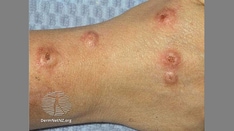
| Media file 1: Prurigo nodularis. Courtesy of Jeffrey Meffert, MD. | |
![]() | View Full Size Image | Media type: Photo |
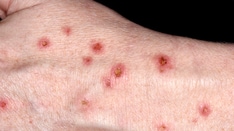
| Media file 2: Prurigo nodularis. Courtesy of Jeffrey Meffert, MD. | |
![]() | View Full Size Image | Media type: Photo |
Article Last Updated: May 2, 2006