You are in: eMedicine Specialties >
Dermatology > MALIGNANT NEOPLASMS
Arsenical Keratosis
Article Last Updated: Mar 24, 2008
AUTHOR AND EDITOR INFORMATION
Section 1 of 11
Author: Chih-Shan Jason Chen, MD, PhD, Assistant Professor, Department of Dermatology, State University of New York at Stony Brook; Director, Dermatologic Surgery and Mohs Micrographic Surgery Unit, MSK Skin Cancer Center, Memorial Sloan-Kettering Cancer Center; Chief, Dermatologic Surgery, Northport Veterans Affairs Medical Center
Chih-Shan Jason Chen is a member of the following medical societies: American Academy of Dermatology, American College of Mohs Micrographic Surgery and Cutaneous Oncology, American College of Mohs Micrographic Surgery and Cutaneous Oncology, American Society for Dermatologic Surgery, and Society for Investigative Dermatology
Coauthor(s):
Daniel Mark Siegel, MD, MS, Director, Procedural Dermatology Fellowship Program, Clinical Professor of Dermatology, Department of Dermatology, State University of New York Downstate
Editors: Daniel J Hogan, MD, Director of Bay Pines Dermatology Residency Program, Bay Pines Veterans Affairs Healthcare System; Richard P Vinson, MD, Assistant Clinical Professor, Department of Dermatology, Texas Tech University School of Medicine; Consulting Staff, Mountain View Dermatology, PA; Lester F Libow, MD, Dermatopathologist, South Texas Dermatopathology Laboratory; Catherine Quirk, MD, Clinical Assistant Professor, Department of Dermatology, Brown University; Dirk M Elston, MD, Director, Department of Dermatology, Geisinger Medical Center
Author and Editor Disclosure
Synonyms and related keywords:
long-term arsenic exposure, chronic arsenic exposure, arsenic-induced skin cancers
Background
Arsenic is a natural element found in many types of rocks. Inorganic arsenicals are known to be chemical carcinogens. Arsenical compounds are used in industrial, agricultural, and medicinal substances. Arsenic is also found to be an environmental contaminant in drinking water (well water) and an occupational hazard for miners and glass workers. Hutchinson reported skin cancer in patients who had taken arsenical medications as early as 1888. Numerous reports have since confirmed that ingested arsenic can cause Bowen disease (squamous cell carcinoma in situ); invasive squamous cell carcinoma; basal cell carcinoma of the skin; and (less frequently) internal cancers of the lung, the kidney, the bladder, and the liver. Arsenic also causes pigment changes and (very frequently) hyperkeratotic lesions of the skin called arsenical keratoses. Arsenical keratoses are the most characteristic skin feature of long-term arsenic exposure.
Other eMedicine articles on arsenic include Arsenic, Toxicity, Arsenic (critical care focus), and Toxicity, Arsenic (emergency medicine focus).
Pathophysiology
The carcinogenic mechanism of arsenic is not well understood. Arsenic compounds have shown no mutagenicity in standard bacterial and mammalian test systems; however, they can increase the mutagenicity of other DNA-damaging agents. Arsenite impairs nucleotide excision repair,1 and it may also affect gene expression by increasing or decreasing DNA methylation. The high affinity of arsenic for sulfhydryl groups makes keratin-rich cells (eg, epidermal keratinocytes) a sensitive target for arsenic-induced toxicity. Arsenic has been shown to alter epidermal keratinocyte differentiation processes,2 induce overexpression of growth factors,3 and enhance proliferation of human keratinocytes. These in vitro findings may have revealed part of the pathogenesis of arsenical keratoses. The oncogenesis of arsenic-induced cancers still awaits elucidation.
Frequency
United States
Arsenical keratosis and arsenic-induced skin cancers are very rare in the United States. Only isolated incidences of cutaneous toxicity from environmental or medicinal exposure have been reported. Several epidemiologic studies of communities exposed to drinking water with higher arsenic levels have not shown any excess incidence of skin cancers.
International
Arsenic-induced skin lesions have been noticed in some endemic regions, mainly due to long-term exposure to high levels of arsenic in drinking water. Such regions have been reported in Taiwan, Mexico, South America, India, and Bangladesh. According to a large epidemiologic study conducted by Yeh et al4 and Tseng et al5 in 1968 in Taiwan, among a high-risk population of 40,421 people, arsenic-induced hyperpigmentation was recognized in 18.4% of patients, arsenical keratosis in 7.1%, and skin cancers in 1.5%. Of the 428 people with skin cancer, 72% also presented with arsenical keratosis and 90% had hyperpigmentation. A study conducted by Fierz6 in Germany of 262 patients who had been taking Fowler solution for 6-26 years revealed that 40% of these patients developed arsenical keratosis and that 8% had skin cancers. In a large-scale study in an endemic region, 18,000 persons in Bangladesh and 86,000 persons in West Bengal were clinically examined. Of them, 3695 (20.6%, including 6.11% children) in Bangladesh and 8500 (9.8%, including 1.7% children) in West Bengal had arsenical dermatological features.7
Mortality/Morbidity
Arsenical keratoses may persist indefinitely, and some may develop into invasive squamous cell carcinoma. Metastatic arsenic squamous cell carcinoma and arsenic-induced visceral malignancies may result in mortality.
Race
Several large studies were focused in the regional endemic area. No global epidemiologic study exists, and no direct comparison has been found among races.
Sex
In a study8 in Bangladesh, 430 out of 1481 research subjects older than age 30 years from villages with arsenic-contaminated wells were found to have arsenic-induced skin lesions, such as keratosis and hyperpigmentation or hypopigmentation. The prevalence rate is approximately 30%, with a slightly higher prevalence in males than in females.
Age
Immediately consider possible arsenic exposure if skin cancer is found in a relatively young person. The presence of arsenic skin toxicity can be seen in all age groups, though a latency period does occur.
- Symptoms of chronic arsenic toxicity developed insidiously after 6 months to 2 years or more of exposure. In the study by Fierz,6 the minimal latency period from exposure to development of arsenical keratoses was 2.5 years, and the average latency period for skin cancer was 14 years.
- A Japanese study reported the appearance of Bowen disease in 10 years, squamous cell carcinoma in 20 years, and lung cancer after 30 years of apparent arsenic exposure.9
- In Taiwanese studies, the youngest patients reported to have skin hyperpigmentation, arsenical keratoses, and skin cancer were aged 3, 4, and 24 years, respectively.
History
- Arsenical keratoses, skin hyperpigmentation, and several types of skin cancers including basal cell carcinoma, squamous cell carcinoma, and Merkel cell carcinoma are characteristic skin lesions of long-term arsenic exposure.
- A long latency period (years to decades) occurs before the development of these cutaneous lesions.
- Chronic arsenicism is usually asymptomatic, and the skin lesions are usually the first sign to present clinically.
Physical
- Arsenical keratoses are usually multiple and typically occur at sites of friction and trauma, especially on the palms and the soles. These lesions are most frequently seen on the thenar and lateral borders of the palms, the base and lateral aspect of the digits, the soles, heels, and toes of the feet.
- Keratoses may also develop on the dorsum of the hands, the arms, and the legs.
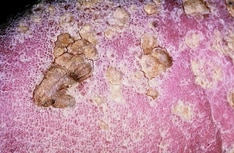
- Keratoses usually present as small, punctate, nontender, horny, hard, yellowish, often symmetric, cornlike papules.
- The diameter of the papule ranges from 0.2-1 cm.
- Lesions may coalesce to form large verrucous plaques.
- Another type of arsenical keratosis that presents as scaly erythematous or pigmented patches on unexposed body areas is seen in most patients with arsenical cancers.
- Mees lines on the fingernails are seen in acute and chronic arsenicalism.
Causes
A dose-response relationship exists between the amount of arsenic exposure and the frequency of various skin lesions. Three main categories of sources from which patients might have been exposed to arsenic include medicinal, drinking water (environmental), and occupational hazards. - Medicinal arsenic
- Inorganic arsenic has been used in medicine for at least 2,500 years, particularly since the 18th century, when it was used to treat a great variety of illnesses (eg, acne, diarrhea, gastric ulcer, asthma, malaria, lupus, psoriasis, neurodermatitis, eczema, rheumatism).
- During the 19th and early 20th centuries, the most popular preparation in the Western world was called Fowler solution, which contained 1% potassium arsenite.
- In Asia, Chinese proprietary herbal medicine has been the mainstay of remedies for thousands of years and is still popular in that area; it is also available in the United States. Some of these traditional Chinese medicines have been reported to contain high levels of arsenic.10, 11
- Drinking water
- Studies from endemic areas have found that arsenic-contaminated water (mainly well water) is the source of exposure.
- Cases of arsenic-induced toxicity have been reported in some endemic areas of Chile, Taiwan, India,12 Bangladesh, and Mexico.
- An area on the southwest coast of Taiwan has been referred to as the endemic area of Blackfoot disease (a chronic peripheral vascular disease that may progress into gangrenous changes of the lower extremities). The same area also showed a high prevalence of skin cancer. Both conditions were dose related to high arsenic levels in artesian well water that local residents consumed daily.
- In a Taiwanese study, Morales et al13 reported the lifetime risk of death is 1 in 100 from consuming 50 mcg/L of arsenic in drinking water.
- Occupational hazards
- Legge reported skin manifestations and lung cancer in sheep dip workers exposed to arsenic as early as 1902.
- Other reports showed arsenic carcinogenesis in smelter workers, pesticide workers, glass manufacturers, and miners.
- Burning plywood may cause arsenic-containing fumes to be inhaled.
- High-tech industries use gallium arsenide to produce semiconductor computer chips.
Clavus
Keratosis Palmaris et Plantaris
Other Problems to be Considered
Callus
Lab Studies
- Chemical analysis of arsenic levels in tissue, hair, or nail is possible, but levels may be normal if exposure is not recent.
- CBC count may reveal anemia, leukopenia, and thrombocytopenia. Red blood cells may show cloverleaf nuclei when systemic symptoms are present.
Imaging Studies
- Imaging studies are not recommended in a standard workup for arsenical keratoses unless internal malignancy or metastatic disease is suspected after taking a thorough history and completing a physical examination.
Other Tests
- Patients with chronic arsenicalism may present with changes on ECG. They may also present with polyneuropathy and changes evident on electromyelography.
Procedures
- A skin biopsy may help establish the diagnosis of arsenical keratosis and rule out the diagnosis of skin cancer.
Histologic Findings
Arsenical keratoses show thick, compact hyperkeratosis and parakeratosis similar to hypertrophic actinic keratoses. Some epidermal keratinocytes may show atypia histologically. The presence of numerous vacuolated keratinocytes and the absence of solar elastosis are suggestive of arsenical keratoses, but these findings are not absolute criteria.
Medical Care
- A chelating agent (eg, dimercaprol) may be helpful to correct acute arsenic exposure, but it has minimal or no effect for patients who had arsenic exposure a long time ago.
- Oral retinoids (eg, acitretin,14, 15 etretinate16) may be helpful in treating arsenic-induced cutaneous lesions and in reducing the risk of cutaneous and internal malignancy formation.
- Topical 5-fluorouracil cream or 5% imiquimod cream17 may be useful in treating arsenical keratoses and Bowen disease.
Surgical Care
Surgical removal or destruction (eg, excision, cryosurgery) is usually the treatment of choice.
Consultations
- Consult a dermatologist for a total body skin examination and screening for skin cancer.
- Consult an internist for a complete physical examination and a review of systems.
- Further workup is indicated if an internal malignancy is suspected.
The goal of pharmacotherapy is to reduce morbidity and to prevent complications.
Drug Category: Retinoids
These agents decrease the cohesiveness of abnormal hyperproliferative keratinocytes, and they may reduce the potential for malignant degeneration.
| Drug Name | Isotretinoin (Accutane) |
| Description | Oral agent that treats serious dermatologic conditions. Retinoic acid analog that is the synthetic 13-cis isomer of naturally occurring tretinoin (trans-retinoic acid). Both agents are structurally related to vitamin A. Decreases sebaceous gland size and sebum production. May inhibit sebaceous gland differentiation and abnormal keratinization. Dose and duration of treatment for arsenical keratosis have not been established. |
| Adult Dose | Acne: 0.5-2 mg/kg/d PO (usually 1 mg/kg/d) for 15-20 wk |
| Pediatric Dose | Not established |
| Contraindications | Documented hypersensitivity |
| Interactions | Toxicity may occur with vitamin A coadministration; absorption increases with milk; increases toxicity of methotrexate (avoid concomitant use); interferes with effects of microdosed progestin minipill |
| Pregnancy | X - Contraindicated; benefit does not outweigh risk
|
| Precautions | Do not use in severe obesity; women of childbearing age must be capable of complying with effective contraceptive measures; perform AST (SGOT), ALT (SGPT), and LDH tests prior to initiation of isotretinoin therapy at intervals of 1-2 wk until stable and thereafter at intervals as clinically indicated |
| Drug Name | Acitretin (Soriatane) |
| Description | Retinoic acid analog, like etretinate and isotretinoin. Etretinate is main metabolite and has demonstrated clinical effects close to those seen with etretinate. Mechanism of action is unknown. |
| Adult Dose | 25 or 50 mg/d PO initially given as single dose with main meal; 25-50 mg/d PO after initial response to treatment; terminate therapy when lesions have resolved sufficiently |
| Pediatric Dose | Not established |
| Contraindications | Documented hypersensitivity; pregnancy or intention to become pregnant within 3 y after discontinuation of therapy |
| Interactions | Increases toxicity of methotrexate (avoid concomitant use); interferes with effects of microdosed progestin minipill; coadministration with alcohol may enhance synthesis of etretinate, which has much longer half-life than acitretin (>120 d) |
| Pregnancy | X - Contraindicated; benefit does not outweigh risk
|
| Precautions | Do not use in severe obesity; women of childbearing age must be capable of complying with effective contraceptive measures; perform AST (SGOT), ALT (SGPT), and LDH tests prior to initiation of acitretin therapy at intervals of 1-2 wk until stable and thereafter at intervals as clinically indicated |
Drug Category: Antineoplastic agents
These agents inhibit cell growth and proliferation.
| Drug Name | Fluorouracil (Topical) |
| Description | Useful in treating arsenical keratoses and Bowen disease. Interferes with DNA synthesis by blocking the methylation of deoxyuridylic acid and inhibits thymidylate synthetase, which subsequently reduces cell proliferation. |
| Adult Dose | Apply bid sparingly to cover lesions; therapy may be required for 10-12 wk |
| Pediatric Dose | Apply as in adults |
| Contraindications | Documented hypersensitivity; potentially serious secondary infections due to induced skin inflammation; pregnancy |
| Interactions | None reported |
| Pregnancy | X - Contraindicated; benefit does not outweigh risk
|
| Precautions | Incidence of inflammatory reactions may occur with occlusive dressings; porous gauze dressing may be applied for cosmetic reasons without increase in reaction |
Drug Category: Immune response modifier
The mechanism of action of imiquimod cream in treating precancerous keratosis is unknown.
| Drug Name | Imiquimod (Aldara) |
| Description | Induces secretion of interferon alpha and other cytokines; mechanisms of action are unknown.
|
| Adult Dose | Apply overnight for 3-5 nights per wk; wash off in 6-10 h
|
| Pediatric Dose | Not established |
| Contraindications | Documented hypersensitivity |
| Interactions | None reported |
| Pregnancy | C - Fetal risk revealed in studies in animals but not established or not studied in humans; may use if benefits outweigh risk to fetus
|
| Precautions | Avoid exposure to sunlight or artificial tanning; regular use of sunscreen is encouraged; avoid contact with lips, eyes, or nostrils; common adverse effects include erythema, edema, vesicles, erosion or ulceration, weeping, exudate, flaking, scaling, dryness, and scabbing or crusting |
Further Outpatient Care
- Regular skin surveillance and physical examination are necessary for patients who present with cutaneous lesions of chronic arsenicalism because aggressive squamous cell carcinoma may evolve de novo or from existing arsenical keratoses or Bowen disease.
Deterrence/Prevention
- Educate patients on early detection and avoidance of arsenic exposure.
- Identify possible exposure sources in the environment (eg, arsenic-contaminated drinking water, plywood containing arsenic).
- Advise patients to avoid taking herbal medicine with uncertain arsenic content.
Complications
- Arsenical keratosis occasionally evolves into carcinoma after a number of years. Bowen disease is the most common form of skin cancer induced by arsenic exposure. Arsenical squamous cell carcinoma occurs less frequently than Bowen disease, but it appears to be more aggressive than sun-induced squamous cell carcinoma. Previous reports have shown a much higher incidence of fatal metastases among patients with arsenical squamous cell carcinoma.
- A variety of internal cancers due to arsenic ingestion have been reported. The presence of arsenic-induced cutaneous Bowen disease has been viewed as a cutaneous marker of possible internal malignancy, but this issue is still controversial.
Prognosis
- Arsenical keratosis is not a fatal disease, but it may persist indefinitely and can become bothersome later due to pain, bleeding, fissuring, and ulceration.
Patient Education
Medical/Legal Pitfalls
- Because of prolonged latency and remote history of arsenic exposure, arsenical keratosis may be misdiagnosed as verruca or other types of palmoplantar keratosis.
- An arsenical etiology should always be included in the list of differential diagnoses when a patient presents with keratotic lesions on the distal extremities or nonmelanotic skin cancers on the non–sun-exposed area of the body.
- Arsenic is still used in murder attempts, usually by family members. This needs to be considered, particularly in acute cases.
| Media file 1:
Arsenical keratosis on the sole of a carpenter. |
 | View Full Size Image | |
Media type: Photo
|
- Hartwig A, Groblinghoff UD, Beyersmann D, Natarajan AT, Filon R, Mullenders LH. Interaction of arsenic(III) with nucleotide excision repair in UV-irradiated human fibroblasts. Carcinogenesis. Feb 1997;18(2):399-405. [Medline].
- Kachinskas DJ, Phillips MA, Qin Q, Stokes JD, Rice RH. Arsenate perturbation of human keratinocyte differentiation. Cell Growth Differ. Nov 1994;5(11):1235-41. [Medline].
- Germolec DR, Yoshida T, Gaido K, Wilmer JL, Simeonova PP, Kayama F, et al. Arsenic induces overexpression of growth factors in human keratinocytes. Toxicol Appl Pharmacol. Nov 1996;141(1):308-18. [Medline].
- Yeh S, How SW, Lin CS. Arsenical cancer of skin. Histologic study with special reference to Bowen's disease. Cancer. Feb 1968;21(2):312-39. [Medline].
- Tseng WP, Chu HM, How SW, Fong JM, Lin CS, Yeh S. Prevalence of skin cancer in an endemic area of chronic arsenicism in Taiwan. J Natl Cancer Inst. Mar 1968;40(3):453-63. [Medline].
- Fierz U. [Follow-up studies of the side-effects of the treatment of skin diseases with inorganic arsenic]. Dermatologica. 1965;131(1):41-58. [Medline].
- Rahman MM, Chowdhury UK, Mukherjee SC, Mondal BK, Paul K, Lodh D, et al. Chronic arsenic toxicity in Bangladesh and West Bengal, India--a review and commentary. J Toxicol Clin Toxicol. 2001;39(7):683-700. [Medline].
- Tondel M, Rahman M, Magnuson A, Chowdhury IA, Faruquee MH, Ahmad SA. The relationship of arsenic levels in drinking water and the prevalence rate of skin lesions in Bangladesh. Environ Health Perspect. Sep 1999;107(9):727-9. [Medline].
- Miki Y, Kawatsu T, Matsuda K, Machino H, Kubo K. Cutaneous and pulmonary cancers associated with Bowen's disease. J Am Acad Dermatol. Jan 1982;6(1):26-31. [Medline].
- Tay CH. Cutaneous manifestations of arsenic poisoning due to certain Chinese herbal medicine. Australas J Dermatol. Dec 1974;15(3):121-31. [Medline].
- Tay CH, Seah CS. Arsenic poisoning from anti-asthmatic herbal preparations. Med J Aust. Sep 13 1975;2(11):424-8. [Medline].
- Guha Mazumder DN. Chronic arsenic toxicity: clinical features, epidemiology, and treatment: experience in West Bengal. J Environ Sci Health A Tox Hazard Subst Environ Eng. Jan 2003;38(1):141-63. [Medline].
- Morales KH, Ryan L, Kuo TL, Wu MM, Chen CJ. Risk of internal cancers from arsenic in drinking water. Environ Health Perspect. Jul 2000;108(7):655-61. [Medline].
- Son SB, Song HJ, Son SW. Successful treatment of palmoplantar arsenical keratosis with a combination of keratolytics and low-dose acitretin. Clin Exp Dermatol. Mar 2008;33(2):202-4. [Medline].
- Yerebakan O, Ermis O, Yilmaz E, Basaran E. Treatment of arsenical keratosis and Bowen's disease with acitretin. Int J Dermatol. Feb 2002;41(2):84-7. [Medline].
- Sharma SC, Simpson NB. Treatment of arsenical keratosis with etretinate. Acta Derm Venereol. 1983;63(5):449-52. [Medline].
- Boonchai W. Treatment of precancerous and cancerous lesions of chronic arsenicism with 5% imiquimod cream. Arch Dermatol. Apr 2006;142(4):531-2. [Medline].
- Centeno JA, Mullick FG, Martinez L, Page NP, Gibb H, Longfellow D, et al. Pathology related to chronic arsenic exposure. Environ Health Perspect. Oct 2002;110 Suppl 5:883-6. [Medline].
- Chi YW, Chen SL, Yang MH, et al. [Heavy metals in traditional Chinese medicine: ba-pao-neu-hwang-san]. Zhonghua Min Guo Xiao Er Ke Yi Xue Hui Za Zhi. May-Jun 1993;34(3):181-90. [Medline].
- Hsueh YM, Cheng GS, Wu MM, Yu HS, Kuo TL, Chen CJ. Multiple risk factors associated with arsenic-induced skin cancer: effects of chronic liver disease and malnutritional status. Br J Cancer. Jan 1995;71(1):109-14. [Medline].
- Jackson R, Grainge JW. Arsenic and cancer. Can Med Assoc J. Sep 6 1975;113(5):396-401. [Medline].
- Jha AN, Noditi M, Nilsson R, Natarajan AT. Genotoxic effects of sodium arsenite on human cells. Mutat Res. Dec 16 1992;284(2):215-21. [Medline].
- Lee CH, Chen JS, Sun YL, Liao WT, Zheng YW, Chai CZ, et al. Defective beta1-integrins expression in arsenical keratosis and arsenic-treated cultured human keratinocytes. J Cutan Pathol. Feb 2006;33(2):129-38. [Medline].
- Lien HC, Tsai TF, Lee YY, Hsiao CH. Merkel cell carcinoma and chronic arsenicism. J Am Acad Dermatol. Oct 1999;41(4):641-3. [Medline].
- Mass MJ, Wang L. Arsenic alters cytosine methylation patterns of the promoter of the tumor suppressor gene p53 in human lung cells: a model for a mechanism ofcarcinogenesis. Mutat Res. Jun 1997;386(3):263-77. [Medline].
- Merck Pharmaceuticals. Merck's Manual of the Materia Medica. ed. Whitehouse Station, NJ: 1899.
- Molin L, Wester PO. The estimated daily loss of trace elements from normal skin by desquamation. Scand J Clin Lab Invest. Nov 1976;36(7):679-82. [Medline].
- Rossman TG, Stone D, Molina M, Troll W. Absence of arsenite mutagenicity in E coli and Chinese hamster cells. Environ Mutagen. 1980;2(3):371-9. [Medline].
- Rubenstein DJ, Schwartz RA, Hansen RC, Payne CM. Punctate hyperkeratosis of the palms and soles. An ultrastructural study. J Am Acad Dermatol. Jul 1980;3(1):43-9. [Medline].
- Saha KC. Diagnosis of arsenicosis. J Environ Sci Health A Tox Hazard Subst Environ Eng. Jan 2003;38(1):255-72. [Medline].
- Shannon RL, Strayer DS. Arsenic-induced skin toxicity. Hum Toxicol. Mar 1989;8(2):99-104. [Medline].
- Tapio S, Grosche B. Arsenic in the aetiology of cancer. Mutat Res. Jun 2006;612(3):215-46. [Medline].
- Tollestrup K, Frost FJ, Cristiani M, McMillan GP, Calderon RL, Padilla RS. Arsenic-induced skin conditions identified in southwest dermatology practices: an epidemiologic tool?. Environ Geochem Health. Feb 2005;27(1):47-53. [Medline].
- WashingtonDeceit. Dermatopathology of arsenical keratosis. YouTube. Available at www.youtube.com/watch?v=xBreXMMHmLU. Accessed February 26, 2008.
- Wong SS, Tan KC, Goh CL. Cutaneous manifestations of chronic arsenicism: review of seventeen cases. J Am Acad Dermatol. Feb 1998;38(2 Pt 1):179-85. [Medline].
- Yeh S. Skin cancer in chronic arsenicism. Hum Pathol. Dec 1973;4(4):469-85. [Medline].
- Yu HS, Liao WT, Chai CY. Arsenic carcinogenesis in the skin. J Biomed Sci. Sep 2006;13(5):657-66. [Medline].
- Zhao CQ, Young MR, Diwan BA, Coogan TP, Waalkes MP. Association of arsenic-induced malignant transformation with DNA hypomethylation and aberrant gene expression. Proc Natl Acad Sci U S A. Sep 30 1997;94(20):10907-12. [Medline].
Arsenical Keratosis excerpt Article Last Updated: Mar 24, 2008
|