Continually Updated Clinical Reference
 
 
  All Sources     eMedicine     Medscape     Drug Reference     MEDLINE
 
eMedicine - Striae Distensae : Article by

Quick Find
Authors & Editors
Introduction
Clinical
Differentials
Workup
Treatment
Medication
Follow-up
Multimedia
References


Patient Education
Click here for patient education.


Author: Samer Alaiti, MD, Clinical Assistant Professor, Departments of Dermatology and Internal Medicine, University of California at Los Angeles School of Medicine

Samer Alaiti is a member of the following medical societies: American Academy of Cosmetic Surgery, American Academy of Dermatology, American College of Phlebology, American College of Physicians-American Society of Internal Medicine, American Society for Dermatologic Surgery, American Society for Laser Medicine and Surgery, and American Society of Lipo-Suction Surgery

Coauthor(s): Zein E Obagi, MD, Medical Director, Obagi Dermatology, Plastic Surgery and Laser Center

Editors: Barbara Reed, MD, Clinical Associate Professor, Department of Dermatology, Dermatology Service, Denver Veterans Administration Hospital, University of Colorado Health Sciences Center; Consulting Staff, Denver Skin Clinic; Richard P Vinson, MD, Assistant Clinical Professor, Department of Dermatology, Texas Tech University School of Medicine; Consulting Staff, Mountain View Dermatology, PA; Lester F Libow, MD, Dermatopathologist, South Texas Dermatopathology Laboratory; Catherine Quirk, MD, Clinical Assistant Professor, Department of Dermatology, Brown University; William D James, MD, Paul R Gross Professor of Dermatology, University of Pennsylvania School of Medicine; Vice-Chair, Program Director, Department of Dermatology, University of Pennsylvania Health System

Author and Editor Disclosure

Synonyms and related keywords: striae atrophicans, striae rubra, striae alba, stretch marks, striae cutis distensae

Background

Striae distensae, a common skin condition, do not cause any significant medical problem; however, striae can be of significant distress to those affected. They represent linear dermal scars accompanied by epidermal atrophy.

Pathophysiology

Striae distensae affect skin that is subjected to continuous and progressive stretching; increased stress is placed on the connective tissue due to increased size of the various parts of the body. It occurs on the abdomen and the breasts of pregnant women, on the shoulders of body builders, in adolescents undergoing their growth spurt, and in individuals who are overweight.

Skin distension apparently leads to excessive mast cell degranulation with subsequent damage of collagen and elastin. Prolonged use of oral or topical corticosteroids or Cushing syndrome (increased adrenal cortical activity) leads to the development of striae. Genetic factors could certainly play a role, although this is not fully understood.

Frequency

United States

Approximately 90% of pregnant women, 70% of adolescent females, and 40% of adolescent males (many of whom participate in sports) have stretch marks.

International

International figures may reasonably mirror the numbers in the United States.

Mortality/Morbidity

Striae distensae are usually a cosmetic problem; however, if extensive, they may tear and ulcerate when an accident or excessive stretching occurs.

Race

Stretch marks affect persons of all races.

Sex

Striae affect women more commonly than men.

Age

Stretch marks affect adolescents, pregnant women, and patients with excessive adrenal cortical activity.


Physical

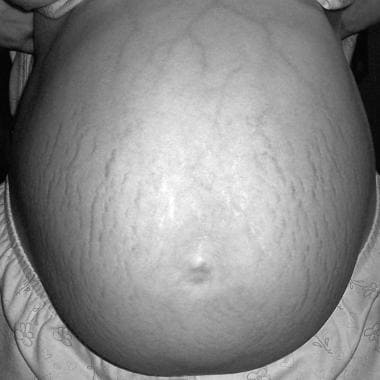
Early striae present as flattened, thinned skin with a pink hue that may occasionally be pruritic. Gradually, they enlarge in length and width and become reddish purple in appearance (striae rubra). The surface of striae may be finely wrinkled. Mature striae are white, depressed, irregularly shaped bands, with their long axis parallel to the lines of skin tension. They are generally several centimeters long and 1-10 mm wide. Gradually, some striae may fade and become inconspicuous. The natural evolution of stretch marks is similar to that of scar formation or a healing wound.

  • In pregnancy, striae usually affect the abdomen and the breasts.
  • The most common sites for striae on adolescents are the outer aspects of the thighs and the lumbosacral region in boys and the thighs, the buttocks, and the breasts in girls. Considerable variation occurs, and other sites, including the outer aspects of the upper arms, are occasionally affected.
  • Striae induced by prolonged systemic steroid use are usually larger and wider than other phenotypes of striae, and they involve widespread areas, occasionally including the face.
  • Striae secondary to topical steroid use are usually related to enhanced potency of the steroids when using occlusive plastic wraps. They usually affect the flexures and may become less visible if the offending treatment is withheld early enough.

Causes

  • The factors that lead to the development of striae are poorly understood. No general consensus exists as to what causes striae. One suggestion is that they develop as a result of stress rupture of the connective tissue framework. It has also been suggested that they develop more easily in skin that has a high proportion of rigid cross-linked collagen, as occurs in early adult life. This is evident in striae due to pregnancy, lactation, weight lifting, and other stressful activities. Increased adrenal cortical activity has been implicated in the formation of striae, as in the case of Cushing syndrome. Additionally, the cellular and extracellular matrix alterations that mediate the clinical phenotype of stretch marks remain poorly understood.


Other Problems to be Considered

Although the diagnosis of striae is usually straightforward, the rare possibility of Cushing syndrome must be entertained. In the latter, striae are characterized by their inordinate breadth, depth, and intense color.

In linear focal elastosis (elastotic striae), asymptomatic, yellow linear bands arrange themselves horizontally over the lower back. These lesions may resemble striae distensae, but they are palpable rather than depressed and yellow rather than purplish or white.


Histologic Findings

In the early stages, inflammatory changes may predominate; edema is present in the dermis along with perivascular lymphocyte cuffing.

In the later stages, the epidermis becomes thin and flattened with loss of the rete ridges. The dermis has thin, densely packed collagen bundles arranged in a parallel array horizontal to the epidermis at the level of the papillary dermis. Elastic stains show breakage and retraction of the elastic fibers in the reticular dermis. The broken elastic fibers curl at the sides of the striae to form a distinctive pattern.

Scanning electron microscopy shows extensive tangles of fine, curled elastic fibers with a random arrangement. This arrangement is in contrast to normal skin, which has thick, elastic fibers with a regular distribution. When viewed by transmission electron microscopy, the ultrastructure of elastic and collagen fibers in striae is similar to that of healthy skin.


Medical Care

  • Adolescents with striae can expect some improvement in their striae with time.
  • Topical application of tretinoin can significantly improve the clinical appearance of early striae distensae.1

Surgical Care

Treatment with the 585-nm flashlamp pulsed dye laser at low energy densities was shown to improve the appearance of striae.2 Multiple treatments at 4- to 6-week intervals are usually required. At a lower fluence (2-4 J/cm2), the 585-nm flashlamp pulse dye laser (FLPDL) has been purported to increase the amount of collagen in the extracellular matrix. The 585-nm FLPDL has a moderate beneficial effect in reducing the degree of erythema in striae rubra but has no apparent benefit in striae alba. Because of the potential for adverse effects, FLPDL treatments should be performed with extreme caution or even not at all in darker-skinned patients (phototypes V and VI).3, 4, 5

A recent study from Korea evaluated the effectiveness of using 585-nm pulsed dye laser with radiofrequency (Thermage; Hayward, Calif) for striae distensae. Thirty-seven patients with abdominal striae distensae were treated with the Thermage and 585-nm pulsed dye laser in the first session at baseline. An additional 2 sessions of pulsed dye laser therapy were performed at weeks 4 and 8. Thermage was used at a fluence  of 53-97 J/cm2, and pulsed dye laser  therapy was used at a fluence of 3 J/cm2 with a 10-mm spot. Skin biopsy specimens were taken from 9 patients. In the subjective assessment, 89.2% of the patients showed "good" and "very good" overall improvement, and 59.4% were graded as "good" and "very good" in elasticity. All of the 9 specimens showed an increase in the amount of collagen fibers, and increased elastic fibers were found in 6 specimens. The authors reported that Thermage and pulsed dye laser appear to be an effective treatment for striae distensae.6

Intense pulsed light, a noncoherent, nonlaser, filtered flashlamp that emits a broadband visible light, has been reported to yield clinical and microscopical improvement in striae distensae. It seems to be a promising treatment modality with minimal adverse effects and little-to-no down time. Its efficacy in the treatment of photodamaged facial skin has been widely reported; it promotes the production of neocollagen and elastic fibers.7

Lasers and light sources emitting UV-B irradiation have been shown to repigment striae distensae (striae alba). The improvement is due to an increase in melanin pigment, hypertrophy of melanocytes, and an increase in the number of melanocytes.2

The authors have had good success using low concentrations (15-20%) of trichloroacetic acid and performing repetitive papillary dermis-level chemexfoliation. The peels can be repeated at monthly intervals, with improvement in skin texture, firmness, and color.8


Drugs of choice should have the ability to improve the skin texture and color, to remodel the collagen in the dermis, and to promote elastin synthesis.

Drug Category: Retinoids

Topical retinoids have been shown to be beneficial in remodeling hypertrophic scars and in improving the clinical appearance, including improvement of the surface texture, fine and coarse wrinkling, skin color, and laxity, of photoaged skin after 3-6 months of therapy.

Drug NameTretinoin (Avita, Retin-A)
DescriptionTrans-retinoic acid is a derivative of vitamin A (retinol), effectively used to treat acne vulgaris and other disorders of keratinization for the past 3 decades. Exhibits a certain degree of vitamin A growth-promoting activity; however, it is not stored in the body as retinol and its esters. Rather, it is metabolized rapidly and mostly excreted in bile. When administered topically, a minute amount passes through dermis but has not been detected systemically.
In epithelial cells, affects differentiation, neoplastic transformation, tumor promotion, collagen synthesis, wound healing, stimulation and modulation of immune response, inflammation, cell membranes, and many other processes.
0.05% strength has been shown to improve hypertrophic scars. Postulated that this is due to effect on fibroblasts (ie, decreased fibroblast proliferation and decreased fibroblast collagen synthesis). Effect on fibroblasts is mediated through specific binding receptor proteins. Topical application significantly improves clinical appearance of early, active stretch marks. Processes responsible for clinical improvement remain unknown.
Patients are instructed to gradually increase amount of tretinoin until mild erythema and exfoliation develops; may also apply a bland emollient if excessive irritation develops.
Adult DoseApply 0.05% or 0.1% cream on affected areas qd/bid
Pediatric DoseApply as in adults
ContraindicationsDocumented hypersensitivity
InteractionsConcomitant topical medication, medicated or abrasive soaps, and cleansers, soaps, and cosmetics have strong drying effects; caution with products high in alcohol, astringents, spices or lime, and preparations containing sulfur, resorcinol, or salicylic acid because tretinoin toxicity may increase
PregnancyC - Safety for use during pregnancy has not been established.
PrecautionsDiscontinue if reaction suggesting sensitivity or chemical irritation occurs; minimize exposure to sunlight, including sunlamps, during use, and advise patients with sunburn not to use product until fully recovered because of heightened susceptibility to sunlight; wearing protective clothing and applying sunscreen products over treated areas is recommended; weather extremes (eg, wind, cold) may irritate patients; degree of local irritation warrants either less frequent applications or treatment to be discontinued (temporarily or altogether)


Complications

  • Striae are usually of a cosmetic concern; however, if extensive, they may rupture in an accident.

Prognosis

  • Adolescents with striae can expect their striae to be less visible with time.
  • Treatment with tretinoin, flashlamp pulsed dye laser, and chemical peels significantly improves the clinical appearance of early, active stretch marks.


Media file 1:  Mature striae distensae on the abdomen following pregnancy (lesions present for 18 y).
Click to see larger pictureClick to see detailView Full Size Image
Media type:  Photo

Media file 2:  Significant improvement following 3 consecutive blue peels (20% trichloroacetic acid to the level of the papillary dermis) completed at 6-week intervals.
Click to see larger pictureClick to see detailView Full Size Image
Media type:  Photo

Media file 3:  Striae distensae on the thigh.
Click to see larger pictureClick to see detailView Full Size Image
Media type:  Photo

Media file 4:  Striae distensae after treatment with topical tretinoin 0.1% cream for 3 months and 2 treatments with the flashlamp pulsed dye laser.
Click to see larger pictureClick to see detailView Full Size Image
Media type:  Photo

Media file 5:  Mature striae distensae on the abdomen secondary to pregnancy (lesions present for 21 y).
Click to see larger pictureClick to see detailView Full Size Image
Media type:  Photo

Media file 6:  Significant improvement is achieved using tretinoin 0.1% daily for 8 weeks.
Click to see larger pictureClick to see detailView Full Size Image
Media type:  Photo


  1. Kang S, Kim KJ, Griffiths CE, Wong TY, Talwar HS, Fisher GJ, et al. Topical tretinoin (retinoic acid) improves early stretch marks. Arch Dermatol. May 1996;132(5):519-26. [Medline].
  2. Goldberg DJ, Marmur ES, Schmults C, et al. Histologic and ultrastructural analysis of ultraviolet B laser and light source treatment of leukoderma in striae distensae. Dermatolog Surg. 2005;31(4):385-7. [Medline].
  3. Jimenez GP, Flores F, Berman B, Gunja-Smith Z. Treatment of striae rubra with the 585-nm pulsed-dye laser. Dermatol Surg. 2003;29(4):362-5. [Medline].
  4. McDaniel DH, Ash K, Zukowski M. Treatment of stretch marks with the 585-nm flashlamp-pumped pulsed dye laser. Dermatol Surg. Apr 1996;22(4):332-7. [Medline].
  5. McDaniel DH. Laser therapy of stretch marks. Dermatol Clin. 2002;20:67-76. [Medline].
  6. Suh DH, Chang KY, Son HC, Ryu JH, Lee SJ, Song KY. Radiofrequency and 585-nm pulsed dye laser treatment of striae distensae: a report of 37 Asian patients. Dermatol Surg. Jan 2007;33(1):29-34. [Medline].
  7. Hernandez-Perez E, Colombo-Charrier E, Valencia-Ibiett E. Intense pulsed light in the treatment of striae distensae. Dermatol Surg. 2002;28(12):1124-30. [Medline].
  8. Obagi ZE, Obagi S, Alaiti S, Stevens MB. TCA-based blue peel: a standardized procedure with depth control. Dermatol Surg. Oct 1999;25(10):773-80. [Medline].
  9. Arnold HL, Odom RB, James WD. Abnormalities of dermal connective tissue. In: Odom RB, James WD, Berger TG, eds. Andrew's Diseases of the Skin Clinical Dermatology. 9th ed. Philadelphia, Pa: WB Saunders; 2000:645-6.
  10. Burton Jl, Lovell CR. Disorders of connective tissue. In: Champion RH, Wilkinson DS, Ebling FJG, et al, eds. Textbook of Dermatology. 6th ed. London, England: Blackwell Science; 1998:2008-9.
  11. Dover JS. Sports dermatology. In: Fitzpatrick TB, Eisen AZ, Wolff K, Freedberg IM, eds. Dermatology in General Medicine. 4th ed. New York, NY: McGraw-Hill; 1993:1618-19.
  12. Fox JL. Pulse dye laser eliminates stretch marks. Cosmetic Dermatology. 1997;10:51-2.
  13. Goldfarb MT, Ellis CN, Weiss JS, Voorhees JJ. Topical tretinoin therapy: its use in photoaged skin. J Am Acad Dermatol. Sep 1989;21(3 Pt 2):645-50. [Medline].
  14. Kligman A. Topical tretinoin: indications, safety, and effectiveness. Cutis. Jun 1987;39(6):486-8. [Medline].
  15. Medical Economics Staff. Physician's Desk Reference. 53rd ed. Montvale, NJ: Medical Economics Company; 1999:2177.

Striae Distensae excerpt

Article Last Updated: Jul 24, 2007