
Practice Essentials
Urticaria is not a single disease but a reaction pattern that represents cutaneous mast cell degranulation, with the condition being defined as chronic if lesions recur for longer than 6 weeks. Mast cell degranulation results in extravasation of plasma into the dermis, forming characteristic hives—edematous pruritic pink wheals of variable size and shape, with or without accompanying angioedema. In angioedema, the swelling is deeper than wheals and may affect mucosal surfaces. Erythema is often absent in angioedema, and typical sites of predilection include the eyelids, lips, and tongue.
In the majority of patients with chronic urticaria, no external cause or underlying disease process can be identified. Several theories regarding the pathogenesis of chronic urticaria exist but none has been conclusively established. It is a disease that can be frustrating to treat for both patients and caregivers, and it can have a detrimental effect on quality of life.
Signs and symptoms
Urticarial lesions are transient in nature, with individual wheals typically lasting for less than 24 hours. Pruritus is the most common associated symptom of chronic urticaria.
Lesions typically can be described as follows:
-
Primary lesions are edematous, erythematous papules or plaques with a pale center (wheal) and surrounding erythema (flare)
-
Lesions may be pale to red (depending on background skin color)
-
Lesions can be localized or generalized
-
Lesions may be round, oval, annular, arcuate, serpiginous, or generalized
-
Lesions resolve without postinflammatory pigmentary changes or scaling
See Clinical Presentation for more detail.
Diagnosis
The diagnosis of chronic urticaria is largely clinical and based on a thorough history and physical examination. A limited set of laboratory studies may be indicated for some patients in the diagnosis of chronic urticaria, and these include the following:
-
Complete blood cell (CBC) count with differential: The eosinophil count may be elevated in patients with parasitic infections, especially in developing countries, or in patients experiencing a drug reaction
-
Examination of the stool for ova and parasites: Should be considered in patients with gastrointestinal tract symptoms, an elevated eosinophil count, or a positive travel history
-
Erythrocyte sedimentation rate (ESR): May be elevated in persons with urticarial vasculitis
-
Antinuclear antibody (ANA) titers: Indicated when urticarial vasculitis is suspected
-
Hepatitis B and C titers: Hepatitis B and C may be associated with cryoglobulinemia, which is associated with some forms of cold-induced urticaria and urticarial vasculitis
-
Serum cryoglobulin and complement assays: Cryoglobulinemia is associated with some forms of cold-induced urticaria
-
Complement assays: C3 (associated with pulmonary involvement in a subset of patients with urticarial vasculitis), C4 (sometimes low in hereditary angioedema), and C1-esterase inhibitor (associated with hereditary angioedema) functional assays may be performed
-
Thyroid function testing and antithyroid microsomal and peroxidase antibody titers: Patients with urticaria unresponsive to antihistamines or steroids may have elevated titers [1] ; the plasma thyrotropin level (TSH) helps screen for thyroid dysfunction
-
Chronic Urticaria (CU) Index: A nonspecific measure of basophil histamine release, which, if positive, may indicate the presence of an autoantibody to the Fc receptor of immunoglobulin E (IgE)—that is, anti-FceR. These patients are likely to have an autoimmune basis for their disease
A skin biopsy is necessary in cases of suspected urticarial vasculitis or in cases of urticaria with atypical features on history and examination. It is also indicated for patients in whom individual urticarial lesions persist for more than 24 hours or are associated with petechiae or purpura, as well as for patients with systemic symptoms such as fever, arthralgia, or arthritis. A neutrophil-predominant pattern of urticaria on biopsy may represent a subtype that does not respond well to antihistamines.
See Workup for more detail.
Management
The following medications can be used in the treatment of chronic urticaria:
-
Nonsedating H1 second-generation antihistamines: The mainstay of pharmacotherapy for chronic urticaria; they decrease the intensity of hives and pruritus in patients with mild chronic urticaria
-
Colchicine and dapsone: May help patients who respond poorly to antihistamine therapy or who are known to have urticaria in which the inflammatory infiltrate is neutrophil-predominant
-
Systemic corticosteroids: Rarely, a short course may be prescribed for severe exacerbations of chronic urticaria, especially when accompanied by angioedema. Long-term use for treatment of patients with chronic urticaria should be avoided as much as possible because of the risk of adverse effects with systemic corticosteroids
-
Levothyroxine: May benefit some patients with chronic urticaria, antithyroid antibodies, or Hashimoto thyroiditis
-
Omalizumab: May benefit some patients with chronic urticaria despite H1 antihistamine treatment
See Treatment and Medication for more detail.

Background
Chronic urticaria, defined as urticaria that persists for longer than 6 weeks, is a frustrating condition for both patients and caregivers. Urticaria is not a single disease but a reaction pattern caused by or related to various factors, which trigger cutaneous mast cell degranulation and resulting extravasation of plasma into the dermis.
Urticaria is characterized by hives or wheals (see images below), which are edematous pruritic papules or plaques. The variety of potential triggers of chronic urticaria, and large number of cases without known cause, can make the approach to diagnosis and treatment a challenge. Patients with chronic urticarial may not improve or may depend on medication for years to relieve symptoms.
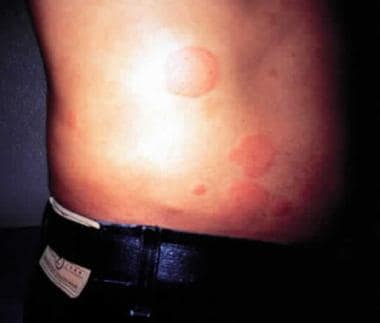
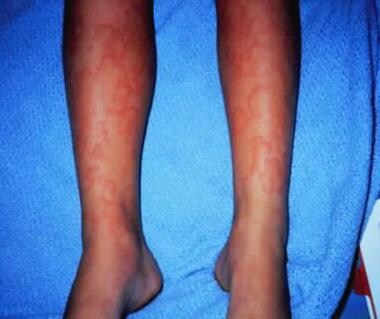
Chronic urticaria may be divided into three primary subgroups, as follows:
-
Physical urticaria/inducible urticaria (ie, symptomatic dermatographism, cholinergic urticaria, pressure urticaria)
-
Urticaria secondary to an underlying medical condition
-
Chronic idiopathic urticaria/chronic spontaneous urticaria
About 20% of patients with chronic urticaria have physical urticaria, in which the appearance of lesions is triggered by a consistent identifiable factor. Physical urticaria is reproducible with the appropriate stimuli, and it can be identified with a thorough history, physical examination, and challenge testing. Some examples of direct triggers include mechanical stimuli, temperature changes, sweating, stress, sun exposure, and water contact.
When a physical etiology has been excluded, the traditional approach has been to order a panel of laboratory tests to uncover an occult medical condition responsible for the skin findings. In many patients, an extensive workup does not uncover an etiology. In systematic review of 6462 patients with chronic urticaria, a causative internal medical condition was found in only 1.6% of patients [6] .Urticaria rarely is the sole manifestation of an underlying medical problem.
The largest subset of patients with chronic urticaria encompasses patients in whom no explanation for their urticaria is definitively established. Traditionally, these patients were said to have chronic idiopathic urticaria; however, findings suggest that about 20-45% of such patients may have an underlying autoimmune process driving their disease, and this specific cohort of patients is said to have chronic autoimmune urticaria. Chronic spontaneous urticaria is a newer label used to refer to all patients with either chronic idiopathic urticaria (55%) or chronic autoimmune urticaria (45%). [7]
An important entity in the differential diagnosis of chronic urticaria is urticarial vasculitis. A forme fruste of leukocytoclastic vasculitis, urticarial vasculitis may be associated with hypocomplementemia and systemic symptoms. If urticarial lesions persist for more than 24 hours, biopsy should be performed to rule out this entity histologically.
Pathophysiology
The mast cell is the primary agent in the pathogenesis of urticaria. Dermal mast cell stimulation results in the release of both preformed (histamine) and newly formed (prostaglandin) mediators, as well as cytokines (interleukin [IL]–1, tumor necrosis factor-α [TNF-α]) from cytoplasmic granules, which cause wheal formation, vasodilatation, and erythema. Mast cells also release chemoattractants for other cells (eg, neutrophils) involved in wheal formation. A complex interplay of varied proinflammarory cytokines, chemokines, and adhesion molecules that regulate vasoactivity and the dynamics of cellular infiltration ultimately evolves to form a lymphocyte- and granulocyte-mediated hypersensitivity reaction in the skin.
This response may be augmented by complement activation and production of C5a. Unlike pulmonary mast cells, cutaneous mast cells have C5a receptors. C5a not only brings about mast cell activation, but is also a neutrophil and eosinophil chemoattractant, leading to accumulation of these cells in lesional skin.
Further, on a molecular level, it has been shown that there is an increased cis-to-trans urocanic acid ratio in the epidermis of patients with chronic urticaria, which is postulated to enhance mast cell degranulation. [8]
The complex nature of the pathogenesis of urticaria beyond the release of histamine from dermal mast cells may explain why antihistamines alone are not always effective therapy. The signals that activate mast cells in urticaria are ill-defined and varied. A number of triggers can result in degranulation of mast cells and initiation of the cascade that results in urticaria formation.
An autoimmune origin is one hypothesis for mast cell activation. IgE- and IgG-dependent mechanisms include autoantibodies encompassing either IgG autoantibodies to the alpha subunit of the Fc receptor of the IgE molecule (35-40% of patients with chronic urticaria)—that is, anti-FcεR—or, less commonly, anti-IgE autoantibodies (5-10% of patients with chronic urticaria), both of which can activate mast cells or basophils to release histamine. [9] A positive functional anti-FcεR test result does not indicate which autoantibody (anti-IgE, anti-FcεRI, or anti-FcεRII) is present, but it does support an autoimmune basis. Affected patients may be categorized as having autoimmune chronic urticaria.
Mast cells may also be degranulated through an IgE- and IgG-independent mechanism in chronic urticaria. [10] Non–IgE-mediated mast cell degranulators include radiocontrast media, morphine, codeine, and vancomycin. Approximately one third of patients with chronic urticaria may develop angioedema after administration of aspirin or other nonsteroidal anti-inflammatory drugs (NSAIDs). [11]
About 85% of the histamine receptors in the skin are H1 receptors, with the remaining 15% being H2 receptors. The addition of an H2-receptor antagonist to an H1-receptor antagonist augments the inhibition of a histamine-induced wheal-and-flare reaction once histamine-receptor blockade has been maximized. The combination of H2-receptor antagonists with an H1-receptor antagonist provides small additional benefit. Doxepin blocks both receptor types and is a much more potent inhibitor of H1 receptors than diphenhydramine or hydroxyzine.
Etiology
A number of different etiologic factors have been reported as proposed causes of chronic urticaria.
Autoimmunity is thought to be one of the most frequent causes of chronic urticaria. Various autoimmune or endocrine diseases have been associated with urticaria, including systemic lupus erythematosus, cryoglobulinemia, juvenile rheumatoid arthritis, and autoimmune thyroid disease (eg, Graves disease). [12, 13]
Several cross-sectional studies have investigated whether patients with chronic urticaria are more prone to autoimmune disorders. Ryhal et al compared 25 patients with urticaria with 75 subjects being treated for other conditions and found that antibodies to thyroid peroxidase (also known as thyroid microsomal antibody) and rheumatoid factor were more common in patients with chronic urticaria (P < .01 and P< .05, respectively) compared with controls. [14] However, no difference was reported in the prevalence of other autoantibodies, such as anti-sDNA, anti-Ro/anti-La ribonucleic acid antibodies, anti-cardiolipin, anti–β2-glycoprotein 1, antimyeloperoxidase, anti–proteinase 3, anti–smooth muscle, and antinuclear antibodies, between the two groups. These data imply that broad nonspecific autoantibodies are not commonly found in patients with chronic urticaria.
There is a significant association of chronic urticaria with thyroid autoimmunity, and antithyroid autoantibodies are significantly increased in patients with chronic urticaria. The prevalence of thyroid autoimmunity among chronic urticaria patients varies from 4.3% to 57% in the literature, and about 5-10% of chronic urticaria patients have abnormal thyroid function. [15] In one study comparing 70 patients with chronic urticaria with 70 healthy controls, it was found that 23-30% of patients with chronic urticaria had either or both antithyroglobulin antibody (anti-Tg) and antimicrosomal antibody (antithyroid peroxidase [TPO]), and as many as 5-10% had abnormal thyroid function. [15] A case control study detected similar rates of thyroid antibodies in chronic urticaria patients, detecting anti-TG positivity in 22% and anti-TPO positivity in 27% of chronic urticaria patients; 93% of patients had normal thyroid function. [16]
Although thyroid autoantibodies are identified more frequently in patients with chronic urticaria compared with the general population, there is no clear evidence that management of chronic urticaria or the course of chronic urticaria differs in this subgroup, nor is there persuasive evidence that administration of thyroid hormone supplementation in such cases is associated with improved outcomes. Because the clinical relevance of these autoantibodies for evaluation and treatment of patients with chronic urticaria has not been established, routine testing for thyroid autoantibodies is not recommended. [9]
Urticaria may be caused or exacerbated by a number of drugs. Among the more common culprits are aspirin and other NSAIDs, opioids, angiotensin-converting enzyme (ACE) inhibitors, and alcohol.
Urticaria has been reported to be associated with a number of infections; however, these associations are not strong and may be spurious. Infectious agents reported to cause urticaria include hepatitis B and C viruses, Streptococcus and Mycoplasma species, Helicobacter pylori, [17, 18] Mycobacterium tuberculosis, and herpes simplex virus (HSV).
There is limited evidence that if H pylori colonization is present, eradication may result in an improvement in chronic urticaria symptoms and thus, screening for H pylori is not recommended. [19]
The nematode Anisakis simplex is often the cause of chronic urticaria in areas where the population frequently consumes raw or marinated fish. A report of adults seen at an allergy center in Bari, Italy, found that 106 (50%) of 213 patients with chronic urticaria had A simplex hypersensitivity; all of the hypersensitive patients regularly ate marinated fish. In comparison, only 16% of a control population without chronic urticaria had sensitization to A simplex. [20] Chronic urticaria disappeared in 82 (77%) of 106 patients who gave up raw fish for 6 months; the condition cleared up in only one (2%) of 42 patients who did not give up raw fish. Additionally, 88% who returned to eating raw fish after their condition disappeared had a relapse of chronic urticaria, compared with 14% of those who remained on the diet. [20]
Some patients report the onset of acute urticaria associated with the consumption of certain foods, such as shellfish, eggs, nuts, strawberries, or certain baked goods. However, food allergy is rarely the basis of chronic urticaria.
Contactants may give rise to contact urticaria syndrome, a term referring to the onset of urticaria within 30-60 minutes of contact with an inciting agent. The lesions may be localized or generalized. Precipitating agents include latex (especially in healthcare workers), plants, animals (eg, caterpillars, dander), medications, and food (eg, fish, garlic, onions, tomato).
Arthropod bites or stings are the most common cause of papular urticaria. Although patients who are bitten by mosquitoes are likely to be aware of the source of the problem, patients with scabies, bedbug bites, flea bites, or other similar problems may not be aware. Ask patients about exposure to animals, recent moves, hobbies, travel, or the presence of a similar skin condition in other members of the household.
Urticaria is a feature of some autoinflammatory diseases, such as Muckle-Wells syndrome (characterized by amyloidosis, nerve deafness, and urticaria) and Schnitzler syndrome [21] (characterized by fever, joint or bone pain, monoclonal gammopathy, and urticaria).
Little evidence exists to support the concern that chronic urticaria may be a cutaneous sign of occult internal malignancy. In a study of 1155 patients with chronic urticaria in Sweden, Sigurgeirsson found no association with cancer, although acquired angioedema associated with C1 inhibitor depletion may be associated with malignancy. [22] In a population-based cohort study in Taiwan, a slightly increased risk of cancer, especially hematologic malignant tumor, was observed among patients with chronic urticarial. [23] However, evidence is not sufficient to suggest any causality. Routine screening for malignancies in chronic urticaria is not suggested; it is only warranted if patient history dictates.
In approximately 20% of cases, physical factors can be identified as a consistent cause or trigger for chronic urticaria. The various types of physical urticaria are diagnosed by challenge testing. Several types exist, and it is not uncommon to find that a single patient has more than one type. The following are some of the types of physical urticaria, along with their triggers:
-
Dermatographism (dermographism) - Firm stroking
-
Delayed pressure urticaria - Pressure
-
Cold urticaria - Cold
-
Aquagenic urticaria - Water exposure
-
Cholinergic urticaria - Heat, exercise, or stress
-
Solar urticaria - Sun exposure (visible light and/or UV)
-
Vibratory urticaria - Vibration
Neurologic factors may play a causative role. An Italian study reported an association between chronic urticaria and fibromyalgia, and the authors suggested that chronic urticaria may be a consequence of fibromyalgia-neurogenic skin inflammation. [24]
Emotional and psychological factors are reported to play a role in a number of patients. Some reports cite improvement of symptoms with hypnotism; however, the role of emotional factors remains controversial.
Hereditary angioedema is characterized by recurrent attacks of angioedema (without urticaria) involving the skin, gastrointestinal (GI) tract, respiratory tract, and mucous membranes in a patient with a positive family history. The disorder is autosomal dominant, and it is caused by a functional deficiency of the C1 inhibitor protein.
Epidemiology
In the general population, the prevalence of chronic urticaria is estimated to be around 0.5-5%. Chronic urticaria is more frequently seen in females. [9]
Patients with chronic urticaria have a strong association with HLA-DR4 and the associated allele HLA-DQ8 compared with a control population. [25]
Prognosis
The primary manifestations of urticaria are rash and pruritus. The course of the disease is unpredictable, and it may last months to years. About 50% of patients experience remission within 1 year. [26] Only rarely does permanent hyperpigmentation or hypopigmentation occur. The only long-term consequences of chronic urticaria are anxiety and depression.
The prognosis in chronic urticaria depends on the comorbid disease causing the urticaria and the patient’s response to therapy. Several diseases associated with chronic urticaria can be associated with significant morbidity and mortality (eg, malignancies, systemic lupus erythematosus). Chronic urticaria can affect the patient’s quality of life, owing to the associated pruritus and loss of sleep. It can lead to anxiety and depression, with rare reports of suicide.
-
Urticaria developed after bites from an imported fire ant.
-
Urticaria associated with a drug reaction.
