Continually Updated Clinical Reference
 
 
  All Sources     eMedicine     Medscape     Drug Reference     MEDLINE
 
eMedicine - Urticaria, Dermographism : Article by

Quick Find
Authors & Editors
Introduction
Clinical
Differentials
Workup
Treatment
Medication
Follow-up
Miscellaneous
Acknowledgments
References

Related Articles
Mastocytosis

Urticaria, Chronic


Patient Education
Allergy Center

Skin, Hair, and Nails Center

Hives and Angioedema Overview

Hives and Angioedema Causes

Hives and Angioedema Symptoms

Hives and Angioedema Treatment


Author: Simone Laube, MD, MRCP, Consulting Staff, Skin Centre, City Hospital, Birmingham, United Kingdom

Editors: Shyam Verma, MBBS, DVD, FAAD, Adjunct Clinical Assistant Professor, Department of Dermatology, University of Virginia, SUNY at Stonybrook, Penn State Univ; Richard P Vinson, MD, Assistant Clinical Professor, Department of Dermatology, Texas Tech University School of Medicine; Consulting Staff, Mountain View Dermatology, PA; Paul Krusinski, MD, Director of Dermatology, Professor, Department of Internal Medicine, Fletcher Allen Health Care, University of Vermont; Catherine Quirk, MD, Clinical Assistant Professor, Department of Dermatology, Brown University; William D James, MD, Paul R Gross Professor of Dermatology, University of Pennsylvania School of Medicine; Vice-Chair, Program Director, Department of Dermatology, University of Pennsylvania Health System

Author and Editor Disclosure

Synonyms and related keywords: dermatographism, urticaria, urticarial dermographism, factitious urticaria, allergy, allergic reaction, anaphylaxis, anaphylactoid reaction, angioedema, triple response of Lewis, linear wheal, whealing, red dermatographism, red urticaria, skin scratch reactions, hives, itching

Background

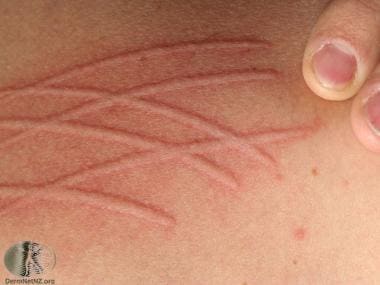
Dermographism is a normal physiological response of the skin. The term literally means writing on the skin. Firm stroking of the skin produces an initial red line (capillary dilatation), followed by an axon-reflex flare with broadening erythema (arteriolar dilatation) and the formation of a linear wheal (transudation of fluid/edema) termed the triple response of Lewis. An exaggerated response accompanied by itching to this constitutional whealing tendency is seen in approximately 2-5% of the population and is termed symptomatic dermographism. Dermographism is the most common form of physical urticaria.

For information on other the types of urticaria not discussed in this article, see the following articles:

Pathophysiology

The exact mechanism of dermographism remains uncertain. Trauma may release an antigen that interacts with the membrane-bound immunoglobulin E of mast cells, which release inflammatory mediators, particularly histamine, into the tissues. This causes small blood vessels to leak, allowing fluid to accumulate in the skin. Other mediators possibly involved are leukotrienes, heparin, bradykinin, kallikrein, and peptides such as substance P.

Frequency

International

Symptomatic dermographism is the most common of the physical urticarias, affects approximately 2-5% of the population, and can occur with other forms of urticaria. Increased incidence has been reported in pregnancy (especially in second half), at the onset of menopause, in atopic children, and in patients with Behçet disease.1

Mortality/Morbidity

Simple dermographism is the most common variant, and patients with this form are asymptomatic. However, other forms are associated with pruritus. Most people with dermographism are otherwise healthy. An association with thyroid disease has been described in some patients but remains controversial.

Race

No racial variance in prevalence is known.

Sex

Whether a sexual variance in prevalence occurs is unclear. None has been consistently reported, although one study on dermographism in children reported a female predominance.2

Age

Dermographism can appear in persons of any age but is more common in young adults. Peak incidence is in the second and third decades.


History

Whealing usually develops within 5 minutes of stroking the skin and persists for 15-30 minutes. A short refractory period after clearance of the wheal has been reported. Giant wheals can develop if deep extension of the swelling occurs.

  • Intermediate and delayed forms of dermographism are also described. These develop more slowly and can last several hours to days.
  • In patients with symptomatic dermographism, the skin eruption is associated with itching, which is often most severe at night.
  • Symptoms can be aggravated by heat (hot bath), minor pressure (scratching, friction from clothes or from rubbing with towels), exercise, stress, and emotion.

Physical

Itching and whealing can affect all body surfaces, but the scalp and genitalia are less frequently involved. However, dyspareunia and vulvodynia have been reported in patients with symptomatic dermographism.3 Rarer forms of dermographism include the following:

  • Red dermographism: Repeated rubbing induces small, punctate wheals that are more prominent on the trunk than on the limbs. This form is possibly associated with seborrheic dermatitis.
  • Follicular dermographism: Transitory, discrete, follicular, urticarial papules occur on a bright erythematous background.
  • Cholinergic dermographism: A large erythematous line studded with punctate wheals similar to cholinergic urticaria (wheals smaller than classic urticaria and surrounded by large areas of macular erythema). Purpura has been noted in severe cases. It can be associated with cholinergic urticaria.
  • Delayed dermographism: Approximately 3-8 hours after the immediate dermographic response, a deep, tender, burning wheal returns to the same site and persists for up to 48 hours. This form is recalcitrant to conventional therapy and is closely related to pressure urticaria.
  • Cold precipitated dermographism: One case report has been published.
  • Exercise-induced dermographism
  • Familial dermographism: One case report has been published. It is probably inherited as an autosomal dominant trait.4

Causes

Symptomatic dermographism is usually idiopathic. It may have an immunologic basis in some patients. Passive transfer of the dermographic response with immunoglobulin E– or immunoglobulin M–containing serum has been reported but no allergen has been identified.

  • Symptomatic dermographism may be triggered by drugs (eg, penicillin), an insect bite, Helicobacter pylori infection, or an infestation (eg, scabies, Fasciola hepatica).
  • Congenital symptomatic dermographism has been described as the first sign of systemic mastocytosis.5
  • Approximately 75% of patients with hypereosinophilic syndrome, which has multisystem involvement and high mortality, have dermographism.
  • One study reported that psychic factors and a history of stressful life events seem to play a triggering role in 30% of patients.6


Mastocytosis
Urticaria, Chronic

Other Problems to be Considered

Systemic mastocytosis and urticaria pigmentosa are associated with a positive Darier sign.

Forms of false dermographism (misnomers, not associated with urticaria) include (1) white dermographism, which is a blanching response resulting from capillary vasoconstriction following skin stroking and is more pronounced in persons with atopy; (2) black dermographism, which is black or greenish discoloration of the skin after contact with certain metallic objects; and (3) yellow dermographism, which probably results from bile pigment deposits in the skin.


Lab Studies

  • The results from hematological and biochemical screening tests are normal. Breathnach et al7 found a significant reduction in the level of circulating alpha-1 antitrypsin, a protease inhibitor. In some patients, an increase in blood histamine levels is seen after experimental scratching.

Procedures

  • The diagnosis is usually made by observing the clinical response after using moderate pressure to stroke or gently scratch the skin. The site is important because areas protected from regular pressure and environmental influences, such as the back, are more reactive than more exposed areas, such as the buttocks and limbs.
  • A dermographometer (spring-loaded stylus) can be used to apply graded, reproducible pressure (eg, 3600 g/cm2) and record skin responses. It is mostly limited to research settings.

Histologic Findings

Biopsy specimens show dermal edema with a few perivascular mononuclear cells.


Medical Care

Patients with simple dermographism are asymptomatic and require no therapy. Recognition of the problem, avoidance of precipitating physical stimuli, reduction of stress and anxiety are important factors in medical care. Also, scratching because of dry skin can be reduced with good skin care and emollients.

H1 antihistamines are the drugs of choice. In some patients, several antihistamines or a combination of two may be required. Sedating antihistamines such as hydroxyzine can be helpful. Regular treatment may need to be continued for several months.

The addition of H2-receptor antagonists appears to result in little symptomatic benefit, although some studies have shown a further small reduction in the whealing response.8

Physical urticarias are usually unresponsive to systemic corticosteroids. UV-B light therapy and oral psoralen plus UV-A light therapy have been tried; however, the improvement was short lived and was not associated with a reduction in whealing.


The goals of pharmacotherapy are to reduce morbidity and to prevent complications.

Drug Category: Antihistamines

Act by competitive inhibition of histamine at the H1 receptor, H2 receptor, or both. This mediates wheal and flare reactions, bronchial constriction, mucus secretion, smooth muscle contraction, edema, hypotension, CNS depression, and cardiac arrhythmias.

Drug NameCetirizine (Zyrtec, Zyrtec Chewable Tablets)
DescriptionForms complex with histamine for H1-receptor sites in blood vessels, GI tract, and respiratory tract.
Adult Dose10 mg PO qd
Pediatric Dose<2 years: Not recommended
2-6 years: 5 mg PO qd or 2.5 mg PO bid
>6 years: Administer as in adults
ContraindicationsDocumented hypersensitivity
InteractionsIncreases toxicity of CNS depressants
PregnancyB - Fetal risk not confirmed in studies in humans but has been shown in some studies in animals
PrecautionsSedation and antimuscarinic effects (low); caution in hepatic or renal dysfunction; doses >10 mg/d may cause drowsiness

Drug NameLoratadine (Claritin)
DescriptionSelectively inhibits peripheral histamine H1 receptors.
Adult Dose10 mg PO qd
Pediatric Dose<2 years: Not recommended
2-12 years and <30 kg: 5 mg PO qd
>30 kg: Administer as in adults
ContraindicationsDocumented hypersensitivity
InteractionsKetoconazole, erythromycin, procarbazine, and alcohol may increase levels
PregnancyB - Fetal risk not confirmed in studies in humans but has been shown in some studies in animals
PrecautionsInitiate therapy at lower dose in liver impairment

Drug NameDesloratadine (Clarinex)
DescriptionLong-acting tricyclic histamine antagonist selective for H1 receptor. Relieves nasal congestion and systemic effects of seasonal allergy. Major metabolite of loratadine, which, after ingestion, is metabolized extensively to active metabolite 3-hydroxydesloratadine.
Adult Dose5 mg PO qd
Pediatric Dose<12 years: Not established
>12 years: Administer as in adults
ContraindicationsDocumented hypersensitivity
InteractionsData are limited; erythromycin and ketoconazole increase desloratadine and 3-hydroxydesloratadine plasma concentrations, but no increase in clinically relevant adverse effects, including QTc, observed
PregnancyC - Fetal risk revealed in studies in animals but not established or not studied in humans; may use if benefits outweigh risk to fetus
PrecautionsDecrease dose in hepatic impairment; rarely causes pharyngitis or dry mouth

Drug NameAcrivastine (Semprex)
DescriptionCompetes with histamine for H1 receptors on GI tract, blood vessels, and respiratory tract, reducing hypersensitivity reactions.
Adult Dose8 mg PO tid
Pediatric DoseNot established
ContraindicationsDocumented hypersensitivity; within 14 d of initiating MAOI therapy; severe coronary disease; severe hypertension; elderly
InteractionsGuanethidine, methyldopa, reserpine, or beta-blockers may decrease effects; CNS depressants, alcohol, and sympathomimetics increase toxicity
PregnancyC - Fetal risk revealed in studies in animals but not established or not studied in humans; may use if benefits outweigh risk to fetus
PrecautionsSedation and antimuscarinic effects may occur; caution in high blood pressure, diabetes, ischemic heart disease, GI or GU obstruction, thyroid disease, prostatic hypertrophy, and increased intraocular pressure

Drug NameFexofenadine (Allegra)
DescriptionCompetes with histamine for H1 receptors on GI tract, blood vessels, and respiratory tract, reducing hypersensitivity reactions. Does not sedate.
Adult Dose60 mg PO bid
Pediatric Dose<12 years: Not recommended
>12 years: Administer as in adults
ContraindicationsDocumented hypersensitivity
InteractionsToxicity increases with coadministration of erythromycin and ketoconazole
PregnancyC - Fetal risk revealed in studies in animals but not established or not studied in humans; may use if benefits outweigh risk to fetus
PrecautionsNo data available on use while breastfeeding; may cause dizziness

Drug NameHydroxyzine (Atarax, Vistaril, Vistazine)
DescriptionSedative antihistamine that is also anxiolytic. Antagonizes H1 receptors in periphery. May suppress histamine activity in subcortical region of CNS.
Adult DosePruritus: 25 mg PO hs initially; increase prn to 25 mg PO tid/qid
Anxiety: 50-100 mg PO qid
Pediatric Dose<6 months: Not recommended
6 months to 6 years: 5-15 mg/d PO; increase to 50 mg/d PO divided tid/qid
>6 years: 15-25 mg/d PO; increase to 50-100 mg/d PO divided tid/qid
ContraindicationsDocumented hypersensitivity
InteractionsMay enhance response to alcohol, barbiturates, and other CNS depressants
PregnancyC - Fetal risk revealed in studies in animals but not established or not studied in humans; may use if benefits outweigh risk to fetus
PrecautionsAssociated with clinical exacerbations of porphyria (may not be safe for porphyria patients); ECG abnormalities (alterations in T waves) may occur; may cause drowsiness


Further Outpatient Care

  • Treat symptomatic dermographism until the problem is adequately controlled or resolved.

Prognosis

  • The natural history of symptomatic dermographism is unpredictable. In many patients, the condition gradually improves and clears after several years. Symptomatic dermographism appears to have the best prognosis of the chronic urticarias in terms of clearance after 5 (36%) and 10 (51%) years.9

Patient Education

  • Reassure patients about the benign nature of the disorder, and inform them of the possible prolonged course.
  • Explain the adverse effects of antihistamines.
  • For excellent patient education resources, visit eMedicine's Allergy Center and Skin, Hair, and Nails Center. Also, see eMedicine's patient education article Hives and Angioedema.


Medical/Legal Pitfalls

  • Dermographism can be distressing but is not life threatening. Warn patients undergoing treatment with antihistamines about drowsiness, especially when driving or handling machinery.


The authors and editors of eMedicine gratefully acknowledge the contributions of previous author, Elsbeth Young, MD, FRCP, to the development and writing of this article.


  1. Dinç A, Karaayvaz M, Caliskaner AZ, Pay S, Erdem H, Turan M. Dermographism and atopy in patients with Behçet's disease. J Investig Allergol Clin Immunol. Nov-Dec 2000;10(6):368-71. [Medline].
  2. Martorell A, Sanz J, Ortiz M, Julve N, Cerdá JC, Ferriols E. Prevalence of dermographism in children. J Investig Allergol Clin Immunol. May-Jun 2000;10(3):166-9. [Medline].
  3. Lambiris A, Greaves MW. Dyspareunia and vulvodynia: unrecognised manifestations of symptomatic dermographism. Lancet. Jan 4 1997;349(9044):28. [Medline].
  4. Jedele KB, Michels VV. Familial dermographism. Am J Med Genet. May 1 1991;39(2):201-3. [Medline].
  5. Grimm V, Mempel M, Ring J, Abeck D. Congenital symptomatic dermographism as the first symptom of mastocytosis. Br J Dermatol. Nov 2000;143(5):1109. [Medline].
  6. Taskapan O, Harmanyeri Y. Evaluation of patients with symptomatic dermographism. J Eur Acad Dermatol Venereol. Jan 2006;20(1):58-62. [Medline].
  7. Breathnach SM, Allen R, Ward AM, Greaves MW. Symptomatic dermographism: natural history, clinical features laboratory investigations and response to therapy. Clin Exp Dermatol. Sep 1983;8(5):463-76. [Medline].
  8. Sharpe GR, Shuster S. In dermographic urticaria H2 receptor antagonists have a small but therapeutically irrelevant additional effect compared with H1 antagonists alone. Br J Dermatol. Nov 1993;129(5):575-9. [Medline].
  9. van der Valk PG, Moret G, Kiemeney LA. The natural history of chronic urticaria and angioedema in patients visiting a tertiary referral centre. Br J Dermatol. Jan 2002;146(1):110-3. [Medline].
  10. Casale TB, Sampson HA, Hanifin J, Kaplan AP, Kulczycki A, Lawrence ID, et al. Guide to physical urticarias. J Allergy Clin Immunol. Nov 1988;82(5 Pt 1):758-63. [Medline].
  11. Champion RH. Urticaria: then and now. Br J Dermatol. Oct 1988;119(4):427-36. [Medline].
  12. Giam YC, Rajan VS. An approach to urticaria. Ann Acad Med Singapore. Jan 1983;12(1):74-80. [Medline].
  13. Jorizzo JL, Smith EB. The physical urticarias. An update and review. Arch Dermatol. Mar 1982;118(3):194-201. [Medline].
  14. Kirby JD, Matthews CN, James J, Duncan EH, Warin RP. The incidence and other aspects of factitious wealing (dermographism). Br J Dermatol. Oct 1971;85(4):331-5. [Medline].
  15. Kobza Black A. The physical urticarias. In: Champion RH, Greaves MW, Kobza Black A, Pye RJ, eds. The Urticarias. Edinburgh, Scotland: Churchill Livingstone; 1985:168-90.
  16. Kobza Black A, Champion RH. Urticaria. In: Champion RH, Burton JL, Burns DA, Breathnach SM, eds. Rook/Wilkinson/Ebling Textbook of Dermatology. Vol 3. 6th ed. London, England: Blackwell Science; 1998:2113-39.
  17. Nettis E, Pannofino A, D'Aprile C, Ferrannini A, Tursi A. Clinical and aetiological aspects in urticaria and angio-oedema. Br J Dermatol. Mar 2003;148(3):501-6. [Medline].
  18. Wong RC, Fairley JA, Ellis CN. Dermographism: a review. J Am Acad Dermatol. Oct 1984;11(4 Pt 1):643-52. [Medline].

Urticaria, Dermographism excerpt

Article Last Updated: Feb 27, 2007