Continually Updated Clinical Reference
 
 
  All Sources     eMedicine     Medscape     Drug Reference     MEDLINE
 
eMedicine - Urticaria, Pressure : Article by

Quick Find
Authors & Editors
Introduction
Clinical
Differentials
Workup
Treatment
Medication
Follow-up
Miscellaneous
References

Related Articles
Angioedema, Acquired

Angioedema, Hereditary

Urticaria, Acute

Urticaria, Chronic

Urticaria, Dermographism

Urticaria, Solar

Urticarial Vasculitis


Patient Education
Allergy Center

Skin, Hair, and Nails Center

Hives and Angioedema Overview

Hives and Angioedema Causes

Hives and Angioedema Symptoms

Hives and Angioedema Treatment


Author: Joslyn Sciacca-Kirby, MD, Staff Physician, Department of Dermatology, Hospital of the University of Pennsylvania

Joslyn Sciacca-Kirby is a member of the following medical societies: American Academy of Dermatology, American Medical Association, and Philadelphia County Medical Society

Coauthor(s): Ellen Kim, MD, Assistant Professor, Department of Dermatology, Hospital of the University of Pennsylvania School of Medicine; Robin M Levin, MD, Staff Physician, Assistant Professor, Department of Family Medicine, Division of Dermatology, Kennedy Hospital at Stratford; Warren R Heymann, MD, Head, Division of Dermatology, Professor, Department of Internal Medicine, University of Medicine and Dentistry of New Jersey

Editors: Daniel J Hogan, MD, Director of Bay Pines Dermatology Residency Program, Bay Pines Veterans Affairs Healthcare System; Michael J Wells, MD, Associate Professor, Department of Dermatology, Texas Tech University Health Sciences Center; Jeffrey Meffert, MD, Assistant Clinical Professor of Dermatology, University of Texas Health Science Center-San Antonio; Catherine Quirk, MD, Clinical Assistant Professor, Department of Dermatology, Brown University; Dirk M Elston, MD, Director, Department of Dermatology, Geisinger Medical Center

Author and Editor Disclosure

Synonyms and related keywords: vibratory urticaria, delayed pressure urticaria, dermatographism, PU, physical urticaria

Background

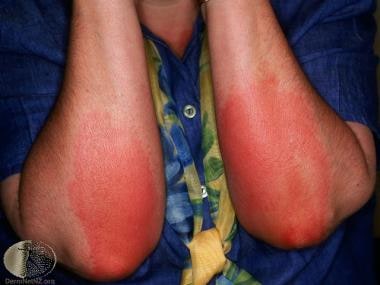
Pressure urticaria (PU) is an uncommon form of physical urticaria. It may occur immediately, within minutes, after a pressure stimulus. More commonly, wheals develop after a delay of 4-6 hours after a pressure stimulus. The lesions may last for 8-72 hours. The hands, the feet, the trunk, the buttocks, the legs, and the face are the most common areas affected. Lesions can be induced by a variety of stimuli, including standing, walking, wearing tight clothes, or sitting on a hard surface.

Pathophysiology

The pathogenesis of PU is unknown. No allergen can usually be found. Mast cells are believed to play a role because injection of a compound "48/80", which causes depletion of mast cell mediators, prevents the induction of lesions in the injected area. Histamine levels are increased in lesional skin, and intracellular histamine levels are decreased in peripheral white blood cells. Despite these findings and the finding of increased stimulated histamine release, histamine is not likely to be the sole mediator in PU, given the relative unresponsiveness of conditions to antihistamine treatment.

Other possible mediators include eosinophils, given the elevated numbers of eosinophils, eosinophil cationic protein (ECP), and interleukin 5 found on the biopsies of some patients with PU, particularly bullous PU. Interleukin 6 has also been found in elevated concentrations in lesional skin.

Frequency

United States

PU is considered a rare entity, but some investigators have suggested that PU may be more common but not consistently recognized.

Mortality/Morbidity

PU is a chronic disease, with a mean duration of 9 years (range, 1-40 y). Depending on the severity of the disease and the associated symptoms, PU can be disabling, especially in patients who perform manual labor.

Sex

PU is slightly more common in men than in women.

Age

The peak age of onset is in the 20s and 30s (range, 5-63 y).


History

  • Signs and symptoms of delayed PU, which is by far the more common presentation of the disease, initially appear 30 minutes to 6 hours after a pressure stimulus. Lesions peak at 6 hours and they remain for 8 hours to 3 days. The less common form, immediate PU, develops within minutes of the pressure stimulus and can be confused with dermatographism.
  • Lesions can occur on any cutaneous surface, and they may be associated with fever; malaise; fatigue; and, occasionally, chills, headache, and generalized arthralgias. The lesions may be pruritic, painful, or burning.
  • Affected areas can be refractory to the development of new lesions for 1-2 days.
  • In as many as 60% of individuals who are affected, PU coexists with chronic urticaria, immediate and/or delayed dermatographism, and/or angioedema.

Physical

  • The physical findings in PU include wheals, typically involving the palms, soles, legs, and waist. Lesions may also involve the genitals.
  • The wheals, which appear as deep dermal and subcutaneous swellings that may resemble angioedema, are induced by a pressure stimulus.

Causes

  • Pressure stimuli
    • Standing, walking, or sitting on a hard surface
    • Using tools, such as a screwdriver or a hammer
    • Hand clapping
    • Carrying a handbag
    • Wearing tight-fitting clothes, such as bra straps, belts, shoes, cuffs, or watches
    • Dental work
    • Kissing
    • Sexual intercourse
    • Tampon use
  • Occasionally aggravated by heat, aspirin, or menstruation


Angioedema, Acquired
Angioedema, Hereditary
Urticaria, Acute
Urticaria, Chronic
Urticaria, Dermographism
Urticaria, Solar
Urticarial Vasculitis

Other Problems to be Considered

Delayed dermatographism
Vibratory urticaria


Lab Studies

  • An elevated white blood cell count may be found with a CBC count.
  • The erythrocyte sedimentation rate may be elevated.
  • Thyroid microsomal antibodies may be present in cases associated with chronic urticaria.

Other Tests

  • Pressure challenge testing (dermographometer, suspended weight method) may be performed. Methods of applying measured amounts of pressure can be used to test for the development of PU. The time needed to develop a wheal after a pressure stimulus is indirectly related to the amount of pressure applied.

Histologic Findings

The histologic features of the lesions are variable, ranging from dermal mononuclear cell infiltrates alone to combinations of mononuclear cells, eosinophils, and neutrophils in a perivascular and interstitial pattern in the dermis and subcutaneous fat. Degranulated mast cells may be noted. Early lesions are characterized by eosinophils and neutrophils, whereas the late lesions typically demonstrate eosinophils and lymphocytes.

Several reports of bullous PU have been reported, and histology findings show spongiosis and intraepidermal bullae associated with an eosinophil-rich inflammatory infiltrate in the superficial and deep dermis.

No vessel-related changes (eg, leukocytoclasis, fibrinoid necrosis) are seen, such as in urticarial vasculitis.


Medical Care

  • Patients should avoid pressure stimuli, though this is not easily achieved or especially helpful in patients with moderate-to-severe disease.
  • Antihistamines are helpful in controlling associated chronic urticaria.
  • Systemic corticosteroids and/or nonsteroidal anti-inflammatory drugs (NSAIDs) produce variable responses.
  • Other possible therapies include colchicine, dapsone, sulfasalazine, and montelukast.
  • Cyclosporine and intravenous immunoglobulin have been used in a small number of patients with severe and refractory disease.

Consultations

Consult a dermatologist for evaluation for other causes of urticaria.

Activity

Restrictions in activity depend on the severity of the disease.


Results of treatment of PU are relatively disappointing. Antihistamines are helpful in controlling associated chronic urticaria but not the lesions of PU. Prednisone and NSAIDs produce variable responses. NSAIDs as a treatment may be suboptimal and they, along with aspirin, may worsen urticaria and angioedema. Prednisone has some clinical efficacy, but long-term therapy is problematic because of its many adverse effects. A recent study of a small group of patients showed efficacy of high-potency topical steroids for reducing edema, erythema, and pruritus associated with PU lesions.

Drug Category: Corticosteroids

These agents have been used with variable success for their anti-inflammatory properties.

Drug NamePrednisone (Deltasone, Sterapred)
DescriptionMay decrease inflammation by reversing increased capillary permeability and suppressing PMN activity. Stabilizes lysosomal membranes and also suppresses lymphocyte and antibody production.
Adult Dose0.5-2 mg/kg/d or 5-60 mg PO qd; taper as condition improves; single morning dose is safer for long-term use, but divided doses have more anti-inflammatory effect
Pediatric DoseAdminister as in adults
ContraindicationsDocumented hypersensitivity; viral, fungal, tubercular skin, or connective-tissue infections; peptic ulcer disease; hepatic dysfunction; GI disease; cataract, glaucoma, and coadministration with live vaccines
InteractionsCoadministration with estrogens may decrease clearance; when used with digoxin, digitalis toxicity secondary to hypokalemia may increase; phenobarbital, phenytoin, and rifampin may increase metabolism of glucocorticoids (consider increasing maintenance dose); monitor for hypokalemia with coadministration of diuretics; efficacy of oral hypoglycemics (eg, metformin, sulfonylureas) my decrease
PregnancyB - Usually safe but benefits must outweigh the risks.
PrecautionsAbrupt discontinuation of glucocorticoids may cause adrenal crisis; hyperglycemia, edema, osteonecrosis, myopathy, peptic ulcer disease, hypokalemia, osteoporosis, euphoria, psychosis, myasthenia gravis, growth suppression, and infections may occur with glucocorticoid use

Drug Category: Antihistamines

These agents may be useful in helping control symptoms of chronic urticaria, which frequently coexists with PU.

Drug NameHydroxyzine (Atarax, Vistaril)
DescriptionAntagonizes H1 receptors in periphery. May suppress histamine activity in subcortical region of CNS.
Adult Dose0.5 mg/kg up to 25-50 mg PO q4-6h prn; not to exceed 600 mg/d
Pediatric Dose0.6 mg/kg/dose PO q6h
0.5-1 mg/kg per dose IM q4-6h
ContraindicationsDocumented hypersensitivity
InteractionsCNS depression may increase with alcohol or other CNS depressants, nonnarcotic analgesics, barbiturates, and alcohol
PregnancyC - Safety for use during pregnancy has not been established.
PrecautionsAssociated with clinical exacerbations of porphyria (may not be safe for patients with porphyria); ECG abnormalities (alterations in T waves) may occur; may cause drowsiness

Drug NameLoratadine (Claritin)
DescriptionSelectively inhibits peripheral histamine H1 receptors.
Adult Dose10 mg/d PO on empty stomach
Liver failure: 10 mg qod (on empty stomach)
Pediatric Dose<2 years: Not established
2-6 years: 5 mg/d PO
>6 years: Administer as in adults
ContraindicationsDocumented hypersensitivity
InteractionsKetoconazole, erythromycin, procarbazine, and alcohol may increase levels
PregnancyB - Usually safe but benefits must outweigh the risks.
PrecautionsInitiate therapy at lower dose in liver impairment

Drug NameDesloratadine (Clarinex)
DescriptionLong-acting tricyclic histamine antagonist selective for H1 receptor. It is a major metabolite of loratadine, which after ingestion is extensively metabolized to active metabolite 3-hydroxydesloratadine.
Adult Dose5 mg PO qd
Pediatric Dose<6 months: Not established
6-11 months: 1 mg PO qd
12 months to 5 years: 1.25 mg PO qd
6-11 years: 2.5 mg PO qd
>12 years: Administer as in adults
ContraindicationsDocumented hypersensitivity to desloratadine or loratadine
InteractionsLimited data exist; erythromycin and ketoconazole increase desloratadine and 3-hydroxydesloratadine plasma concentrations, but no increase was observed in clinically relevant adverse effects, including QTc
PregnancyC - Safety for use during pregnancy has not been established.
PrecautionsDecrease dose in hepatic impairment; rarely causes pharyngitis or dry mouth

Drug NameCetirizine (Zyrtec)
DescriptionSelectively inhibits histamine H1 receptor sites in blood vessels, GI tract, and respiratory tract, which, in turn, inhibits physiologic effects that histamine normally induces at H1 receptor sites. Once-daily dosing is convenient. Bedtime dosing may be useful if sedation is a problem.
Adult Dose5-10 mg PO qd
Pediatric DoseOral syr
<6 months: Not established
6 months to 2 years: 2.5 mg PO qd; may increase dose for children 12 months to 2 years to 2.5 mg PO bid
2-5 years: 2.5 mg PO qd
>5 years: 5-10 mg PO qd
Chewable tab
<2 years: Not established
2-5 years: For children taking cetirizine syrup 5 mg PO qd, may take chewable tab at same dose (do not substitute 5 mg chewable tab for children taking oral syrup 2.5 mg/d)
>5 years and adults: 5-10 mg PO qd
ContraindicationsDocumented hypersensitivity
InteractionsCNS depression may increase with alcohol or other CNS depressants, nonnarcotic analgesics, barbiturates, and alcohol
PregnancyB - Usually safe but benefits must outweigh the risks.
PrecautionsCaution in hepatic or renal dysfunction; doses higher than 10 mg/d may cause drowsiness

Drug Category: Nonsteroidal anti-inflammatory drugs

NSAIDs are the most commonly used medications to control mild to moderate pain and to decrease inflammation. Sulfasalazine, steroids, and immunosuppressive agents are sometimes used. These agents have been used with variable success.

Drug NameIbuprofen (Ibuprin, Advil, Motrin)
DescriptionNSAID with analgesic, anti-inflammatory, and antipyretic properties. Inhibits inflammatory reactions and pain by decreasing prostaglandin synthesis.
Adult Dose200 mg PO qid or 800 mg PO bid; higher doses have been tried with variable success; not to exceed 3.2 g/d
Pediatric Dose6 months to 12 years: 4-10 mg/kg/dose PO tid/qid; not to exceed 2.4 g/d
>12 years: Administer as in adults
ContraindicationsDocumented hypersensitivity; peptic ulcer disease; recent GI bleeding or perforation; renal insufficiency; high risk of bleeding
InteractionsCoadministration with aspirin increases risk of inducing serious NSAID-related adverse effects; probenecid may increase concentrations and, possibly, toxicity of NSAIDs; may decrease effects of hydralazine, captopril, and beta-blockers; may decrease diuretic effects of furosemide and thiazides; may increase PT when taking anticoagulants (instruct patients to watch for signs of bleeding); may increase risk of methotrexate toxicity; phenytoin levels may be increased when administered concurrently
PregnancyB - Usually safe but benefits must outweigh the risks.
PrecautionsCategory D in third trimester of pregnancy; caution in congestive heart failure, hypertension, and decreased renal and hepatic function; caution in coagulation abnormalities or during anticoagulant therapy

Drug NameNaproxen (Aleve, Naprelan, Anaprox)
DescriptionInhibits inflammatory reactions and pain by decreasing activity of cyclo-oxygenase, which results in a decrease of prostaglandin synthesis.
Adult Dose500 mg PO followed by 250 mg q6-8h; not to exceed 1.25 g/d
Pediatric Dose<2 years: Not established
>2 years: 2.5 mg/kg/dose PO; not to exceed 10 mg/kg/d
ContraindicationsDocumented hypersensitivity; peptic ulcer disease; recent GI bleeding or perforation; renal insufficiency
InteractionsCoadministration with aspirin increases risk of inducing serious NSAID-related adverse effects; probenecid may increase concentrations and, possibly, toxicity of NSAIDs; may decrease effects of hydralazine, captopril, and beta-blockers; may decrease diuretic effects of furosemide and thiazides; may increase PT when taking anticoagulants (instruct patients to watch for signs of bleeding); may increase risk of methotrexate toxicity; phenytoin levels may be increased when administered concurrently
PregnancyB - Usually safe but benefits must outweigh the risks.
PrecautionsCategory D in third trimester of pregnancy; acute renal insufficiency, interstitial nephritis, hyperkalemia, hyponatremia, and renal papillary necrosis may occur; patients with preexisting renal disease or compromised renal perfusion risk acute renal failure; leukopenia rarely occurs, is transient, and usually returns to normal during therapy; persistent leukopenia, granulocytopenia, or thrombocytopenia warrants further evaluation and may require discontinuation of drug

Drug Category: Topical corticosteroids

Some recent small studies have shown efficacy in reducing the size, erythema, and pruritus associated with PU lesions.

Drug NameClobetasol Propionate (Clobex, Olux, Embeline, Temovate)
DescriptionClass I superpotent topical steroid; suppresses mitosis and increases synthesis of proteins that decrease inflammation and cause vasoconstriction. Decreases inflammation by stabilizing lysosomal membranes, inhibiting PMN leukocytes and mast cell degranulation.
Adult DoseTopically apply bid for up to 2 wk; not to exceed 50 g/wk
Pediatric DoseNot established
ContraindicationsDocumented hypersensitivity; viral or fungal skin infections
InteractionsNone reported
PregnancyC - Safety for use during pregnancy has not been established.
PrecautionsMay suppress adrenal function in prolonged therapy


Prognosis

  • PU is a chronic disease that can last for years. One study reported that 28% and 48% of patients with delayed PU were free of lesions after 5 and 10 years, respectively. The morbidity of this disease varies, depending on the severity and the response to treatment.

Patient Education


Special Concerns

  • Development of systemic signs of angioedema and/or urticaria, such as severe swelling and shortness of breath, may coexist with PU.


  • Barlow RJ, Warburton F, Watson K, et al. Diagnosis and incidence of delayed pressure urticaria in patients with chronic urticaria. J Am Acad Dermatol. Dec 1993;29(6):954-8. [Medline].
  • Barlow RJ, Ross EL, MacDonald D, et al. Adhesion molecule expression and the inflammatory cell infiltrate in delayed pressure urticaria. Br J Dermatol. Sep 1994;131(3):341-7. [Medline].
  • Barlow RJ, Ross EL, MacDonald DM, et al. Mast cells and T lymphocytes in chronic urticaria. Clin Exp Allergy. Apr 1995;25(4):317-22. [Medline].
  • Commins SP, Kaplan AP. Immediate pressure urticaria. Allergy. Jan 2002;57(1):56-7. [Medline].
  • Czarnetzki BM, Meentken J, Kolde G, Brocker EB. Morphology of the cellular infiltrate in delayed pressure urticaria. J Am Acad Dermatol. Feb 1985;12(2 Pt 1):253-9. [Medline].
  • Dawn G, Urcelay M, Ah-Weng A, et al. Effect of high-dose intravenous immunoglobulin in delayed pressure urticaria. Br J Dermatol. Oct 2003;149(4):836-40. [Medline].
  • Dover JS, Black AK, Ward AM, Greaves MW. Delayed pressure urticaria. Clinical features, laboratory investigations, and response to therapy of 44 patients. J Am Acad Dermatol. Jun 1988;18(6):1289-98. [Medline].
  • Estes SA, Yung CW. Delayed pressure urticaria: an investigation of some parameters of lesion induction. J Am Acad Dermatol. Jul 1981;5(1):25-31. [Medline].
  • Hartmann K, Hani N, Hinrichs R, et al. Successful sulfasalazine treatment of severe chronic idiopathic urticaria associated with pressure urticaria. Acta Derm Venereol. Jan-Feb 2001;81(1):71. [Medline].
  • Kaplan, AP, Horakova, Z, Katz, SI. Assessment of tissue fluid histamine levels in patients with urticaria. J Allergy Clin Immunol. Jun 1978;61(6):350-4. [Medline].
  • Kerstan A, Rose C, Simon D, et al. Bullous delayed pressure urticaria: pathogenic role for eosinophilic granulocytes?. Br J Dermatol. Aug 2005;153(2):435-9. [Medline].
  • Kozel MM, Sabroe RA. Chronic urticaria: aetiology, management and current and future treatment options. Drugs. 2004;64(22):2515-36. [Medline].
  • Lawlor F, Black AK, Ward AM, et al. Delayed pressure urticaria, objective evaluation of a variable disease using a dermographometer and assessment of treatment using colchicine. Br J Dermatol. Mar 1989;120(3):403-8. [Medline].
  • Lawlor F, Bird C, Camp RD, et al. Increased interleukin 6, but reduced interleukin 1, in delayed pressure urticaria. Br J Dermatol. May 1993;128(5):500-3. [Medline].
  • Lawlor F, Black AK. Delayed pressure urticaria. Immunol Allergy Clin North Am. May 2004;24(2):247-58, vi-vii. [Medline].
  • Ryan TJ, Shim-Young N, Turk JL. Delayed pressure urticaria. Br J Dermatol. Aug 1968;80(8):485-90. [Medline].
  • Sussman GL, Harvey RP, Schocket AL. Delayed pressure urticaria. J Allergy Clin Immunol. Nov 1982;70(5):337-42. [Medline].
  • Vena GA, Cassano N, D'Argento V, Milani M. Clobetasol propionate 0.05% in a novel foam formulation is safe and effective in the short-term treatment of patients with delayed pressure urticaria: a randomized, double-blind, placebo-controlled trial. Br J Dermatol. Feb 2006;154(2):353-6. [Medline].
  • Warin RP. A simple out-patient test for delayed pressure urticaria. Br J Dermatol. May 1987;116(5):742-3. [Medline].

Urticaria, Pressure excerpt

Article Last Updated: Oct 2, 2006