| Patient Education |
|
Click here for patient education.
|
|
You are in: eMedicine Specialties >
Dermatology > ALLERGY AND IMMUNOLOGY
Schnitzler Syndrome
Article Last Updated: Dec 6, 2006
AUTHOR AND EDITOR INFORMATION
Section 1 of 9
Author: Kucy Pon, MD, Assistant Professor, Division of Dermatology, University of Toronto, Sunnybrook and Women's College Heath Sciences Centre
Kucy Pon is a member of the following medical societies: American Academy of Dermatology
Coauthor(s):
Joel DeKoven, MD, Program Director, Department of Medicine, Assistant Professor, Sunnybrook and Women's College Health Science Centre, Canada
Editors: Jean-Hilaire Saurat, MD, Chair, Professor, Department of Dermatology, University of Geneva, Switzerland; Michael J Wells, MD, Associate Professor, Department of Dermatology, Texas Tech University Health Sciences Center; Jeffrey Meffert, MD, Assistant Clinical Professor of Dermatology, University of Texas Health Science Center-San Antonio; Joel M Gelfand, MD, MSCE, Medical Director, Clinical Studies Unit, Assistant Professor, Department of Dermatology, Associate Scholar, Center for Clinical Epidemiology and Biostatistics, University of Pennsylvania; William D James, MD, Paul R Gross Professor of Dermatology, University of Pennsylvania School of Medicine; Vice-Chair, Program Director, Department of Dermatology, University of Pennsylvania Health System
Author and Editor Disclosure
Synonyms and related keywords:
SS, Schnitzler's syndrome, chronic urticaria, nonpruritic urticaria, monoclonal immunoglobulin M gammopathy, monoclonal IgM gammopathy
Background
Schnitzler syndrome (SS), first reported in 1972, is characterized by chronic, nonpruritic urticaria in association with recurrent fever, bone pain, arthralgia or arthritis, and a monoclonal immunoglobulin M (IgM) gammopathy in a concentration that is usually less than 10 g/dL. Since 1972, approximately 50 cases have been reported.
Pathophysiology
The exact pathogenesis of SS is unclear. Some hypothesize that the deposition of the IgM paraprotein, leading to the formation of immune complexes and the activation of the complement cascade, is responsible for the cutaneous manifestations. Another proposed mechanism involves the uncontrolled activation of interleukin 1-alpha (IL-1alpha).
Frequency
United States
Only a few cases have been reported from the United States.
International
SS is rare, with approximately 50 cases reported in the literature. The original case was from France, with most cases from the same country. The vast majority of cases come from Europe.
Mortality/Morbidity
Most patients with SS have a chronic benign course. Spontaneous remissions have not been reported. Approximately 10-15% of patients eventually develop a lymphoproliferative disorder, either a lymphoplasmacytic lymphoma, Waldenström macroglobulinemia, or IgM myeloma. Schnitzler's original patient died at age 88 years, with a diffuse lymphoplasmacytic infiltration of his liver and bone marrow. Thus, the initial workup of a patient with SS should include an examination of the bone marrow, immunoelectrophoresis of serum, and a urinary protein level. A lymph node biopsy should be performed if the nodes are enlarged.
Race
The race distribution is not known.
Sex
Males have a slight predominance.
Age
Patients with SS have ranged from age 29-71 years at the time of diagnosis. The average age of onset is approximately 55 years.
History
- All patients with SS present with a chronic, recurrent, urticarial eruption. Pruritus is usually absent at the disease onset, but lesions may become mildly pruritic in approximately 30% of patients after 3-4 years. The skin eruption is usually the first symptom to occur, primarily affecting the trunk and the extremities, sparing the palms, the soles, and the head and neck areas
- Approximately 90% of patients experience recurrent fevers. Each febrile episode usually resolves within a few hours; however, fevers can persist for up to 24-48 hours. Chills are rare. In most cases, the fever and the skin rash are not related.
- Concurrent with the fever, patients may complain of relapsing arthralgias (60%), bone pain (50%), and myalgias. The bone pain mostly affects the iliac bone and the tibia. The femur, spin, forearms, and clavicle are less often involved.
- Fatigue and weight loss can also be found in a high percentage of patients.
Physical
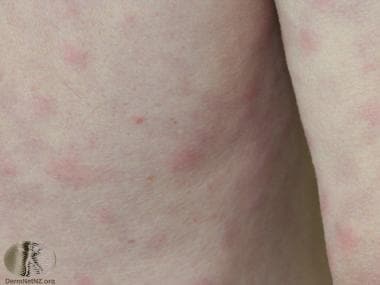
- The urticarial rash consists of pale-rose slightly elevated papules and plaques. Individual lesions are 0.5-3 cm in diameter. New lesions appear daily. They last 12-24 hours and then disappear without sequelae.
- Angioedema is possible, but it very rarely occurs.
- Lymphadenopathy may be found in 50% of patients, hepatomegaly in 25% of patients, and splenomegaly in 6.7% of patients.
Causes
The pathogenesis of SS is still not well defined. Cases have shown deposition of IgM in the involved tissue. In 1980, using anti-idiotype antibodies, Olsen et al demonstrated that IgM monoclonal antibodies reacted with epidermal antigens. In one case of SS, Saurat et al found that the monoclonal IgM targeted 50-kd, 31-kd, and 17-kd proteins within epidermal extracts. These findings suggest that the IgM deposits may be involved in the pathogenesis, perhaps via the formation of immune complexes and the activation of the complement system.
IL-1alpha is a known mediator of inflammation, and its injection into the skin causes persistent erythema. In 1991, Saurat et al found that the serum from 6 out of 9 patients with SS contained polyclonal immunoglobulin G (IgG)–type autoantibodies directed against IL-1alpha. These autoantibodies have been shown to prolong the half-life of IL-1alpha, to change its tissue distribution, and to enhance its effects. Therefore, this increase in IL-1alpha activity could account for the symptoms of urticaria and fever found in SS.
Morita et al showed elevated levels of interleukin 6 (IL-6), granulocyte-macrophage colony-stimulating factor (GM-CSF), and granulocyte colony-stimulating factor (G-CSF) in the serum of some patients with SS. What role these cytokines play in the pathogenesis of the disease is not clear.
Lupus Erythematosus, Acute
Urticarial Vasculitis
Other Problems to be Considered
Adult-onset Still disease is associated with fever, rash, arthralgias, and/or myalgias. The rash in Still disease is evanescent. The urticarial lesions in SS are chronically recurrent. In addition, monoclonal gammopathy does not occur in Still disease.
Systemic lupus erythematosus (SLE) may be associated with urticaria, fever, arthralgia, and an elevated erythrocyte sedimentation rate (ESR). However, leukopenia, neutropenia, and thrombocytopenia are seen in SLE, compared to the leukocytosis and thrombocytosis in SS. Antinuclear antibodies are present in SLE, but not in SS.
Urticarial vasculitis can have features of nonpruritic urticaria, persisting for more than 24 hours; myalgia; arthralgia; fever; an elevated ESR; and an increased white count. Skin biopsy of urticarial vasculitis shows fibrinoid necrosis of vessels and a perivascular neutrophilic infiltrate. Fibrinoid necrosis is rarely seen with SS.
Cryoglobulinemia shows clinical signs and symptoms at cold temperatures and demonstrates the presence of cryoglobulins.
Hyperimmunoglobulin D syndrome shows elevated immunoglobulin D levels.
Delayed pressure urticaria can occasionally be nonpruritic. However, it is not associated with an elevated ESR or an increased white count. In addition, anemia is not seen with delayed pressure urticaria.
Waldenström macroglobulinemia shows a lymphoid proliferation in the bone marrow, and the monoclonal IgM gammopathy is found in large amounts, usually more than 10,000 mg/L. Often, it is associated with hepatosplenomegaly. In SS, the monoclonal gammopathy is less than that seen in Waldenström macroglobulinemia.
Lab Studies
- All cases of SS are associated with an IgM monoclonal gammopathy, which is demonstrated by serum immunoelectrophoresis. Most cases are of the IgM-kappa isotype. A few cases of IgM-lambda and IgM-kappa/lambda have occurred. The serum IgM levels are usually less than 10 g/dL. In 51% of cases, serum protein electrophoresis may not detect the IgM gammopathy because the levels can be very low. One case has been presented in the literature where the patient had clinical features of SS but had an associated IgG gammopathy rather than an IgM gammopathy.
- The ESR is elevated in approximately 85% of cases. Leukocytosis (60%), thrombocytosis (20%), and anemia (35%) may also be found. Both low serum complement levels and low serum C1 inhibitor levels are seen in nearly 10% of patients. Cryoglobulin, antinuclear antibody (ANA), and rheumatoid factor (RF) test results are positive in a small percentage: 3%, 7%, and 7%, respectively.
- Abnormal lymphoid proliferation can be seen in 10% of bone marrow biopsy samples and 10% of lymph node biopsy samples.
Imaging Studies
- Radiologic evaluation shows evidence of hyperostosis in 35%. Often, the areas of hyperostosis coincide with areas of symptomatic bone pain, such as the iliac bone, the tibia, the femur, and the vertebral columns.
Histologic Findings
A recent review of the pathology of SS showed that the histopathologic findings were not consistent; features in some included a superficial dermal and perivascular infiltrate of polymorphonuclear cells, mostly neutrophils, suggestive of neutrophilic urticaria. A small percentage demonstrated a superficial perivascular mononuclear infiltrate suggestive of chronic urticaria and lymphocytic inflammation. Vessels were intact, and dilatation of dermal lymphatics with mild superficial edema was present.
Rare cases show fibrin deposition, extravasation of erythrocytes, or leukocytoclastic vasculitis.
Deposits of IgM and complement in the upper dermis and/or at the dermoepidermal junction were seen in 45% of cases. Rarely were IgM deposits found within vessel walls.
Medical Care
The urticarial eruption of SS is typically resistant to treatment. No treatment is consistently effective. Nonsteroidal anti-inflammatory drugs (NSAIDs), corticosteroids, and immunosuppressive agents have been reported to provide variable relief from the symptoms of bone pain and arthralgias. Some patients remain symptomatic to a large degree, and this may have an impact on their day-to-day functioning.
Skin and extracutaneous manifestations respond poorly to H1 and H2 antihistamines. Colchicine and dapsone have been tried with variable success in different patients. Reports using chloroquine, chlorambucil, cyclophosphamide, azathioprine, plasmapheresis, and high-dose intravenous immunoglobulin indicated no response. PUVA may reduce the intensity of the rash in some patients.
Systemic steroids are not effective at controlling the cutaneous eruption. NSAIDs have proved to be of some benefit for the bone pain and fever, but not for the urticaria. NSAIDs, most notably ibuprofen, are the first treatment choices for most patients. Steroids and immunosuppressive agents are only indicated when the systemic symptoms (eg, fever, arthralgias) are disabling and do not respond to first-line therapy.
The goals of pharmacotherapy are to reduce morbidity and to prevent complications.
Drug Category: Nonsteroidal anti-inflammatory drugs
These agents are the most commonly used medications to control mild to moderate pain and decrease inflammation. NSAIDs provide some relief of bone pain and fever but not the chronic urticaria.
| Drug Name | Ibuprofen (Ibuprin, Advil, Motrin) |
| Description | DOC for mild to moderate pain. Inhibits inflammatory reactions and pain by decreasing prostaglandin synthesis. |
| Adult Dose | 200-400 mg PO q4-6h while symptoms persist; not to exceed 3.2 g/d |
| Pediatric Dose | 6 months to 12 years: 4-10 mg/kg/dose PO tid/qid >12 years: Administer as in adults |
| Contraindications | Documented hypersensitivity; intrinsic coagulation defects or on anticoagulant therapy because of inhibitory effects on platelet aggregation |
| Interactions | Coadministration with aspirin increases risk of inducing serious NSAID-related adverse effects; probenecid may increase concentrations and, possibly, toxicity of NSAIDs; may decrease effect of hydralazine, captopril, and beta-blockers; may decrease diuretic effects of furosemide and thiazides; may increase PT when taking anticoagulants (instruct patients to watch for signs of bleeding); may increase risk of methotrexate toxicity; phenytoin levels may be increased when administered concurrently |
| Pregnancy | D - Unsafe in pregnancy
|
| Precautions | Category D in third trimester of pregnancy; caution in congestive heart failure, hypertension, and decreased renal and hepatic function; caution in coagulation abnormalities or during anticoagulant therapy; high doses can cause tinnitus |
Further Outpatient Care
- Monitoring patients with periodic serum protein electrophoresis and reevaluation for lymphadenopathy and bone marrow involvement if clinically indicated is important because of possible development of a lymphoplasmacytic malignancy.
Complications
- A lymphoplasmacytic malignancy, such as Waldenström macroglobulinemia, lymphoplasmacytic lymphoma, or IgM myeloma, may occur.
Prognosis
- Overall, the prognosis of SS is good. However, in approximately 10-15% of patients, the development of a lymphoplasmacytic malignancy can occur.
- Berdy SS, Bloch KJ. Schnitzler''s syndrome: a broader clinical spectrum. J Allergy Clin Immunol. Apr 1991;87(4):849-54. [Medline].
- Bonnetblanc JM, Drouet M, Laplaud P, et al. Urticaria with macroglobulinaemia. Disease activity associated alterations in immunoglobulins profile and bone marrow hypodiploidy. Dermatologica. 1990;181(1):41-3. [Medline].
- Borradori L, Rybojad M, Puissant A, et al. Urticarial vasculitis associated with a monoclonal IgM gammopathy: Schnitzler''s syndrome. Br J Dermatol. Jul 1990;123(1):113-8. [Medline].
- Harati A, Brockmeyer NH, Altmeyer P, Kreuter A. Skin disorders in association with monoclonal gammopathies. Eur J Med Res. Mar 29 2005;10(3):93-104. [Medline].
- Janier M, Bonvalet D, Blanc MF, et al. Chronic urticaria and macroglobulinemia (Schnitzler''s syndrome): report of two cases. J Am Acad Dermatol. Feb 1989;20(2 Pt 1):206-11. [Medline].
- Lebbe C, Rybojad M, Klein F, et al. Schnitzler''s syndrome associated with sensorimotor neuropathy. J Am Acad Dermatol. Feb 1994;30(2 Pt 2):316-8. [Medline].
- Lewicki M, Lewicka K, Kotyla PJ, et al. [Schnitzler''s syndrome]. Pol Arch Med Wewn. Jun 2004;111(6):735-41. [Medline].
- Machet L, Vaillant L, Machet MC, et al. Schnitzler''s syndrome (urticaria and macroglobulinemia): evolution to Waldenstrom''s disease is not uncommon. Acta Derm Venereol. Sep 1996;76(5):413. [Medline].
- Morita A, Sakakibara S, Yokota M, Tsuji T. A case of urticarial vasculitis associated with macroglobulinemia (Schnitzler''s syndrome). J Dermatol. Jan 1995;22(1):32-5. [Medline].
- Nashan D, Sunderkotter C, Bonsmann G, et al. Chronic urticaria, arthralgia, raised erythrocyte sedimentation rate and IgG paraproteinaemia: a variant of Schnitzler''s syndrome?. Br J Dermatol. Jul 1995;133(1):132-4. [Medline].
- Olsen E, Forre O, Lea T, Langeland T. Unique antigenic determinants (idiotypes) used as markers in a patient with macroglobulinemia and urticaria. Similar idiotypes demonstrated in the skin and on peripheral blood lymphocytes. Acta Med Scand. 1980;207(5):379-84. [Medline].
- Paulin P, Cusset C, Jacquelin L, et al. [Schnitzler''s syndrome. A new case]. Presse Med. Nov 7 1992;21(37):1758-61. [Medline].
- Puddu P, Cianchini G, Girardelli CR, et al. Schnitzler''s syndrome: report of a new case and a review of the literature. Clin Exp Rheumatol. Jan-Feb 1997;15(1):91-5. [Medline].
- Pujol RM, Barnadas MA, Brunet S, de Moragas JM. Urticarial dermatosis associated with Waldenstrom''s macroglobulinemia. J Am Acad Dermatol. May 1989;20(5 Pt 1):855-7. [Medline].
- Sanmartin O, Febrer I, Botella R, et al. Urticarial lesions and monoclonal IgM gammopathy. Schnitzler''s syndrome. Arch Dermatol. Sep 1994;130(9):1195, 1198. [Medline].
- Saurat JH, Schifferli J, Steiger G, et al. Anti-interleukin-1 alpha autoantibodies in humans: characterization, isotype distribution, and receptor-binding inhibition--higher frequency in Schnitzler''s syndrome (urticaria and macroglobulinemia). J Allergy Clin Immunol. Aug 1991;88(2):244-56. [Medline].
- Schnitzler L, Schubert B, Boasson M. Urticaire chronique, lons osseuses, macroglobuline IgM: maladie de Waldenstrom. Bull Soc Franc Derm Syph. 1974;81:363.
Schnitzler Syndrome excerpt Article Last Updated: Dec 6, 2006
|