Continually Updated Clinical Reference
 
 
  All Sources     eMedicine     Medscape     Drug Reference     MEDLINE
 
You are in: eMedicine Specialties > Dermatology > Malignant Neoplasms

Bowen Disease

Last Updated: February 26, 2007
Email to a Colleague
Synonyms and related keywords: squamous cell carcinoma in situ, SCC, human papilloma virus 16, HPV 16

  AUTHOR INFORMATION Section 1 of 11    Click here to go to the next section in this topic
Author Information Introduction Clinical Differentials Workup Treatment Medication Follow-up Miscellaneous Pictures Bibliography

Author: Mark L Welch, MD, Clinical Assistant Professor, Department of Dermatology, Howard University; Assistant Professor, Department of Dermatology, Uniformed Services University of Health Sciences

Mark L Welch, MD, is a member of the following medical societies: American Academy of Dermatology, American College of Mohs Micrographic Surgery and Cutaneous Oncology, American Medical Association, and American Society for Dermatologic Surgery

Editor(s): Steven Spencer, MD, Professor, Departments of Medicine and Surgery, Dartmouth College Medical School; David F Butler, MD, Professor, Texas A&M University College of Medicine; Director, Division of Dermatology, Scott and White Clinic; Edward F Chan, MD, Clinical Assistant Professor, Department of Dermatology, University of Pennsylvania School of Medicine; Catherine Quirk, MD, Clinical Assistant Professor, Department of Dermatology, Brown University; and Dirk M Elston, MD, Director, Department of Dermatology, Geisinger Medical Center

Disclosure


  INTRODUCTION Section 2 of 11   Click here to go to the previous section in this topic Click here to go to the top of this page Click here to go to the next section in this topic
Author Information Introduction Clinical Differentials Workup Treatment Medication Follow-up Miscellaneous Pictures Bibliography

Background: First described by John T. Bowen in 1912, Bowen disease is a squamous cell carcinoma (SCC) in situ with the potential for significant lateral spread. Larger lesions can reach several centimeters in diameter. Much controversy exists as to whether Bowen disease is associated with internal malignancies. Many early papers reported such an association in 15-70% of cases. Some later reports supported an association of internal malignancies with Bowen disease that was associated with arsenic ingestion but not with Bowen disease from other causes. Most of the recent studies, with a larger number of cases and better scientific methods, have refuted any association; currently, Bowen disease is not believed to be a paraneoplastic condition.

Pathophysiology: Both chronic solar damage and inorganic arsenic ingestion have been implicated as etiologic factors in the development of Bowen disease. The human papilloma virus (HPV) also has been documented as a cause of Bowen disease, especially HPV 16. Genetics, trauma, other chemical carcinogens, and radiation also may play a role. Quite often, no etiologic factor is determined.

Frequency:

  • In the US: In 1991, a study from Minnesota reported the annual average rate of Bowen disease as 14 cases per 100,000 whites. In 1994, a study from Hawaii reported a rate 10 times that, 142 cases per 100,000 whites.

Mortality/Morbidity: Prognosis of Bowen disease is favorable, with less than 5% of cases advancing to invasive SCC, and metastases are even more rare.

Race: Bowen disease most commonly is reported in whites.

Sex: The ratio is approximately equal between males and females.

Age: Bowen disease has its highest incidence in the older age groups.


  CLINICAL Section 3 of 11   Click here to go to the previous section in this topic Click here to go to the top of this page Click here to go to the next section in this topic
Author Information Introduction Clinical Differentials Workup Treatment Medication Follow-up Miscellaneous Pictures Bibliography

History: Patients often present with an asymptomatic, slowly enlarging, erythematous, scaly patch or plaque. It may occur anywhere on the mucocutaneous surface. A delay in diagnosis often is encountered because the lesion is asymptomatic; early skin changes may be subtle and overlap with clinical features seen in many benign conditions.

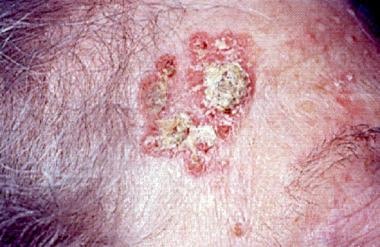
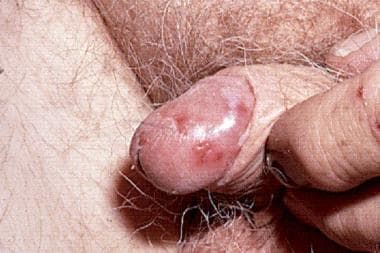
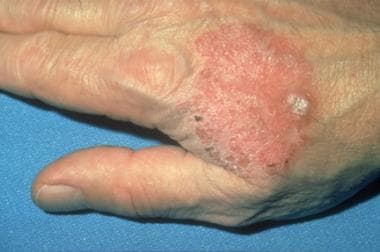
Physical: Bowen disease presents as a single lesion in two thirds of cases. Lesions may appear on sun-exposed or covered skin. The head and neck are the most commonly affected anatomic locations, followed by the limbs. Lesions vary in size from a few millimeters to several centimeters in diameter. A sharply demarcated, irregular border usually is present. Lesions are erythematous, scaly patches or plaques that may become hyperkeratotic, crusted, fissured, or ulcerated. Rarely, the lesions are pigmented, especially in the genital region and the nails. Lesions in these locations may simulate melanoma. Bowen disease also may occur on mucous membranes. When it arises on the glans penis, it is referred to as erythroplasia of Queyrat.
Causes:

  • Chronic UV radiation: Sun-exposed distribution of Bowen disease (over one half of lesions occur on the head, neck, and hands) implicates chronic sun damage as one factor in its formation.
  • Arsenic exposure: The main sources of arsenic exposure include Fowler solution, a medication formerly used to treat psoriasis; Gay solution, a medication formerly used to treat asthma; contaminated well water; and certain pesticides.
  • Human papilloma virus: HPV 16 is by far the most common subtype isolated from lesions of Bowen disease, although other subtypes, such as HPV 2, also have been found.
  • Other possible causes include genetic factors, trauma, other chemical carcinogens, and x-ray radiation.
  DIFFERENTIALS Section 4 of 11   Click here to go to the previous section in this topic Click here to go to the top of this page Click here to go to the next section in this topic
Author Information Introduction Clinical Differentials Workup Treatment Medication Follow-up Miscellaneous Pictures Bibliography

Actinic Keratosis
Basal Cell Carcinoma
Lichen Simplex Chronicus
Paget Disease, Mammary
Psoriasis, Plaque
Squamous Cell Carcinoma


Other Problems to be Considered:

Benign lichenoid keratosis
Eczema
Paget disease (extramammary)

Quick Find
Author Information
Introduction
Clinical
Differentials
Workup
Treatment
Medication
Follow-up
Miscellaneous
Pictures
Bibliography

Click for related images.

Related Articles
Actinic Keratosis

Basal Cell Carcinoma

Lichen Simplex Chronicus

Paget Disease, Mammary

Psoriasis, Plaque

Squamous Cell Carcinoma


Patient Education
Click here for patient education.


  WORKUP Section 5 of 11   Click here to go to the previous section in this topic Click here to go to the top of this page Click here to go to the next section in this topic
Author Information Introduction Clinical Differentials Workup Treatment Medication Follow-up Miscellaneous Pictures Bibliography

Procedures:

  • Skin biopsy: Perform a shave or punch biopsy to confirm the diagnosis of Bowen disease. Incorporating follicular structures in the biopsy material is helpful. These procedures are typically performed in the physician's office with the patient under local anesthesia. Pathologic analyses are best completed by dermatopathologists.
  • Complete skin examination: Perform a total body skin examination on patients with Bowen disease on sun-exposed skin. Studies indicate a higher incidence of nonmelanoma skin cancers may exist in these patients.
Histologic Findings: Bowen disease is a full-thickness anaplasia of the epidermis, with loss of the normal maturation of its components. Keratinocytes are atypical and disorderly, often described as having a windblown appearance. Although the basal cell layer is intact, extension of keratinocyte atypia down the follicular epithelium is seen. Vacuolization, mitoses, individually keratinizing cells, and multinucleated cells are present in the epidermis. Large pale keratinocytes with abundant ground glass cytoplasm, so-called pagetoid cells, often are distributed haphazardly throughout the epidermis. Hyperkeratosis, parakeratosis, and acanthosis are seen to some degree in lesions of Bowen disease. The upper dermis has a moderate lymphocytic infiltrate.

  TREATMENT Section 6 of 11   Click here to go to the previous section in this topic Click here to go to the top of this page Click here to go to the next section in this topic
Author Information Introduction Clinical Differentials Workup Treatment Medication Follow-up Miscellaneous Pictures Bibliography

Medical Care:

Surgical Care:

  • Simple excision with conventional margins
    • This surgery is the most common and preferred treatment for smaller lesions and those not in problematic areas, such as the face and digits.
    • Although lesions are typically well demarcated, the actual extent of the disease may be well beyond the clinical margins. For this reason, the excision should be made at least 4 mm outside the clinical margin.
  • Mohs micrographic surgery
    • This is an excellent method for larger lesions, recurrent lesions, or those in areas where tissue sparing is vital. Mohs micrographic surgery uses the systematic surgical removal of skin cancers with very small margins of normal tissue followed by frozen section examination of nearly 100% of the tissue margin.
    • It offers the highest cure rate of all treatment modalities, and, because relatively thin layers are taken only in areas of proven tumor, it is a tissue-sparing procedure.
  • Curettage and electrodesiccation, cryotherapy, and carbon dioxide laser ablation
    • These are blind surgical methods (no pathologic confirmation of removal) that are established treatment modalities for Bowen disease.
    • As compared with excision and Mohs surgery, they are less likely to remove tumors that are present down in the adnexal structures.

  MEDICATION Section 7 of 11   Click here to go to the previous section in this topic Click here to go to the top of this page Click here to go to the next section in this topic
Author Information Introduction Clinical Differentials Workup Treatment Medication Follow-up Miscellaneous Pictures Bibliography

The goals of therapy are to reduce morbidity and to prevent complications.

Drug Category: Antineoplastic agents -- Topical agents that may be used in the management of Bowen disease.
Drug Name
5-Fluorouracil (Efudex, Carac, Adrucil, Fluoroplex) -- 5-Fluorouracil administered topically under occlusion, following the use of keratolytic or cryotherapy, or by iontophoresis (an electrogradient-driven chemical delivery system), can be used. Interferes with DNA synthesis by blocking methylation of deoxyuridylic acid and inhibits thymidylate synthetase, which subsequently reduces cell proliferation.
Adult DoseOnly 5% strength recommended; apply bid, sparingly to cover lesions (minimum 3 wk); therapy may be required for 10-12 wk
Pediatric DoseAdminister as in adults
ContraindicationsDocumented hypersensitivity; potentially serious infections
InteractionsNone reported
Pregnancy X - Contraindicated in pregnancy
PrecautionsIncidence of inflammatory reactions may occur with occlusive dressings; porous gauze dressing may be applied for cosmetic reasons without increase in reaction
Drug Name
Imiquimod (Aldara) -- Precise mechanism of action for treatment of Bowen disease is unknown. May increase tumor infiltration of lymphocytes, dendritic cells, and macrophages. Indicated when surgical methods are not appropriate.
Adult DoseApply cream to treatment area (including 1 cm of skin surrounding tumor) 3-7 d/wk for up to 16 wk; leave on for at least 8 h, then wash area
Pediatric DoseNot established
ContraindicationsDocumented hypersensitivity
InteractionsNone reported
Pregnancy C - Safety for use during pregnancy has not been established.
PrecautionsMandatory follow-up to ensure treatment response; may cause redness, swelling, and sore development at application site; may cause itching or burning
  FOLLOW-UP Section 8 of 11   Click here to go to the previous section in this topic Click here to go to the top of this page Click here to go to the next section in this topic
Author Information Introduction Clinical Differentials Workup Treatment Medication Follow-up Miscellaneous Pictures Bibliography

Further Outpatient Care:

Prognosis:

Patient Education:

  MISCELLANEOUS Section 9 of 11   Click here to go to the previous section in this topic Click here to go to the top of this page Click here to go to the next section in this topic
Author Information Introduction Clinical Differentials Workup Treatment Medication Follow-up Miscellaneous Pictures Bibliography

Medical/Legal Pitfalls:

  • A failure to recognize Bowen disease or to perform a biopsy in patients suspected of having Bowen disease leads to a delay in treatment. A high degree of suspicion is needed in both sun-exposed and non–sun-exposed areas of the skin.
  • Surgery for patients with Bowen disease may cause bleeding, scarring, infection, deformity, and nerve damage. Discussing these risks with the patient prior to surgery is important.

Special Concerns:

  • Rule out an invasive SCC.
  PICTURES Section 10 of 11   Click here to go to the previous section in this topic Click here to go to the top of this page Click here to go to the next section in this topic
Author Information Introduction Clinical Differentials Workup Treatment Medication Follow-up Miscellaneous Pictures Bibliography

Caption: Picture 1. Squamous cell carcinoma in situ, Bowen disease. Courtesy of Hon Pak, MD.
Click to see larger pictureClick to see detailView Full Size Image
Picture Type: Photo
Caption: Picture 2. Bowen disease right temple.
Click to see larger pictureClick to see detailView Full Size Image
Picture Type: Photo
Caption: Picture 3. Erythroplasia of Queyrat, squamous cell carcinoma in situ of the glans penis.

Click to see larger pictureClick to see detailView Full Size Image
Picture Type: Photo
  BIBLIOGRAPHY Section 11 of 11   Click here to go to the previous section in this topic Click here to go to the top of this page
Author Information Introduction Clinical Differentials Workup Treatment Medication Follow-up Miscellaneous Pictures Bibliography

  • Arbesman H, Ransohoff DF: Is Bowen's disease a predictor for the development of internal malignancy? A methodological critique of the literature. JAMA 1987 Jan 23-30; 257(4): 516-8[Medline].
  • Arnold HL, Odom RB, James WD: Bowen's disease. In: Arnold HL, Andrews GC, Odom RB, James WB, eds. Andrews' Diseases of the Skin. 8th ed. Philadelphia, Pa: WB Saunders; 1990: 783-5.
  • Bargman H, Hochman J: Topical treatment of Bowen's disease with 5-Fluorouracil. J Cutan Med Surg 2003 Mar-Apr; 7(2): 101-5[Medline].
  • Braathen LR, Szeimies RM, Basset-Seguin N, et al: Guidelines on the use of photodynamic therapy for nonmelanoma skin cancer: an international consensus. J Am Acad Dermatol 2007 Jan; 56(1): 125-43[Medline].
  • Cox NH, Eedy DJ, Morton CA: Guidelines for management of Bowen's disease: 2006 update. Br J Dermatol 2007 Jan; 156(1): 11-21[Medline].
  • Dupree MT, Kiteley RA, Weismantle K, et al: Radiation therapy for Bowen's disease: lessons for lesions of the lower extremity. J Am Acad Dermatol 2001 Sep; 45(3): 401-4[Medline].
  • Fulton JE, Carter DM, Hurley HJ: Treatment of Bowen's disease with topical 5-fluorouracil under occlusion. Arch Dermatol 1968 Feb; 97(2): 178-80[Medline].
  • Gard D: Nonpigmented premalignant lesions of the skin. Clin Plast Surg 1987 Apr; 14(2): 413-23[Medline].
  • Graham JH, Helwig EB: Bowen's disease and its relationship to systemic cancer. AMA Arch Derm 1959 Aug; 80(2): 133-59[Medline].
  • Jaeger AB, Gramkow A, Hjalgrim H, et al: Bowen disease and risk of subsequent malignant neoplasms: a population-based cohort study of 1147 patients. Arch Dermatol 1999 Jul; 135(7): 790-3[Medline].
  • Jones CM, Mang T, Cooper M, et al: Photodynamic therapy in the treatment of Bowen's disease. J Am Acad Dermatol 1992 Dec; 27(6 Pt 1): 979-82[Medline].
  • Lee MM, Wick MM: Bowen's disease. Clin Dermatol 1993 Jan-Mar; 11(1): 43-6[Medline].
  • Leibovitch I, Huilgol SC, Selva D, et al: Cutaneous squamous carcinoma in situ (Bowen's disease): treatment with Mohs micrographic surgery. J Am Acad Dermatol 2005; 52(6): 97-1002[Medline].
  • Mackenzie-Wood A, Kossard S, de Launey J, et al: Imiquimod 5% cream in the treatment of Bowen's disease. J Am Acad Dermatol 2001 Mar; 44(3): 462-70[Medline].
  • Poole S, Fenske NA: Cutaneous markers of internal malignancy, II. J Am Acad Dermatol 1993; 28: 147-164[Medline].
  • Ragi G, Turner MS, Klein LE, Stoll HL Jr: Pigmented Bowen's disease and review of 420 Bowen's disease lesions. J Dermatol Surg Oncol 1988 Jul; 14(7): 765-9[Medline].
  • Reizner GT, Chuang TY, Elpern DJ, et al: Bowen's disease (squamous cell carcinoma in situ) in Kauai, Hawaii. A population-based incidence report. J Am Acad Dermatol 1994 Oct; 31(4): 596-600[Medline].
  • Saxena A, Kasper DA, Campanelli CD, et al: Pigmented Bowen's disease clinically mimicking melanoma of the nail. Dermatol Surg 2006 Dec; 32(12): 1522-5[Medline].
  • Sturm HM: Bowen's disease and 5-fluorouracil. J Am Acad Dermatol 1979 Dec; 1(6): 513-22[Medline].
  • Tantikun N: Treatment of Bowen's disease of the digit with carbon dioxide laser. J Am Acad Dermatol 2000 Dec; 43(6): 1080-3[Medline].
  • Welch ML, Grabski WJ, McCollough ML, et al: 5-fluorouracil iontophoretic therapy for Bowen's disease. J Am Acad Dermatol 1997 Jun; 36(6 Pt 1): 956-8[Medline].

Bowen Disease excerpt