| Patient Education |
|
Click here for patient education.
|
|
You are in: eMedicine Specialties >
Dermatology > DISEASES OF THE ADNEXA
Perifolliculitis Capitis Abscedens et Suffodiens
Article Last Updated: Nov 21, 2006
AUTHOR AND EDITOR INFORMATION
Section 1 of 11
Author: Malgorzata D Skibinska, MD, PhD, Locum Consultant Dermatologist, Department of Dermatology, Basildon University Hospital, UK
Malgorzata D Skibinska is a member of the following medical societies: British Medical Association
Coauthor(s):
Robert A Schwartz, MD, MPH, Professor and Head of Dermatology, Professor of Medicine, Professor of Pediatrics, Professor of Pathology, Professor of Preventive Medicine and Community Health, UMDNJ-New Jersey Medical School
Editors: Leonard Sperling, MD, Chair, Professor, Department of Dermatology, Uniformed Services University of the Health Sciences; Richard P Vinson, MD, Assistant Clinical Professor, Department of Dermatology, Texas Tech University School of Medicine; Consulting Staff, Mountain View Dermatology, PA; Jeffrey J Miller, MD, Associate Professor, Department of Dermatology, Penn State University, Milton S Hershey Medical Center; Glen H Crawford, MD, Assistant Clinical Professor, Department of Dermatology, University of Pennsylvania School of Medicine; Chief, Division of Dermatology, The Pennsylvania Hospital; William D James, MD, Paul R Gross Professor of Dermatology, University of Pennsylvania School of Medicine; Vice-Chair, Program Director, Department of Dermatology, University of Pennsylvania Health System
Author and Editor Disclosure
Synonyms and related keywords:
PCAS, dissecting cellulitis of the scalp, Hoffman disease, Hoffman's disease, dissecting cellulitis, scalp cellulitis, acne conglobata, hidradenitis suppurativa, pilonidal cysts
Background
Perifolliculitis capitis abscedens et suffodiens (PCAS) is a therapeutically challenging suppurative scalp disease of unknown etiology. Spitzer first described the disease in 1903, and Hoffman named it descriptively in 1907 (suffodiens is from the Latin suffodio, meaning to dig under).1 It predominantly occurs in black males in their second-to-fourth decade of life. The clinical course is chronic and unpredictable with relapses, although spontaneous resolution may occur.
Pathophysiology
The condition can be associated with acne conglobata, hidradenitis suppurativa, and pilonidal cysts, with follicular blockage as the proposed common mechanism. As retention of material dilates follicles and causes them to rupture, keratin and organisms from the damaged hair follicles can initiate a neutrophilic and granulomatous response. Bacterial infection appears to be a secondary event, not an etiologic factor in the pathogenesis.
Frequency
International
No data are available, but the disease is uncommon.
Mortality/Morbidity
PCAS is not life threatening, but it is chronic and relapsing and can be complicated by squamous cell carcinoma.
Race
PCAS is found most commonly in black men, but white persons are also affected.
Sex
PCAS is found mostly in men, although cases in women are also reported.
Age
The most common age group affected is those aged 18-40 years.
History
- The disease begins as a simple folliculitis, most often of the vertex and/or occiput, with clusters of perifollicular pustules rapidly followed by abscess and sinus formation.
- Nodules range from a few millimeters to several centimeters in diameter and may be firm or fluctuant.
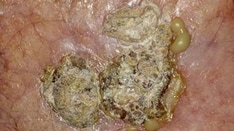
- Seropurulent fluid may be expressed from fluctuant nodules.
- Lesions at different stages may persist for years, healing with a scarring alopecia.
- PCAS has a strong tendency for recurrence.
- No systemic symptoms are usually evident.
Physical
- Vertex and occipital regions of the scalp are sites most often affected by PCAS.
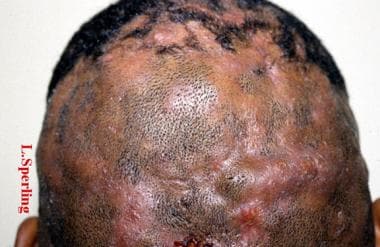
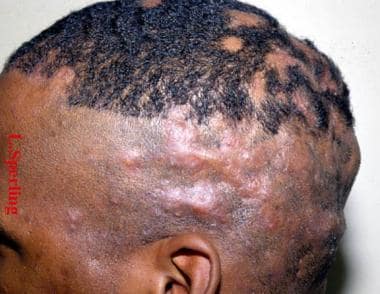
- The main physical signs, depending on the disease stage, are perifollicular pustules, tender nodules (some discharging pus or a jellylike substance), intercommunicating sinuses between nodules, and patchy alopecia with scarring.
- Shedding hair from the surface of nodules and sparing in between the inflamed areas can be observed.
- Regional lymphadenopathy is rarely noted.
- Spondyloarthropathy has been reported in patients with PCAS.
Causes
The cause of PCAS is not known.
- The hypothesis is that blockage of follicles, retention of contents, and subsequent rupture leads to inflammation. Acne conglobata, hidradenitis suppurativa, and pilonidal cysts are frequent concomitant diseases, often referred to as the follicular occlusion triad or tetrad.
- Bacterial infection is probably secondary in the course of the disease because most bacteriological cultures are negative. The most frequently isolated pathogens are Staphylococcus aureus, Staphylococcus epidermidis, and Staphylococcus albus.
Acne Keloidalis Nuchae
Pseudopelade, Brocq
Tinea Capitis
Other Problems to be Considered
Folliculitis decalvans
Lab Studies
Perform bacteriological culture on pus from the discharging lesions in order to treat the secondary infection, mainly S aureus.
Histologic Findings
The histopathologic picture depends on the stage of the disease. Early lesions can be characterized by a dense neutrophilic, lymphocytic, histiocytic, and plasma cellular infiltrate. Abscesses may be present in the dermis and even in the subcutaneous tissue. In later stages, chronic granulomas can be observed that consist of lymphocytes, plasma cells, and foreign-body giant cells. Scarring and fibrosis can also be seen in the late stages.
Medical Care
PCAS is a chronic disease with an unpredictable course.
- Several methods and medicines have been tried in the treatment of PCAS, with most of them yielding disappointing results.
- Oral isotretinoin may be considered the treatment of choice.
- X-ray epilation was previously reported successful, but currently, the authors do not recommend it. However, recently, a modern modification of external beam radiation therapy was used in 4 patients with good results.2
- Intralesional corticosteroids (eg, triamcinolone acetonide at 5 mg/mL) can be injected into boggy nodules and sinus tracts. This results in a prompt decrease in inflammation and may reduce the severity of long-term scarring and hair loss. However, the benefit is short-lived, and intralesional corticosteroids should be considered a temporizing measure.
- Carbon dioxide laser ablation3 and epilation of hair follicles with an 800-nm diode laser4 and long-pulse non–Q-switched ruby laser was tried in a single patient, with good results. Repeated treatments with a long-pulsed Nd:YAG laser were used in 4 patients, with some improvement.5
Surgical Care
Surgical excision of lesions should be considered in severe or recalcitrant cases. Wide excision of the affected areas and split-thickness skin grafting are favored by some as the treatment of choice.6
No single, effective treatment is available because the etiology of PCAS is unknown. Antibiotics are not a standard treatment because bacterial infection is a secondary event. Intralesional steroid injections may be helpful in early stages of the disease. Oral zinc sulfate7, 8 was successful in 2 patients at 400 mg tid and 135 mg tid for 3 months, respectively. Topical isotretinoin was described as a successful treatment of PCAS in one patient. The best results have been reported with oral isotretinoin, which may be helpful in the follicular retention aspect of the disease. A long course is considered the most effective treatment, with a daily dose of 1 mg/kg/d for approximately 4 months and then not less than 0.75 mg/kg for another 6-7 months. To avoid relapses, continue the treatment for approximately 4 months after the disease seems to be clinically inactive.
Drug Category: Retinoids
Decrease cohesiveness of abnormal hyperproliferative keratinocytes and may reduce potential for malignant degeneration. Modulate keratinocyte differentiation. Have been shown to reduce risk of skin cancer formation in renal transplant patients.
| Drug Name | Isotretinoin (Accutane) |
| Description | Oral agent that treats serious dermatologic conditions. Synthetic 13-cis isomer of the naturally occurring tretinoin (trans-retinoic acid). Both agents are structurally related to vitamin A. First-line treatment in PCAS because of its influence on pilosebaceous unit. Changes pattern of keratinization of follicle and has anticomedogenic effect, reduces sebaceous glands size and activity, and reduces bacterial flora. Also has some anti-inflammatory effect. Effective March 1, 2006 the FDA requires that prescribers of isotretinoin, patients who take isotretinoin, and pharmacists who dispense isotretinoin all must register with the I Pledge system. |
| Adult Dose | 0.5-1.5 mg/kg/d (usually 1 mg/kg/d) PO |
| Pediatric Dose | Administer as in adults |
| Contraindications | Documented hypersensitivity; pregnant women or women of childbearing potential (unless under adequate contraception), renal or hepatic failure, hypertriglyceridemia, or elevated cholesterol level |
| Interactions | Toxicity may occur with vitamin A coadministration; pseudotumor cerebri or papilledema may occur; may reduce plasma levels of carbamazepine; microdoses of progesterone tabs may be inadequate contraception |
| Pregnancy | X - Contraindicated; benefit does not outweigh risk
|
| Precautions | May decrease night vision; may be associated with development of hepatitis Occasional exaggerated healing response of acne lesions (excessive granulation with crusting) may occur Diabetic patients may experience problems controlling blood sugar while on isotretinoin Avoid exposure to UV light or sunlight until tolerance achieved; discontinue treatment if rectal bleeding, abdominal pain, or severe diarrhea occur All women of childbearing potential must use 2 separate, effective forms of contraception simultaneously and should sign a consent form prior to starting therapy (1 mo before starting therapy, during therapy, and 1 mo following discontinuation of therapy) Patients should not donate blood during treatment and 1 mo after discontinuation Skin resurfacing procedures and waxing should be avoided during therapy and 6 mo after discontinuation Some patients may have problems using contact lenses Reports of depression, psychosis, or even suicide attempts; however, role as the cause of such effects is controversial Musculoskeletal symptoms including skeletal hyperostosis and premature epiphyseal closure have been reported using higher doses (2.24 mg/kg/d) for longer periods of time, especially in children Other adverse effects include cheilitis, dry mouth, dry nose, dry skin, epistaxis, flushing, fragility of skin, bruising, pruritus, nail dystrophy, alopecia, pyogenic granuloma, rash, abnormal wound healing, allergic reactions, fatigue, dizziness, drowsiness, headaches, malaise, arthralgia, anaphylactic and other allergic reactions, allergic vasculitis, pseudotumor cerebri, skeletal hyperostosis, calcification of tendons and ligaments, premature epiphyseal closure, hepatitis, pancreatitis, corneal opacities, hearing impairment, hypertriglyceridemia, elevated of serum cholesterol, anemia, thrombocytopenia, neutropenia, agranulocytosis, elevated CK, hyperuricemia, increased alkaline phosphatase, SGOT, and SGPT Should be prescribed by a practitioner experienced in its use |
Further Outpatient Care
- People with PCAS taking isotretinoin should be seen monthly during therapy, and then they can be seen every 2-3 months. Additional appointments should be made if any sign of relapse appears.
Complications
- Squamous cell carcinoma development is a possibility in chronic, relapsing lesions.
- Permanent alopecia occurs in chronically inflamed, scarred areas.
- Marginal keratitis has recently been described as a possible clinical association in patients with PCAS.
Prognosis
- The prognosis for complete recovery is poor.
Medical/Legal Pitfalls
- Failure to inform the patient about the chronic, relapsing, and locally destructive course of the disease
| Media file 1:
Dissecting cellulitis in a black man. Painful cutaneous nodules and patchy alopecia. |
 | View Full Size Image | |
Media type: Photo
|
| Media file 2:
Side view of patient in Media File 1. Black man with painful cutaneous nodules and patchy alopecia, characteristic of dissecting cellulitis. |
 | View Full Size Image | |
Media type: Photo
|
| Media file 3:
A white patient with painful nodules. Image used with permission from Medical Science Monitor, 2000, 6(3): 602-4. |
 | View Full Size Image | |
Media type: Photo
|
| Media file 4:
Same white patient as shown in Media File 3 after 3 months of isotretinoin treatment. Image used with permission from Medical Science Monitor, 2000, 6(3): 602-4. |
 | View Full Size Image | |
Media type: Photo
|
| Media file 5:
Histopathologic picture of biopsy taken from a white patient with perifolliculitis capitis abscedens et suffodiens. Hematoxylin and eosin stain, original magnification 400X. Image used with permission from Medical Science Monitor, 2000, 6(3): 602-4. |
 | View Full Size Image | |
Media type: Image
|
- Hoffman E. Perifolliculitis capitis abscedens et suffodiens: case presentation. Dermatol Zeitschrift (Berlin). 1908;15:122-3.
- Chinnaiyan P, Tena LB, Brenner MJ, Welsh JS. Modern external beam radiation therapy for refractory dissecting cellulitis of the scalp. Br J Dermatol. Apr 2005;152(4):777-9. [Medline].
- Glass LF, Berman B, Laub D. Treatment of perifolliculitis capitis abscedens et suffodiens with the carbon dioxide laser. J Dermatol Surg Oncol. Jun 1989;15(6):673-6. [Medline].
- Boyd AS, Binhlam JQ. Use of an 800-nm pulsed-diode laser in the treatment of recalcitrant dissecting cellulitis of the scalp. Arch Dermatol. Oct 2002;138(10):1291-3. [Medline].
- Krasner BD, Hamzavi FH, Murakawa GJ, Hamzavi IH. Dissecting cellulitis treated with the long-pulsed Nd:YAG laser. Dermatol Surg. Aug 2006;32(8):1039-44. [Medline].
- Bellew SG, Nemerofsky R, Schwartz RA, Granick MS. Successful treatment of recalcitrant dissecting cellulitis of the scalp with complete scalp excision and split-thickness skin graft. Dermatol Surg. Oct 2003;29(10):1068-70. [Medline].
- Berne B, Venge P, Ohman S. Perifolliculitis capitis abscedens et suffodiens (Hoffman). Complete healing associated with oral zinc therapy. Arch Dermatol. Aug 1985;121(8):1028-30. [Medline].
- Kobayashi H, Aiba S, Tagami H. Successful treatment of dissecting cellulitis and acne conglobata with oral zinc. Br J Dermatol. Dec 1999;141(6):1137-8. [Medline].
- Benvenuto ME, Rebora A. Fluctuant nodules and alopecia of the scalp. Perifolliculitis capitis abscedens et suffodiens. Arch Dermatol. Aug 1992;128(8):1115-7, 1118-9. [Medline].
- Bjellerup M, Wallengren J. Familial perifolliculitis capitis abscedens et suffodiens in two brothers successfully treated with isotretinoin. J Am Acad Dermatol. Oct 1990;23(4 Pt 1):752-3. [Medline].
- Boyd AS, Zemtsov A. A case of pyoderma vegetans and the follicular occlusion triad. J Dermatol. Jan 1992;19(1):61-3. [Medline].
- Chicarilli ZN. Follicular occlusion triad: hidradenitis suppurativa, acne conglobata, and dissecting cellulitis of the scalp. Ann Plast Surg. Mar 1987;18(3):230-7. [Medline].
- Chui CT, Berger TG, Price VH, Zachary CB. Recalcitrant scarring follicular disorders treated by laser-assisted hair removal: a preliminary report. Dermatol Surg. Jan 1999;25(1):34-7. [Medline].
- Curry SS, Gaither DH, King LE Jr. Squamous cell carcinoma arising in dissecting perifolliculitis of the scalp. A case report and review of secondary squamous cell carcinomas. J Am Acad Dermatol. Jun 1981;4(6):673-8. [Medline].
- Dhaoui MA, Mebazaa A, Doss N. [Dissecting cellulitis of the scalp: treatment by isotretinoine]. Ann Dermatol Venereol. May 2001;128(5):688. [Medline].
- Dubost-Brama A, Delaporte E, Alfandari S, Piette F, Bergoend H. [Perifolliculitis capitis abscedens and suffidiens. Efficacy of isotretinoin]. Ann Dermatol Venereol. 1994;121(4):328-30. [Medline].
- Herman A, David M, Pitlik S. Perifolliculitis capitis abscedens et suffodiens. Int J Dermatol. Oct 1992;31(10):746. [Medline].
- Karpouzis A, Giatromanolaki A, Sivridis E, Kouskoukis C. Perifolliculitis capitis abscedens et suffodiens successfully controlled with topical isotretinoin. Eur J Dermatol. Mar-Apr 2003;13(2):192-5. [Medline].
- Koca R, Altinyazar HC, Ozen OI, Tekin NS. Dissecting cellulitis in a white male: response to isotretinoin. Int J Dermatol. Aug 2002;41(8):509-13. [Medline].
- Kuklova I, Profeldova B. Folliculitis keloidalis nuchae u pacienta z Liberie. Cesko-Slovenska Dermatologie. 2001;76:76-8.
- Kumar PP, Henschke UK, Kovi J. Perifolliculitis capitis abscedens et suffodiens. J Natl Med Assoc. Jan 1976;68(1):9-13. [Medline].
- Libow LF, Friar DA. Arthropathy associated with cystic acne, hidradenitis suppurativa, and perifolliculitis capitis abscedens et suffodiens: treatment with isotretinoin. Cutis. Aug 1999;64(2):87-90. [Medline].
- Maintz L, Betz RC, Allam JP, Wenzel J, Jaksche A, Friedrichs N, et al. Keratitis-ichthyosis-deafness syndrome in association with follicular occlusion triad. Eur J Dermatol. Sep-Oct 2005;15(5):347-52. [Medline].
- McMullan FH, Zeligman I. Perifolliculitis capitis abscedens et suffodiens; its successful treatment with x-ray epilation. AMA Arch Derm. Mar 1956;73(3):256-63. [Medline].
- Montgomery JR, White TW, Martin BL, Turner ML, Holland SM. A novel connexin 26 gene mutation associated with features of the keratitis-ichthyosis-deafness syndrome and the follicular occlusion triad. J Am Acad Dermatol. Sep 2004;51(3):377-82. [Medline].
- Moscatelli P, Ippoliti D, Bergamo F, Piazza P. Guess what. Perifolliculitis capitis abscedens et suffodiens. Eur J Dermatol. Mar-Apr 2001;11(2):155-6. [Medline].
- Moschella SL, Klein MH, Miller RJ. Perifolliculitis capitis abscedens et suffodiens. Report of a successful therapeutic scalping. Arch Dermatol. Aug 1967;96(2):195-7. [Medline].
- Moyer DG, Williams RM. Perifolliculitis capitis abscedens et suffodiens. A report of six cases. Arch Dermatol. Mar 1962;85:378-84. [Medline].
- Omulecki A, Dabkowski J, Zak-Prelich M. Perifolliculitis capitis abscedens et suffodiens--a case report. Med Sci Monit. May-Jun 2000;6(3):602-4. [Medline].
- Ramesh V. Dissecting cellulitis of the scalp in 2 girls. Dermatologica. 1990;180(1):48-50. [Medline].
- Salim A, David J, Holder J. Dissecting cellulitis of the scalp with associated spondylarthropathy: case report and review. J Eur Acad Dermatol Venereol. Nov 2003;17(6):689-91. [Medline].
- Scheinfeld N. Cimetidine: a review of the recent developments and reports in cutaneous medicine. Dermatol Online J. Mar 2003;9(2):4. [Medline].
- Schewach-Millet M, Ziv R, Shapira D. Perifolliculitis capitis abscedens et suffodiens treated with isotretinoin (13-cis-retinoic acid). J Am Acad Dermatol. Dec 1986;15(6):1291-2. [Medline].
- Shaffer N, Billick RC, Srolovitz H. Perifolliculitis capitis abscedens et suffodiens. Resolution with combination therapy. Arch Dermatol. Oct 1992;128(10):1329-31. [Medline].
- Sivakumaran S, Meyer P, Burrows NP. Dissecting folliculitis of the scalp with marginal keratitis. Clin Exp Dermatol. Sep 2001;26(6):490-2. [Medline].
- Sperling LC. Scarring alopecia and the dermatopathologist. J Cutan Pathol. Aug 2001;28(7):333-42. [Medline].
- Spitzer L. Dermatitis follicularis et perifollicularis conglobata. Dermatol Zeitschrift (Berlin). 1903;10:109-20.
- Stites PC, Boyd AS. Dissecting cellulitis in a white male: a case report and review of the literature. Cutis. Jan 2001;67(1):37-40. [Medline].
- Twersky JM, Sheth AP. Tinea capitis mimicking dissecting cellulitis: a distinct variant. Int J Dermatol. May 2005;44(5):412-4. [Medline].
- Williams CN, Cohen M, Ronan SG, Lewandowski CA. Dissecting cellulitis of the scalp. Plast Reconstr Surg. Mar 1986;77(3):378-82. [Medline].
- Zisova L, Sakakushev B. Acne tetrad in a family. Folia Med (Plovdiv). 1994;36(4):51-7. [Medline].
Perifolliculitis Capitis Abscedens et Suffodiens excerpt Article Last Updated: Nov 21, 2006
|