Practice Essentials
Confluent and reticulated papillomatosis is a rare disease typically affecting young persons. It may be underdiagnosed. [1] Confluent and reticulated papillomatosis is characterized by grayish blue hyperkeratotic papules, usually located on the trunk. The lesions coalesce to form confluent plaques centrally and a reticular pattern peripherally. Confluent and reticulated papillomatosis may represent an endocrine disturbance, a disorder of keratinization, an abnormal host reaction to fungi or bacteria, a hereditary disorder, or a variant of amyloidosis. The eruption is chronic with exacerbations and remissions. Confluent and reticulated papillomatosis is responsive to treatment but frequently recurs after discontinuation of therapy.
Signs and symptoms
Also see History.
Physical findings of confluent and reticulated papillomatosis are limited to the skin, as shown in the images below.
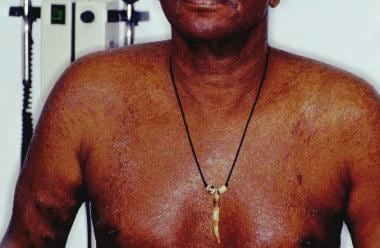 Grayish brown hyperkeratotic papules and plaques in a confluent pattern on the intermammary region with a reticular pattern peripherally.
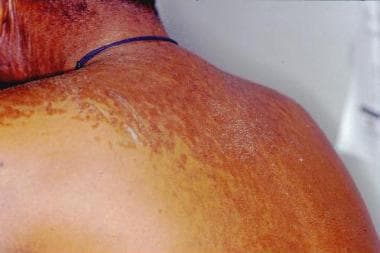 Close-up view of the interscapular area, again demonstrating a confluent pattern centrally and a more reticular pattern peripherally.
Primary lesion in confluent and reticulated papillomatosis
Lesions begin as slightly hyperkeratotic to warty papules that are 1-2 mm in diameter. They enlarge to 4-5 mm in diameter and coalesce to form a reticular pattern peripherally and confluent plaques centrally.
Skin markings are preserved and sometimes exaggerated, especially in the neck and the axillae, where the skin may be thickened. It has been described with vertically rippled and keratotic plaques [2] and as punctate pigmented papillomatosis. [3] The former have also been called linear pseudostriae and are characterized as a diagnostic sign. [4]
Atrophic macules rarely may be seen.
Scraping of lesions produces a fine powdery scale or mealy deposit.
Dermoscopic evaluation may show a brownish pigmentation with ill-defined borders, covered with white scales and a pattern of labeled "sulci and gyri" [5] and facilitate distinction from other acquired pigmentary disorders. [6]
The color of confluent and reticulated papillomatosis is noteworthy; they are erythematous early and later evolve to grayish brown.
Distribution of lesions in confluent and reticulated papillomatosis
This autosomal dominant trait is characterized by many asymptomatic oval macules symmetrically distributed on axillae, groin, face, neck, arms, and trunk; scattered comedolike papules (dark dot follicles); and pitted acneiform scars. [7]
Confluent and reticulated papillomatosis usually begins on the skin of the intermammary or epigastric region, spreading over a period of weeks or months to the breasts, the lower abdomen, the flanks, and the pubic area.
In one case, lesions were entirely confined to the cheeks [8] ; in another case, lesions were entirely confined to the pubic area. [9]
The eruption may be found in the interscapular region, from which it spreads to the shoulders, the nape of the neck, and the gluteal cleft.
Involvement of the face and the proximal extremities may be seen. [10] It may also occur on the forehead. [11]
The mucous membranes are spared.
Diagnostics
Also see Histologic Findings.
Potassium hydroxide (KOH) examination of skin scrapings in confluent and reticulated papillomatosis: Pityrosporum orbiculare or Pityrosporum ovale spores and rarely hyphae may be found.
Fungal culture in confluent and reticulated papillomatosis: P orbiculare or P ovale may be cultured in some cases. The laboratory needs to be informed to make specific modifications to the media to grow this yeast.
Wood lamp examination in confluent and reticulated papillomatosis: Yellow fluorescence occurs when Pityrosporum organisms are present.
Management
Confluent and reticulated papillomatosis is strictly a disorder of the skin that results in cosmetic disfigurement, with no adverse systemic effects; therefore, no treatment is necessary other than for eradication of the rash (see Medication).
Many different modalities have been used in the treatment of confluent and reticulated papillomatosis, with variable results. The most consistent results may be seen with minocycline. [12, 13, 14, 15, 16, 17] Oral doxycycline is another option. [18] Other modalities include keratolytics; intramuscular, oral, and topical forms of vitamin A; sodium thiosulphate; ammoniated mercury; oral contraceptives; oral and topical retinoids [19, 20, 21, 22, 23] ; thyroid extract; ultraviolet light; propylene glycol; antibiotics [16, 24, 25, 26, 27, 28, 29, 30, 31] ; antimycotics; and calcipotriene. [32, 33, 34, 35]
The most consistently effective treatment for confluent and reticulated papillomatosis, and the only one evaluated by retrospective and prospective studies, has been oral antibiotics. Successful treatment of confluent and reticulated papillomatosis has been reported with topical mupirocin. [36] Another therapeutic option in confluent and reticulated papillomatosis may be tazarotene gel. [37] The treatment was well tolerated and may be an alternative to systemic retinoid therapy.
A good part of the hyperpigmentation can be removed using 70% alcohol swabbing. [38]
Surgical treatment of confluent and reticulated papillomatosis has been unsuccessful.
The lesions of confluent and reticulated papillomatosis may regress with weight reduction.

Background
Gougerot and Carteud originally described confluent and reticulated papillomatosis (CRP) in 1927 under the name papillomatose pigmentée innominée and later renamed it papillomatose pigmentée confluente et réticulée. [39, 40, 41] Confluent and reticulated papillomatosis was subsequently categorized as a new form of cutaneous papillomatosis and diagnostic criteria were established. Wise described the first case in the United States in 1937 and called it confluent and reticular papillomatosis. [42, 43] The existence of confluent and reticulated papillomatosis as a distinct entity was argued for many years because of the clinical and histologic similarities between confluent and reticulated papillomatosis and the different forms of acanthosis nigricans, but the disease is now generally accepted as a distinct entity. [44]
Pathophysiology
Both electron microscopy studies and immunohistochemical analysis of lesions of confluent and reticulated papillomatosis support the concept of abnormal keratinocyte differentiation and maturation. These findings include an increased transition cell layer and increased lamellar granules in the stratum granulosum, along with increased involucrin, keratin 16, and Ki-67 expression. [45] Increased melanosomes in the stratum corneum probably account for the observed pigmentary changes.
Yeastlike spores were evident in 6 of 10 Lebanese cases, supporting a role for Malassezia furfur in the pathogenesis of confluent and reticulated papillomatosis. [46]
Etiology
Theories as to the etiology of confluent and reticulated papillomatosis include an endocrine disturbance, a disorder of keratinization, and an abnormal host reaction to Pityrosporum organisms or bacteria. Reports also exist of familial cases of confluent and reticulated papillomatosis [47, 48, 49, 50] and the possibility of confluent and reticulated papillomatosis representing a variant of amyloidosis. [51]
Endocrine disturbance in confluent and reticulated papillomatosis
Gougerot himself suggested the possibility of an endocrine disturbance having a role in confluent and reticulated papillomatosis. Others have also advanced this theory in light of the common observation of endocrine disturbances in patients with confluent and reticulated papillomatosis (eg, Cushing disease, menstrual irregularities, obesity, abnormal glucose tolerance or diabetes mellitus, thyroid disease, pituitary dysfunction, hirsutism or hypertrichosis). Its resolution after bariatric surgery for obesity may also suggest an association with insulin resistance and obesity. [52] It has been described in at least one patient with hyperthyroidism. [53]
In Japan, 76.5% of cases of confluent and reticulated papillomatosis are associated with obesity or rapid weight gain.
In addition, lesions of confluent and reticulated papillomatosis have been noted to remit during pregnancy or with weight loss.
No single endocrine abnormality is seen; however, in many of the cases, no abnormality exists at all.
Disorder of keratinization in confluent and reticulated papillomatosis
Miescher first proposed that confluent and reticulated papillomatosis is due to a defect in keratinization. This idea is supported by electron microscopic studies, which demonstrate increased lamellar granules in the stratum granulosum, a finding seen in conditions of increased cell turnover and desquamation (eg, psoriasis), and an increased transition cell layer, which represents the zone where granular cells are converted into cornified cells.
The above findings are consistent with immunohistochemical studies of lesions of confluent and reticulated papillomatosis, which demonstrate increased expression of involucrin, keratin 16, and Ki-67—protein markers for keratinocyte differentiation and maturation.
Further evidence for the role of a defect of keratinization is the response of confluent and reticulated papillomatosis to topical and oral retinoids, which are useful in treating such defects. Most recently, confluent and reticulated papillomatosis has been shown to respond to topical analogues of vitamin D, agents that also regulate cell differentiation and inhibit keratinocyte proliferation.
Ultraviolet light exposure and avitaminosis have been associated with the development of confluent and reticulated papillomatosis, as they may trigger or exacerbate the underlying abnormality. [54] It is possible that HIV infection may do the same. [55]
Another interesting association is that of 2 patients with both confluent and reticulated papillomatosis and atopy, a condition where other disorders of keratinization are found. [19]
Fungal infection in confluent and reticulated papillomatosis
Another theory holds that confluent and reticulated papillomatosis represents an abnormal host reaction to Pityrosporum orbiculare, either in the yeast or the hyphal form. This theory is based on the observation that confluent and reticulated papillomatosis is sometimes colonized with Pityrosporum organisms, and clearance occurs with antifungals and the associated eradication of Pityrosporum organisms.
Many cases of confluent and reticulated papillomatosis do not have any evidence of Pityrosporum infection, and fail to respond to antifungal therapy.
In one study, 20 of 31 cases of confluent and reticulated papillomatosis had negative potassium hydroxide examinations, and 14 of 19 patients treated with topical imidazoles failed to respond, with no correlation between potassium hydroxide (KOH) examinations and response to therapy.
In another study, P obiculare was isolated in only 15 of 54 cases, and only 8 of 26 cases improved with antimycotic therapy. Similarly, in Japan, fungus could be detected in only 6 of 44 cases. However, yeastlike spores were evident in 6 of 10 Lebanese cases, supporting a role for Malassezia furfur in the pathogenesis of confluent and reticulated papillomatosis. [46]
A genetic or diet-induced abnormal keratinizing response is suggested to be triggered by P orbiculare.
Bacterial infection in confluent and reticulated papillomatosis
The use of antibiotics in the treatment of confluent and reticulated papillomatosis was introduced after the fortuitous discovery of improvement in a patient who was taking furacycline for arthritis. Since then, an increase has occurred in the number of reports of successful treatment of confluent and reticulated papillomatosis with antibiotics of the tetracycline, macrolide, cephalosporin and (most recently) steroid classes. This finding has lead to the concept that bacteria, perhaps within the hair follicle, are the etiologic agents.
An exciting development in our understanding of the cause of confluent and reticulated papillomatosis is the report of a newly described dietzia strain of Actinomyces, isolated from a patient with confluent and reticulated papillomatosis. [56] Antibiotic minimal inhibitory concentrations suggested sensitivity to tetracycline and erythromycin, and the patient responded to treatment with these medications. The authors of this study propose that confluent and reticulated papillomatosis is probably a reaction pattern to bacterial infection in susceptible individuals, resulting in epidermal proliferation, and have named this A dietzia strain X.
Another explanation for the effectiveness of antibiotics may be the anti-inflammatory and antiproliferative actions of these agents; however, some authors argue that confluent and reticulated papillomatosis is not an inflammatory disorder.
Heredity in confluent and reticulated papillomatosis: Six familial reports of confluent and reticulated papillomatosis have raised the possibility of it being a heritable disorder. These cases include 2 sisters and a brother; 2 sisters and 1 of their daughters; a mother, a daughter, and a son; and 3 sets of brothers, including 1 observed by the authors of this article. This small number of reports does not suggest any particular pattern or mode of inheritance.
Variant of amyloidosis
The report of amyloid in skin lesions of only 3 patients makes this theory unlikely.
Epidemiology
Frequency
The frequency of confluent and reticulated papillomatosis internationally is unknown. It is considered to be rare.
Race
Older reviews report confluent and reticulated papillomatosis being more common among blacks than other races, with a ratio of 2:1, but more recent surveys, including one survey of 90 cases, show a predominance in whites.
Sex
The proportion of women to men affected by confluent and reticulated papillomatosis has been reported to be as high as 2.8:1, but the ratio is probably closer to 1.4:1. The opposite is true in Japan, where confluent and reticulated papillomatosis is more common in men than in women. In one study of 10 Lebanese cases, half were of each sex. [46]
Age
The onset of confluent and reticulated papillomatosis usually occurs shortly after puberty. The mean patient age at onset varies from 18.5-21 years, with a range of 5-63 years. Similarly, the average patient age at onset is 17.1 years in Japan, with a range of 3-30 years. In one study of 10 Lebanese cases, the mean age at diagnosis was 19 years. [46]
Prognosis
Confluent and reticulated papillomatosis is a chronic disease characterized by exacerbations and remissions. Discontinuation of successful therapy usually results in recurrence of the confluent and reticulated papillomatosis.
-
Grayish brown hyperkeratotic papules and plaques in a confluent pattern on the intermammary region with a reticular pattern peripherally.
-
Close-up view of the interscapular area, again demonstrating a confluent pattern centrally and a more reticular pattern peripherally.
-
A biopsy specimen showing hyperkeratosis, papillomatosis, and a mild superficial perivascular inflammation (hematoxylin and eosin, original magnification X125).
Tables

What would you like to print?
- Expert Tips on Mohs Surgery for Melanoma
- Childhood Vaccination Rates Are Slipping
- Trump Nominations for US Health Agencies Spark Controversy, Criticism, Praise
- Antibiotic Resistance in Dermatology Part 2: Combating Resistance
-
 Ketosis, Including Ketogenic Diets, Implicated in Prurigo Pigmentosa
-
Beyond Spaghetti and Meatballs: Skin Diseases Associated With the Malassezia Yeasts