Continually Updated Clinical Reference
 
 
  All Sources     eMedicine     Medscape     Drug Reference     MEDLINE
 
eMedicine - Neurotic Excoriations : Article by

Quick Find
Authors & Editors
Introduction
Clinical
Differentials
Workup
Treatment
Medication
Follow-up
Miscellaneous
Multimedia
References

Related Articles
Delusions of Parasitosis

Dermatitis Herpetiformis

Prurigo Nodularis

Scabies


Patient Education
Click here for patient education.


Author: Noah S Scheinfeld, MD, JD, FAAD, Assistant Clinical Professor, Department of Dermatology, Columbia University; Consulting Staff, Department of Dermatology, St Luke's Roosevelt Hospital Center, Beth Israel Medical Center, New York Eye and Ear Infirmary; Private Practice

Noah S Scheinfeld is a member of the following medical societies: American Academy of Dermatology

Editors: Shyam Verma, MBBS, DVD, FAAD, Adjunct Clinical Assistant Professor, Department of Dermatology, University of Virginia, State University of New York at Stonybrook, Penn State University; David F Butler, MD, Professor of Dermatology, Texas A&M University College of Medicine; Director, Division of Dermatology, Scott and White Clinic; Director Dermatology Residency Training Program, Scott and White Clinic; Rosalie Elenitsas, MD, Associate Professor of Dermatology, University of Pennsylvania School of Medicine; Director, Penn Cutaneous Pathology Services, Department of Dermatology, University of Pennsylvania Health System; Joel M Gelfand, MD, MSCE, Medical Director, Clinical Studies Unit, Assistant Professor, Department of Dermatology, Associate Scholar, Center for Clinical Epidemiology and Biostatistics, University of Pennsylvania; Dirk M Elston, MD, Director, Department of Dermatology, Geisinger Medical Center

Author and Editor Disclosure

Synonyms and related keywords: NE, picker's nodules, prurigo nodularis, repetitive scratching, unconscious picking at the skin, uncontrollable picking at lesions

Background

Patients consciously create neurotic excoriations (NEs) by repetitive scratching. This allows NEs to be distinguished from dermatitis artefacta in which patients unconsciously scratch. NEs can be initiated by some minor skin pathology, such as an insect bite, folliculitis, or acne, but it can also be independent of any pathology. Because no significant underlying pathology is present in the skin, NEs are really a psychologic process with dermatologic manifestations.

Because patients create NEs, the lesions have the quality of "an outside job," that is, clean, linear erosions, crusts, and scars that can be hypopigmented or hyperpigmented. The erosions and scars of NEs often have irregular borders and are usually similar in size and shape. They occur on areas that the patient can scratch, particularly the extensor surfaces of the extremities, the face, and the upper part of the back. The distribution is bilateral and symmetric.

The manifestations of NEs vary widely from unconscious picking at the skin to uncontrollable picking at lesions to remove imaginary foreign bodies. Picking is usually episodic and irregular, but it can be constant. The picking can have the quality of a ritual and may take place in a state of dissociation.

In 2006, Shah and Fried1 reported that neurotic excoriations are among the most common factitial skin diseases observed in children. They further noted that factitial skin disease is less common in children and can often be linked to comorbid psychiatric diagnoses or a psychosocial stressor that can be identified.

Pathophysiology

NEs are due either to an underlying psychopathology or to the formation of habit. As such, its pathophysiology is poorly understood.

Frequency

United States

NEs are thought to be common and underreported. The rate of NEs among patients at dermatologic clinics is 2%. The rate of NEs in patients with pruritus is 9%.

Mortality/Morbidity

Scars often remain on patients with this condition.

Sex

In studies, 52-92% of patients with NEs are female.

Age

Most studies report a mean patient age at onset of 30-45 years.


History

Patients give a history of picking, digging, or scraping their skin. Sometimes, an inciting incident is the cause, and, sometimes, no inciting incident is present. Patients might note that they do not scratch themselves consciously; rather, they pick and then notice that they are picking. Cyr and Dreher2 have an excellent summary of NEs and their historical and clinical findings and manifestations.

Patients can have a psychiatric history that includes depression, obsessive-compulsive disorder, and anxiety. Most patients do not have any particular psychopathology; however, psychiatric diagnoses to be considered include the following:

  • Depression
  • Trichotillomania
  • Anxiety
  • Tic disorder
  • Obsessive-compulsive disorder
  • Body dysmorphic disorder
  • Somatoform disorders (eg, facial dermatitis, somatization, hypochondriasis)
  • Borderline personality (self-mutilation)
  • Delusions of parasitosis (may be part of a larger diagnostic group, such as schizophrenia)

Patients pick at areas until they can pull material from the skin. This may be referred to as "pulling a thread from the skin."

Setyadi et al3 noted that trigeminal trophic syndrome can result in nasal ulcerations (the nasal ala and paranasal locations), most commonly manifesting in older women following therapy for trigeminal neuralgia.

Young women who pick at their faces may have a history of mild acne. Such cases are referred to as acne excoriée. This condition is not discussed in this article. The erosions can heal slowly because of recurrent picking.

Asking the patient what came first the lesion or the urge to itch is useful. On close questioning, most patients say that they scratched their skin and then saw a lesion. The lesions of NEs have a component of an itch-scratch cycle, whereby the urge to scratch generates an even greater urge to scratch.

Because a variety of conditions can cause itching and then lesions, these must be excluded or, at least, not considered as likely to firmly make a diagnosis of NE. These conditions include the following:

  • Scabies
  • Dermatitis herpetiformis
  • Renal disease
  • Cocaine use
  • Opiate use
  • Medication reactions
  • Multiple sclerosis
  • Hepatic disease
  • Lymphoma
  • Pregnancy
  • Internal cancers
  • Uremia
  • Carcinoid
  • Delirium
  • Polycythemia vera
  • Diabetes mellitus
  • Hypothyroidism
  • Iron deficiency anemia
  • Hyperthyroidism
  • Xerosis
  • Urticaria
  • Intestinal parasitosis

Myeloma can be reported.

Patients may report headache or menstrual disorders.

As reported by Shenefelt in 20044, hypnotic suggestion successfully alleviated the behavioral picking aspect of acne excoriée des juenes filles in a pregnant woman who had been picking at the acne lesions on her face for 15 years. Acne excoriée is a subset of psychogenic or NE. Conventional topical antibiotic treatment was used to treat the acne. Compared with other treatments for uncomplicated acne excoriée, hypnosis is relatively brief and cost-effective and is nontoxic in pregnancy.

Physical

  • Often, right-handed persons tend to pick at their left side and left-handed people pick at their right side.
  • The erosions and scars tend to have angulated borders.
  • The quantity of erosions and scars is variable. Several lesions to hundreds of lesions can be present. Erosions, crusts, and scars are only located where the patient can pick.
  • Erosions can vary in morphology and can sometimes evolve into frank ulcers. Dug-out erosions or ulcers, crusted erosions, and ulcers can be present. Sometimes, erythema and scars are present around the erosions and the ulcers.
  • In dermatitis artefacta, the patient creates skin lesions to satisfy an internal psychological need, usually a need to be taken care of. The clinical presentation is characteristic, and it differs from that of NEs, delusional disorders, malingering, and Munchausen syndrome. Munchausen syndrome by proxy is a form of dermatitis artefacta.
    • Except when the lesions mimic another disease, those that do not conform to descriptions of known dermatoses are shrouded in mystery, appearing fully formed on accessible skin, within the context of a characteristic psychological constellation. The patient is friendly but bewildered, and relatives may be angry and frustrated.
    • Because of lack of diagnostic stringency, quoted female-to-male ratios range from 3-20:1, with the highest incidence of onset in late adolescence to early adult life. Most patients have a personality disorder; borderline features are common.
    • The patient's denial of psychic distress and the possible negative feelings aroused in health care personnel make management difficult.
    • Setting limits for the protection of both the physician and patient; creating an accepting, empathic, and nonjudgmental environment; and closely supervising symptomatic dermatologic care permit the development of a therapeutic relationship in which psychological issues may be gradually introduced, which may occasionally permit referral to a psychiatrist. Issues of etiology should be sidestepped because confrontation is counter-productive.
    • If the patient refuses referral to a psychiatrist, psychotropic drug therapy prescribed by dermatologists is helpful and appropriate. The upper dose range of selective serotonin reuptake inhibitors (SSRIs) or low-dose atypical antipsychotic agents may be effective.
    • Except in mild transient cases triggered by an immediate stress, the prognosis for cure is poor. The condition tends to wax and wane with the circumstances of the patient's life.
    • Lesions can be kept to a minimum, the patient can be protected from unnecessary and intrusive studies, and society can be protected from escalating and unnecessary expenditure of medical resources if, rather than discharging the patient, the dermatologist continues to see the patient on an ongoing basis for supervision and support, regardless of whether lesions are present.
    • Research studies are necessary to more accurately document the expectable cause, treatment outcome, and prognosis for this group of patients.

Causes

The causes of NEs are manifold and can relate to picking as a means of resolving stress or some underlying psychopathology. Some believe NEs are a physical manifestation of obsessive-compulsive disorder.


Delusions of Parasitosis
Dermatitis Herpetiformis
Prurigo Nodularis
Scabies

Other Problems to be Considered

Dermatitis artefacta
Trigeminal trophic syndrome


Lab Studies

  • To rule out systemic disease, perform the following tests:
    • Complete blood cell count with differential
    • Chemistry profile
    • Determination of thyrotropin levels
    • Fasting plasma glucose level
  • The appropriate workup for cancer can be performed if indicated by the patient's history.

Imaging Studies

  • A chest radiograph can help to rule out lymphoma if suspected.

Other Tests

  • Patients can be assessed for contact dermatitis or food allergies.

Procedures

  • A skin biopsy can be helpful to rule out other pathology.

Histologic Findings

Biopsy samples of NEs generally reveal epidermal ulceration with a mild superficial mixed infiltrate and crusts formed from fluid and RBCs. In older lesions, superficial dermal scar tissue and changes of lichen simplex chronicus, such as irregular epidermal hyperplasia with hyperkeratosis, hypergranulosis, and vertical streaking of papillary dermal collagen, may be observed.


Medical Care

In 2005, Krishnan and Koo5 reported that the pathology of the opioid neurotransmitter system and the central nervous system is the neurological basis for neurotic excoriations and thus psychiatric medications that can normalize nervous system pathology can abate neurotic excoriations.

In the treatment of NEs, studies have shown that the serotonergic effect of SSRIs consistently produces the strongest antipruritic effect. The relief of pruritus is unrelated to changes in the patient's mood and happens faster than would be expected for antidepressant effects.

For its sedating and antipsychotic effects, doxepin (10-25 mg PO qhs) is a useful medication in treating NEs.

Dereli et al6 found that gabapentin is a useful treatment for recalcitrant chronic prurigo nodularis.

Consultations

Consult a psychiatrist and a psychologist. NEs can be associated with psychopathology. Social stressors may be well hidden because of shame or a delusional belief system. Suppression, inappropriate channeling, and repression of aggression can be a result of unmet emotional needs. Conflicts can result from past or current situations. Resolving these issues alone can be difficult. NEs can be associated with anxiety disorders, low self-confidence, generalized apprehension, meticulousness, depressive mood, and hypersensitivity to perceived self-negativism. Thus, the intervention of a psychiatrist or other trained mental health care professionals can be useful. Patients can benefit from psychotherapy and other forms of counseling.


NEs are treated with a variety of psychotropic medications. The doses can be lower than those used in treating depression, and the medications can act more quickly.

Using hypnosis to facilitate resolution of psychogenic excoriations in acne excoriée has been reported.

Olanzapine may be an effective adjunctive therapy in the management of acne excoriée.7

Paroxetine was reportedly effective in a case of psychogenic pruritus and NEs.8

Drug Category: Antipsychotic agents

Decrease the urge to scratch and relieve anxiety.

Drug NameDoxepin (Sinequan)
DescriptionInhibits histamine and acetylcholine activity and has proven useful in the treatment of various forms of depression associated with chronic and neuropathic pain.
Adult Dose10-25 mg PO qhs
Pediatric DoseNot commonly used
<12 years: Not recommended
>12 years: 10 mg qhs
ContraindicationsDocumented hypersensitivity; urinary retention; acute recovery phase following myocardial infarction; glaucoma
InteractionsDecreases antihypertensive effects of clonidine but increases effects of sympathomimetics and benzodiazepines; effects of desipramine increase with phenytoin, carbamazepine, and barbiturates
PregnancyC - Fetal risk revealed in studies in animals but not established or not studied in humans; may use if benefits outweigh risk to fetus
PrecautionsCaution in cardiovascular disease, conduction disturbances, seizure disorders, urinary retention, and hyperthyroidism; caution in patients receiving thyroid replacement

Drug Category: Antianxiety agents

Used to reduce the level of anxiety in patients who experience pruritus.

Drug NameBuspirone (BuSpar)
DescriptionA 5-HT1 agonist with serotonergic neurotransmission and some dopaminergic effects in CNS. Has anxiolytic effect but may take up to 2-3 wk for full efficacy.
Adult Dose15 mg PO qd/tid
Pediatric DoseNot established
ContraindicationsDocumented hypersensitivity
InteractionsToxicity is increased with MAOIs, phenothiazines, and CNS depressants; increases toxicity of digoxin and haloperidol
PregnancyB - Fetal risk not confirmed in studies in humans but has been shown in some studies in animals
PrecautionsCaution in hepatic or renal impairment

Drug Category: Antidepressant agents

May be used to improve mood and to restore normal sleep patterns in patients who experience pruritus.

Drug NameFluoxetine (Prozac)
DescriptionSelectively inhibits presynaptic serotonin reuptake with minimal or no effect in the reuptake of norepinephrine or dopamine.
Adult Dose20 mg PO qd
Pediatric Dose<18 years: Not established; initial doses of 20 mg/d in children 6-14 y have been used
>18 years: Administer as in adults
ContraindicationsDocumented hypersensitivity; concurrently taking MAOIs or have taken them in the last 2 wk
InteractionsIncreases toxicity of diazepam and trazodone by decreasing clearance; also increases toxicity of MAOIs and highly protein bound drugs; serotonin syndrome (ie, myoclonus, rigidity, confusion, nausea, hyperthermia, autonomic instability, coma, eventual death) occurs with simultaneous use of other serotonergic agents (eg, anorectic agents, tramadol, buspirone, trazodone, clomipramine, nefazodone, tryptophan); discontinue other serotonergic agents at least 2 wk prior to SSRIs
PregnancyC - Fetal risk revealed in studies in animals but not established or not studied in humans; may use if benefits outweigh risk to fetus
PrecautionsCaution in hepatic impairment and history of seizures; discontinue MAOIs at least 14 d before initiating therapy

Drug Category: Topical cortisone agents

Have anti-inflammatory properties and cause profound and varied metabolic effects. Corticosteroids modify the body's immune response to diverse stimuli.

Drug NameTriamcinolone topical (Aristocort)
DescriptionTreats inflammatory dermatosis that is responsive to steroids. Decreases inflammation by suppressing the migration of polymorphonuclear leukocytes and reversing capillary permeability.
Adult DoseApply thin film bid/tid until favorable response obtained
Pediatric DoseApply as in adults with caution
ContraindicationsDocumented hypersensitivity; fungal, viral, and bacterial skin infections
InteractionsNone reported
PregnancyC - Fetal risk revealed in studies in animals but not established or not studied in humans; may use if benefits outweigh risk to fetus
PrecautionsDo not use in decreased skin circulation; prolonged use, applying over large areas, and using potent steroids and occlusive dressings may result in systemic absorption; systemic absorption may cause Cushing syndrome, reversible HPA-axis suppression, hyperglycemia, and glycosuria

Drug Category: Antiepileptic agents

Decrease impulsiveness.

Drug NameTopiramate (Topamax)
DescriptionSulfamate-substituted monosaccharide with broad spectrum of antiepileptic activity that may have state-dependent sodium channel blocking action. Potentiates inhibitory activity of GABA. May block glutamate activity.
Not necessary to monitor plasma concentrations to optimize therapy. On occasion, addition of topiramate to phenytoin may require phenytoin dose adjustment to achieve optimal clinical outcome.
Adult Dose50 mg/d and titrate by 50 mg/d at 1-wk intervals to target a dose of 200 mg bid; not to exceed 1600 mg/d
Pediatric DoseNot established
ContraindicationsDocumented hypersensitivity; use with extreme caution when administering concurrently with CNS depressants because may have an additive effect in CNS depression and other cognitive or neuropsychiatric adverse events
InteractionsPhenytoin, carbamazepine, and valproic acid can significantly decrease levels; reduces digoxin and norethindrone levels when administered concomitantly; concomitant use with carbonic anhydrase inhibitors may increase risk of renal stone formation and should be avoided
PregnancyC - Fetal risk revealed in studies in animals but not established or not studied in humans; may use if benefits outweigh risk to fetus
PrecautionsRisk of developing kidney stones increased 2-4 times that of untreated population; risk may be reduced by increasing fluid intake; caution in renal or hepatic impairment; patients should seek immediate medical attention if they experience blurred vision or periorbital pain; continued usage after symptoms develop, can lead to glaucoma; primary treatment is discontinuation; if left untreated, serious sequelae, including permanent vision loss, may occur


Further Outpatient Care

  • Patients can be seen by psychiatrists and benefit from follow-up care to encourage the maintenance of treatment.

In/Out Patient Meds

  • As outpatients, patients can be treated with low-dose psychotropic medications and cortisone creams.

Complications

  • If NEs are not treated, they can result in scarring.

Prognosis

  • NEs can be controlled if the underlying psychological illness is controlled. Patients need intervention but sometimes have difficulty in changing the habit of picking. Without medical and psychiatric treatment, this tends to be a chronic condition.

Patient Education

  • Patients need to understand that they can be helped and that the urge to itch can be a representation of other underlying conditions.


Medical/Legal Pitfalls

  • Because psychotropic medications can treat NEs, doctors must be ready to prescribe them for NEs or to refer patients to doctors who will. Fried notes that lawsuits have occurred against doctors for not treating patients who itch themselves and are left with scars.9


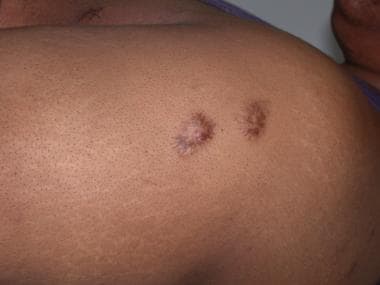
Media file 1:  A picker's nodules with no crust and a scarred appearance.
Click to see larger pictureClick to see detailView Full Size Image
Media type:  Photo

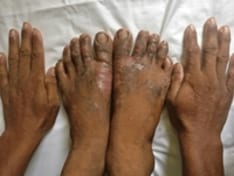
Media file 2:  A picker's nodule with crusted lesions.
Click to see larger pictureClick to see detailView Full Size Image
Media type:  Photo


  1. Shah KN, Fried RG. Factitial dermatoses in children. Curr Opin Pediatr. Aug 2006;18(4):403-9. [Medline].
  2. Cyr PR, Dreher GK. Neurotic excoriations. Am Fam Physician. Dec 15 2001;64(12):1981-4. [Medline].
  3. Setyadi HG, Cohen PR, Schulze KE, Mason SH, Martinelli PT, Alford EL, et al. Trigeminal trophic syndrome. South Med J. Jan 2007;100(1):43-8. [Medline].
  4. Shenefelt PD. Using hypnosis to facilitate resolution of psychogenic excoriations in acne excoriée. Am J Clin Hypn. Jan 2004;46(3):239-45. [Medline].
  5. Krishnan A, Koo J. Psyche, opioids, and itch: therapeutic consequences. Dermatol Ther. Jul-Aug 2005;18(4):314-22. [Medline].
  6. Dereli T, Karaca N, Inanir I, Oztürk G. Gabapentin for the treatment of recalcitrant chronic prurigo nodularis. Eur J Dermatol. Jan-Feb 2008;18(1):85-6. [Medline].
  7. Gupta MA, Gupta AK. Olanzapine may be an effective adjunctive therapy in the management of acne excoriée: a case report. J Cutan Med Surg. Jan-Feb 2001;5(1):25-7. [Medline].
  8. Biondi M, Arcangeli T, Petrucci RM. Paroxetine in a case of psychogenic pruritus and neurotic excoriations. Psychother Psychosom. May-Jun 2000;69(3):165-6. [Medline].
  9. Fried R. Psychodermatology. Dialogues in Dermatology. American Academy of Dermatology. Available at http://www.aad.org/Marketplace/Catalog/dialogues.html. Accessed 2003.
  10. Fried RG. Nonpharmacologic treatments in psychodermatology. Dermatol Clin. Jan 2002;20(1):177-85. [Medline].
  11. Gupta MA, Gupta AK. Fluoxetine is an effective treatment for neurotic excoriations: case report. Cutis. May 1993;51(5):386-7. [Medline].
  12. Gupta MA, Lanius RA, Van der Kolk BA. Psychologic trauma, posttraumatic stress disorder, and dermatology. Dermatol Clin. Oct 2005;23(4):649-56. [Medline].
  13. Koblenzer CS. Neurotic excoriations and dermatitis artefacta. Dermatol Clin. Jul 1996;14(3):447-55. [Medline].
  14. Koblenzer CS. Psychocutaneous disease. Clin Dermatol. 1985;4:1-14.
  15. Shapira NA, Lessig MC, Murphy TK, Driscoll DJ, Goodman WK. Topiramate attenuates self-injurious behaviour in Prader-Willi Syndrome. Int J Neuropsychopharmacol. Jun 2002;5(2):141-5. [Medline].
  16. Usatine RP, Saldana-Arregui MA. Excoriations and ulcers on the arms and legs. J Fam Pract. Sep 2004;53(9):713-6. [Medline].

Neurotic Excoriations excerpt

Article Last Updated: Feb 18, 2008