You are in: eMedicine Specialties >
Emergency Medicine > TRAUMA AND ORTHOPEDICS
Lumbar (Intervertebral) Disk Disorders
Article Last Updated: Feb 8, 2007
AUTHOR AND EDITOR INFORMATION
Section 1 of 10
Author: Jere F Baldwin, MD, Medical Director, Department of Emergency Medicine, Mercy Hospital Port Huron
Jere F Baldwin is a member of the following medical societies: American Academy of Family Physicians, American College of Emergency Physicians, American Medical Association, Michigan State Medical Society, and Society for Academic Emergency Medicine
Coauthor(s):
Jeffrey Horwitz, DO, Director, Assistant Clinical Professor, Department of Emergency Medicine, North Shore University Hospital at Forest Hills
Editors: Mark S Slabinski, MD, FACEP, FAAEM, Mid-Atlantic Regional Director, Emergency Medicine Physicians, Ltd; Francisco Talavera, PharmD, PhD, Senior Pharmacy Editor, eMedicine; David B Levy, DO, FACEP, FAAEM, Chairman, Department of Emergency Medicine, St Elizabeth Health Center; Associate Professor of Emergency Medicine, Northeastern Ohio Universities College of Medicine; John D Halamka, MD, MS, Associate Professor of Medicine, Harvard Medical School, Beth Israel Deaconess Medical Center; Chief Information Officer, CareGroup Healthcare System and Harvard Medical School; Attending Physician, Division of Emergency Medicine, Beth Israel Deaconess Medical Center; Rick Kulkarni, MD, Medical Director, Assistant Professor of Surgery, Section of Emergency Medicine, Yale-New Haven Hospital
Author and Editor Disclosure
Synonyms and related keywords:
lumbar disk disorders, lumbar disk disease, low back pain, sciatica, intervertebral disk disorders, back pain, sciatic nerve, disk herniation, disk bulge, disk protrusion, disk extrusion, disk sequestration, herniated disk
Background
Lumbar disk disease is a frequent source of low back pain.
Sciatica is defined as neuralgia along the course of the sciatic nerve.
Pathophysiology
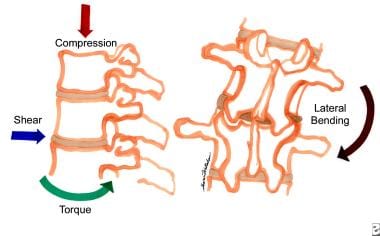
The intervertebral disks act as shock absorbers and are found between the bodies of the vertebrae. They have a central area composed of a colloidal gel, called the nucleus pulposus, which is surrounded by a fibrous capsule, the annulus fibrosis. This structure is held together by the anterior longitudinal ligament, which is anterior to the vertebral bodies, and the posterior longitudinal ligament, which is posterior to the vertebral bodies and anterior to the spinal cord. The muscles of the trunk provide additional support.
The most common site of disk herniation is at the L5-S1 interspace in the lumbosacral region. This is believed to be due to the thinning of the posterior longitudinal ligament as it extends caudally.
Nomenclature specific to lumbar disk disease is as follows:
- Disk bulge - Annular fibers intact
- Disk protrusion - Localized bulging with damage of some annular fibers
- Disk extrusion - Extended bulge with loss of annular fibers, but disk remains intact
- Disk sequestration - Fragment of disk broken off from the nucleus pulposus
Frequency
United States
Sciatica has been reported by various authors to occur in 1-10% of the population.
Mortality/Morbidity
Low back pain usually is self-limited and of short duration.
Sex
The male-to-female ratio is approximately 1:1.
Age
The group most commonly affected is adults aged 25-45 years.
History
The history may be sufficient to make presumptive diagnosis of a disk disorder, or it may guide the physician's usage of ancillary testing and consultations to further differentiate both the specific type of disk disease and potential other etiologies of the patient's back pain.
- Patients with disk disease usually are not able to give a precise time that the problem began because it usually is preceded by multiple episodes of less severe low back pain.
- Asking the patient the location of the pain is important.
- Pain that is localized to the lower back and gluteal area often is associated with disk disease.
- Pain associated with nerve root involvement commonly radiates down the leg, particularly below the level of the knee.
- Ask the patient about any unusual recent activity, especially if it involved the patient remaining in a flexed or rotated position. Find out if the patient experienced any recent trauma.
- Pain with flexion, rotation, or prolonged sitting or standing, and sharp (rather than dull) pain are suggestive of disk disease.
- The onset of pain may begin suddenly or gradually after injury.
- Typically, the pain is located bilaterally at the posterior belt line.
- The pain pattern usually is referred rather than radicular.
- Back motion, which includes sitting, standing, lifting, bending, and twisting, usually aggravates the pain; it often is relieved with rest and a recumbent position.
Physical
Nerve roots exit the spine below the intervertebral disks; thus, herniation of a disk involves the nerve root below it.
- Observe the patient for abnormal gait, which is suggestive of a loss of the normal rhythm. Have ambulatory patients walk on their toes to test the function of S1.
- Observe the patient for abnormal posture, which is suggestive of splinting or guarding from pain.
- Test the patient's ability to dorsiflex the foot while sitting to test the L5 nerve root. Test for sensory loss that corresponds to a dermatomal area.
- Palpation of the lumbar spine and lower back is not helpful in the diagnosis of disk disease, but it should be done to rule out other causes of low back pain.
- A positive straight leg raising test is indicative of nerve root involvement.
- This test is performed while the patient is lying supine with one leg either straight or flexed at the knee, with the sole of the foot flat on the stretcher. The other leg is kept straight and lifted by the examiner.
- If pain occurs when the leg is lifted between 30-70 degrees from horizontal and travels down the leg until below the knee, the test is positive.
- Nerve root stretch test results are often negative.
- Patients may exhibit decreased lumbar range of motion (ROM).
- The usual motor, sensory, and reflex examinations (including perianal sensation and anal sphincter tone when appropriate) should be performed.
- A careful abdominal and vascular examination is mandatory in evaluation of these patients.
Causes
- The normal aging process of the musculoskeletal system aggravates acute events.
- Risk factors
- Age
- Activity
- Smoking
- Obesity
- Vibration (eg, driving a car)
- Sedentary lifestyle
- Psychosocial factors
Abdominal Pain in Elderly Persons
Anemia, Sickle Cell
Aneurysm, Abdominal
Arthritis, Rheumatoid
Back Pain, Mechanical
Cauda Equina Syndrome
Constipation
Dissection, Aortic
Diverticular Disease
Epidural and Subdural Infections
Fractures, Pelvic
Herpes Zoster
Neoplasms, Spinal Cord
Osteomyelitis
Pediatrics, Sickle Cell Disease
Pelvic Inflammatory Disease
Renal Calculi
Spinal Cord Infections
Spinal Cord Injuries
Other Problems to be Considered
Spinal stenosis
Spondylolisthesis
Fracture
Ankylosing spondylitis
Degenerative joint disease
Metastatic disease
Lab Studies
- Laboratory tests generally are not helpful in the diagnosis of lumbar disk disease.
- Indications for screening laboratory examinations include pain of a nonmechanical nature, atypical pain pattern, persistent symptoms, and age older than 50 years.
- Complete blood count (CBC) with differential
- Erythrocyte sedimentation rate (ESR)
- Alkaline and acid phosphatase level
- Serum calcium level
- Serum protein electrophoresis
Imaging Studies
- Radiographic studies are very helpful in the diagnosis of lumbar disk disease, but several important caveats should be taken into account with the use of these tests.
- Most patients with pain from lumbar disk disease have resolution of their symptoms with conservative treatment.
- For an otherwise healthy individual, unless the patient is immobilized completely by the pain and requires admission, or the pain has been present for more than 6 weeks, diagnostic studies are not recommended. Elderly patients or those with a history of cancer or chronic infection (including tuberculosis), trauma, or osteoporosis should have imaging studies performed as part of their routine workup during initial presentation.
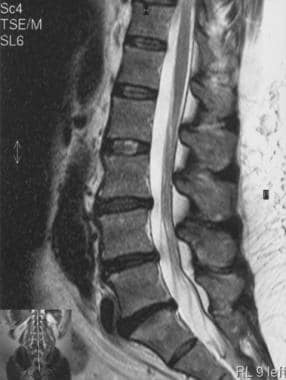
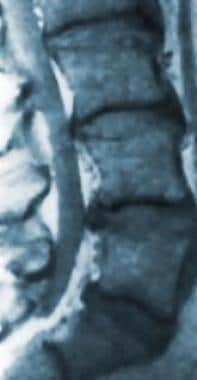
- MRI is the imaging modality of choice in evaluating patients with lumbar disk disease. Studies have shown that as many as 60% of people without back symptoms have disk bulges and protrusions on MRI. Therefore, these findings may not correlate with the patient's symptoms.
- CT scanning is useful for diagnosing disk disease but is less sensitive than MRI. CT scanning of the abdomen can help to evaluate and rule out other etiologies of pain such as aortic aneurysm, ureteral calculi, and intra-abdominal causes. Combining CT scan with myelography can increase the sensitivity of the modality for spinal cord pathology.
- Myelography may provide a definitive diagnosis on its own, but this is an invasive test requiring a lumbar puncture and the use of contrast material.
- Plain films of the lumbar spine generally are not helpful in the diagnosis of lumbar disk disease, except to rule out other diseases and to evaluate for possible skeletal etiology as the cause of the patient's symptoms. They should be performed in patients who are elderly or those with a history of cancer or chronic infection (including tuberculosis), trauma, or osteoporosis.
- Bone scan (scintigraphy)
- Technetium-99m labeled phosphorus indicates active mineralization of bone.
- A bone scan is indicated to rule out tumors, trauma, or infection.
Prehospital Care
Little is needed in the way of prehospital care. Appropriate spinal immobilization should be considered if the patient has evidence of trauma; otherwise, simple transportation in the position of comfort is all that is indicated.
Emergency Department Care
- Patients should lie in a position in which they are most comfortable.
- Muscle relaxants are of limited use, and clinical studies have not proven their efficacy. This class includes benzodiazepines, methocarbamol, and cyclobenzaprine. Patients should be warned that all of these drugs are sedating.
- Opioids provide very effective acute pain relief, but they should not be used in patients with chronic pain.
- Salicylates, acetaminophen, and nonsteroidal anti-inflammatory drugs (NSAIDs) all have been used in the treatment of pain from lumbar disk disease, but none of these has been shown to be superior to the others. Acetaminophen lacks anti-inflammatory activity.
The goals of therapy are to reduce pain and inflammation.
Drug Category: Nonsteroidal anti-inflammatory drugs (NSAIDs)
These agents are used most commonly for the relief of mild to moderately severe pain. Although effects of NSAIDs in the treatment of pain tend to be patient specific, ibuprofen usually is the DOC for initial therapy. Other options include flurbiprofen, ketoprofen, and naproxen.
| Drug Name | Ibuprofen (Ibuprin, Advil, Motrin) |
| Description | Usually DOC for treatment of mild to moderately severe pain if no contraindications. |
| Adult Dose | 200-400 mg PO q4-6h while symptoms persist; not to exceed 3.2 g/d |
| Pediatric Dose | <6 months: Not established 6 months to 12 years: 20-40 mg/kg/d PO divided tid or qid >12 years: Administer as in adults |
| Contraindications | Documented hypersensitivity; peptic ulcer disease; recent GI bleeding or perforation; renal insufficiency; high risk of bleeding |
| Interactions | Aspirin increases risk of inducing serious NSAID-related adverse effects; probenecid may increase concentrations and, possibly, toxicity; may decrease effects of hydralazine, captopril, and beta-blockers; may decrease diuretic effects of furosemide and thiazides; may increase PT in patients taking anticoagulants (monitor PT closely and instruct patients to watch for signs of bleeding); may increase risk of methotrexate toxicity; may increase phenytoin levels |
| Pregnancy | B - Usually safe but benefits must outweigh the risks.
|
| Precautions | Category D in third trimester of pregnancy; caution in congestive heart failure, hypertension, and decreased renal and hepatic function; caution in coagulation abnormalities or during anticoagulant therapy |
| Drug Name | Ketoprofen (Oruvail, Orudis, Actron) |
| Description | Used for relief of mild to moderately severe pain and inflammation. Administer small dosages initially to patients with small body size, to elderly persons, and to those with renal or liver disease. Doses higher than 75 mg do not increase therapeutic effects. Administer high doses with caution, and closely observe patient for response. |
| Adult Dose | 25-50 mg PO q6-8h prn; not to exceed 300 mg/d |
| Pediatric Dose | <3 months: Not established 3 months to 12 years: 0.1-1 mg/kg PO q6-8h >12 years: Administer as in adults |
| Contraindications | Documented hypersensitivity |
| Interactions | Aspirin increases risk of inducing serious NSAID-related adverse effects; probenecid may increase concentrations and, possibly, toxicity; may decrease effects of hydralazine, captopril, and beta-blockers; may decrease diuretic effects of furosemide and thiazides; may increase PT in patients taking anticoagulants (monitor PT closely and instruct patients to watch for signs of bleeding); may increase risk of methotrexate toxicity; may increase phenytoin levels |
| Pregnancy | B - Usually safe but benefits must outweigh the risks.
|
| Precautions | Category D in third trimester of pregnancy; caution in congestive heart failure, hypertension, and decreased renal and hepatic function; caution in coagulation abnormalities or during anticoagulant therapy |
| Drug Name | Flurbiprofen (Ansaid) |
| Description | May inhibit enzyme cyclooxygenase, which, in turn, inhibits prostaglandin biosynthesis. These effects may be mechanism of its analgesic, antipyretic, and anti-inflammatory activities. |
| Adult Dose | 200-300 mg/d PO divided bid/qid |
| Pediatric Dose | Not established |
| Contraindications | Documented hypersensitivity |
| Interactions | Aspirin increases risk of inducing serious NSAID-related adverse effects; probenecid may increase concentrations and, possibly, toxicity; may decrease effects of hydralazine, captopril, and beta-blockers; may decrease diuretic effects of furosemide and thiazides; may increase PT in patients taking anticoagulants (monitor PT closely and instruct patients to watch for signs of bleeding); may increase risk of methotrexate toxicity; may increase phenytoin levels |
| Pregnancy | C - Safety for use during pregnancy has not been established.
|
| Precautions | Category D in third trimester of pregnancy; acute renal insufficiency, interstitial nephritis, hyperkalemia, hyponatremia, and renal papillary necrosis may occur; patients with preexisting renal disease or compromised renal perfusion risk acute renal failure; leukopenia occurs rarely, is transient, and usually returns to normal during therapy; persistent leukopenia, granulocytopenia, or thrombocytopenia warrants further evaluation and may require discontinuation of drug |
| Drug Name | Naproxen (Anaprox, Naprelan, Naprosyn) |
| Description | Used for relief of mild to moderately severe pain. Inhibits inflammatory reactions and pain by decreasing activity of enzyme cyclooxygenase, causing decrease in prostaglandin synthesis. |
| Adult Dose | 500 mg followed by 250 mg PO q6-8h; not to exceed 1.25 g/d |
| Pediatric Dose | <2 years: Not established >2 years: 2.5 mg/kg/dose PO; not to exceed 10 mg/kg/d |
| Contraindications | Documented hypersensitivity; peptic ulcer disease; recent GI bleeding or perforation; renal insufficiency |
| Interactions | Aspirin increases risk of inducing serious NSAID-related adverse effects; probenecid may increase concentrations and, possibly, toxicity; may decrease effects of hydralazine, captopril, and beta-blockers; may decrease diuretic effects of furosemide and thiazides; may increase PT in patients taking anticoagulants (monitor PT closely and instruct patients to watch for signs of bleeding); may increase risk of methotrexate toxicity; may increase phenytoin levels |
| Pregnancy | B - Usually safe but benefits must outweigh the risks.
|
| Precautions | Category D in third trimester of pregnancy; acute renal insufficiency, interstitial nephritis, hyperkalemia, hyponatremia, and renal papillary necrosis may occur; patients with preexisting renal disease or compromised renal perfusion risk acute renal failure; leukopenia occurs rarely, is transient, and usually returns to normal during therapy; persistent leukopenia, granulocytopenia, or thrombocytopenia warrants further evaluation and may require discontinuation of drug |
Further Inpatient Care
- Inpatient care generally is not required, except for those rare cases of intractable pain or in cases in which the social situation does not allow adequate home care. Further inpatient care mostly consists of continued analgesics, physical therapy, and possible consultation with a spine specialist.
Further Outpatient Care
- Patients should lie in a position in which they are most comfortable.
- Bed rest is not recommended most of the time. The exception is for patients whose pain is so severe that they cannot ambulate.
- Prolonged immobilization may worsen pain and extend recovery time.
- Strict bed rest should never exceed 2 days. Patients should be encouraged to begin limited activity as soon as possible.
- Whether spinal manipulation (ie, chiropractic care) improves the rate of recovery in patients with disk disease is controversial.
- Multiple surgical techniques have been used in patients with disk herniation who have not responded to 6 weeks of conservative therapy. These techniques include diskectomy, spinal fusion, and injection of chymopapain. Newer techniques continue to be developed.
- The Spine Patient Outcomes Research Trial (SPORT) in 2006 failed to find any statistical superiority of surgical treatment versus conservative treatment for lumbar disk herniation (Weinstein and Tosteson, 2006). This occurred because the study design allowed crossover of treatment based on the patients' preference. These findings suggest that, in most cases, there is no clear reason to advocate for surgery apart from patient preference.
Deterrence/Prevention
- Smoking cessation
- Weight reduction
- Improve general physical condition
- Avoid aggravating factors
Complications
- Incorrect diagnosis
- Chronic low back pain
- Narcotic addiction
- Persistent psychosocial problems
Prognosis
- Most patients can resume normal activities.
Patient Education
Medical/Legal Pitfalls
- Failure to consider alternate diagnoses, such as acute vascular, neurologic, malignant, or infectious etiologies, of the patient's pain
- Failure to adequately advise the patient of warning signs of complications from their diagnosis. These may include loss of bowel or bladder control due to cauda equina syndrome, persistent leg numbness, weakness from a further disk herniation, or other complications.
- Carragee E. Surgical treatment of lumbar disk disorders. JAMA. Nov 22 2006;296(20):2485-7. [Medline].
- Deen HG Jr. Diagnosis and management of lumbar disk disease. Mayo Clin Proc. Mar 1996;71(3):283-7. [Medline].
- Deyo RA. Diagnostic evaluation of LBP: reaching a specific diagnosis is often impossible. Arch Intern Med. Jul 8 2002;162(13):1444-7; discussion 1447-8. [Medline].
- Deyo RA, Gray DT, Kreuter W, et al. United States trends in lumbar fusion surgery for degenerative conditions. Spine. Jun 15 2005;30(12):1441-5; discussion 1446-7. [Medline].
- Dullerud R, Nakstad PH. CT changes after conservative treatment for lumbar disk herniation. Acta Radiol. Sep 1994;35(5):415-9. [Medline].
- Frost H, Lamb SE, Doll HA, et al. Randomised controlled trial of physiotherapy compared with advice for low back pain. BMJ. Sep 25 2004;329(7468):708. [Medline].
- Gilbert FJ, Grant AM, Gillan MG, et al. Low back pain: influence of early MR imaging or CT on treatment and outcome--multicenter randomized trial. Radiology. May 2004;231(2):343-51. [Medline].
- Jarvik JG, Hollingworth W, Martin B, et al. Rapid magnetic resonance imaging vs radiographs for patients with low back pain: a randomized controlled trial. JAMA. Jun 4 2003;289(21):2810-8. [Medline].
- Jensen MC, Brant-Zawadzki MN, Obuchowski N, et al. Magnetic resonance imaging of the lumbar spine in people without back pain. N Engl J Med. Jul 14 1994;331(2):69-73. [Medline].
- Toyone T, Takahashi K, Kitahara H. Visualisation of symptomatic nerve roots. Prospective study of contrast-enhanced MRI in patients with lumbar disc herniation. J Bone Joint Surg Br. Jul 1993;75(4):529-33. [Medline].
- Weinstein JN, Tosteson TD, Lurie JD, et al. Surgical vs nonoperative treatment for lumbar disk herniation: the Spine Patient Outcomes Research Trial (SPORT): a randomized trial. JAMA. Nov 22 2006;296(20):2441-50. [Medline].
- Weinstein JN, Lurie JD, Tosteson TD, et al. Surgical vs nonoperative treatment for lumbar disk herniation: the Spine Patient Outcomes Research Trial (SPORT) observational cohort. JAMA. Nov 22 2006;296(20):2451-9. [Medline].
Lumbar (Intervertebral) Disk Disorders excerpt Article Last Updated: Feb 8, 2007
|