Continually Updated Clinical Reference
 
 
  All Sources     eMedicine     Medscape     Drug Reference     MEDLINE
 
eMedicine - Osgood-Schlatter Disease : Article by

Quick Find
Authors & Editors
Introduction
Clinical
Differentials
Workup
Treatment
Medication
Follow-up
Miscellaneous
References

Related Articles
Fractures, Tibia and Fibula


Patient Education
Foot, Ankle, Knee, and Hip Center

Arthritis Center

Bone Health Center

Knee Pain Introduction


Author: Andrew K Chang, MD, Assistant Professor, Department of Emergency Medicine, Albert Einstein College of Medicine, Montefiore Medical Center

Andrew K Chang is a member of the following medical societies: American Academy of Emergency Medicine, American Academy of Neurology, American College of Emergency Physicians, and Society for Academic Emergency Medicine

Editors: Mark S Slabinski, MD, Mid-Atlantic Regional Director, Emergency Medicine Physicians, Ltd; Francisco Talavera, PharmD, PhD, Senior Pharmacy Editor, eMedicine; David Levy, DO, Chairman, Department of Emergency Medicine, St Elizabeth Health Center; Associate Professor of Emergency Medicine, Northeastern Ohio Universities College of Medicine; John Halamka, MD, Chief Information Officer, CareGroup Healthcare System, Assistant Professor of Medicine, Department of Emergency Medicine, Beth Israel Deaconess Medical Center; Assistant Professor of Medicine, Harvard Medical School; Rick Kulkarni, MD, Medical Director, Assistant Professor of Surgery, Section of Emergency Medicine, Yale-New Haven Hospital

Author and Editor Disclosure

Synonyms and related keywords: Osgood-Schlatter disease, OS, OS disease, knee pain, knee injury, apophysitis tibialis adolescentium, Schlatter's disease, Schlatter disease, Schlatter-Osgood disease, traction apophysitis, partial avulsion fracture, proximal tibial tuberosity, patellar insertion, extra-articular disease, quadriceps atrophy, exercise, chronic microtrauma, overuse of quadriceps muscle, repetitive jumping sports, rapid skeletal growth

Background

Osgood-Schlatter (OS) disease is one of the most common causes of knee pain in the adolescent. Consisting of pain and edema of the tibial tubercle (and hence this is an extra-articular disease), OS disease is generally a benign, self-limited knee condition associated with traction apophysitis in adolescent boys and girls.

Paget first described the clinical syndrome in 1891. In 1903, Osgood and Schlatter published separate papers on the subject. Because of a lack of a precise definition, differentiating OS disease from avulsion fractures of the tibial tubercle is difficult.

Pathophysiology

Histologic studies suggest a traumatic etiology for OS disease. Bone growth is faster than soft tissue growth, which may result in muscle tendon tightness across the joint and loss of flexibility.

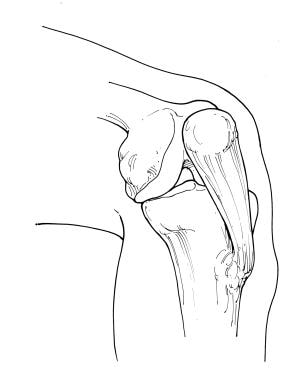
During periods of rapid growth, stress from contraction of the quadriceps is transmitted through the patellar tendon onto a small portion of the partially developed tibial tuberosity. This may result in a partial avulsion fracture through the ossification center. Eventually, secondary heterotopic bone formation occurs in the tendon near its insertion, producing a visible lump. Approximately 25% of patients have bilateral lesions.

In an MRI study of 20 patients with OS disease, the patellar tendon was noted to attach more proximally and in a broader area to the tibia in patients with OS disease.1

Frequency

United States

The frequency of OS disease is not known, but the condition is uncommon.

International

One Finnish study found that OS disease affected 13% of athletes.

Mortality/Morbidity

OS disease is typically a benign and self-limited condition that waxes and wanes but often takes months to years to resolve entirely.

Sex

OS disease occurs more frequently in boys, probably because a greater number of boys participate in sports.

Age

  • OS disease usually is seen in the adolescent years after undergoing a rapid growth spurt the previous year.
  • Girls who are affected are typically aged 10-11 years.
  • Boys who are affected are typically aged 13-14 years.


History

  • Pain is the most common presenting complaint.
    • The pain may be reproduced by extending the knee against resistance, stressing the quadriceps, or squatting with the knee in full flexion.

    • Running, jumping, kneeling, squatting, and ascending/descending stairs exacerbate the pain.

    • Relief of symptoms occurs with rest or restriction of activities.

    • Pain usually has been present intermittently for several months before the patient sees the physician.

    • The pain is bilateral in 25% of cases.

    • Approximately 50% of patients give a history of precipitating trauma.

Physical

  • A visible soft tissue edema is present over the proximal tibial tuberosity.
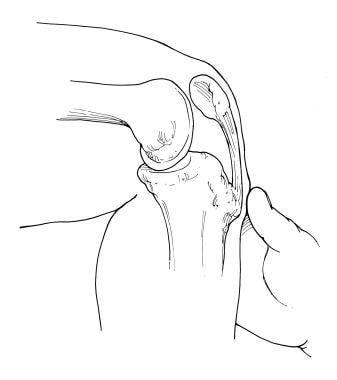
  • Tenderness to palpation over the proximal tibial tuberosity at the site of patellar insertion may be present.
  • A firm mass may be palpable.
  • Pain is reproduced by extension against forced resistance.
  • Knee joint examination is normal; OS disease is an extra-articular disease.
  • Absence of effusion or condylar tenderness is typical.
  • Erythema of the tibial tuberosity may be present.
  • Some patients may have quadriceps atrophy.

Causes

  • The etiology is controversial, but the condition clearly is exacerbated by exercise.
  • Approximately 50% of patients relate a history of precipitating trauma.
  • Chronic microtrauma to the tibial tuberosity secondary to overuse of the quadriceps muscle is a leading theory of etiology.
  • Histologic studies support a traumatic etiology.
  • Risk factors
    • Age between 11 and 18 years
    • Male sex
    • Rapid skeletal growth
    • Repetitive jumping sports


Fractures, Tibia and Fibula

Other Problems to be Considered

Quadriceps tendon avulsion
Patellofemoral stress syndrome
Pes anserinus bursitis
Chondromalacia patellae
Osteomyelitis of the proximal tibia
Patellar tendonitis
Sinding-Larsen-Johansson syndrome


Lab Studies

  • Laboratory evaluation is not indicated unless other diagnoses are being entertained.

Imaging Studies

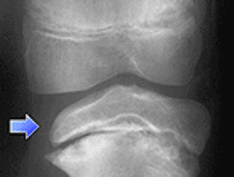
  • Knee radiography (anteroposterior and lateral)

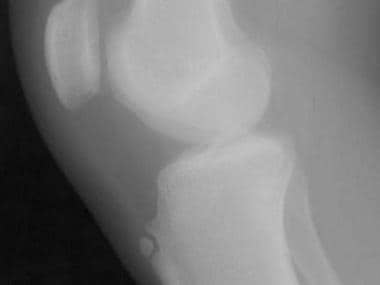
    • The OS lesion is best seen on the lateral view with the knee in slight internal rotation.
    • Not all patients with OS disease need radiography since the diagnosis is primarily clinical. Plain films are helpful to rule out other etiologies, such as neoplasm and infection.
    • Superficial ossicle in the patellar tendon
    • Irregular ossification of the proximal tibial tuberosity
    • Calcification within the patellar tendon
    • Thickening of the patellar tendon
    • Soft tissue edema proximal to the tibial tuberosity
  • Bone scan may demonstrate increased uptake in the area of the tibial tuberosity.

Procedures

  • Corticosteroid injections are not recommended because of case reports of complications, primarily related to subcutaneous atrophy.


Emergency Department Care

No prospective, interventional studies evaluating the treatment of OS disease, including the recommended conservative treatments (ice, analgesics, activity restriction, stretching, strengthening, or anti-inflammatory medications), are available.

  • Once the diagnosis is made and other pathologies are ruled out, the patient may be discharged with primary care or orthopedic referral. Therapy is conservative.
  • Initial treatment includes the application of ice for 20 minutes every 2-4 hours.
  • Analgesics and nonsteroidal anti-inflammatory drugs (NSAIDs) may be given for pain relief and reduction of local inflammation.
  • Inform the patient to avoid pain-producing activities (eg, sports that involve excess amounts of jumping).
  • Use of a knee immobilizer for a few days may improve compliance, especially in more severe cases. Pads or braces also can be used for support.
  • Once the acute symptoms have abated, quadriceps-stretching exercises, including hip extension for a complete stretch of the extensor mechanism, may be performed to reduce tension on the tibial tubercle. Stretching exercises for the hamstrings, which are commonly tight, may also be performed.

Consultations

Approximately 90% of cases do well with nonoperative treatment. Refractory cases unresponsive to conservative treatment should be referred to an orthopedist for possible surgical intervention.


The only medications that need to be prescribed are NSAIDs for pain relief and reduction of local inflammation (any NSAID may be used). However, one author concluded that anti-inflammatory drugs are not particularly beneficial in the management of OS disease.

Drug Category: Nonsteroidal anti-inflammatory agents

These agents are commonly used for relief of mild to moderate pain. Although the effects of NSAIDs in the treatment of pain tend to be patient specific, ibuprofen is usually the DOC for initial therapy. Other options include naproxen, flurbiprofen, and ketoprofen.

Drug NameIbuprofen (Ibuprin, Advil, and Motrin)
DescriptionDOC for patients with mild to moderate pain. Inhibits inflammatory reactions and pain by decreasing prostaglandin synthesis.
Adult Dose200-400 mg PO q4-6h while symptoms persist; not to exceed 3.2 g/d
Pediatric Dose<6 months: Not established
6 months to 12 years: 20-40 mg/kg/d PO divided tid/qid
>12 years: Administer as in adults
ContraindicationsDocumented hypersensitivity; peptic ulcer disease; recent GI bleeding or perforation; renal insufficiency; high risk of bleeding
InteractionsCoadministration with aspirin increases risk of inducing serious NSAID-related adverse effects; probenecid may increase concentrations and, possibly, toxicity of NSAIDs; may decrease effect of hydralazine, captopril, and beta-blockers; may decrease diuretic effects of furosemide and thiazides; monitor PT closely (instruct patients to watch for signs of bleeding); may increase risk of methotrexate toxicity; phenytoin levels may be increased when administered concurrently
PregnancyB - Usually safe but benefits must outweigh the risks.
D - Unsafe in pregnancy
PrecautionsCaution in congestive heart failure, hypertension, and decreased renal and hepatic function; caution in anticoagulation abnormalities or during anticoagulant therapy

Drug NameKetoprofen (Oruvail, Orudis, and Actron)
DescriptionFor relief of mild to moderate pain and inflammation. Small doses initially are indicated in small and elderly patients and in those with renal or liver disease. Doses >75 mg do not increase therapeutic effects. Administer high doses with caution, and closely observe patient for response.
Adult Dose25-50 mg PO q6-8h prn; not to exceed 300 mg/d
Pediatric Dose<3 months: Not established
3 months to 12 years: 0.1-1 mg/kg PO q6-8h
>12 years: Administer as in adults
ContraindicationsDocumented hypersensitivity
InteractionsCoadministration with aspirin increases risk of inducing serious NSAID-related adverse effects; probenecid may increase concentrations and, possibly, toxicity of NSAIDs; may decrease effect of hydralazine, captopril, and beta-blockers; may decrease diuretic effects of furosemide and thiazides; monitor PT closely (instruct patients to watch for signs of bleeding); may increase risk of methotrexate toxicity; phenytoin levels may be increased when administered concurrently
PregnancyB - Usually safe but benefits must outweigh the risks.
D - Unsafe in pregnancy
PrecautionsCaution in congestive heart failure, hypertension, and decreased renal and hepatic function; caution in anticoagulation abnormalities or during anticoagulant therapy

Drug NameFlurbiprofen (Ansaid)
DescriptionMay inhibit cyclooxygenase enzyme, which inhibits prostaglandin biosynthesis. These effects may result in analgesic, antipyretic, and anti-inflammatory activities.
Adult Dose200-300 mg/d PO divided bid/qid
Pediatric DoseNot established
ContraindicationsDocumented hypersensitivity
InteractionsCoadministration with aspirin increases risk of inducing serious NSAID-related adverse effects; probenecid may increase concentrations and, possibly, toxicity of NSAIDs; may decrease effect of hydralazine, captopril, and beta-blockers; may decrease diuretic effects of furosemide and thiazides; monitor PT closely (instruct patients to watch for signs of bleeding); may increase risk of methotrexate toxicity; phenytoin levels may be increased when administered concurrently; nephrotoxicity of cyclosporine may be increased
PregnancyC - Safety for use during pregnancy has not been established.
D - Unsafe in pregnancy
PrecautionsAcute renal insufficiency, interstitial nephritis, hyperkalemia, hyponatremia, and renal papillary necrosis may occur; patients with preexisting renal disease or compromised renal perfusion risk acute renal failure; leukopenia occurs rarely, is transient, and usually returns to normal during therapy; persistent leukopenia, granulocytopenia, or thrombocytopenia warrants further evaluation and may require discontinuation of drug

Drug NameNaproxen (Anaprox, Naprelan, and Naprosyn)
DescriptionFor relief of mild to moderate pain; inhibits inflammatory reactions and pain by decreasing activity of cyclooxygenase, which results in a decrease of prostaglandin synthesis.
Adult Dose500 mg PO, followed by 250 mg q6-8h; not to exceed 1.25 g/d
Pediatric Dose<2 years: Not established
>2 years: 2.5 mg/kg/dose PO; not to exceed 10 mg/kg/d
ContraindicationsDocumented hypersensitivity; peptic ulcer disease; recent GI bleeding or perforation; renal insufficiency
InteractionsCoadministration with aspirin increases risk of inducing serious NSAID-related adverse effects; probenecid may increase concentrations and, possibly, toxicity of NSAIDs; may decrease effect of hydralazine, captopril, and beta-blockers; may decrease diuretic effects of furosemide and thiazides; monitor PT closely (instruct patients to watch for signs of bleeding); may increase risk of methotrexate toxicity; phenytoin levels may be increased when administered concurrently
PregnancyB - Usually safe but benefits must outweigh the risks.
D - Unsafe in pregnancy
PrecautionsAcute renal insufficiency, interstitial nephritis, hyperkalemia, hyponatremia, and renal papillary necrosis may occur; patients with preexisting renal disease or compromised renal perfusion risk acute renal failure; leukopenia occurs rarely, is transient, and usually returns to normal during therapy; persistent leukopenia, granulocytopenia, or thrombocytopenia warrants further evaluation and may require discontinuation of drug


Further Inpatient Care

  • Surgical treatment is rarely indicated and is generally reserved for patients with recurrent disabling pain unresponsive to conservative therapy. In general, surgical intervention yields good results, especially for patients with bony or cartilaginous ossicles.
    • Once the other physes have closed, surgery may be necessary for non-united ossicles.
    • Simple excision of the mobile ossicle may be necessary.
    • A tuberosity thinning procedure followed by ossicle excision may be performed.
    • In one case series, 67 patients (70 knees) with at least 1.5 years of symptoms despite conservative treatment underwent resection of an ossicle (62 cases) or excision of prominent tibial tubercle (8 cases). These patients (mean age, 19.6 y; 77% male) were observed for 2.2 years, with 56 (90%) of patients with ossicle-resection able to return to maximal sports activity without pain, tenderness, loss of motion, or atrophy.2

Further Outpatient Care

  • Conservative therapy is usually all that is needed.
    • Avoid physical activities that require frequent deep knee bending for 2-4 months.

    • Therapeutic exercises to strengthen the quadriceps and the hamstrings are prescribed.

  • Orthopedic devices
    • Infrapatellar strap

    • Knee brace

    • Walking cylinder cast (full extension for 3-6 wk)

  • Analgesics
    • Control pain and inflammation

    • Corticosteroid injections should be avoided because of the risk of degenerative changes and subcutaneous atrophy.

Deterrence/Prevention

  • Patients should avoid sports that involve heavy quadriceps loading.
  • Patients should increase hamstring and quadriceps flexibility.

Complications

  • Nonunion of the tibial tubercle
  • Upriding of the patella
  • Patellar tendon avulsion
  • Genu recurvatum
  • Patellofemoral degenerative arthritis
  • Patellar subluxation
  • Patella alta
  • Chondromalacia

Prognosis

  • The prognosis is excellent. Symptoms usually resolve spontaneously within 1 year.
  • Discomfort may persist for 2-3 years until the tibial growth plate closes.
  • Persisting complaints may be from residual enlargement of the tuberosity or from ossicle formation in the patellar tendon.

Patient Education


Medical/Legal Pitfalls

  • Failure to consider other diagnoses, such as underlying fracture or tumor
  • Failure to advise the patient of activity restrictions


  1. Demirag B, Ozturk C, Yazici Z, Sarisozen B. The pathophysiology of Osgood-Schlatter disease: a magnetic resonance investigation. J Pediatr Orthop B. Nov 2004;13(6):379-82. [Medline].
  2. Orava S, Malinen L, Karpakka J, Kvist M, Leppilahti J, Rantanen J, et al. Results of surgical treatment of unresolved Osgood-Schlatter lesion. Ann Chir Gynaecol. 2000;89(4):298-302. [Medline].
  3. Aparicio G, Abril JC, Calvo E, Alvarez L. Radiologic study of patellar height in Osgood-Schlatter disease. J Pediatr Orthop. Jan-Feb 1997;17(1):63-6. [Medline].
  4. Binazzi R, Felli L, Vaccari V, Borelli P. Surgical treatment of unresolved Osgood-Schlatter lesion. Clin Orthop. Apr 1993;202-4. [Medline].
  5. Bloom OJ, Mackler L, Barbee J. Clinical inquiries. What is the best treatment for Osgood-Schlatter disease?. J Fam Pract. Feb 2004;53(2):153-6. [Medline].
  6. Dunn JF. Osgood-Schlatter disease. Am Fam Physician. Jan 1990;41(1):173-6. [Medline].
  7. Flowers MJ, Bhadreshwar DR. Tibial tuberosity excision for symptomatic Osgood-Schlatter disease. J Pediatr Orthop. May-Jun 1995;15(3):292-7. [Medline].
  8. Gholve PA, Scher DM, Khakharia S, Widmann RF, Green DW. Osgood Schlatter syndrome. Curr Opin Pediatr. Feb 2007;19(1):44-50. [Medline].
  9. Hussain A, Hagroo GA. Osgood-Schlatter disease. Sports Exer Injury. 1996;2:202-206.
  10. Krause BL, Williams JP, Catterall A. Natural history of Osgood-Schlatter disease. J Pediatr Orthop. Jan-Feb 1990;10(1):65-8. [Medline].
  11. Micheli LJ. The traction apophysitises. Clin Sports Med. Apr 1987;6(2):389-404. [Medline].
  12. Rostron PK, Calver RF. Subcutaneous atrophy following methylprednisolone injection in Osgood-Schlatter epiphysitis. J Bone Joint Surg Am. Jun 1979;61(4):627-8. [Medline].
  13. Smith JB. Knee problems in children. Pediatr Clin North Am. Dec 1986;33(6):1439-56. [Medline].

Osgood-Schlatter Disease excerpt

Article Last Updated: Jul 18, 2007