Practice Essentials
Rotavirus (see the image below) is one of several viruses known to cause a self-limited gastroenteritis. Fluid stool losses may be dramatic, and death from dehydration is not uncommon, particularly in developing countries. [1]
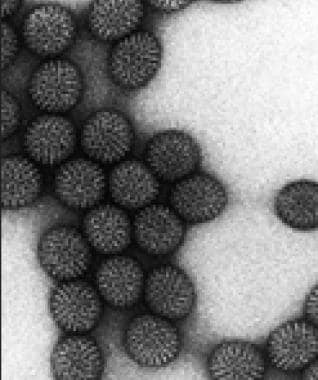 Transmission electron micrograph of rotavirus. Image courtesy of Centers for Disease Control and Prevention.
Signs and symptoms
Symptoms of rotavirus infection usually begin within 2 days of exposure and include the following:
-
Anorexia
-
Low-grade fever
-
Watery, bloodless diarrhea
-
Vomiting
-
Abdominal cramps
Stool output can be copious during the diarrheal phase of the illness, and dehydration is a common presenting complaint.
See Clinical Presentation for more detail.
Diagnosis
The physical examination findings for rotavirus infection are often unremarkable except for signs of dehydration. Other findings on examination may include the following:
-
Hyperactive bowel sounds: Most common finding
-
Sunken eyes and/or anterior fontanelle
-
Dry or sticky-appearing mucosa
-
Rough skin or diarrhea-induced diaper dermatitis
-
Tachycardia: Can be disproportionate to the temperature
-
Rectal examination: May stimulate production of watery, heme-negative stools
-
Depressed sensorium
-
Weight loss
Significantly decreased urine output is an important sign. However, this may be hard to identify in diapered infants, because the massive watery stool output makes it difficult to determine the amount of urine output.
Laboratory testing
Rotavirus may be identified by the following means [2] :
-
Enzyme immunoassay (most common)
-
Latex agglutination
-
Electron microscopy
-
Culture
Other laboratory studies include measurement of electrolyte levels in patients with severe dehydration, alterations in mental status, associated seizures, or oral replenishment with excessive water or salt, as well as measurement of bedside glucose levels in very young infants and in any age child with associated lethargy.
See Workup for more detail.
Management
In most cases, no medication is required for rotavirus infection. Instead, attention should be directed to appropriate fluid intake and other conservative measures.
Supportive care
Supportive care in infants with rotavirus infection includes the following:
-
Ensuring a secure airway and breathing, identification of circulatory compromise, and maintenance of adequate circulation
-
Administering 20 mL/kg boluses of isotonic sodium chloride solution or Ringer lactate solution until volume restoration in infants who appear significantly dehydrated (A total requirement of 60-80 mL/kg is not uncommon.)
-
Maintaining hydration: Key issue for children who are not dehydrated; selection of an appropriate fluid is crucial (ideally, commercial infant solutions, such as Pedialyte and Rice-Lyte); small, frequent feedings work better in infants who are vomiting; after resolution of vomiting, administer standard soy-based infant formula
-
Administering supplemental feedings of oral maintenance solutions to infants with excessive fluid losses
-
Consideration of antiemetics for vomiting children older than 6 months
There are currently 2 FDA-approved rotavirus vaccines to protect against rotavirus gastroenteritis (ie, RotaTeq and Rotarix). These vaccines are indicated in infants aged 6-32 weeks (RotaTeq) and those aged 6-24 weeks (Rotarix).
Note that in June 2013, the FDA approved required labeling for RotaTeq regarding intussusception data from the Mini-Sentinel’s Postlicensure Rapid Immunization Safety Monitoring (PRISM) program, the largest vaccine safety surveillance program in the United States. [3] The Mini-Sentinel PRISM study identified an increased risk of intussusception in the 21-day time period after the first dose of RotaTeq, with most cases occurring in the first 7 days after vaccination. No increased risk was found after the second or third doses. The findings translate into 1 to 1.5 additional cases of intussusception per 100,000 first doses of RotaTeq. [3]
The data from the Mini-Sentinel PRISM study regarding the risk of intussusception following the use of Rotarix were inconclusive. [3] Therefore, no labeling changes were required.
See Treatment and Medication for more detail.

Background
Rotavirus is one of several viruses known to cause gastroenteritis. The rotavirus genome consists of 11 segments of double-stranded RNA enclosed in a double-shelled capsid. It is classified in the Reoviridae family. Rotavirus is a self-limited infection. Fluid stool losses may be dramatic, and death from dehydration is not uncommon, particularly in developing countries. [1]
Transmission electron micrograph of rotavirus. Image courtesy of Centers for Disease Control and Prevention.
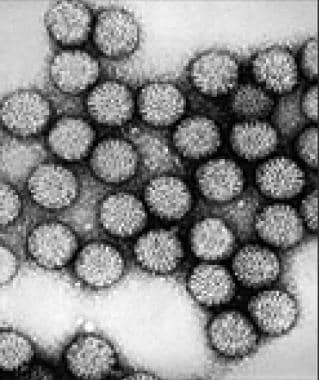 Transmission electron micrograph of intact rotavirus particles, double-shelled. Image courtesy of Centers for Disease Control and Prevention and Dr. Erskine Palmer.
Rotavirus infection most commonly strikes during the winter months (December through May), but it occurs year round in developing countries. In the United States every year, rotavirus first appears in the Southwest and spreads to the Northeast. [4] Almost every child 5 years and younger at some point will be infected with rotavirus in both developed countries and developing countries.
The most significant risk factor for rotavirus infection appears to be participation in group daycare, presumably because the virus is spread through fecal-oral contact by the children themselves and by the daycare workers who are responsible for diapering. Also, fomites serve as important vectors for viral transmission.
Pathophysiology
Rotavirus, like other viruses that cause enteritis, primarily infects the cells of the small intestinal villi, especially those cells near the tips of the villi. Because these particular cells have a role in the digestion of carbohydrates and in the intestinal absorption of fluid and electrolytes, rotavirus infections lead to malabsorption by impaired hydrolysis of carbohydrates and excessive fluid loss from the intestine. A secretory component of the diarrhea with increased motility can further exacerbate the illness. This increased motility appears to be secondary to virus-induced functional changes at the villus epithelium.
The pathologic changes to the intestinal lining may not correlate well with the clinical manifestations of the illness. In normal hosts, infections rarely occur in another organ system, although extraintestinal infections have been seen in immunocompromised hosts. [5]
The virus is shed in high titers in the stool starting before the onset of symptoms and persists for up to 10 days after symptom appearance.
Epidemiology
United States statistics
Before the introduction of the rotavirus vaccines, this virus was estimated to cause 2.1-3.2 million diarrheal illnesses each year, with 55,000-70,000 of these requiring hospitalization annually. [2, 6, 7] In the 1990s and early 2000s, 410,000-600,000 office visits and 205,000-272,000 emergency department annual visits were attributed to rotavirus, and this resulted in yearly direct and indirect costs of the illness to be approximately $1 billion. [2, 7]
International statistics
Worldwide incidence of rotavirus is estimated to cause more than 125 million cases of infantile diarrhea annually. [8] Rotavirus is the foremost cause of childhood dehydrating gastroenteritis worldwide. [2, 9] More than 2 million children younger than 5 years of age are hospitalized annually due to rotavirus gastroenteritis, and, of these, approximately 500,000-527,000 children die from this disease. [10, 11]
In South Africa, a meta-analysis by Omatola et al found that rotavirus vaccination was associated with a reduction in the pooled national prevalence of rotavirus infection, which decreased from an estimated 24% before the vaccine was introduced to 23% after the vaccine became available. [12] In Nigeria, a meta-analysis by Digwo et al showed that the nationwide pooled prevalence of rotavirus infection among children aged younger than 5 years is 23%. [13]
Race-, sex-, and age-related demographics
Race
Race is not a factor in rotavirus infection, but one study did show that there was a reduced risk of hospitalization in infants born from Asian mothers in Washington State. [14] Socioeconomic class also plays an important role as this disease is more prevalent among children with Medicaid insurance. [14]
Sex
Rotavirus affects males and females equally, although males with viral gastroenteritis have been associated with an increased risk of hospitalization compared with females. [14]
Age
Rotavirus can cause illness in adults and children. However, adults are often asymptomatic or less severely affected.
Adults, if affected, usually have a few days of nausea, anorexia, and cramping pain. [15] Diarrhea is a less significant symptom in adults than in children.
Young children aged 4-24 months, particularly those in group daycare settings, are at increased risk for acquiring rotavirus.
Low birth weight and prematurity as well as the paucity of breastfeeding have been associated with hospitalization from rotavirus. [16]
Almost every child worldwide is infected by rotavirus by the age of 3 to 5 years. [17]
In countries with relatively low incomes, the median age at which an infant develops rotavirus infectious symptoms is between 6 to 9 months with 80% of the infections occurring at < 1 year of age. [17]
In higher income countries, there is often a delay in rotavirus infectious symptoms until age 2-5 years, but there is a similarity with other countries in that the majority occur during infancy (65% occurring here in infants < 1 year of age). [17]
Prognosis
The prognosis for rotavirus infection is excellent as long as adequate hydration is maintained. Most children recover within a week of symptom onset.
Rotavirus enteritis has virtually no important long-term sequelae.
Reinfection is a common phenomenon.
Morbidity/mortality
Before the introduction of the newer rotavirus vaccines, rotavirus was estimated to cause 20-60 deaths annually in the United States in children younger than 5 years. [2, 18]
Approximately 500,000-527,000 deaths in children younger than 5 years are seen worldwide due to rotavirus. [10, 11] More than 80% of deaths attributable to rotavirus infection occur in sub-Saharan Africa. [19] Virtually all these deaths throughout the world occur as a result of hypovolemia.
Significant morbidity is rare in the United States, but dehydration and shock can result in ischemic injury to the kidneys or the central nervous system.
Children who become severely dehydrated may develop deep venous thromboses or cerebral venous thrombosis.
Following introduction of the rotavirus vaccine in 2006, the incidence of severe gastroenteritis has declined significantly not only among children younger than 5 years but also in older age groups. A study using data from the Nationwide Inpatient Sample analyzed rotavirus-coded and cause-unspecified gastroenteritis discharges over a 10-year period and found there were significant reductions in rate ratios (RR) of rotavirus-coded gastroenteritis during 2008-2010 in the 0-4 year age group (RR, 0.20), those aged 5-14 years (RR, 0.30), and those aged 15-24 years (RR, 0.47). [20, 21] Moreover, significant reductions also occurred in cause-unspecified gastroenteritis in the 0-4 year age group (RR, 0.58), those aged 5-14 years (RR, 0.70), those aged 15-24 years (RR, 0.89), and those aged 25-44 years (RR, 0.94). [20, 21]
Complications
The most important complication of rotavirus infection is dehydration.
Multisystem organ failure is possible when dehydration leads to shock and even death.
Patient Education
Parents should be taught the signs and symptoms associated with dehydration and should be instructed to seek care immediately upon noticing any of these signs or symptoms in a child.
Parents must know which fluids should and should not be given and how to administer these fluids to young children who are vomiting.
Parents should be informed about early refeeding with a soy-based infant formula and a bland, general diet, which may include lactose-free milk for toddlers.
Diarrhea can last for 5-7 days.
-
Transmission electron micrograph of rotavirus. Image courtesy of Centers for Disease Control and Prevention.
-
Transmission electron micrograph of intact rotavirus particles, double-shelled. Image courtesy of Centers for Disease Control and Prevention and Dr. Erskine Palmer.
-
This electron micrograph reveals a number of RNA rotavirus virions, and a number of unknown, 29nm virion particles. Image courtesy of Centers for Disease Control and Prevention.
Tables

What would you like to print?
- Live Rotavirus Vaccine Safe for Newborns of Biologic-Treated Moms With IBD
- UK Health Officials Warn of Second Norovirus Wave
- Doctor With Wish List for More Vaccine Scrutiny Named Assistant to New FDA Chief, Sources Say
-
 Norovirus Cases Are on the Upswing, CDC Says
-
Rotavirus Vaccine Gives No Type 1 Diabetes Prevention
-
Acute Gastroenteritis in US CausesWidespread Disease



 Top News From IDSA 2011: Slideshow