Continually Updated Clinical Reference
 
 
  All Sources     eMedicine     Medscape     Drug Reference     MEDLINE
 
eMedicine - Plant Poisoning, Toxicodendron : Article by

Quick Find
Authors & Editors
Introduction
Clinical
Differentials
Workup
Treatment
Medication
Follow-up
Multimedia
References

Related Articles
Nontoxicodendron contact dermatitis

Urticaria


Patient Education
Allergy Center

Allergy: Poison Ivy, Oak, and Sumac Overview

Allergy: Poison Ivy, Oak, and Sumac Causes

Allergy: Poison Ivy, Oak, and Sumac Symptoms

Allergy: Poison Ivy, Oak, and Sumac Treatment


Author: Steven L Stephanides, MD, Associate Professor, Department of Emergency Medicine, University of California at Irvine School of Medicine; Consulting Staff, Department of Emergency Medicine, Eisenhower Medical Center

Steven L Stephanides is a member of the following medical societies: American College of Emergency Physicians, National Association of EMS Physicians, Society for Academic Emergency Medicine, and Wilderness Medical Society

Coauthor(s): Chris Moore, MD, PhD, Medical Director, Department of Emergency Medicine, Virginia Mason Medical Center

Editors: Miguel C Fernandez, MD, FAAEM, FACEP, FACMT, Associate Clinical Professor; Medical and Managing Director, South Texas Poison Center, Department of Surgery/Emergency Medicine and Toxicology, University of Texas Health Science Center at San Antonio; John T VanDeVoort, PharmD, ABAT, Director of Pharmacy, Sacred Heart Hospital; Michael Hodgman, MD, Assistant Clinical Professor of Medicine, Department of Emergency Medicine, Bassett Healthcare; John Halamka, MD, Chief Information Officer, CareGroup Healthcare System, Assistant Professor of Medicine, Department of Emergency Medicine, Beth Israel Deaconess Medical Center; Assistant Professor of Medicine, Harvard Medical School; Asim Tarabar, MD, Assistant Professor, Department of Surgery, Section of Emergency Medicine, Yale University School of Medicine; Consulting Staff, Department of Emergency Medicine, Yale-New Haven Hospital

Author and Editor Disclosure

Synonyms and related keywords: rhus dermatitis, urushiol-containing plants, poison ivy, Toxicodendron rydbergii, poison oak, Toxicodendron diversilobum, poison sumac, Toxicodendron vernix, plant poisoning, toxicodendron exposure, toxicodendron dermatitis, allergic contact dermatitis, allergic phytodermatitis, contact dermatitis


Background

Toxicodendron dermatitis is an allergic contact dermatitis (allergic phytodermatitis) that occurs from exposure to members of the plant genus Toxicodendron. In North America, this includes poison ivy, poison oak, and, much less frequently, poison sumac. Although technically not Toxicodendron species, the irritant chemical (urushiol) is also found in mangoes and Japanese lacquer trees and can incite a similar clinical picture. A large number of other botanicals that produce a similar reaction mediated by different irritant chemicals also exist.

Pathophysiology

Toxicodendron species contain oleoresins known collectively as urushiol. In susceptible individuals, these compounds trigger a type IV delayed hypersensitivity reaction. Usually, the skin is involved; however, the eyes, airway, and lungs may be involved if exposed to smoke from burning plants. Reactions from gastrointestinal exposure in the form of urushiol-containing homeopathic remedies have also been reported. In susceptible individuals, lesions generally appear within 12-48 hours, although they have been noted to appear earlier. New lesions may continue to appear for up to 2-3 weeks. Initially, these lesions tend to occur from the slow reaction to adsorbed urushiol; however, lesions that appear later are often secondary to contact with contaminated surfaces (eg, clothing, pet hair, gardening tools, camping equipment). Although a common misconception, fluid from the vesicles of a poison ivy rash does not contain urushiol and is not an irritant source for new lesions.

Frequency

United States

Toxicodendron species are abundant throughout the United States except in desert areas, elevations above 4000 ft, Alaska, or Hawaii. Poison oak is most common west of the Rockies, poison ivy to the east, and poison Sumac in the southeast. Approximately 50-70% of the US population is susceptible if exposed casually; however, this percentage increases with significant exposure. Approximately 10-15% of the population is extremely sensitive. Toxicodendron dermatitis is the most common cause of contact dermatitis in the United States, exceeding all other causes combined.

International

Toxicodendron dermatitis occurs outside North America. However, the most prevalent form of plant dermatitis worldwide occurs from exposure to the numerous members of the family Compositae and varied sesquiterpene lactone allergens from these plants. With increasing global travel and transport of plants, true toxicodendron dermatitis is being increasingly reported in Europe, although it is still case reportable.1, 2

Mortality/Morbidity

Morbidity is related to sensitivity of the individual exposed as well as the degree and route of exposure. Morbidity ranges from localized mild erythema and pruritus to diffuse erythema, edema, severe pain, and pruritus with bullous lesions. Secondary infection can complicate the dermatitis.

Race

No clear racial difference in susceptibility exists.

Sex

No difference in susceptibility between the sexes exists.

Age

Elderly people have reduced sensitivity.


History

  • Known exposure to poison ivy, oak, or sumac
  • Outdoor activities in areas with Toxicodendron species within the previous 8 hours to 14 days
  • History of toxicodendron dermatitis
  • Contact with a pet who has been outside in an area with Toxicodendron species

Physical

The dermatitidis is highly variable and depends on the sensitivity of the patient and extent of exposure.

  • Mild cases
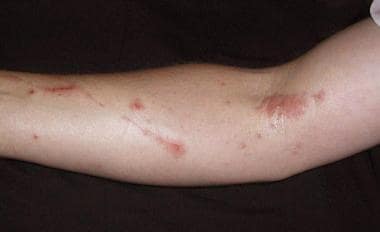
    • In mild cases, classic lesions on exposed skin are secondary to brushing against the plant or excoriations from scratching.
    • Characteristics of mild classic lesions are as follows:
      • Linear
      • Erythematous, possibly edematous
      • Pruritic or mildly painful
      • May have small vesicles
  • Moderate-to-severe cases
    • Diffuse areas of erythema and edema
    • Severe pruritus and/or pain
    • Bullae (Note that fluid from bullae does not contain urushiol.)
  • Erythema multiforme is an atypical presentation of toxicodendron dermatitis.

Causes

Exposure to urushiol-containing plants

  • Poison ivy (Toxicodendron rydbergii), poison oak (Toxicodendron diversilobum), and poison sumac (Toxicodendron vernix) are most common in North America.
  • Urushiol can also be found in mango plants and Japanese lacquer tree (Rhus verniciflua), although these are not Toxicodendron species.
    • Mango fruit skin can cause reaction in susceptible individuals.
    • Exposure to unroasted cashew nut shells can cause a dermatitis often confused with toxicodendron dermatitis in susceptible individuals. Roasting inactivates the allergen.


Nontoxicodendron contact dermatitis
Urticaria

Other Problems to Be Considered

Photosensitivity
Cellulites
Contact dermatitis, nontoxicodendron


Lab Studies

  • Laboratory testing is usually not necessary as part of the ED evaluation.

Imaging Studies

  • Imaging studies do not aid in diagnosing toxicodendron dermatitis.

Other Tests

  • Patch testing is discouraged for toxicodendron dermatitis because it might sensitize an unsensitized individual. However, if contact dermatitis is being considered, patch testing for other allergens might be considered.


Prehospital Care

The initial treatment of toxicodendron dermatitis includes using barriers to prevent exposure and washing the affected area as soon as possible after exposure.

  • Barriers
    • Classic preventative strategies include wearing long sleeves, long pants, and gloves. Vinyl gloves are preferred because they will not absorb the urushiol as readily as leather or fabric glove. Rubber gloves can be permeable to urushiol.
    • A number of commercially available creams are marketed to prevent penetration of urushiol into the skin. The published data on these remedies are limited and conflicting. Although some protective effect is suggested, the degree of protection and the cost-to-benefit ratio are unclear.
  • Washing: Washing exposed areas with copious amounts of water within 20 minutes of exposure has been shown to reduce reactivity. The efficacy of washing appears to decrease over time.

Emergency Department Care

Treatment can be considered in the following 3 categories: decontamination, topical/symptomatic treatment, and immunomodulation.

  • Decontamination
    • Immediate decontamination: Urushiol penetrates the skin and binds to membrane lipids within 10-20 minutes of contact. If the toxin can be removed before this occurs, reaction can be avoided.
    • Although multiple products are marketed for skin decontamination, they are only slightly more efficacious than soap and water. Copious water is recommended because soaps can spread the urushiol oil around the skin.
    • It is important to instruct patients to clean their clothes and any other objects that might have been in contact with the oils.
  • Topical or symptomatic care
    • Topical preparations for symptomatic relief are the standard care for poison ivy exposure. Domeboro, calamine, oatmeal baths, and Burow solution all have been recommended. To prevent ground oatmeal from caking in pipes, it can be placed in a tied sock before being dropped in the bathtub.
    • In recent years, a new product (ie, Zanfel) claiming to bind the urushiol resin for a number of days after exposure has been aggressively marketed. Limited data on this product show a mild benefit of up to 6 days after experimental exposure.
    • A number of herbally based folk remedies have been proposed over the years and are receiving some new attention, although none can be particularly endorsed at this time.3
    • Oral antihistamines can be of some benefit for the relief of pruritus, especially in severe cases with urticarial lesions accompanying the bullae.
    • Low-dose steroids and topical antihistamines have not been shown to have any beneficial effect.
    • Oral analgesics occasionally are required for very severe cases, especially as an aid to sleep.
  • Immunomodulation
    • Systemic steroids are the standard for severe toxicodendron dermatitis. These generally are given orally, although some authors prefer high-potency steroid creams (fluocinonide or clobetasol propionate applied topically twice a day for a week and then once a day for a week) if started early in the course. Orally, various bursts of prednisone or methylprednisolone are used. These medications should be tapered off for at least 10-14 days.
    • Early withdrawal of steroid therapy can lead to a recrudescence of the lesions. Therefore, avoid premade dose packs, and emphasize to the patient the importance of finishing his or her course of medication.


Drug Category: Corticosteroids

These agents have anti-inflammatory properties and cause profound and varied metabolic effects. They modify the body's immune response to diverse stimuli.

Drug NamePrednisone (Deltasone)
DescriptionImmunosuppressant that may decrease inflammation by reversing increased capillary permeability and suppressing PMN activity. DOC used in moderate-to-severe cases. Blocks type IV hypersensitivity reaction.
Adult Dose40-60 mg PO qd initial; courses <2 wk may result in recurrence; taper over 2 wk
Pediatric Dose2 mg/kg PO qd initial; taper over 2 wk
ContraindicationsDocumented hypersensitivity; viral, fungal, connective tissue, and tubercular skin infections; peptic ulcer disease; hepatic dysfunction; GI disease
InteractionsCoadministration with estrogens may decrease clearance; concurrent use with digoxin may cause digitalis toxicity secondary to hypokalemia; phenobarbital, phenytoin, isoniazid, and rifampin may increase metabolism of glucocorticoids (consider increasing maintenance dose); monitor for hypokalemia with coadministration of diuretics
PregnancyB - Fetal risk not confirmed in studies in humans but has been shown in some studies in animals
PrecautionsAbrupt discontinuation of glucocorticoids may cause adrenal crisis; hyperglycemia, edema, osteonecrosis, myopathy, peptic ulcer disease, hypokalemia, osteoporosis, euphoria, psychosis, myasthenia gravis, growth suppression, and infections may occur with glucocorticoid use

Drug NameMethylprednisolone (Solu-Medrol)
DescriptionSteroids ameliorate delayed effects of anaphylactoid reactions and may limit biphasic anaphylaxis. In severe cases of serum sickness, parenteral steroids may be beneficial to reduce inflammatory effects of this immune complex–mediated disease. Available as PO/IV preparations.
Adult Dose80-125 mg PO/IV
Pediatric Dose1-2 mg/kg PO/IV
ContraindicationsDocumented hypersensitivity; viral, fungal, or tubercular skin infections
InteractionsCoadministration with digoxin may increase digitalis toxicity secondary to hypokalemia; estrogens may increase levels of methylprednisolone; phenobarbital, phenytoin, isoniazid, and rifampin may decrease levels of methylprednisolone (adjust dose); monitor patients for hypokalemia when taking medication concurrently with diuretics
PregnancyC - Fetal risk revealed in studies in animals but not established or not studies in humans; may use if benefits outweigh risk to fetus
PrecautionsHyperglycemia, edema, osteonecrosis, peptic ulcer disease, hypokalemia, osteoporosis, euphoria, psychosis, growth suppression, myopathy, and infections are possible complications of glucocorticoid use

Drug Category: Antihistamines

These agents provide symptomatic relief of pruritus.

Drug NameDiphenhydramine (Benadryl)
DescriptionFor symptomatic relief of symptoms caused by release of histamine in allergic reactions.
Adult Dose25-50 mg PO/IV q6h
Pediatric Dose5 mg/kg/d PO/IV divided q6h
ContraindicationsDocumented hypersensitivity; MAOIs
InteractionsPotentiates effect of CNS depressants; because of alcohol content, do not give syrup dosage form to patient taking medications that can cause disulfiramlike reactions
PregnancyC - Fetal risk revealed in studies in animals but not established or not studies in humans; may use if benefits outweigh risk to fetus
PrecautionsMay exacerbate angle-closure glaucoma, hyperthyroidism, peptic ulcer, and urinary tract obstruction

Drug NameHydroxyzine (Vistaril, Atarax)
DescriptionAntagonizes H1 receptors in periphery. May suppress histamine activity in subcortical region of CNS. Sedating, alternative to diphenhydramine.
Adult Dose25-50 mg PO q4-6h
Pediatric Dose2-4 mg/kg/d PO divided q6h
ContraindicationsDocumented hypersensitivity
InteractionsCNS depression may increase with alcohol or other CNS depressants
PregnancyC - Fetal risk revealed in studies in animals but not established or not studies in humans; may use if benefits outweigh risk to fetus
PrecautionsAssociated with clinical exacerbations of porphyria (may not be safe for porphyric patients); ECG abnormalities (alterations in T-waves) may occur; may cause drowsiness

Drug NameCimetidine (Tagamet)
DescriptionIf no response to H1 antagonist alone, coadministration with this H2 antagonist treats itching and flushing in anaphylaxis, pruritus, urticaria, and contact dermatitis.
Adult Dose300 mg PO/IV q6h or 800 mg PO qhs
Pediatric Dose20-40 mg/kg PO/IV q12h
ContraindicationsDocumented hypersensitivity
InteractionsCan increase blood levels of theophylline, warfarin, tricyclic antidepressants, triamterene, phenytoin, quinidine, propranolol, metronidazole, fluoroquinolones, procainamide, and lidocaine
PregnancyB - Fetal risk not confirmed in studies in humans but has been shown in some studies in animals
PrecautionsElderly persons may experience confusional states; may cause impotence and gynecomastia in young males; may increase levels of many drugs; adjust dose or discontinue treatment if changes in renal function occur


Further Outpatient Care

  • Patients should follow up with their primary care physician.
  • All contaminated clothing and articles should be washed. Pets that have been exposed should be bathed well to remove the oil from their fur.
  • Precautions include watching for secondary bacterial infection of skin lesions.

Deterrence/Prevention

  • Avoid exposure.
  • Protective clothing, such as gloves (nonlatex), should be worn if handling the plants or contaminated objects or animals.
  • A number of barrier creams are available. Although they cannot completely eliminate the reaction, they can significantly diminish the exposure.

Complications

  • Superinfection of skin lesions
  • Hyperpigmentation of healing lesions (usually resolves spontaneously within a few weeks)

Prognosis

  • Complete resolution is expected within 7-21 days.

Patient Education

  • Instruct the patient that the fluid from the bullae is not an irritant and cannot extend the rash.
  • If steroids have been given, caution the patient on the risks of rebound flare if steroid therapy is stopped prematurely.
  • For excellent patient education resources, visit eMedicine's Allergy Center. Also, see eMedicine's patient education article Allergy: Poison Ivy, Oak, and Sumac.


Media file 1:  Forearm approximately 10 days after exposure to poison ivy in a garden. Note vesicles and linear areas of the rash.

Click to see larger pictureClick to see detailView Full Size Image
Media type:  Photo


  1. Leclercq RM. [Severe contact-allergy dermatitis due to poison ivy--a plant that is rarely encountered in The Netherlands; a family history]. Ned Tijdschr Geneeskd. Jul 23 2005;149(30):1697-700. [Medline].
  2. Gach JE, Tucker W, Hill VA. Three cases of severe Rhus dermatitis in an English primary school. J Eur Acad Dermatol Venereol. Feb 2006;20(2):212-3. [Medline].
  3. Canavan D, Yarnell E. Successful treatment of poison oak dermatitis treated with Grindelia spp. (Gumweed). J Altern Complement Med. Aug 2005;11(4):709-11. [Medline].
  4. Botanical dermatology: allergic contact dermatitis. Electronic Textbook of Dermatology. Available at http://telemedicine.org/botanica/bot6.htm. Accessed June 16, 2007.
  5. Cardinali C, Francalanci S, Giomi B, et al. Contact dermatitis from Rhus toxicodendron in a homeopathic remedy. J Am Acad Dermatol. Jan 2004;50(1):150-1. [Medline].
  6. Chapel TA, Chapel J. Toxicodendron dermatitis. In: Emergency Medicine - A Comprehensive Study Guide. 4th ed. 1996:1111-1113.
  7. Davila A, Laurora M, Fulton J. A New Topical Agent, Zanfel, Ameliorates Urushiol-Induced Toxicodendron Allergic Contact Dermatitis. Ann Emerg Med. 2003;42(4 supp 1):Abstract no 364; s98.
  8. Epstein WL. The poison ivy picker of Pennypack Park: the continuing saga of poison ivy. J Invest Dermatol. Mar 1987;88(3 Suppl):7s-11s. [Medline].
  9. Epstein WL. Topical prevention of poison ivy/oak dermatitis. Arch Dermatol. Apr 1989;125(4):499-501. [Medline].
  10. Epstein WL, Epstein JH. Plant-induced dermatitis. In: Auerbach PS, ed. Wilderness Medicine. 4th ed. Mosby; 2001:1088-1107.
  11. Oh SH, Haw CR, Lee MH. Clinical and immunologic features of systemic contact dermatitis from ingestion of Rhus (Toxicodendron). Contact Dermatitis. May 2003;48(5):251-4. [Medline].
  12. Orchard SM, Fellman JH, Storrs FJ. Topical substances which prevent poison ivy allergic contact dermatitis. Acta Derm Venereol Suppl (Stockh). 1987;134:103-6. [Medline].
  13. Stibich AS, Yagan M, Sharma V, Herndon B, Montgomery C. Cost-effective post-exposure prevention of poison ivy dermatitis. Int J Dermatol. Jul 2000;39(7):515-8. [Medline].
  14. Tanner TL. Rhus (Toxicodendron) dermatitis. Prim Care. Jun 2000;27(2):493-502. [Medline].
  15. Williford PM, Sheretz EF. Poison ivy dermatitis. Nuances in treatment. Arch Fam Med. Feb 1994;3(2):184-8. [Medline].
  16. Wooldridge WE. Acute allergic contact dermatitis. How to manage severe cases. Postgrad Med. Mar 1990;87(4):221-4. [Medline].

Plant Poisoning, Toxicodendron excerpt

Article Last Updated: Aug 8, 2007