| Patient Education |
|
Click here for patient education.
|
|
You are in: eMedicine Specialties >
Emergency Medicine > TRAUMA AND ORTHOPEDICS
Toenails, Ingrown
Article Last Updated: Jul 24, 2008
AUTHOR AND EDITOR INFORMATION
Section 1 of 11
Author: Thomas E Benzoni, DO, Medical Director of Mercy Air Care, Consulting Staff, Department of Emergency Medicine, Mercy Medical Center
Thomas E Benzoni is a member of the following medical societies: American College of Emergency Physicians, American College of Osteopathic Emergency Physicians, American Osteopathic Association, and Iowa Medical Society
Editors: Theodore J Gaeta, DO, MPH, FACEP, Clinical Associate Professor, Department of Emergency Medicine, Joan and Sanford Weill Medical College at Cornell University; Vice Chairman and Program Director of Emergency Medicine Residency Program, Department of Emergency Medicine, New York Methodist Hospital; Academic Chair, Adjunct Professor, Department of Emergency Medicine, St George's University School of Medicine; Francisco Talavera, PharmD, PhD, Senior Pharmacy Editor, eMedicine; Tom Scaletta, MD, Past-President, American Academy of Emergency Medicine; Chairperson, Department of Emergency Medicine, Edward Hospital; Assistant Professor of Emergency Medicine, Rush Medical College and Cook County Hospital; John D Halamka, MD, MS, Associate Professor of Medicine, Harvard Medical School, Beth Israel Deaconess Medical Center; Chief Information Officer, CareGroup Healthcare System and Harvard Medical School; Attending Physician, Division of Emergency Medicine, Beth Israel Deaconess Medical Center; Rick Kulkarni, MD, Medical Director, Assistant Professor of Surgery, Section of Emergency Medicine, Yale-New Haven Hospital
Author and Editor Disclosure
Synonyms and related keywords:
ingrown toenail, sore toe, sore toenail, painful toe, swollen toe, unguis incarnatus, mycoses, chemical cautery, tender toe, diabetes, arterial insufficiency, lymphangitis
Background
Ingrown toenails (unguis incarnatus) are a common toenail problem of uncertain etiology. Various causes include poorly fit (tight) footwear, infection, improperly trimmed toenails, trauma, and heredity. The great toe is the most commonly involved. The lateral side is involved more commonly than the medial side.
Pathophysiology
The underlying cause of this condition is a foreign body reaction. When the nail bed is compressed from the side, the edge of the nail then penetrates the cuticle. The presence of the keratinaceous material of the nail in the flesh of the toe sets up a foreign body reaction.
Frequency
United States
The occurrence of this common disorder is poorly measured, because many instances are not brought to the attention of the medical community.
International
The frequency is unknown.
Mortality/Morbidity
The principle morbid condition of this disorder is pain. However, it can be the initiating pathway for more serious disorders in certain patients at risk, especially those with diabetes or arterial insufficiency.
- Particular attention must be paid to high-risk patients. Referral to specialty clinics for follow-up (eg, surgeon, podiatrist) is recommended.
- No direct mortality for this disorder exists.
Race
No racial predilection.
Sex
No sexual predilection.
Age
This disorder is not found in the preambulatory stages. Rare in preteens, it is more common in teenagers, and its occurrence increases throughout life.
History
- Patients with an ingrown toenail have a painful, swollen, and tender toe.
- When infection is present, the patient may have local discharge.
- Important components of the history include a previous history of risk factors for diabetes and arterial insufficiency.
Physical
- The affected toe has all the classic signs of infection: edema, erythema, and warmth.
- Lymphangitis is rare.
- The affected side is readily apparent.
- Inspection for other contributing causes, particularly mycoses, is important.
Causes
Ingrowth of the toenail is generally thought to be multifactorial.
- Nail length: Cutting the nail so short that it is not constrained by the distal portion of the cuticles, allowing side slippage and penetration of the lateral nail bed by the nail substance.
- External pressure: Wearing shoes that are so tight they compress the ridges of the cuticles against the relatively stiff nail material, turning the nail into a cutting surface.
Nailbed Injuries
Lab Studies
- Lab studies have no use for ingrown toenails and should be directed at underlying disorders.
Imaging Studies
- Radiography should be considered when it is necessary to rule out osteomyelitis (rare) or in the setting of trauma to rule out toe fractures (common).
Procedures
See Treatment.
Prehospital Care
Once nails have started to grow in, the basement membranes of the cuticle are open to bacterial invasion and action is needed to forestall progression. - The edge of the nail should be elevated from the bed. This elevation can be accomplished by simply rolling a cotton wisp from the lateral side of the nail gently under the edge of the nail (in the case of a lateral ingrowth). Forcing the cotton wisp in from the tip is much more painful.
- If the nail is too ingrown to do this without pain, try soaking the foot in warm water with an antibacterial agent. Soaking may soften the nail enough to allow elevation of the edge without much pain.
Emergency Department Care
These conservative measures should be enacted as soon as possible and may be sufficient to render surgical treatment unnecessary. - If soaking fails, perform a digital block (outlined below) before elevating the nail edge. The toe is exquisitely sensitive. The block may hurt more than the procedure if it is not performed slowly with a small (30-gauge) needle and buffered lidocaine.
- Partial nail removal with cauterization of the nail matrix is curative in 70-90% of cases.
- Alternatively, part of the nail plate may be removed by laser. However, there is little to no advantage to the use of the laser over chemical cautery.
- Chemical cautery of the nail matrix can be done by using phenol or 10% sodium hydroxide.
- Obtain informed consent; consent should be obtained by the physician and not delegated. Make no guarantees of cure or lack of complications; explain the risk of infection, regrowth, and reoccurrence; and discuss the proposed procedure.
- Prepare and drape the toe by using povidone-iodophor or a skin cleanser of choice, and perform a digital block at the metatarsal head or proximal phalanx. Use buffered lidocaine (usually without epinephrine, although there is no evidence to support this recommendation), and inject 1 mL at each digital nerve.
- Using a nail cutter, elevate the ingrown portion of the nail, rolling the nail from the ingrown side toward the midline of the toe. Be sure to expose the germinal end of the nail. (This end has a soft, feathered edge.) The proximal end is under the cuticle and usually is white. Cut about one-fourth to one-third of the nail, perpendicular to the end of the nail. Discard the piece after showing it the patient.
- Place a cotton-tipped applicator, soaked in super-saturated phenol or 10% sodium hydroxide, into the proximal sulcus exposed by removal of the germinal portion of the nail. Wait 60 seconds; repeat this step. Rinse the site, especially the sulcus, with rubbing alcohol. Use an alcohol-saturated applicator to ensure removal of all chemical.
- Apply a light gauze dressing, and instruct the patient to change the gauze the next day and then daily for 3-5 days. The patient should expect a slight discharge as the body cleanses the nail bed. Importantly, this discharge should occur as the site improves in appearance; discharge and increasing signs of inflammation may mean infection or an incomplete removal of the nail fragments.
Also see, Ingrown Toenail Removal.
Consultations
Consultation is encouraged for those patients with risk factors (e.g., those with diabetes or compromised circulation), related to either the disease or the procedure.
Medications are needed for only those with complications. Antibiotics are not indicated unless lymphangitic spread is noted. Antifungal agents are needed for onychomycosis. Ibuprofen is used for pain.
Drug Category: Analgesics
Pain control is essential to quality patient care. It ensures patient comfort, promotes pulmonary toilet, and enables physical therapy regimens. Most analgesics have sedating properties, which are beneficial for patients who have painful lesions.
| Drug Name | Ibuprofen (Advil, Motrin, Nuprin, and Genpril) |
| Description | Usually the label directions are sufficient for the treatment of mild to moderate pain, if no contraindications are present. Inhibits inflammatory reactions and pain by decreasing prostaglandin synthesis. |
| Adult Dose | 200-400 mg PO q4-6h while symptoms persist; not to exceed 3.2 g/d |
| Pediatric Dose | <6 months: Not established 6 months to 12 years: 30-70 mg/kg/d PO tid/qid; not to exceed 2.4 g/d >12 years: Administer as in adults |
| Contraindications | Documented hypersensitivity; peptic ulcer disease, recent GI bleeding or perforation, renal insufficiency, or high risk of bleeding |
| Interactions | Coadministration with aspirin increases risk of inducing serious NSAID-related adverse effects; probenecid may increase concentrations and, possibly, toxicity of NSAIDs; may decrease effect of hydralazine, captopril, and beta-blockers; may decrease diuretic effects of furosemide and thiazides; monitor PT closely (instruct patients to watch for signs of bleeding); may increase risk of methotrexate toxicity; phenytoin levels may be increased when administered concurrently |
| Pregnancy | B - Fetal risk not confirmed in studies in humans but has been shown in some studies in animals D - Fetal risk shown in humans; use only if benefits outweigh risk to fetus
|
| Precautions | Caution in congestive heart failure, hypertension, decreased renal and hepatic function, anticoagulation abnormalities, or during anticoagulant therapy |
| Drug Name | Acetaminophen (Tylenol, Aspirin Free Anacin) |
| Description | DOC for pain in patients with documented hypersensitivity to aspirin or NSAIDs, those with upper GI disease, or those taking oral anticoagulants. |
| Adult Dose | 325-650 mg PO q4-6h or 1000 mg PO tid/qid; not to exceed 4 g/d |
| Pediatric Dose | <12 years: 10-15 mg/kg/dose PO q4-6h prn; not to exceed 2.6 g/d >12 years: 325-650 mg PO q4h; not to exceed 5 doses in 24 h |
| Contraindications | Documented hypersensitivity; known G-6-PD deficiency |
| Interactions | Rifampin can reduce analgesic effects; coadministration with barbiturates, carbamazepine, hydantoins, and isoniazid may increase hepatotoxicity |
| Pregnancy | B - Fetal risk not confirmed in studies in humans but has been shown in some studies in animals
|
| Precautions | Hepatotoxicity possible in chronic alcoholism following various dose levels; severe or recurrent pain or high or continued fever may indicate a serious illness; many OTC products contain acetaminophen, and combined use may result in cumulative acetaminophen doses exceeding recommended maximum dose |
| Drug Name | Acetaminophen and Codeine (Tylenol with codeine) |
| Description | Drug combination indicated for the treatment of mild to moderate pain. |
| Adult Dose | 30-60 mg/dose based on codeine content PO q4-6h or 1-2 tab PO q4h; not to exceed 12 tabs in 24 h |
| Pediatric Dose | 0.5-1 mg/kg/dose based on codeine PO q4-6h; 10-15 mg/kg/dose based on acetaminophen content PO; not to exceed 2.6 g/d of acetaminophen |
| Contraindications | Documented hypersensitivity |
| Interactions | Toxicity increases with CNS depressants or tricyclic antidepressants |
| Pregnancy | C - Fetal risk revealed in studies in animals but not established or not studied in humans; may use if benefits outweigh risk to fetus
|
| Precautions | Caution in patients dependent on opiates (substitution may result in acute opiate-withdrawal symptoms); caution in severe renal or hepatic dysfunction |
Further Outpatient Care
- Follow-up for uncomplicated cases of ingrown toenails is needed only to reassure the patient.
- A lot of drainage (but little bleeding) may occur in the 2-3 days following removal. The toe looks better, the patient has less pain, and the redness decreases.
- Patients with risk factors require close follow-up, as noted in Consultations.
Deterrence/Prevention
- If inciting factors are present, counseling about prevention is indicated.
- Preventive measures include the use of properly fitted footwear and correct trimming of nails.
- Shoes should have a toe box large enough to fit the toes without pressure and to allow for normal spreading of the toes with walking.
- Nails should be cut straight across with clean, sharp, preferably bulldog-type nail trimmers. Nails should not be cut shorter at the lateral edges.
Complications
- Complications of ingrown toenails are very rare, except in those predisposed because of underlying pathologic conditions.
- Complications include infection and loss of the nail.
Prognosis
- Generally, the prognosis is excellent.
- Recurrence and/or regrowth of the treated side occurs in 10-30% of cases.
Patient Education
Medical/Legal Pitfalls
- Good communication regarding the risks and purposes of the cauterizing procedure is the best protection.
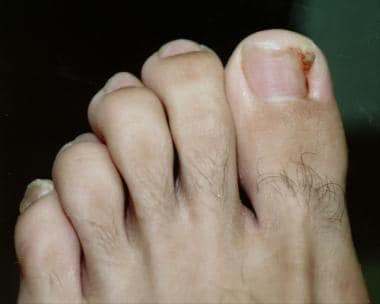
| Media file 4:
Appearance of toenail at end of the cauterizing procedure. |

 | View Full Size Image | |
Media type: Photo
|
- Barker LR, Burton JR, Zieve PD. Principles of Ambulatory Medicine. 3rd ed. Williams & Wilkins; 1991.
- Bossers AM, Jansen IM, Eggink WF. Rational therapy for ingrown toenails. A prospective study. Acta Orthop Belg. 1992;58(3):325-9. [Medline].
- Fulton GJ, O'Donohoe MK, Reynolds JV, Keane FB, Tanner WA. Wedge resection alone or combined with segmental phenolization for the treatment of ingrowing toenail. Br J Surg. Jul 1994;81(7):1074-5. [Medline].
- Giacalone VF. Phenol matricectomy in patients with diabetes. J Foot Ankle Surg. Jul-Aug 1997;36(4):264-7; discussion 328. [Medline].
- Ingrown toenails. Last updated May 2007. Familydoctor.org. Available at http://familydoctor.org/online/famdocen/home/common/skin/disorders/208.html.
- Kimata Y, Uetake M, Tsukada S, Harii K. Follow-up study of patients treated for ingrown nails with the nail matrix phenolization method. Plast Reconstr Surg. Apr 1995;95(4):719-24. [Medline].
- Mori H, Umeda T, Nishioka K, et al. Ingrown nails: a comparison of the nail matrix phenolization method with the elevation of the nail bed-periosteal flap procedure. J Dermatol. Jan 1998;25(1):1-4. [Medline].
- Ozdemir E, Bostanci S, Ekmekci P, Gurgey E. Chemical matricectomy with 10% sodium hydroxide for the treatment of ingrowing toenails. Dermatol Surg. Jan 2004;30(1):26-31. [Medline].
- Sauer GC. Manual of Skin Diseases. JB Lippincott; 1985.
- Wollina U. Modified Emmet's operation for ingrown nails using the Er:YAG laser. J Cosmet Laser Ther. May 2004;6(1):38-40. [Medline].
- Zaborszky Z, Fekete L, Tauzin F, Orgovan G. Treatment of ingrowing toenail with segmental chemical ablation. Acta Chir Hung. 1997;36(1-4):398-400. [Medline].
Toenails, Ingrown excerpt Article Last Updated: Jul 24, 2008
|