
Practice Essentials
Mushroom poisoning (mushroom toxicity) occurs after the ingestion of mushrooms that contain toxins, often in the context of foraging for nontoxic, similarly appearing mushrooms. Mushrooms are the fruiting bodies of a group of higher fungi that have evolved contemporaneously with plants for millions of years. They are widely distributed throughout the world. There are thousands of species of mushrooms, but approximately 100 species of mushrooms casue the majority of cases of poisoning when eaten by humans, and only 15-20 mushroom species are potentially lethal when ingested.
While mushroom poisoning outbreaks are rare in the United States, they are a major food safety issue in China. [1] In a recent evaluation of macrofungi in China, 1662 species of mushroom were identified with 1020 classified as edible, 692 as medicinal, and 480 as poisonous. While 277 were classified as both edible and medicinal, 193 poisonous species were found to be also edible and/or medicinal. [2]
No simple rule exists for distinguishing edible mushrooms from poisonous mushrooms. In more than 95% of mushroom toxicity cases, poisoning occurs as a result of misidentification of the mushroom by an amateur mushroom hunter. In less than 5% of the cases, poisoning occurs after the mushroom is consumed for its mind-altering properties.

Pathophysiology
Each poisonous mushroom species contains 1 or more toxins, which may be classified on the basis of the mushroom’s physiologic and clinical effects in humans, the target organ toxicity, and the time to symptom onset. The clinical spectrum and toxicity vary with the following factors:
-
Species consumed
-
Amount consumed
-
Season
-
Geographic location where the mushroom was grown
-
Preparation method
-
Individual response to the toxins
Diaz, in a review of mushroom poisoning cases reported in the literature over 50 years, classified mushroom poisoning into the following 3 major categories on the basis of the time from ingestion to the development of symptoms [3, 4] :
-
Early symptom category – Symptoms generally appear within the first 6 hours of mushroom ingestion and include gastrointestinal (GI), allergic, and neurologic syndromes
-
Late symptom category – Signs and symptoms begin to appear between 6 and 24 hours after ingestion and may include hepatotoxic, nephrotoxic, and erythromelalgic syndromes
-
Delayed symptom category – Symptoms appear more than 24 hours after ingestion and include mostly nephrotoxic syndromes
Mushroom toxins include the following [3, 4, 5, 6] :
-
Cyclopeptides - Amatoxin
-
Gyromitrins (monomethylhydrazine)
-
Orellanine
-
Muscarine
-
Muscimol and ibotenic acid
-
Nephrotoxins (norleucine)
-
Myotoxins
-
Immunoactive toxins
-
Hemolytic toxins
-
GI irritants
GI poisons are the most frequently encountered mushroom toxins. Amatoxins, gyromitrins, and orellanine are the toxins most commonly implicated in fatal mushroom poisonings worldwide. The amatoxins, and to a lesser extent the gyromitrins, are hepatotoxic. Gyromitrins are also epileptogenic. Orellanine and norleucine are nephrotoxic. Muscarine, psilocybin, muscimol, and ibotenic acid are CNS poisons. Coprine causes a disulfiramlike reaction when combined with alcohol.
Cyclopeptides
Cyclopeptides include amatoxins (high toxicity), phallotoxins (medium toxicity), and virotoxins (no toxicity).
Amatoxins, which are responsible for more than 95% of mushroom-related fatalities in the United States, are cyclic octapeptides that are synthesized by some Amanita, Galerina, and Lepiota species (see the list below).
At least 5 subtypes of amatoxins are known, the only significant human toxin being alpha-amatoxin, which inhibits RNA polymerase II and protein synthesis. Alpha-amatoxin is rapidly absorbed by the GI tract, has limited protein binding, and may undergo enterohepatic recirculation. It is excreted in the urine and may be detected in the vomitus and feces. Hepatocellular damage is presumably caused by the formation of free radical intermediates.
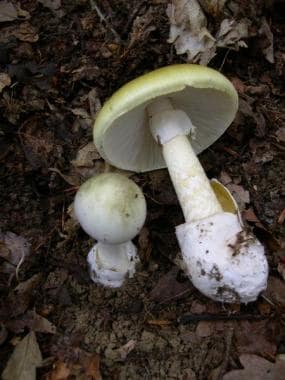
Amanita phalloides death cap), Amanita virosa (destroying angel), Amanita verna (fool’s mushroom), Amanita bisporigera, Galerina autumnalis (autumn skullcap), and Galerina sulcipes are the most common mushrooms implicated in liver injury and death amongst the amatoxin-containing mushrooms.
The other associated toxin in Amanita ingestions are the phallotoxins, specifically phalloidin, which produce a choleralike syndrome with vomiting and watery diarrhea, usually starting 6 hours after ingestion, although cases with both earlier and later onset have occurred. Many Lepiota species lack phallotoxins, so ingestion of these may not present with the onset of vomiting and diarrhea until after 12 hours post ingestion, or they may occasionally present only with symptoms of liver failure at 24 hours post ingestion.
Amanitin-containing mushroom species
The Amanita group includes the following [4] :
-
Amanita phalloides [7] (see the image below)
-
Amanita virosa
-
Amanita verna
-
Amanita ocreata
-
Amanita bisporigera
-
Amanita suballiacea
-
Amanita magniverrucata [8]
-
Amanita muscaria [9]
The Lepiota group includes the following:
-
Lepiota helveola
-
Lepiota chlorophyllum
-
Lepiota josserandi
-
Lepiota fulvella
-
Lepiota subincarnata
-
Lepiota brunneoincarnata
-
Lepiota brunneolilacea
The Galerina group includes the following:
-
Galerina autumnalis
-
Galerina sulcipes
-
Galerina marginata
Gyromitrins
Gyromitrin is a volatile hydrazine derivative synthesized by certain species of false morel (Gyromitra esculenta) and is easily confused with the early false morel (Verpa bohemica). Gyromitrin poisoning typically occurs after ingestion of the toxin-containing mushrooms but may also result from inhalation of the cooking vapors during their preparation.
In the stomach, gyromitrin is rapidly hydrolyzed into acetaldehyde and N-methyl-N-formyl hydrazine (MFH), which is then slowly converted to N-methylhydrazine (MH). Both MFH and MH are toxic to humans. MFH inhibits a number of hepatic systems, including cytochrome P-450 and glutathione, and causes hepatic necrosis. Hepatocellular damage is presumably caused by the formation of free radical intermediates.
MH inhibits pyridoxine kinase and interferes with all the pyridoxine-requiring enzymes in the body, including those involved in the synthesis of gamma-aminobutyric acid (GABA). The reduction of GABA concentrations in the brain leads to CNS hyperexcitability and convulsions. Gyromitrin ingestion may also rarely result in methemoglobinemia, hemolysis, and renal failure.
Orellanine
Orellanine is a nephrotoxic compound that is synthesized by several species of Cortinarius mushrooms. Orellanine-containing species include Cortinarius orellanus and Cortinarius speciosissimus, both of which are commonly found in Europe and Japan but not in North America. Cortinarius species that may contain small amounts of orellanine include Cortinarius gentilis, Cortinarius rainierensis, and Cortinarius splendens henrici; however, there are very few confirmed cases of Cortinarius-induced renal failure in North America. [10, 11]
Orellanine is colorless and crystalline in nature and may be converted into orelline, which itself may be toxic. Orellanine generates oxygen radicals and simultaneously shuts down the oxidative defence, by down-regulating most anti-oxidative enzymes. [12] It is highly kidney-specific and the main effects are on the renal tubular system, where it causes necrosis with relative sparing of the glomerular apparatus. Fatty degeneration of the liver and severe inflammatory changes in the intestine may accompany the renal damage. Cortinarius mushrooms also may elaborate other compounds, such as cortinarin A, B, and C, which exhibit a nephrotoxic potential in laboratory animals.
Norleucine
Other nephrotoxic mushrooms, such as Amanita smithiana and Amanita proxima, have also been associated with an acute oliguric renal failure. Amanita smithiana may be mistaken for the matsutake mushroom (Tricholoma magnivelare) by foragers. These mushrooms cause vomiting and diarrhea 1-12 hours after ingestion, followed by a transient elevation of transaminases, then oliguric renal failure in 3-6 days. It is important to note that renal failure occurs within days of ingestion, as opposed to orellanine-induced renal failure that has an onset over 1-2 weeks. Exposure to norleucine-containing mushrooms may require temporary hemodialysis.
Psilocybin
Psilocybin and psilocin are elaborated by a number of mushroom genera, including Psilocybe cubensis, Psilocybe semilanceata (Liberty cap), Panaeolus cyanescens (previously referred to as Copelandia species), Gymnopilus spectabili (Big Laughing Jim), Conocybe cyanopus, Psathyrella foenisecii, and several species of Pluteus. Psilocybin and psilocin are serotonin (5-HT2) agonists and, when ingested, cause psychedelic effects similar to those of lysergic acid diethylamide (LSD).
Ibotenic acid and muscimol
Amanita muscaria (fly agaric) and Amanita pantherina (panthercap) mushrooms synthesize ibotenic acid and muscimol, both of which are excitatory neurotoxins and may be mildly hallucinogenic.
Ibotenic acid is structurally similar to glutamic acid and acts as an agonist at the glutamic acid receptors (NMDA receptors) in the CNS. Ibotenic acid is decarboxylated in vivo to muscimol. Muscimol is structurally similar to GABA and acts as a GABA-receptor agonist. Amanita muscaria (fly agaric) and Amanita pantherina also may contain some anticholinergic substances and small amounts of muscarine, a cholinergic agent.
Muscarine
Muscarine stimulates M1 and M2 types of postganglionic cholinergic receptors (muscarinic receptors) in the autonomic nervous system. This action results in parasympathetic stimulation similar to that caused by the release of endogenous acetylcholine at postganglionic receptors of smooth muscle and exocrine glands. The action on muscarinic receptors produces a cholinergic syndrome that is characterized by sweating, bronchorrhea with shortness of breath, salivation, lacrimation, diarrhea, miosis, abdominal cramps, and rarely bradycardia.
There is negligible activity on nicotinic receptors; hence, muscle weakness, fasciculations, and paralysis are not present. Because muscarine is a quaternary amine, it does not readily cross the blood-brain barrier and does not directly cause CNS effects. Muscarine is not metabolized by cholinesterase and has a longer biologic half-life than acetylcholine does.
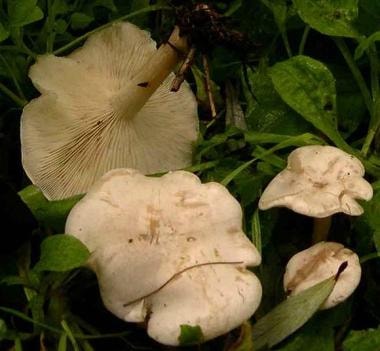
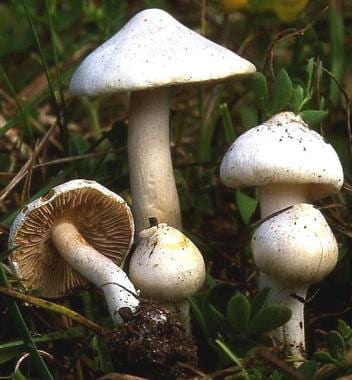
Mushrooms that contain muscarine are commonly found in yards, parks, and wooded areas throughout the United States, Europe, and Asia. Species from the genera Clitocybe and Inocybe (see the images below) are most commonly responsible for muscarinic mushroom poisoning in the United States.
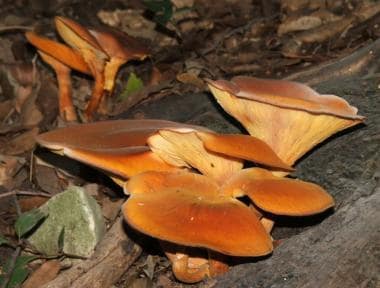
Clitocybe dealbata (the sweating mushroom) may be confused with the edible fairy ring champignon (Marasmius oreadus) or sweetbread mushroom (Clitopilus prunulus). Omphalotus olearius (the Jack O’ Lantern mushroom; see the image below) may be confused with the edible chanterelle (Cantharellus cibarius). Other muscarine-containing mushrooms include species from the genera Boletus, Mycena, and Omphalotus. Although Amanita muscaria derives its name from the trace amounts of muscarine it contains, it does not cause clinical cholinergic toxicity.
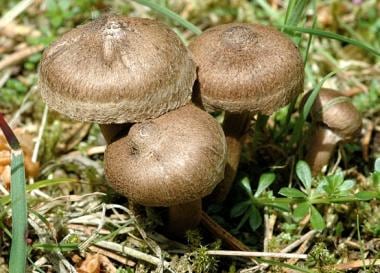
Muscarine-containing mushrooms typically produce cholinergic symptoms such as sweating, facial flushing, salivation, lacrimation, vomiting, abdominal cramps, diarrhea, urination, and miosis; occasionally, bradycardia, hypotension, and dizziness develop. Symptoms typically occur within 1 hour of ingestion and last for 4-24 hours. In most cases, they resolve without drug therapy or with a dose of atropine. [13]
Coprine
A few species of mushrooms, including Coprinopsis atramentaria (formerly known as Coprinus atramentarius), commonly referred to as inky cap or tippler’s bane and mistaken for the edible Coprinus comatus (shaggy mane), produce coprine, an amino acid that is metabolized to 1-aminocyclopropanol in the human body. This metabolite blocks acetaldehyde dehydrogenase, and in the presence of alcohol, acetaldehyde builds up, resulting in a disulfiram reaction. The effects of 1-aminocyclopropanol may last as long as 72 hours after ingestion of the mushroom.
Involutin
Ingestion of Paxillus involutus may result in the acute onset of abdominal pain, nausea, vomiting, and diarrhea within 30 minutes to 3 hours of ingestion, followed by an immune complex-mediated hemolytic anemia with hemoglobinuria, oliguria, anuria, and acute renal failure.
GI toxins
Hundreds of mushrooms contain toxins that can cause GI symptoms (eg, nausea, vomiting, diarrhea, and abdominal pain) similar to those observed with more dangerous mushrooms. They include Chlorophyllum molybdites (green gill), Boletus piperatus (pepper bolete), and Agaricus arvensis (horse mushroom), among many others.
Bronchoalveolar allergic syndrome
An immune reaction is believed to be the cause of the bronchoalveolar allergic syndrome seen after inhalation of spores of some puffball (Lycoperdon) mushroom species.
Erythromelalgia syndrome
Two species of mushrooms, Clitocybe acromelaga (in Japan) and Clitocybe amoenolens (in Europe), cause a painful burning sensation with reddening of the skin several days after eating them. In Europe, the Clitocybe amoenolens mushroom has been mistaken for the edible mushroom Lepista inversa. The suspected toxin is acromelic acid A.
Etiology
The main causes of mushroom toxicity are as follows:
-
Incorrect identification of a mushroom (eg, by a novice mushroom harvester or by someone who mistakes a poisonous local variety for an edible variety that is native to where they learned to pick mushrooms); many species are similar enough in appearance to confuse an inexperienced or insufficiently informed mushroom hunter
-
Unintentional ingestion by a child who found mushrooms growing in yards or outdoor play areas
-
Intentional ingestion by a person with euphoric intent (substance abuse)
Rare causes are as follows:
-
Intentional ingestion by a suicidal person
-
Foul play in which an individual is poisoned by someone else
-
Inadvertent poisoning from dried mushrooms purchased on the Internet or from other sources for which the composition of the mushroom is unreliable or the mushroom might be contaminated with unknown toxic compounds
Accidental poisoning accounts for more than 95% of the cases of mushroom intoxications; most of the remaining cases are due to intentional ingestion of the mushrooms for their mind-altering properties.
Cyclopeptide (amatoxin) poisoning most commonly is due to the following:
-
Amanita species (ie, bisporigera, ocreata, phalloides, tenuifolia, virosa, verna)
-
Galerina species (ie, autumnalis, sulcipes, marginata)
-
Lepiota species (brunneoincartata, helveola, josserandii, subincarnata)
Gyromitrin (monomethylhydrazine) poisoning is commonly due to Gyromitra esculenta.
Orellanine poisoning is commonly due to Cortinarius orellanus and Cortinarius speciosissimus.
Norleucine nephrotoxicity is due to Amanita smithiana and Amanita proxima.
Psilocybin and psilocin poisoning are commonly due to various Psilocybe species (semilenciata, and cubensis, among others), but it also may be due to the ingestion of many Panaeolus species, Gymnopilusspectabilis, Psathyrella foenisecii, and Psathyrella sepulcharis.
Ibotenic acid and muscimol poisonings are commonly due to some Amanita species (gemmata, muscaria, pantherina, and cokeri).
Muscarine poisoning is commonly due to Clitocybe species (dealbata, dilatata, illudens, and nebulens) and Omphalotus olearius (Jack O’Lantern mushroom). Most Inocybe species also contain muscarine and may result in muscarinelike symptoms. Additionally, some Amanita species (muscaria, gemmata, pantherina, and parcivolvata) and some Boletus species contain small amounts of muscarine, along with other toxins.
Coprine poisoning is commonly due to ingestion of Coprinus and related mushrooms, including Coprinus atramentaria. Clitocybe clavipes may also contain coprine. Coprine causes a disulfiramlike reaction if ingested with alcohol.
Immunoallergic reactions resulting in hemolysis, hemoglobinuria, and immune-complex–mediated renal failure have occurred after the ingestion of Paxillus involutus. In Europe, Paxillus involutus has been reported to cause severe illness and death due to a Paxillus syndrome, which is characterized by abdominal cramps, diaphoresis, ice-cold extremities, weakness, loss of consciousness, and circulatory collapse.
Bronchoalveolar allergic syndrome results from the inhalation of spores of many Lycoperdon (puffball) species.
Rhabdomyolysis with renal failure has been reported after the ingestion of Tricholomaflavovirens (also know as Tricholoma equestre) in France and with Russula subnigricans in Taiwan and Korea. [14]
Clitocybe acromelaga (in Japan) and Clitocybe amoenolens (in Europe) cause erythromelalgia.
The mushrooms that cause GI symptoms when ingested by humans include many of the “little brown mushrooms.” Additionally, Chlorophyllum species (esculentum and molybdites), Clitocybe nebularis, and Laetarius species cause GI irritation only.
Epidemiology
United States statistics
Because the number of unreported cases is unknown, accurate figures regarding the frequency of mushroom poisoning are difficult to obtain. Cases usually are sporadic, and a few outbreaks have been reported. Accidental poisonings tend to occur most commonly in the spring and fall, when mushroom species are at the peak of their fruiting stage. In general, most ingestions result in minor GI illness, with only the most severe requiring medical attention. According to the 2021 annual report from the AAPCC National Poison Data System, of 6783 total single exposures to mushrooms, 595 had a moderate outcome and 54 had a major outcome. Three deaths were reported. [11]
During the 10-year period from 2001 to 2011, 83,140 mushroom ingestions were reported to US Poison Control Centers; of these, 64,534 (77.6%) were pediatric ingestions and 48,437 (58.3%) occurred in children younger than 6 years. A total of 48,423 (58.2%) patients were male. The majority of ingestions, 65,255 (78.5%), were unintentional. Identification was made in only 4,232 (5.1%) exposures and included 185 distinct species. The 5 most common species (number of identifications) were (1) Morchella angusticeps (507), (2) Chlorophyllum molybdites (374), (3) Amanita muscaria (319), (4) Lycoperdon candidum (228), and (5) Calvatia lepidophora (175). The toxin group was identified in 12,147 (14.6%) of ingestions. [15]
The toxin groups and number of cases with identification were as follows:
-
Cyclopeptides (512)
-
Muscimol (ibotenic acid) (480)
-
Monomethylhydrazine (MMH) (448)
-
Muscarine (284)
-
Coprine (141)
-
Hallucinogenics (psilocybin and psilocin) (8375)
-
GI irritants (1866)
-
Orellanine (41) (none confirmed)
Of the symptomatic cases, effects were minor in 10,953 (56.5%), moderate in 7,804 (40.3%), major in 568 (2.9%), and fatal in 45 (0.2%). Of the 614 cases of major effect or death, a species was identified in 64 (10.4%). [15]
The 5 most common species (number of cases) identified as responsible for major effects or death were Amanita phalloides (27) [7, 16] , Amanita muscaria (22), Amanita pantherina (9), Amanita smithiana/proxima/pseudoporphyria (5), and Amanita bisporigera (3). Of the 97 cases in which Amanita phalloides was identified, 23 (23.7%) resulted in major effects and 4 (4.1%) in death. [15]
International statistics
Mushroom foraging is common in Russia, Asia, and Europe; however, accurate figures regarding the incidence of mushroom toxicity (mushroom poisoning) are difficult to obtain. Outbreaks of severe mushroom poisoning have occurred in Europe, Russia, the Middle East, and the Far East. In April 2008, an outbreak of mushroom poisonings in the Upper Assam part of India claimed more than 30 lives.
In 2018, more than 1200 mushroom poisonings were seen in hospital emergency departments in 13 west and northwestern provinces of Iran; 112 (8.9%) patients were hospitalized and 19 fatalities ere reported. Patients presenting with severe abdominal pain, nausea, vomiting, and diarrhea soon after consumption of wild mushrooms. Lepiota brunneioncarnata, Hypholoma fascicalare, and Coprinopsis atramentaria were involved in this outbreak. [17]
The Chinese Foodborne Disease Outbreak Surveillance System reported a total of 10,036 mushroom poisoning outbreaks between 2010-2020. These outbreaks resulted in a cumulative 38,676 illnesses and 788 deaths during that period. The majority of the outbreaks (84.6%) were associated with consumption in the home. [1]
Age-related demographics
Adults are frequently involved as foragers for edible mushrooms. Because of errors in identification, they may ingest toxin-containing mushrooms that resemble nontoxic varieties. Adults and adolescents may also be inadvertently poisoned when they intentionally consume mushrooms, picked from the ground or purchased dried, to achieve intoxication. Young children may be poisoned by mushrooms when they unintentionally eat mushrooms found outside, typically in yards or outdoor play areas.
Children and elderly patients are at the greatest risk for toxicity. According to the 2020 annual report from the AAPCC National Poison Data System, 3497 of 6419 total single mushroom exposures were reported in those younger than 6 years; 413 exposures were reported in those aged 6-12 years, 455 in those aged 13 to 19, and 1015 were reported in those older than 19 years. [11]
Prognosis
To a great extent, morbidity and mortality depend on the patient’s age and general health. Children and elderly persons are at the greatest risk for toxicity. Rapid diagnosis and treatment can also alter mortality substantially.
Over the course of 2 weeks in December 2016, California Poison Control System (CPCS) investigated 14 suspected A phalloides ingestions in five northern California counties. One of those patients, a child, developed cerebral edema and suffered permanent neurologic sequelae. All the remaining patients recovered completely, although 3 patients received liver transplants because of irreversible fulminant hepatic failure. [18]
With good supportive care, the mortality for amatoxin poisoning may be reduced from 50-60% to less than 5%. [19] In a retrospective analysis of amatoxin-poisoned patients, Giannini found that the evolution of hepatic transaminase levels and the prothrombin time over the initial 4 days were highly predictive of recovery or death. [20]
In a retrospective study of 144 amatoxin-poisoned patients seen between 1996 and 2009, Trabulus et al reported a mortality of 9.7% (14 patients). [21] Factors associated with a greater likelihood of death included the following:
-
Low mean arterial pressure
-
Encephalopathy
-
Mucosal hemorrhage
-
Oliguria-anuria
-
Hypoglycemia
-
Low sodium values
-
High urea, hepatic transaminase, total bilirubin, lactate dehydrogenase (LDH), prothrombin time (PT), international normalized ratio (INR), and activated partial thromboplastin time (aPTT) values
Most patients recover from gyromitrin poisoning. In the United States, death from this event is rare, but in some areas of Europe, mushrooms containing gyromitrins account for the most mushroom fatalities.
Although orellanine poisoning is rare in the United States, mushrooms containing orellanine account for the most mushroom fatalities in some areas of Europe. A shorter time course between ingestion and toxicity portends a worse prognosis. Mild renal insufficiency may resolve a few months after the ingestion.
In a study of long-term effects of orellanine poisoning, the outcomes of 28 patients who ingested mushrooms of the Cortinarius specie in the period from 1979 to 2012 were reviewed. The researchers reported 22 patients (78%) developed acute kidney injury requiring dialysis of which 15 received a kidney transplantation. No damage was found in any other organs and mortality rates were similar to a control group. [12]
The prognosis for muscarine poisoning is excellent and fatalities are very rare. Many patients who ingest muscarine-containing mushrooms have minor or no symptoms; when symptoms do occur, they tend to be temporary and self-limited, lasting 6-24 hours. [13] Most patients recover without drug therapy.
However, a case report from Australia described a 53-year-old woman who ate 2 large muscarine-containing Rubinoboletus mushrooms and came to a hospital with a 2-hour history of headache, chest and abdominal pain, vomiting, and profuse sweating. At 3 hours, she also developed diarrhea, and her condition deteriorated rapidly with hypotension, bradycardia, coma, and respiratory distress. At 7 hours, the patient remained in shock and did not respond to resuscitative measures. During the first hour of hemodialysis, she developed asystole. At 10 hours after ingestion, the patient died. Her partner had also eaten some of the mushrooms but promptly vomited and did not exhibit any toxic effects. Whether this mushroom grows in North America is unknown. [22]
Patient Education
Education regarding the poisonous nature of wild mushrooms may act as a deterrent to mushroom foraging and ingestion. Patients ingesting coprine-containing mushrooms should be educated regarding the interaction with alcohol.
For patient education resources, see the Poisoning Center, as well as Food Poisoning and Activated Charcoal.

-
Amanita phalloides.
-
Inocybe geophylla.
-
Inocybe lacera.
-
Clitocybe dealbata.
-
Omphalotus olearius (Jack O'Lantern mushroom).
