AUTHOR AND EDITOR INFORMATION
Section 1 of 11
Author: Crispian Scully, MD, PhD, CBE, MDS, Professor, Dean, Director of Studies and Research, and Eastman Dental Institute for Oral Health Care Sciences, International Centers for Excellence in Dentistry, University of London, UK
Editors: Hassan H Ramadan, MD, MSc, Professor and Vice-Chair, Department of Otolaryngology-Head and Neck Surgery, Professor, Department of Pediatrics, West Virginia University; Francisco Talavera, PharmD, PhD, Senior Pharmacy Editor, eMedicine; Robert M Kellman, MD, Professor and Chair, Department of Otolaryngology and Communication Sciences, State University of New York, Upstate Medical University; Christopher L Slack, MD, Otolaryngology-Facial Plastic Surgery, Private Practice, Associated Coastal ENT; Medical Director, Treasure Coast Sleep Disorders; Arlen D Meyers, MD, MBA, Professor, Department of Otolaryngology-Head and Neck Surgery, University of Colorado School of Medicine
Author and Editor Disclosure
Synonyms and related keywords:
recurrent aphthous stomatitis, RAS, aphthae, canker sores, Mikulicz ulcers, Mikulicz aphthae, Sutton ulcers, periadenitis mucosa necrotica recurrens, PMNR, hematinic deficiency, celiac disease, Crohn disease, Neumann bipolar aphthosis, Behçet syndrome, Behcet syndrome, human immunodeficiency virus infection, HIV infection, neutropenia, periodic fever, aphthous stomatitis, pharyngitis, cervical adenitis, PFAPA syndrome, aphthous ulcers, aphthouslike ulcers
Background
Recurrent aphthous stomatitis (RAS) is a common condition, restricted to the mouth, that typically starts in childhood or adolescence as recurrent small, round, or ovoid ulcers with circumscribed margins, erythematous haloes, and yellow or gray floors. A positive family history of similar ulcers is common.
Ulcers with similar clinical features may be termed "aphthouslike ulcers" and may then be associated with systemic conditions such as Behçet syndrome or HIV/AIDS.
Pathophysiology
The etiology of RAS is not entirely clear, and aphthae are therefore termed idiopathic. RAS may be the manifestation of a group of disorders of quite different etiology, rather than a single entity. Despite many studies trying to identify a causal microorganism, RAS does not appear to be infectious, contagious, or sexually transmitted. Immune mechanisms appear at play in persons with a genetic predisposition to oral ulceration. A genetic basis exists for some RAS. This is shown by a positive family history in about one third of patients with RAS and an increased frequency of HLA types A2, A11, B12, and DR2. RAS probably involves cell-mediated mechanisms, but the precise immunopathogenesis remains unclear. Phagocytic and cytotoxic T cells probably aid in destruction of oral epithelium that is directed and sustained by local cytokine release. Patients with active RAS have an increased proportion of gamma-delta T cells compared with control subjects and patients with inactive RAS. Gamma-delta T cells may be involved in antibody-dependent cell-mediated cytotoxicity (ADCC). Compared with control subjects, individuals with RAS have raised serum levels of cytokines such as interleukin (IL)–6 and IL-2R, soluble intercellular adhesion modules (ICAM), vascular cell adhesion modules (VCAM), and E-selectin; however, some of these do not correlate with disease activity. Cross-reactivity between a streptococcal 60- to 65-kd heat shock protein (hsp) and the oral mucosa has been demonstrated, and significantly elevated levels of serum antibodies to hsp are found in patients with RAS. Lymphocytes of patients with RAS have reactivity to a peptide of Mycobacterium tuberculosis. Some cross-reactivity exists between the 65-kd hsp and the 60-kd human mitochondrial hsp. Monoclonal antibodies to part of the 65-kd hsp of M tuberculosis react with Streptococcus sanguis. RAS thus may be a T cell–mediated response to antigens of S sanguis, which cross-react with the mitochondrial hsp and induce oral mucosal damage. Predisposing factors found may include the following: - Hematinic deficiency: Up to 20% of patients are deficient of iron, folic acid (folate), or vitamin B.
- Malabsorption in gastrointestinal disorders: About 3% of patients experience these disorders, particularly celiac disease (gluten-sensitive enteropathy) but, occasionally, Crohn disease, pernicious anemia, and dermatitis herpetiformis. HLA DRW10 and DQW1 may predispose patients with celiac disease to RAS.
- Cessation of smoking: This may precipitate or exacerbate RAS in some cases.
- Stress: This underlies RAS in some cases; ulcers appear to exacerbate during school or university examination times.
- Trauma: Biting of the mucosa and wearing of dental appliances may lead to some ulcers; RAS is uncommon on keratinized mucosae.
- Endocrine factors in some women: RAS is clearly related to the progestogen level fall in the luteal phase of the menstrual cycle, and ulcers may then temporarily regress in pregnancy.
- Allergies to food: Food allergies occasionally underlie RAS; the prevalence of atopy is high.
- Sodium lauryl sulphate (SLS): This is a detergent in some oral healthcare products that may produce oral ulceration.
- Immune deficiencies: Ulcers similar to RAS may be seen in patients with HIV and some other immune defects.
- Drugs, especially NSAIDs, alendronate, and nicorandil:1 These may produce lesions clinically similar to RAS.
Frequency
United States
RAS affects 5-66% of the population. Approximately 1% of children from higher socioeconomic groups in developed countries have RAS; however, 40% of selected groups of children can have a history of RAS, with ulceration beginning before age 5 years and with the frequency of affected patients increasing with age.
Mortality/Morbidity
Most patients with RAS are otherwise well.
Race
RAS have been reported in all races
Sex
A slight female predominance exists.
Age
RAS typically starts in childhood or adolescence.
History
The 3 main clinical types of recurrent aphthous stomatitis (RAS) are as follows: (1) Minor aphthous ulcers (MiAUs, 80% of all RAS) (2) Major aphthous ulcers (MjAUs) (3) Herpetiform ulcers. However, any significance of these distinctions is unclear (ie, they could just be 3 distinct disorders). Diagnosis is based on history and clinical features. Characteristics of MiAUs (ie, Mikulicz ulcers) include the following: - They occur mainly in persons 10-40 years of age.
- They often cause minimal symptoms.
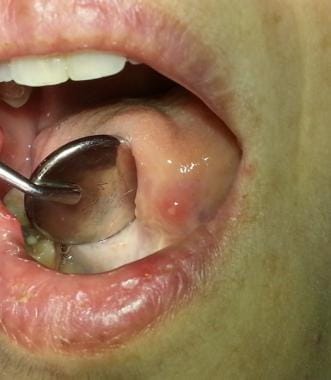
- They are small round or ovoid ulcers 2-4 mm in diameter. (MiAUs are round or ovoid in most situations but are often more linear when in the buccal sulcus, a common site.)
- They have an ulcer floor that is initially yellowish but assumes a gray hue as healing and epithelialization proceeds.
- They are surrounded by an erythematous halo and some edema.
- They are found mainly on the nonkeratinized mobile mucosa of the lips, cheeks, floor of the mouth, sulci, or ventrum of the tongue; they are uncommonly seen on the keratinized mucosa of the palate or dorsum of the tongue.
- They occur in groups of only a few ulcers (ie, 1-6) at a time.
- They heal in 7-10 days.
- They recur at intervals of 1-4 months.
- They leave little or no evidence of scarring.
Characteristics of MjAUs (ie, Sutton ulcers, periadenitis mucosa necrotica recurrens [PMNR]) include the following: - They are larger, of longer duration, of more frequent recurrence, and often more painful than MjAUs.
- They are round or ovoid like MjAUs but are larger and associated with surrounding edema.
- They reach a large size, usually about 1 cm in diameter or even larger.
- They are found on any area of the oral mucosa, including the keratinized dorsum of the tongue or palate.
- They occur in groups of only a few ulcers (ie, 1-6) at one time.
- They heal slowly over 10-40 days.
- They recur extremely frequently.
- They may heal with scarring.
- They occasionally are found with a raised erythrocyte sedimentation rate or plasma viscosity.
Characteristics of herpetiform ulceration (HU) include the following: - They are found in a slightly older age group than the other RAS.
- They are mainly found in females.
- They begins with vesiculation that passes rapidly into multiple, minute, pinhead-sized, discrete ulcers.
- They involve any oral site, including the keratinized mucosa, increase in size, and coalesce to leave large round ragged ulcers.
- They heal in 10 days or longer.
- They are often extremely painful.
- They recur so frequently that ulceration may be virtually continuous.
Most patients appear to be otherwise well, but a minority have etiologic factors that can be identified by the history. These factors may include the following: - Dentifrices containing sodium lauryl sulfate
- Trauma
- Stress
- Cessation of smoking
- Menstrual cycle association
- Food allergy
Aphthouslike ulcers may appear in the following diseases and states: - Hematinic deficiency (eg, iron, folate, vitamin B-12)
- Celiac disease
- Crohn disease
- Neumann bipolar aphthosis, in which genital ulcers may also be present
- Behçet syndrome, which may include genital, cutaneous, ocular, or other lesions (The mouth ulcers in Behçet syndrome are often major aphthae, with frequent episodes and long duration to healing.)
- Human immunodeficiency virus (HIV) infection, neutropenia, and other immunodeficiencies (Ulcers appearing on a regular 3-week cycle may indicate a neutropenia.)
- Periodic fever, aphthous stomatitis, pharyngitis, and cervical adenitis syndrome (PFAPA) in children
- Malignancy (ulcers appearing for the first time in an older individual may reflect underlying systemic disease [eg, colonic carcinoma with chronic hemorrhage] or drug use [eg, nicorandil].)
- Sweet syndrome, a rare immunologically mediated condition that belongs to the group of neutrophilic dermatoses and must be differentiated, particularly from Behçet disease
- Sweet syndrome is characterized by red-brown plaques and nodules that are frequently painful and occur primarily on the head, neck, and upper extremities.
- Patients often also have neutrophilia and fever and may have oral ulceration.
Physical
RAS ulcers are recurrent small, round, or ovoid ulcers with circumscribed margins, erythematous haloes, and yellow or gray floors. No specific investigations exist for RAS.
Causes
Some RAS cases involve a familial and genetic basis; approximately 40% of patients with RAS have a familial history, but inheritance may be polygenic with penetrance dependent on other factors. - Most relevant studies have found hematinic (eg, iron, folic acid, vitamin B-12) deficiencies in as many as 20% of patients with recurrent ulcers. In addition, deficiencies of vitamins B-1, B-2, and B-6 have been noted in some patient cohorts.
- The previously proposed association between recurrent ulcers and celiac disease (gluten-sensitive enteropathy [GSE]) is tenuous, despite some evidence that the haplotype of HLA-DRW 10 and DQW1 may predispose patients with GSE to RAS.
- Hypersensitivity reactions to exogenous antigens other than gluten do not have a significant etiologic role in RAS, and associations with atopy are inconsistent.
- Local physical trauma may initiate ulcers in susceptible people, and RAS is uncommon where mucosal keratinization is present or in patients who smoke tobacco.
- A consistent association between aphthouslike ulceration and psychological illness, zinc deficiency, or sex hormone levels is unlikely.
- Various microorganisms have been examined for a causal association. Latterly, Helicobacter pylori has been detected in lesional tissue of ill-defined oral ulcers, but the frequency of serum immunoglobin G (IgG) antibodies to H pylori is not increased in RAS. Little evidence suggests an etiologic association between viruses and RAS. Human herpesviruses (HHV)–6 and HHV-7 DNA have not been demonstrated in RAS, but HHV-8 DNA is present in HIV-related oral ulcers.
Other Problems to be Considered
Mouth ulcers can arise from local causes; malignancy; drug adverse effects; or systemic conditions (particularly infections, blood disorders, gastrointestinal disorders or skin diseases).
Recurrent multiple ulcers are most typical of the following conditions: Hematinic deficiency (eg, iron, folate, vitamin B-12) Celiac disease Crohn disease Neumann bipolar aphthosis Behçet syndrome Sweet syndrome HIV infection, neutropenia, and other immunodeficiencies Periodic fever, aphthous stomatitis, pharyngitis, and cervical adenitis syndrome (PFAPA) in children
Lab Studies
- Systemic disorders should particularly be suspected in the presence of features that may suggest a systemic background.
- Diagnosis of recurrent aphthous stomatitis (RAS) is based on history and clinical features. No specific tests are available; however, to exclude systemic disorders discussed above, the following tests may be helpful:
- Complete blood cell count
- Hemoglobin test
- White blood cell count with differential
- Red blood cell indices
- Iron studies (usually an assay of serum ferritin levels)
- Red blood cell folate assay
- Serum vitamin B-12 measurements
- Serum antiendomysium antibody and transglutaminase assay (positive in celiac disease)
- Rarely, biopsy may be indicated in cases in which a different diagnosis is suspected.
Histologic Findings
The histology is nonspecific. The ulcer is depressed well below the surface, and the inflammation extends deeply. The surface of the ulcer is covered by a fibrinous exudate infiltrated by polymorphs. Beneath is a layer of granulation tissue with dilated capillaries and edema. Deeper still is a repair reaction, with fibroblasts in the surrounding connective tissue laying down fibrous tissue.
Medical Care
Identify and correct predisposing factors for recurrent aphthous stomatitis (RAS). Ensure that patients brush atraumatically (eg, with a small-headed, soft toothbrush) and avoid eating particularly hard or sharp foods (eg, toast, potato crisps) and avoid other trauma to the oral mucosa. SLS should be avoided if implicated as a predisposing factor. Any iron or vitamin deficiency should be corrected once the cause of that deficiency has been established. If an obvious relationship to certain foods is established, these should be excluded from the diet. Patch testing may be indicated to reveal allergies. The occasional patient who relates ulcers to her menstrual cycle or to use of an oral contraceptive may benefit from suppression of ovulation with a progestogen or a change in the oral contraceptive. Causal drugs should be excluded. In most cases, the natural history of RAS is one of eventual remission. However, for some patients, remission occurs spontaneously several years later; thus, treatment is indicated in these patients if discomfort is significant. Relief of pain and reduction of ulcer duration are the main goals of therapy. Objective evidence shows the most efficacy from corticosteroids and antimicrobials used topically.
- Topical corticosteroids (TCs) remain the mainstays of treatment. A spectrum of different TCs can be used. At best, TCs reduce painful symptoms but not the rate of ulcer recurrence. The commonly used preparations are as follows:
- Hydrocortisone hemisuccinate pellets (Corlan), 2.5 mg
- Triamcinolone acetonide in carboxymethyl cellulose paste (Adcortyl in orabase, Kenalog), administered 4 times daily
- Betamethasone sodium phosphate as a 0.5-mg tablet dissolved in 15 mL of water to make a mouth rinse, used 4 times daily
- Hydrocortisone and triamcinolone preparations are popular because neither causes significant adrenal suppression; however, ulcers still recur.
- Betamethasone, fluocinonide, fluocinolone, fluticasone, and clobetasol are more potent and effective than hydrocortisone and triamcinolone, but they carry the possibility of some adrenocortical suppression and a predisposition to candidiasis.
- Topical tetracyclines may reduce the severity of ulceration, but they do not alter the recurrence rate. A doxycycline capsule of 100 mg in 10 mL of water administered as a mouth rinse for 3 minutes or tetracycline 500 mg plus nicotinamide 500 mg administered 4 times daily may provide relief and reduce ulcer duration. Avoid tetracyclines in children younger than 12 years who might ingest them and develop tooth staining.
- Chlorhexidine gluconate mouth rinses reduce the severity and pain of ulceration but not the frequency.
- Anti-inflammatory agents can help; a spectrum of topical agents such as benzydamine and amlexanox may help. Benzydamine hydrochloride mouthwash, though no more beneficial than a placebo, can produce transient pain relief.
- If RAS fails to respond to local measures, systemic immunomodulators may be required. A wide spectrum of agents has been suggested as beneficial, but few studies have been performed to assess their efficacy (or their adverse effects are significant). Thalidomide 50-100 mg daily is effective against severe RAS, although ulcers tend to recur within 3 weeks. Teratogenicity, neuropathy, and other adverse effects dissuade most physicians from its use.
- Few, if any, of the other medications used for RAS have undergone serious scientific evaluation. These include transfer factor, gamma-globulin therapy, sodium cromoglycate lozenges, dapsone, colchicine, pentoxifylline, levamisole, colchicine, azathioprine, prednisolone, azelastine, alpha 2-interferon, ciclosporin, deglycerinated liquorice, 5-aminosalicylic acid (5-ASA), prostaglandin E2 (PGE2), sucralfate, diclofenac, and aspirin.
Consultations
- Gastroenterologist
- Immunologist/allergologist
- Hematologist
- Rheumatologist
Diet
The patient should avoid consuming any foods that could lead to RAS.
TCs remain the mainstay of treatment for recurrent aphthous stomatitis (RAS). TCs reduce the number of ulcer days compared with controls, but they have no consistent effect on the frequency of ulceration. TCs may reduce the ulcer duration and pain. Chlorhexidine gluconate mouth rinses reduce the severity and pain of ulceration but do not affect the frequency.
Drug Category: Corticosteroids
A spectrum of different TCs can be used. All can reduce symptoms, and neither hydrocortisone nor triamcinolone preparations cause adrenal suppression. Ulcers still recur.
| Drug Name | Hydrocortisone (Cortaid, Dermacort, Westcort) |
| Description | Decreases inflammation by suppressing migration of PMNs and reversing increased capillary permeability. |
| Adult Dose | Apply sparingly to affected areas bid/qid |
| Pediatric Dose | Administer as in adults with caution |
| Contraindications | Documented hypersensitivity; viral, fungal, and bacterial skin infections |
| Interactions | None reported |
| Pregnancy | C - Fetal risk revealed in studies in animals but not established or not studied in humans; may use if benefits outweigh risk to fetus
|
| Precautions | Prolonged use, application over large surface areas, application of potent steroids, and occlusive dressings may increase systemic absorption of corticosteroids and may cause Cushing syndrome, reversible HPA axis suppression, hyperglycemia, and glycosuria; caution in hyperthyroidism, osteoporosis, peptic ulcer disease, cirrhosis, nonspecific ulcerative colitis, diabetes, and myasthenia gravis |
| Drug Name | Triamcinolone (Aristocort, Flutex, Kenalog) |
| Description | Decreases inflammation by suppressing migration of PMNs and reversing capillary permeability. |
| Adult Dose | Apply thin film bid/tid until favorable response obtained |
| Pediatric Dose | Administer as in adults with caution |
| Contraindications | Documented hypersensitivity; fungal, viral, and bacterial skin infections |
| Interactions | None reported |
| Pregnancy | C - Fetal risk revealed in studies in animals but not established or not studied in humans; may use if benefits outweigh risk to fetus
|
| Precautions | Do not use in patients with decreased skin circulation; prolonged use, applications over large areas, and use of potent steroids and occlusive dressings may result in systemic absorption; systemic absorption may cause Cushing syndrome, reversible HPA axis suppression, hyperglycemia, and glycosuria |
| Drug Name | Betamethasone (Alphatrex, Diprolene, Maxivate) |
| Description | For inflammatory dermatoses responsive to steroids. Decreases inflammation by suppressing migration of PMNs and reversing capillary permeability. |
| Adult Dose | Apply thin film bid/qid until response |
| Pediatric Dose | Administer as in adults with caution |
| Contraindications | Documented hypersensitivity; paronychia; cellulitis; impetigo; angular cheilitis; erythrasma; erysipelas; rosacea; perioral dermatitis; acne |
| Interactions | None reported |
| Pregnancy | C - Fetal risk revealed in studies in animals but not established or not studied in humans; may use if benefits outweigh risk to fetus
|
| Precautions | Do not use on skin with decreased circulation; can cause atrophy of groin, face, and axillae; may cause striae distensae and rosacealike eruption; may increase skin fragility; rarely may suppress HPA axis; if infection develops that is not responsive to antibiotic treatment, discontinue until infection is controlled; do not use monotherapy to treat widespread plaque psoriasis |
| Drug Name | Fluocinolone (Synalar, Fluonid) |
| Description | High-potency topical corticosteroid that inhibits cell proliferation and is immunosuppressive, antiproliferative, and anti-inflammatory. |
| Adult Dose | Apply sparingly bid/qid as severity warrants |
| Pediatric Dose | Administer as in adults |
| Contraindications | Documented hypersensitivity; herpes simplex infection; fungal, viral, or tubercular skin lesions |
| Interactions | None reported |
| Pregnancy | C - Fetal risk revealed in studies in animals but not established or not studied in humans; may use if benefits outweigh risk to fetus
|
| Precautions | May cause adverse systemic effects if used over large areas or denuded areas, on occlusive dressings, or during prolonged treatment periods |
| Drug Name | Fluocinonide (Fluonex, Lidex) |
| Description | High-potency topical corticosteroid that inhibits cell proliferation and is immunosuppressive and anti-inflammatory. |
| Adult Dose | Apply sparingly bid/qid as severity warrants |
| Pediatric Dose | Administer as in adults |
| Contraindications | Documented hypersensitivity; herpes simplex infection; fungal, viral, or tubercular skin lesions |
| Interactions | None reported |
| Pregnancy | C - Fetal risk revealed in studies in animals but not established or not studied in humans; may use if benefits outweigh risk to fetus
|
| Precautions | May cause adverse systemic effects if used over large areas or on denuded areas, on occlusive dressings, or during prolonged treatment periods |
| Drug Name | Clobetasol (Temovate) |
| Description | Class I superpotent topical steroid; suppresses mitosis and increases synthesis of proteins that decrease inflammation and cause vasoconstriction. |
| Adult Dose | Apply bid for up to 2 wk; not to exceed 50 g/wk |
| Pediatric Dose | <12 years: Not recommended >12 years: Administer as in adults |
| Contraindications | Documented hypersensitivity; viral or fungal skin infections |
| Interactions | None reported |
| Pregnancy | C - Fetal risk revealed in studies in animals but not established or not studied in humans; may use if benefits outweigh risk to fetus
|
| Precautions | May suppress adrenal function in prolonged therapy |
Deterrence/Prevention Avoid precipitants (eg, trauma). Complications Scarring can be severe in rare cases. Prognosis The natural history of RAS is of amelioration with age. Patient Education For excellent patient education resources, visit eMedicine's Teeth and Mouth Center. Also, see eMedicine's patient education article Canker Sores.
Medical/Legal Pitfalls
Misdiagnosis is possible if adequate history is not taken and investigations are inadequate. Always exclude systemic disease and cancer.
| Media file 1:
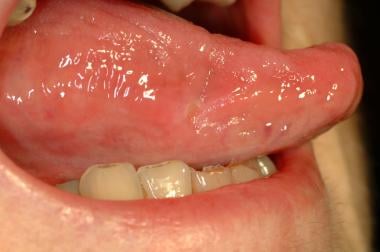
Traumatic ulcer on ventrum/lateral margin of tongue; these must be differentiated from aphthae. |
 | View Full Size Image | |
Media type: Photo
|
| Media file 2:
Recurrent aphthae in floor of mouth, showing ovoid ulcer with inflammatory halo. |
 | View Full Size Image | |
Media type: Photo
|
| Media file 3:
Typical aphthous ulcer in a common site, showing inflammatory halo surrounding a yellowish round ulcer |
 | View Full Size Image | |
Media type: Photo
|
- Shotts RH, Scully C, Avery CM, Porter SR. Nicorandil-induced severe oral ulceration: a newly recognized drug reaction. Oral Surg Oral Med Oral Pathol Oral Radiol Endod. Jun 1999;87(6):706-7. [Medline].
- Akintoye SO, Greenberg MS. Recurrent aphthous stomatitis. Dent Clin North Am. Jan 2005;49(1):31-47, vii-viii. [Medline].
- Barrons RW. Treatment strategies for recurrent oral aphthous ulcers. Am J Health Syst Pharm. Jan 1 2001;58(1):41-50; quiz 51-3. [Medline].
- Edres MA, Scully C, Gelbier M. Use of proprietary agents to relieve recurrent aphthous stomatitis. Br Dent J. Feb 22 1997;182(4):144-6. [Medline].
- Eisen D, Lynch DP. Selecting topical and systemic agents for recurrent aphthous stomatitis. Cutis. Sep 2001;68(3):201-6. [Medline].
- Femiano F, Gombos F, Scully C. Recurrent aphthous stomatitis unresponsive to topical corticosteroids: a study of the comparative therapeutic effects of systemic prednisone and systemic sulodexide. Int J Dermatol. May 2003;42(5):394-7. [Medline].
- Lo Muzio L, della Valle A, Mignogna MD, Pannone G, Bucci P, Bucci E, et al. The treatment of oral aphthous ulceration or erosive lichen planus with topical clobetasol propionate in three preparations: a clinical and pilot study on 54 patients. J Oral Pathol Med. Nov 2001;30(10):611-7. [Medline].
- Piskin S, Sayan C, Durukan N, Senol M. Serum iron, ferritin, folic acid, and vitamin B12 levels in recurrent aphthous stomatitis. J Eur Acad Dermatol Venereol. Jan 2002;16(1):66-7. [Medline].
- Porter S, Scully C. Aphthous ulcers (recurrent). Clin Evid. 2004;12:360-361.
- Porter SR, Hegarty A, Kaliakatsou F, Hodgson TA, Scully C. Recurrent aphthous stomatitis. Clin Dermatol. Sep-Oct 2000;18(5):569-78. [Medline].
- Porter SR, Scully C, Pedersen A. Recurrent aphthous stomatitis. Crit Rev Oral Biol Med. 1998;9(3):306-21. [Medline].
- Scully C. Clinical practice. Aphthous ulceration. N Engl J Med. Jul 13 2006;355(2):165-72. [Medline].
- Scully C, Gorsky M, Lozada-Nur F. The diagnosis and management of recurrent aphthous stomatitis: a consensus approach. J Am Dent Assoc. Feb 2003;134(2):200-7. [Medline].
- Ship JA, Chavez EM, Doerr PA, et al. Recurrent aphthous stomatitis. Quintessence Int. Feb 2000;31(2):95-112. [Medline].
Aphthous Ulcers excerpt Article Last Updated: May 9, 2008
|