You are in: eMedicine Specialties > Medicine, Ob/Gyn, Psychiatry, and Surgery > Cardiology
|
Myocarditis Last Updated: September 22, 2005 |
|
| Synonyms and related keywords: myocardium, Fiedler myocarditis, giant cell myocarditis, myocardial infarction, MI, heart failure, arrhythmia, fulminant myocarditis, acute myocarditis, chronic active myocarditis, chronic persistent myocarditis, dilated cardiomyopathy, myocyte destruction, viral myocarditis, postpartum cardiomyopathy, lymphocytic myocarditis, acute decompensation of heart failure, sarcoid myocarditis, acute rheumatic fever, hypersensitive myocarditis, eosinophilic myocarditis, peripartum cardiomyopathy, idiopathic dilated cardiomyopathy, posttransplant cellular rejection, systemic inflammatory disease, right ventricular endomyocardial biopsy, EMB
|
|   |
AUTHOR INFORMATION
| Section 1 of 10  |
|
| Author: WH Wilson Tang, MD, Assistant Professor of Medicine, Section of Heart Failure and Cardiac Transplantation Medicine, Cleveland Clinic Foundation Coauthor(s): James B Young, MD, Chairman, Professor of Medicine, Department of Medicine, Cleveland Clinic Foundation |
| WH Wilson Tang, MD, is a member of the following medical societies:
American College of Cardiology,
American College of Physicians,
American Diabetes Association,
American Heart Association,
Heart Failure Society of America, and
International Society of Heart and Lung Transplantation |
| Editor(s): George A Stouffer III, MD, Henry A Foscue Distinguished Professor of Medicine and Cardiology, Director of Interventional Cardiology, Cardiac Catheterization Laborator, Vice Chief, Cardiology for Clinical Affairs, Director UNC Heart Center, Division of Cardiology, University of North Carolina Medical Center; Francisco Talavera, PharmD, PhD, Senior Pharmacy Editor, eMedicine;
Steven J Compton, MD, FACC, FACP, Director of Cardiac Electrophysiology, Alaska Heart Institute, Providence and Alaska Regional Hospitals;
Amer Suleman, MD, Consultant in Electrophysiology and Cardiovascular Medicine, Department of Internal Medicine, Division of Cardiology, Medical City Dallas Hospital;
and Michael E Zevitz, MD, Assistant Professor of Medicine, Finch University of the Health Sciences, The Chicago Medical School; Consulting Staff, Private Practice |
Disclosure
|   |
INTRODUCTION
| Section 2 of 10  |
|
Background: Myocarditis is an inflammatory disease of the myocardium with a wide range of clinical presentation, from subtle to devastating. It is diagnosed by established histologic, immunologic, and immunochemical criteria. Myocarditis is described as "an inflammatory infiltrate of the myocardium with necrosis and/or degeneration of adjacent myocytes" (Dallas classification, 1987). It usually manifests in an otherwise healthy person and can result in rapidly progressive (and often fatal) heart failure and arrhythmia.
Lieberman proposed an alternative clinicopathologic classification (although it has not been popularized) as follows:
- Fulminant myocarditis - Follows a viral prodrome; distinct onset of illness comprising severe cardiovascular compromise with ventricular dysfunction and multiple foci of active myocarditis; either resolves spontaneously or results in death
- Acute myocarditis - Less distinct onset of illness, with established ventricular dysfunction; may progress to dilated cardiomyopathy
- Chronic active myocarditis - Less distinct onset of illness, with clinical and histologic relapses; development of ventricular dysfunction associated with chronic inflammatory changes (including giant cells)
- Chronic persistent myocarditis - Less distinct onset of illness; persistent histologic infiltrate with foci of myocyte necrosis without ventricular dysfunction despite symptoms (eg, chest pain, palpitations)
Pathophysiology: Myocarditis is likely caused by a wide variety of infectious organisms, autoimmune disorders, and exogenous agents, with genetic and environmental predisposition. Most cases are presumed to be caused by a common pathway of host-mediated, autoimmune-mediated injury, although direct cytotoxic effects of the causative agent and damages due to cytokine expression in the myocardium may play some role in myocarditis etiology. Damage occurs through the following mechanisms:
- Direct cytotoxic effect of the causative agent
- Secondary immune response, which can be triggered by the causative agent
- Cytokine expression in the myocardium (eg, tumor necrosis factor-alpha, nitric oxide synthase)
- Aberrant induction of apoptosis
Myocardial damage has 2 main phases, as follows:
- Acute phase (first 2 wk): Myocyte destruction is a direct consequence of the offending agent, which causes cell-mediated cytotoxicity and cytokine release, contributing to myocardial damage and dysfunction. Detection of the causal agent is uncommon during this stage.
- Chronic phase: Continuing myocyte destruction is autoimmune in nature, with associated abnormal expression of human leukocyte antigen (HLA) in myocytes (and in the case of viral myocarditis, persistence of viral genome in myocardium).
In viral myocarditis, viral isolates differ in tissue tropism and virulence. For example, coxsackievirus A9 is a self-limiting myocarditis, whereas coxsackievirus B3 causes severe myocarditis resulting in a high mortality rate. The induction of the coxsackie-adenovirus receptor (CAR) and the complement deflecting protein decay accelerating factor (DAF, CD55) may allow efficient internationalization of the viral genome. Viral replication may lead to further disruption of metabolism and perturbation of inflammation and its response. Vasospasm induced by endothelial cell viral infection may also contribute to further damage. New evidence of dystrophin disruption by expression of enteroviral protease 2A points to yet another unique pathogenic mechanism. Frequency:
- In the US: Frequency is difficult to ascertain, owing to the wide variation of clinical presentation. Incidence is usually estimated at 1-10 cases per 100,000 persons. Incidence of positive right ventricular biopsy findings in patients with suspected myocarditis is highly variable (ranging from 0-80%). According to estimates, as many as 1-5% of patients with acute viral infections may have involvement of the myocardium.
- Internationally: A population study by Karjalainen and Heikkila found that, of nearly 700,000 healthy young male military recruits in Finland, with 98 cases of myocarditis mimicking myocardial ischemia, 1 case presented as sudden death and 9 cases presented as recent-onset dilated cardiomyopathy.
- A Japanese 20-year series of 377,841 autopsies found idiopathic, nonspecific, interstitial, or viral myocarditis in only 0.11% of individuals.
Mortality/Morbidity: Most patients with mild symptoms recover completely without any residual cardiac dysfunction, with a third subsequently developing dilated cardiomyopathy.
- In the Myocarditis Treatment Trial, the 1-year mortality rate was 20% and the 4-year mortality rate was 56% in a population with symptomatic heart failure presentation and left ventricular ejection fraction lower than 45% at baseline.
- For untreated giant cell myocarditis, median survival from symptom onset is only 5.5 months, and the 1-year mortality rate is 80% (includes death and transplant).
- Mortality rate for postpartum cardiomyopathy at 1 year also can be as high as 50%.
Race: No particular predominance is noted except for peripartum cardiomyopathy, which is known to have a higher incidence in patients of African descent.
Sex: Incidence is similar between males and females, although young males are particularly susceptible.
Age: Patients are usually fairly young. The median age of patients affected with lymphocytic myocarditis is 42 years.
- Patients with giant cell myocarditis may be older (mean age 58 y), but this condition usually does not discriminate with respect to age, sex, or presenting symptoms.
- Other susceptible groups include immunocompromised individuals, pregnant women, and children (particularly neonates).
|   |
CLINICAL
| Section 3 of 10  |
|
History: Clinical history is of acute decompensation of heart failure in a person with no other underlying cardiac dysfunction or with low cardiac risk. The diagnosis is usually presumptive, based on patient demographics and the clinical course (eg, spontaneous recovery following supportive care). - Patients may present with mild symptoms of chest pain (in concurrent pericarditis), fever, sweats, chills, and dyspnea.
- In viral myocarditis, patients may present with a history of recent (within 1-2 wk) flulike syndrome of fevers, arthralgias, and malaise or pharyngitis, tonsillitis, or upper respiratory tract infection.
- Population studies suggest that adults may present with few symptoms, rather than the acute toxic state of cardiogenic shock or frank heart failure (fulminant myocarditis) that is often associated with myocarditis.
- Symptoms of palpitations, syncope, or even sudden cardiac death may develop, due to underlying ventricular arrhythmias or atrioventricular block (especially in giant cell myocarditis).
- Adults may present with heart failure years after initial index event of myocarditis (as many as 12.8% of patients with idiopathic dilated cardiomyopathy had presumed prior myocarditis in one case series).
Physical: Patients with myocarditis usually present with signs and symptoms of acute decompensation of heart failure (eg, tachycardia, gallop, mitral regurgitation, edema) and pericardial friction rub in those with concomitant pericarditis. Specific findings in special cases are as follows: - Sarcoid myocarditis - Lymphadenopathy, also with arrhythmias, sarcoid involvement in other organs (up to 70%)
- Acute rheumatic fever (usually affects heart in 50-90%) - Associated signs such as erythema marginatum, polyarthralgia, chorea, subcutaneous nodules (Jones criteria)
- Hypersensitive/eosinophilic myocarditis - Pruritic maculopapular rash and history of using offending drug
- Giant cell myocarditis - Sustained ventricular tachycardia in rapidly progressive heart failure
- Peripartum cardiomyopathy - Heart failure developing in the last month of pregnancy or within 5 months following delivery
Causes: Approximately 50% of the time, myocarditis is classified as idiopathic, although a viral etiology is often suspected but unproved, even with sophisticated immunohistochemical and genomic studies. Recent studies on patients with idiopathic dilated cardiomyopathy found evidence of viral particles in endomyocardial biopsy specimens in up to two thirds of the patients. - Viral - Enterovirus, coxsackie B, adenovirus, influenza, cytomegalovirus, poliomyelitis, Epstein-Barr virus, HIV-1, viral hepatitis, mumps, rubeola, varicella, variola/vaccinia, arbovirus, respiratory syncytial virus, herpes simplex virus, yellow fever virus, rabies
- Rickettsial - Scrub typhus, Rocky Mountain spotted fever, Q fever
- Bacterial - Diphtheria, tuberculosis, streptococci, meningococci, brucellosis, clostridia, staphylococci, melioidosis, Mycoplasma pneumoniae, psittacosis
- Spirochetal - Syphilis, leptospirosis/Weil disease, relapsing fever/Borrelia, Lyme disease
- Fungal - Candidiasis, aspergillosis, cryptococcosis, histoplasmosis, actinomycosis, blastomycosis, coccidioidomycosis, mucormycosis
- Protozoal - Chagas disease, toxoplasmosis, trypanosomiasis, malaria, leishmaniasis, balantidiasis, sarcosporidiosis
- Helminthic - Trichinosis, echinococcosis, schistosomiasis, heterophyiasis, cysticercosis, visceral larva migrans, filariasis
- Bites/stings - Scorpion venom, snake venom, black widow spider venom, wasp venom, tick paralysis
- Drugs (usually causing hypersensitivity myocarditis)
- Chemotherapeutic drugs - Doxorubicin and anthracyclines, streptomycin, cyclophosphamide, interleukin-2, anti-HER-2 receptor antibody/Herceptin
- Antibiotics - Penicillin, chloramphenicol, sulfonamides
- Antihypertensive drugs - Methyldopa, spironolactone
- Antiseizure drugs - Phenytoin, carbamazepine
- Amphetamines, cocaine, catecholamines
- Chemicals - Hydrocarbons, carbon monoxide, arsenic, lead, phosphorus, mercury, cobalt
- Physical agents (radiation, heatstroke, hypothermia)
- Systemic inflammatory disease - Giant cell myocarditis, sarcoidosis, Kawasaki disease, Crohn disease, systemic lupus erythematosus, ulcerative colitis, Wegener granulomatosis, thyrotoxicosis, scleroderma, rheumatoid arthritis
- Peripartum cardiomyopathy
- Posttransplant cellular rejection
|   |
DIFFERENTIALS
| Section 4 of 10  |
|
Cardiac Tamponade Cardiogenic Shock Cardiomyopathy, Alcoholic Cardiomyopathy, Cocaine Cardiomyopathy, Dilated Cardiomyopathy, Hypertrophic Cardiomyopathy, Peripartum Cardiomyopathy, Restrictive Chagas Disease (American Trypanosomiasis)
[Coronary Artery Anomalies] Coronary Artery Atherosclerosis Coronary Artery Vasospasm Myocardial Infarction Myocardial Ischemia Pulmonary Edema, Cardiogenic Pulmonary Edema, High-Altitude Pulmonary Edema, Neurogenic Pulmonary Fibrosis,
Interstitial (Nonidiopathic) Unstable Angina Ventricular Tachycardia
Other Problems to be Considered:
Sudden cardiac death |
| Related Articles | Cardiac Tamponade
Cardiogenic Shock
Cardiomyopathy, Alcoholic
Cardiomyopathy, Cocaine
Cardiomyopathy, Dilated
Cardiomyopathy, Hypertrophic
Cardiomyopathy, Peripartum
Cardiomyopathy, Restrictive
Chagas Disease (American Trypanosomiasis)
[Coronary Artery Anomalies]
Coronary Artery Atherosclerosis
Coronary Artery Vasospasm
Myocardial Infarction
Myocardial Ischemia
Pulmonary Edema, Cardiogenic
Pulmonary Edema, High-Altitude
Pulmonary Edema, Neurogenic
Pulmonary Fibrosis, Interstitial (Nonidiopathic)
Unstable Angina
Ventricular Tachycardia
|
|
Patient Education
|
|
Click here for patient education.
|
|
|
|
|
|   |
WORKUP
| Section 5 of 10  |
|
Lab Studies:
- CBC count - Leukocytosis (may demonstrate eosinophilia)
- Elevated erythrocyte sedimentation rate (and other acute phase reactants such as C-reactive protein)
- Rheumatologic screening - To rule out systemic inflammatory diseases
- Elevated cardiac enzymes (creatine kinase or cardiac troponins)
- These are an indicator for cardiac myonecrosis. Cardiac troponin (troponin I or T), in particular, is elevated in at least 50% of patients with biopsy-proven myocarditis.
- The test has 89% specificity and 34% sensitivity and increases more frequently than creatine kinase MB subunits (elevated in only 5.7% of patients with biopsy-proven myocarditis).
- Giant cell myocarditis - Associated with increased tissue cytokine levels that decrease with immunosuppressive treatment
- Serum viral antibody titers for viral myocarditis
- Titers increase 4-fold or more with gradual fall during convalescence (nonspecific).
- This test is rarely indicated, however, in the diagnosis of viral myocarditis or any dilated cardiomyopathies, owing to its low specificity and the delay of rising viral titers, which would have no impact on therapeutic decisions.
Imaging Studies:
- Echocardiography: This is performed to exclude other causes of heart failure (eg, valvular, amyloidosis, congenital) and to evaluate the degree of cardiac dysfunction (usually diffuse hypokinesis and diastolic dysfunction). It also may allow gross localization of the extent of inflammation (ie, wall motion abnormalities, wall thickening, pericardial effusion). In addition, echocardiography may distinguish between fulminant and acute myocarditis by identifying near-normal left ventricular diastolic dimensions and increased septal thickness in fulminant myocarditis (versus increased left ventricular diastolic dimensions and normal septal thickness in acute myocarditis), with marked improvement in systolic function in time.
- Antimyosin scintigraphy (using antimyosin antibody injections): Antimyosin scintigraphy can identify myocardial inflammation with high sensitivity (91-100%) and negative predictive power (93-100%) but has low specificity (31-44%) and low positive predictive power (28-33%).
- Gallium scanning: This technique is used to reflect severe myocardial cellular infiltration and has a good negative predictive value, although specificity is low.
- Gadolinium-enhanced MRI: This imaging technique is used for assessment of the extent of inflammation, although it is still nonspecific and investigational.
- Cardiac angiography often is indicated to rule out coronary ischemia as a cause of new-onset heart failure, especially when clinical presentation mimics acute myocardial infarction. It usually shows high filling pressures and reduced cardiac outputs.
Other Tests:
- Electrocardiogram - Often nonspecific (eg, sinus tachycardia, nonspecific ST or T-wave changes)
- Occasionally, heart block (atrioventricular block or intraventricular conduction delay), ventricular arrhythmia, or injury patterns with ST- or T-wave changes mimicking myocardial ischemia or pericarditis (pseudoinfarction pattern) may indicate poorer prognosis.
- Arrhythmia is common in Chagas heart disease. The following may be seen: right bundle-branch block with or without bifascicular block (50%), complete heart block (7-8%), atrial fibrillation (7-10%), and ventricular arrhythmia (39%).
Procedures:
- Right ventricular endomyocardial biopsy (EMB): This is the criterion standard for diagnosis of myocarditis, although it still has limited sensitivity and specificity, as inflammation can be diffuse or focal. Routine EMB in establishing diagnosis of myocarditis rarely is helpful clinically, however, since histologic diagnosis seldom has an impact on therapeutic strategies, unless giant cell myocarditis is suspected.
- Because of sampling technique, sensitivity may increase with multiple biopsies (50% for 1 biopsy, 90% for 7 biopsies). The standard is to obtain at least 4 or 5 biopsies, although false-negative rates still may be as high as 55%.
- False-positive rates are also high, owing to small numbers of normally occurring lymphocytes in the myocardium and the difficulty in distinguishing between lymphocytes and other cells (such as eosinophils in hypersensitive/eosinophilic myocarditis).
- Wide interobserver variability in histologic interpretations is also a factor.
- Noncaseating granulomas for sarcoid myocarditis are found in only 5% of cases by biopsies, and in as many as 27% in autopsy series.
- Persisting viral mRNA can be found in only 25-50% of patients with biopsy-proven acute myocarditis, and persistent viral mRNA often confers a poor prognosis. Recent epidemiological results from the European Study on the Epidemiology and Treatment of Cardiac Inflammatory Disease (ESETCID) database found that only 11.8% of patients with suspected acute or chronic myocarditis and reduced ejection fractions had detectable viral genomes in biopsy samples.
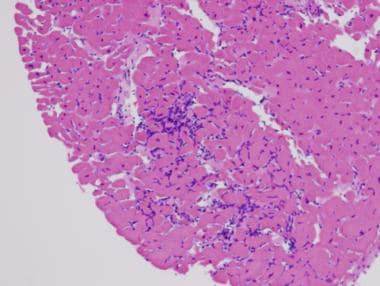
Histologic Findings: Biopsy specimens from EMB should reveal the simultaneous findings of lymphocyte infiltration and myocyte necrosis.Staging: The Dallas classification (1987) and the World Health Organization (WHO) Marburg classification (1996) are commonly used. - Cell types - Lymphocytic, eosinophilic, neutrophilic, giant cell, granulomatous, or mixed
- Amount - None (grade 0), mild (grade 1), moderate (grade 2), or severe (grade 3)
- Distribution - Focal (outside vessel lumen), confluent, diffuse, or reparative (in fibrotic areas)
- Dallas classification (1987)
- Initial biopsy
- Myocarditis - Myocardial necrosis, degeneration, or both, in the absence of significant coronary artery disease with adjacent inflammatory infiltrate with or without fibrosis
- Borderline myocarditis - Inflammatory infiltrate too sparse or myocyte damage not apparent
- No myocarditis
- Subsequent biopsy
- Ongoing (persistent) myocarditis with or without fibrosis
- Resolving (healing) myocarditis with or without fibrosis
- Resolved (healed) myocarditis with or without fibrosis
- WHO Marburg criteria (1996) defines myocarditis as a minimum of 14 infiltrating leukocytes/mm2, preferably T cells (CD45RO), with as many as 4 macrophages possibly included.
|   |
TREATMENT
| Section 6 of 10  |
|
Medical Care: Treatment of myocarditis includes supportive therapy for symptoms of acute heart failure with use of diuretics, nitrates/sodium nitroprusside, and angiotensin-converting enzyme (ACE) inhibitors (see Pulmonary Edema, Cardiogenic). Inotropic drugs (eg, dobutamine, milrinone) may be necessary for severe decompensation, although they are highly arrhythmogenic. Long-term treatment follows the same medical regimen, including ACE inhibitors, beta-blockers, and aldosterone receptor antagonists. However, in some instances, some of these drugs cannot be implemented initially because of hemodynamic instability. - Withdrawal of the offending agent is called for, if applicable (eg, cardiotoxic drugs, alcohol). Treat underlying infectious or systemic inflammatory etiology. Nonsteroidal anti-inflammatory agents should be avoided in the acute phase, as their use may impede myocardial healing and actually exacerbate the inflammatory process and increase the risk of mortality.
- Anticoagulation may be advisable as a preventive measure, as in other causes of heart failure, although no definitive evidence is available.
- Antiarrhythmics can be used cautiously, although most antiarrhythmic drugs have negative inotropic effects that may aggravate heart failure.
- Supraventricular arrhythmias should be converted electrically.
- High-grade ventricular ectopy and ventricular tachyarrhythmia should be treated cautiously with beta-blockers and antiarrhythmics.
- Patients are usually very sensitive to digoxin and should use it with caution and in low doses. (Digoxin increases expression of proinflammatory cytokines and mortality rate in animal models.)
- Complete heart block is an indication for temporary transvenous pacing.
- Implantable defibrillators rarely are indicated in lymphocytic myocarditis unless extensive scarring has occurred.
- This condition carries a low threshold for ventilatory and circulatory support (such as intra-aortic balloon pump) because of the rapidly progressive course of decompensation and the potential for reversal.
- Immunosuppression has not been demonstrated to change the natural history of infectious myocarditis. Three large-scale prospective clinical trials on immunosuppressive strategies have been performed in patients with myocarditis, none of which showed significant benefits (National Institutes of Health [NIH] prednisone trial, Myocarditis Treatment Trial, and Intervention in Myocarditis and Acute Cardiomyopathy [IMAC] trial). Empirical treatment with immunosuppression for systemic autoimmune disease, especially in giant cell myocarditis and sarcoid myocarditis, is often given based on evidence from small series.
- No benefit has been established for the use of antiviral agents, although some small series have demonstrated their efficacy (the efficacy of interferon-alpha will be evaluated in the ongoing ESETCID).
Surgical Care: - Left ventricular assistive devices (LVADs) and extracorporeal membrane oxygenation (ECMO) may be indicated for short-term circulatory support if needed for cardiogenic shock.
- Survival rates have not been shown to be decreased in patients with acute myocarditis, although retrospective observations have been made that more posttransplant acute rejections and subsequent posttransplant vasculopathy may occur in these patients.
- Transplantation has been shown to be particularly beneficial to those with biopsy-proven giant cell myocarditis; the 5-year survival rate after transplantation was 71%, despite a 25% incidence of posttransplantation recurrence, as seen in 9 of 34 patients in the Multicenter Giant Cell Myocarditis study.
Consultations: - Infectious disease and/or rheumatology consultations
Diet: Low-sodium diet similar to that of heart failure management Activity: Bedrest and avoidance of athletic activities are recommended from anecdotal experiences (with lower incidence of arrhythmia).
|   |
MEDICATION
| Section 7 of 10  |
|
In general, treatment of both acute and chronic myocarditis is aimed at reducing congestion and improving cardiac hemodynamics in heart failure, as well as providing supportive therapy with the hopes of prolonging survival (see Treatment). Treatment of heart failure follows the same treatment regimen regardless of the underlying cause (ie, ACE inhibitors, beta-adrenergic blockers).
Intensive immunosuppressive therapy (eg, corticosteroids, azathioprine, cyclosporine, muromonab-CD3/OKT3) has been shown to have some benefit only in small-scale clinical studies in treatment of giant cell myocarditis and has not been validated in large clinical trials. At this time, immunosuppressive therapy is not recommended for myocarditis until clear evidence is available from the results of multicenter trials.
Drug Category: Vasodilators -- Reduce systemic vascular resistance, allowing more forward flow and improving cardiac output. This in turn improves myocardial oxygen supply, resulting in dilatation of epicardial and collateral vessels, improving blood supply to the ischemic myocardium. Drug Name
| Nitroglycerin (Tridil, Nitro-Bid IV) -- DOC for patients who are not hypotensive. Provides excellent and reliable preload reduction. Higher doses provide mild afterload reduction.
Has rapid onset and offset (both within minutes), allowing for rapid clinical effects and rapid discontinuation of effects in adverse reactions.| Adult Dose | Mild-to-moderately severe respiratory distress: 1-2 inches topically if good skin perfusion; not effective in peripheral vessel vasoconstriction resulting from shock
Moderate-to-severe respiratory distress: 0.3-0.4 mg SL q3-5min
Severe distress: 10-20 mcg/min IV, titrate 5- to 10-mcg increments q5min as BP tolerates| Pediatric Dose | Not established |
|---|
| Contraindications | Documented hypersensitivity; hypotension; severe anemia; shock; postural hypotension; head trauma; closed-angle glaucoma; cerebral hemorrhage |
|---|
| Interactions | Sildenafil (Viagra) taken within 24 h may induce precipitous decreases in BP; aspirin may increase nitrate serum concentrations; marked symptomatic orthostatic hypotension may occur with coadministration of calcium channel blockers (dose adjustment of either agent may be necessary) |
|---|
| Pregnancy |
C - Safety for use during pregnancy has not been established.
|
|---|
| Precautions | Caution in right ventricular infarction or severe aortic stenosis because of importance of maintaining adequate preload in maintaining cardiac output |
|---|
|
|---|
|
|---|
Drug Name
| Sodium nitroprusside (Nitropress) -- Considered an afterload reducer. Potent direct smooth muscle–relaxing agent that results primarily in afterload reduction but can cause mild preload reduction. Produces improved cardiac output but also can cause precipitous decreases in BP. Intra-arterial BP monitoring strongly recommended.
Excellent medication in critically ill patients because of rapid onset and offset of action (within 1-2 min). Excellent for use in cardiogenic pulmonary edema associated with relative hypertension in myocarditis.| Adult Dose | 0.1-0.3 mcg/kg/min continuous IV infusion initial, titrate q5-10min; not to exceed 5-10 mcg/kg/min |
|---|
| Pediatric Dose | Not established |
|---|
| Contraindications | Documented hypersensitivity; severe aortic stenosis or idiopathic hypertrophic subaortic stenosis |
|---|
| Interactions | Not established in short-term (<24 h) use for stabilization; combined use with other vasodilators may induce significant decreases in BP (continuous hemodynamic monitoring by arterial line is imperative) |
|---|
| Pregnancy |
C - Safety for use during pregnancy has not been established.
|
|---|
| Precautions | Can result in precipitous decreases in BP; coat drug reservoir and tubing with opaque material (eg, aluminum foil) to protect against light sensitivity; adverse effects may include thiocyanate toxicity (symptoms include headache, nausea, vomiting); monitor thiocyanate levels in prolonged use (24 h or 6-12 h in renal failure); fetal cyanide toxicity is concern in prolonged use during pregnancy, convert to oral vasodilator once condition stable |
|---|
|
|---|
Drug Category: ACE inhibitors -- Following stabilization of heart failure symptoms, initiation of ACE inhibitors is the standard of care to delay disease progression in heart failure. Beta-adrenergic antagonists should be used only following resolution of congestive symptoms and clinical stabilization of the patient's condition.Drug Name
| Enalapril (Vasotec) -- Competitive inhibitor of angiotensin-converting enzymes. Reduces angiotensin II levels, causing decrease in aldosterone secretion. |
|---|
| Adult Dose | 1.25 mg IV q6h
2.5-20 mg PO bid| Pediatric Dose | Not established |
|---|
| Contraindications | Documented hypersensitivity, pregnancy; renal insufficiency; history of angioedema or ACE inhibitor allergy; hypotension |
|---|
| Interactions | NSAIDs may reduce hypotensive effects; may increase digoxin, lithium, and allopurinol levels; rifampin decreases levels; probenecid may increase levels; diuretics may enhance hypotensive effects |
|---|
| Pregnancy |
D - Unsafe in pregnancy
|
|---|
| Precautions | Caution in renal impairment, severe aortic stenosis, or severe congestive symptoms in heart failure; may cause hypotension |
|---|
|
|---|
Drug Category: Diuretics -- Reduce preload. The initial drop in cardiac output produced by diuresis causes a compensatory increase in peripheral vascular resistance. With continuing diuretic therapy, the extracellular fluid volume and plasma volume return almost to pretreatment levels, and peripheral vascular resistance falls below its pretreatment baseline.Drug Name
| Furosemide (Lasix) -- Most commonly used loop diuretic. Increases excretion of water by interfering with chloride-binding cotransport system, resulting in inhibition of sodium and chloride reabsorption in ascending loop of Henle and distal renal tubule. Reduces preload through diuresis in 20-60 min. May contribute to more rapid preload reduction through direct vasoactive mechanism, but this is controversial. As many as half of all patients with cardiogenic pulmonary edema (CPE) are total-body euvolemic. Generally administered to all patients with CPE but probably is most useful in patients with total-body fluid overload. PO form has slower onset of action, and therefore, generally not considered appropriate for treating these patients. |
|---|
| Adult Dose | 1 mg/kg or 40-80 mg IV push; in severe cases may be given in continuous IV drip format, starting 10-20 mg/h IV gtt |
|---|
| Pediatric Dose | Not established |
|---|
| Contraindications | Documented hypersensitivity |
|---|
| Interactions | Metformin decreases concentrations; interferes with hypoglycemic effect of antidiabetic agents and antagonizes muscle-relaxing effect of tubocurarine; aminoglycosides increase risk of auditory toxicity—hearing loss of varying degrees may occur; may increase anticoagulant activity of warfarin; may increase plasma levels and toxicity of lithium |
|---|
| Pregnancy |
C - Safety for use during pregnancy has not been established.
|
|---|
| Precautions | Patients with anuria will not produce urine in response to furosemide; some clinicians believe acute use of furosemide in these patients is appropriate because of direct vasoactive effect; perform frequent serum electrolyte, bicarbonate, glucose, creatinine, uric acid, calcium, and BUN determinations during first few months of therapy and periodically thereafter |
|---|
|   |
FOLLOW-UP
| Section 8 of 10  |
|
Further Outpatient Care:
- Ongoing chronic inflammation may cause dilated cardiomyopathy and subsequent heart failure. Patients with a history of myocarditis should be monitored at intervals of 1-3 months initially, with gradual return of physical activity.
Deterrence/Prevention:
- Vaccination should reduce the incidence of myocarditis caused by measles, rubella, mumps, poliomyelitis, and influenza. Development of vaccines for other cardiotropic viruses may prevent viral myocarditis in the future.
Complications:
- Cardiogenic shock may occur in fulminant cases of myocarditis.
- Severe heart block requiring permanent pacemaker placement occurred in 1% of patients in the Myocarditis Treatment trial.
Prognosis:
- Patients who have survived fulminant myocarditis have a good prognosis. In a study of 147 cases of myocarditis monitored for an average of 5.6 years, 93% of the 15 patients with fulminant disease were alive without transplant 11 years after biopsy, compared with 45% of the 132 patients with less severe disease. Left ventricular dilation was not as severe in the fulminant cases as in the nonfulminant ones.
- Expression of soluble Fas and Fas ligands at initial presentation appears to be a good serologic marker to predict the prognosis of acute myocarditis, while antimyosin autoantibodies are associated with development of worse cardiac dysfunction in chronic myocarditis.
- Predictors of death or need for heart transplantation after acute myocarditis in multivariate analyses include syncope, low ejection fraction, and left bundle-branch block, all indicators of advanced cardiomyopathy.
|   |
MISCELLANEOUS
| Section 9 of 10  |
|
Medical/Legal Pitfalls:
- High clinical suspicion of acute myocarditis is required for young and otherwise healthy individuals who develop heart failure with a rapid deteriorating course.
- Young patients presenting with cardiogenic shock with classic ECG changes of myocardial infarction but febrile may suffer from pseudomyocardial infarction, which is consistent with myocarditis. These people certainly need cardiac catheterization to rule out ischemic causes, despite the possibility of myocarditis.
- Close follow-up care is needed for patients who survive acute myocarditis, despite full initial recovery, as persistent chronic inflammation may lead to subsequent dilated cardiomyopathy and heart failure.
- Giant cell myocarditis has a more aggressive course and may require prompt surgical support (LVAD, transplant).
|   |
BIBLIOGRAPHY
| Section 10 of 10 |
|
-
Aretz HT, Billingham ME, Edwards WD, et al: Myocarditis. A histopathologic definition and classification. Am J Cardiovasc Pathol 1987 Jan; 1(1): 3-14[Medline].
-
Badorff C, Knowlton KU: Dystrophin disruption in enterovirus-induced myocarditis and dilated cardiomyopathy: from bench to bedside. Med Microbiol Immunol (Berl) 2004 May; 193(2-3): 121-6[Medline].
-
Bowles NE, Towbin JA: Molecular aspects of myocarditis. Curr Opin Cardiol 1998 May; 13(3): 179-84[Medline].
-
Cooper LT Jr, Berry GJ, Shabetai R: Idiopathic giant-cell myocarditis--natural history and treatment. Multicenter Giant Cell Myocarditis Study Group Investigators. N Engl J Med 1997 Jun 26; 336(26): 1860-6[Medline].
-
D'Ambrosio A, Patti G, Manzoli A, et al: The fate of acute myocarditis between spontaneous improvement and evolution to dilated cardiomyopathy: a review. Heart 2001 May; 85(5): 499-504[Medline].
-
Dec GW Jr, Palacios IF, Fallon JT, et al: Active myocarditis in the spectrum of acute dilated cardiomyopathies. Clinical features, histologic correlates, and clinical outcome. N Engl J Med 1985 Apr 4; 312(14): 885-90[Medline].
-
Feldman AM, McNamara D: Myocarditis. N Engl J Med 2000 Nov 9; 343(19): 1388-98[Medline].
-
Frustaci A, Chimenti C, Calabrese F, et al: Immunosuppressive therapy for active lymphocytic myocarditis: virological and immunologic profile of responders versus nonresponders. Circulation 2003 Feb 18; 107(6): 857-63[Medline].
-
Fuse K, Kodama M, Okura Y, et al: Predictors of disease course in patients with acute myocarditis. Circulation 2000 Dec 5; 102(23): 2829-35[Medline].
-
Hufnagel G, Pankuweit S, Richter A, et al: The European Study of Epidemiology and Treatment of Cardiac Inflammatory Diseases (ESETCID). First epidemiological results. Herz 2000 May; 25(3): 279-85[Medline].
-
Karjalainen J, Heikkila J: Incidence of three presentations of acute myocarditis in young men in military service. A 20-year experience. Eur Heart J 1999 Aug; 20(15): 1120-5[Medline].
-
Kawai C: From myocarditis to cardiomyopathy: mechanisms of inflammation and cell death: learning from the past for the future. Circulation 1999 Mar 2; 99(8): 1091-100[Medline].
-
Kuhl U, Pauschinger M, Noutsias M, et al: High prevalence of viral genomes and multiple viral infections in the myocardium of adults with "idiopathic" left ventricular dysfunction. Circulation 2005 Feb 22; 111(7): 887-93[Medline].
-
Lauer B, Schannwell M, Kuhl U, et al: Antimyosin autoantibodies are associated with deterioration of systolic and diastolic left ventricular function in patients with chronic myocarditis. J Am Coll Cardiol 2000 Jan; 35(1): 11-8[Medline].
-
Mason JW, O'Connell JB, Herskowitz A, et al: A clinical trial of immunosuppressive therapy for myocarditis. The Myocarditis Treatment Trial Investigators. N Engl J Med 1995 Aug 3; 333(5): 269-75[Medline].
-
McCarthy RE 3rd, Boehmer JP, Hruban RH, et al: Long-term outcome of fulminant myocarditis as compared with acute (nonfulminant) myocarditis. N Engl J Med 2000 Mar 9; 342(10): 690-5[Medline].
-
McNamara DM, Starling RC, Dec GW: Intervention in myocarditis and acute cardiomyopathy with immune globulin: results from the randomized placebo controlled IMAC trial. Circulation 1999; 100(suppl): I-21.
-
Oakley CM: Myocarditis, pericarditis and other pericardial diseases. Heart 2000 Oct; 84(4): 449-54[Medline].
-
Parrillo JE, Cunnion RE, Epstein SE, et al: A prospective, randomized, controlled trial of prednisone for dilated cardiomyopathy. N Engl J Med 1989 Oct 19; 321(16): 1061-8[Medline].
-
Pulerwitz TC, Cappola TP, Felker GM, et al: Mortality in primary and secondary myocarditis. Am Heart J 2004 Apr; 147(4): 746-50[Medline].
-
Rosenstein ED, Zucker MJ, Kramer N: Giant cell myocarditis: most fatal of autoimmune diseases. Semin Arthritis Rheum 2000 Aug; 30(1): 1-16[Medline].
-
Wakafuji S, Okada R: Twenty year autopsy statistics of myocarditis incidence in Japan. Jpn Circ J 1986; 50: 1288-1293[Medline].
Myocarditis excerpt |