Continually Updated Clinical Reference
 
 
  All Sources     eMedicine     Medscape     Drug Reference     MEDLINE
 
eMedicine - Calcium Pyrophosphate Deposition Disease : Article by

Quick Find
Authors & Editors
Introduction
Clinical
Differentials
Workup
Treatment
Medication
Follow-up
Miscellaneous
Multimedia
References

Related Articles
Gout

Hemochromatosis

Hyperparathyroidism

Hypothyroidism

Osteoarthritis

Rheumatoid Arthritis

Septic Arthritis


Patient Education
Click here for patient education.


Author: Constantine Saadeh, MD, Chief, Department of Internal Medicine, Northwest Texas Hospital; President, Allergy ARTS, LLP; Clinical Professor, Departments of Internal Medicine, Pediatrics, Microbiology, and Immunology, Texas Tech Health Science Center

Constantine Saadeh is a member of the following medical societies: American Academy of Allergy Asthma and Immunology, American College of Rheumatology, American Medical Association, Southern Medical Association, and Texas Medical Association

Coauthor(s): Jan Malacara, PA-C, Consulting Staff, Allergy ARTS, LLP

Editors: Kristine M Lohr, MD, MS, Program Director, Professor, Department of Internal Medicine, Division of Rheumatology and Women's Health, University of Kentucky School of Medicine; Francisco Talavera, PharmD, PhD, Senior Pharmacy Editor, eMedicine; Lawrence H Brent, MD, Associate Professor of Medicine, Thomas Jefferson University; Chair, Program Director, Department of Medicine, Division of Rheumatology, Albert Einstein Medical Center; Alex J Mechaber, MD, FACP, Assistant Dean for Medical Curriculum, Associate Professor of Medicine, Division of General Internal Medicine, University of Miami Miller School of Medicine; Arthur Weinstein, MD, Professor of Medicine, Georgetown University Medical Center; Associate Chairman, Department of Medicine, Director, Section of Rheumatology, Washington Hospital Center

Author and Editor Disclosure

Synonyms and related keywords: CPDD, chondrocalcinosis, pseudogout, pyrophosphate arthropathy, lanthanic, acute pseudogout, pseudoosteoarthritis, pseudorheumatoid arthritis, pseudo-rheumatoid arthritis, pseudo-osteoarthritis, pseudoneuropathic joints, pseudo-neuropathic joints, calcium pyrophosphate dihydrate, CPPD, gout, pseudo-gout, arthritis, pseudoarthritis, pseudo-arthritis, osteoarthritis

Background

Calcium pyrophosphate deposition disease (CPDD) is a metabolic arthropathy resulting from the deposition of calcium pyrophosphate dihydrate (CPPD) in and around joints, especially in articular and fibrocartilage. Although CPDD often is asymptomatic, with only radiographic changes (ie, chondrocalcinosis), various clinical manifestations may occur, including acute (pseudogout) and chronic arthritis. Although almost any joint may be involved, the knees, wrists, and hips are most commonly affected. This condition is the most common cause of secondary metabolic osteoarthritis.

Pathophysiology

Although the exact mechanism for the development of CPDD remains unknown, increased adenosine triphosphate breakdown with resultant increased inorganic pyrophosphate in the joints occurs as a result of aging, genetic factors, or both. Changes in the cartilage matrix may play an important role in promoting CPPD deposition. Rare hereditary forms of CPDD occur, generally inherited in an autosomal dominant mode.

Overactivity of enzymes that breakdown triphosphates, such as nucleoside triphosphate pyrophosphohydrolase, has been observed in the cartilage of patients with CPDD. Therefore, inorganic pyrophosphate can bind calcium, leading to CPPD deposition in cartilage and synovium. Hyaline cartilage is affected most commonly, but fibrocartilage, such as the meniscal cartilage of the knee, also can be involved.

Hypotheses based on in vitro studies propose that pyrophosphohydrolase activity and inorganic phosphate content, as noted above, are generalized phenomena that occur in fibroblasts. Although these phenomena are generalized, the reason they occur only in joints remains unknown.

Recently, genetic defects have been identified as specific gene mutations in a few kindred families. The mutation occurred in specific genes known as ANKH and COL, which may be involved in the crystal-induced inflammation. This is related to synovial tissue and direct cartilage activation, leading to the arthritis caused by CPPD. The ANKH gene has also been shown to be involved in cellular transport of inorganic phosphate.

Frequency

United States

CPDD is a common condition that occurs with aging in all races. Nearly 50% of people older than 85 years have radiologic evidence of chondrocalcinosis.

Mortality/Morbidity

CPDD can be a cause of significant morbidity, either from the pain of an acute attack of pseudogout or the chronic symptoms associated with chronic arthropathy.

Race

No particular race predilection exists for this condition.

Sex

Women have a slightly higher incidence than men, but the exact ratio is not known. The female-to-male ratio probably is 1.4-1.

Age

CPDD usually occurs in patients who are in the fifth decade of life or older, with increasing prevalence as age increases. When it occurs early, before the fourth decade, it usually is associated with secondary causes such as an underlying metabolic disease or familial causes.


History

Clinical presentations can vary, but according to McCarty, 5 different presentations are most common, as follows:

  • Asymptomatic (lanthanic)
    • This usually is associated with finding chondrocalcinosis on radiographs, without clinical manifestations. This may be the most common form of CPDD.
    • The classic radiologic findings include chondrocalcinosis of the hyaline cartilage and fibrocartilage of the knees, the fibrocartilage of the triangular ligament of the wrist, the fibrocartilage of the symphysis pubis, and the acetabulum labrum of the hips.
  • Acute pseudogout
    • This is characterized by acute monoarticular or oligoarticular arthritis. Pseudogout usually involves the knee or the wrist, although almost any joint can be involved, including the first metatarsophalangeal (MTP) joint, as occurs in patients with gout. This form of CPDD occurs in 25% of patients.
    • Clinical manifestations are similar to acute gouty arthritis, typically presenting with an acute monoarthritis with pain and swelling, although generally not as intense. Polyarticular attacks may occur on occasion. Pseudogout may be precipitated by medical illness such as myocardial infarction, congestive heart failure, or cerebrovascular accident or may occur after surgery. Trauma also may be a precipitating factor. Events that affect serum calcium levels also may precipitate attacks of pseudogout.
    • Occasionally, pseudogout may present as a pseudoseptic syndrome with acute arthritis, fever, and leukocytosis with a left shift.
    • Aspiration of the fluid from affected joints during an acute attack usually yields mildly-to-moderately inflammatory fluid, with 10,000-50,000 WBCs/mcL, more than 90% of which are neutrophils.
    • Glucose levels usually are normal.
    • Characteristically, rhomboid-shaped, weakly positively, birefringent crystals are seen both intracellularly and extracellularly using compensated polarized microscopy. The presence of such crystals intracellularly is pathognomonic for acute pseudogout.
    • Septic arthritis must be excluded; therefore, a Gram stain of the fluid should be performed. The results of the Gram stain are negative unless a concomitant infection is present.
  • Pseudoosteoarthritis
    • Pseudoosteoarthritis often involves the metacarpophalangeal (MCP) joints, wrists, elbows, and shoulders, joints unlikely to be involved with primary osteoarthritis. It affects the knees most commonly and can involve the proximal interphalangeal (PIP) joints and spine, as occurs in patients with primary osteoarthritis. This form of CPDD accounts for 50% of all patients. Approximately half of these patients also have associated pseudogout.
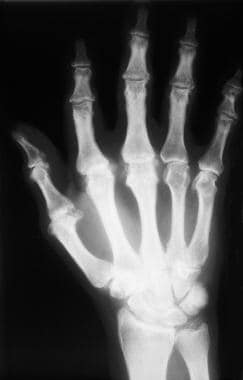
    • Hooklike osteophytes are a common radiological finding in patients with a pseudoosteoarthritis condition and usually are present along the second and third metacarpal heads.
    • The presence of chondrocalcinosis on radiographs is common.
    • The differential diagnosis includes hemochromatosis, hyperparathyroidism, hypothyroidism, and traumatic arthritis (as occurs in heavy equipment machinery operators).
  • Pseudorheumatoid arthritis
    • This pattern is found in approximately 5% of patients with CPDD and is associated with symmetrical inflammation of the PIP and MCP joints.
    • Clinically, these patients complain of morning stiffness and joint swelling.
    • Radiologically, erosions can be observed but usually are associated with chondrocalcinosis.
    • The erythrocyte sedimentation rate (ESR) usually is elevated.
    • The older age at onset for this condition, the lack of rheumatoid factor, and the presence of chondrocalcinosis help differentiate it from true rheumatoid arthritis. However, rheumatoid arthritis can occur in older individuals. In addition, older individuals may have low-titer–positive rheumatoid factor. Thus, the diagnosis must be made with care.
  • Pseudoneuropathic joints
    • Neuropathiclike arthropathy is observed in fewer than 5% of patients with CPDD, most commonly involving the knee. This is a severe destructive arthropathy. Unlike true neuropathic arthropathy, no clear underlying neurological disorder is present.
    • Again, the presence of chondrocalcinosis can help make the diagnosis.
  • Revised diagnostic criteria for calcium pyrophosphate crystal deposition disease were taken from the 1997 Primer on Rheumatic Disease and are used with permission from the Arthritis Foundation.
    • Criterion I - Demonstration of calcium pyrophosphate crystal deposition in tissue or synovial fluid by definitive means (eg, characteristic x-ray films, diffraction analysis, or chemical analysis)
    • Criterion IIa - Identification of monoclinic or triclinic crystals showing no or weakly positive birefringence by compensated polarized light microscopy
    • Criterion IIb - Presence of typical radiographic calcifications
    • Criterion IIIa - Acute arthritis, especially of knees or other large joints
    • Criterion IIIb - Chronic arthritis, especially of knee, hip, wrist, carpus, elbow, shoulder, or MCP joint, especially if accompanied by acute exacerbation; the chronic arthritis shows the following features, which are helpful in differentiating it from osteoarthritis:
      • Uncommon sites - Wrist, MCP joint, elbow, shoulder
      • Radiographic appearance - Radiocarpal or patellofemoral joint-space narrowing, especially if isolated (eg, patella wrapped around the femur)
      • Subchondral cyst formation
      • Severity of degeneration - Progressive, with subchondral bony collapse and fragmentation with formation of intraarticular radiodense bodies
      • Osteophyte formation - Variable and inconsistent
      • Tendon calcifications, especially triceps, Achilles, obturators
    • Categories
      • Definite disease: Criterion I or IIa plus IIb must be fulfilled.
      • Probable disease: Criterion IIa or IIb must be fulfilled.
      • Possible disease: Criterion IIIa or IIIb should alert the clinician to the possibility of underlying calcium pyrophosphate deposition.
  • A number of conditions have been associated with CPDD. When CPDD is diagnosed, especially in a patient younger than 60 years, a metabolic workup should be performed, including measurements of serum calcium, magnesium phosphorus, alkaline phosphatase, iron, total iron-binding capacity (TIBC), transferrin saturation and ferritin, and thyroid-stimulating hormone.
    • True associations - Familial (autosomal dominant), prior trauma or prior surgery, hyperparathyroidism, hemochromatosis, hypophosphatasia, hypomagnesemia, aging
    • Probable associations - Hypothyroidism, gout, familial hypercalciuria
    • Possible associations - Acromegaly, diabetes mellitus, ochronosis, Wilson disease.

Physical

The physical examination findings vary depending on the form of CPDD in a given patient, who may present with an acute arthritis or different patterns of chronic arthritis.

  • Acute pseudogout: Physical examination findings show an acutely inflamed joint with swelling, effusion, warmth, tenderness, and pain on range of motion similar to acute gouty arthritis. This typically occurs in the knee but may occur in the wrists, shoulders, ankles, hands, and feet.
  • Pseudoosteoarthritis: Physical examination findings show a picture similar to osteoarthritis, sometimes with unusual joint predilection. If a patient has osteoarthritis involving the MCP joints and wrists, consider CPDD associated with an underlying metabolic disease.
  • Pseudorheumatoid arthritis: Physical examination findings show a picture similar to rheumatoid arthritis with synovitis in a symmetrical polyarticular pattern, especially involving the wrists and MCP joints.

Causes

See Pathophysiology.


Gout
Hemochromatosis
Hyperparathyroidism
Hypothyroidism
Osteoarthritis
Rheumatoid Arthritis
Septic Arthritis

Other Problems to be Considered

Basic calcium phosphate deposition disease
Lyme arthritis


Lab Studies

  • General laboratory studies usually are not helpful. WBC count and ESR may be elevated.
  • Evaluating for an underlying metabolic disease (eg, hemochromatosis, hyperparathyroidism, hypothyroidism) is reasonable, especially in younger patients.
  • Laboratory tests can include serum calcium, phosphorus, and magnesium and alkaline phosphatase levels; iron levels; TIBC; transferrin saturation and ferritin; and thyroid stimulating hormone and free thyroxine levels.
  • The diagnosis of acute pseudogout is made by performing compensated polarized microscopy after aspiration of fluid from the involved joint.
    • The involved joint most commonly is the knee, followed by the wrist, the MCP joints, the elbows, and the MTP joints.
    • The crystals are rhomboid-shaped, weakly positively birefringent, and difficult to see. If intracellular, an acute attack of pseudogout is strongly suggested.
    • Gout and pseudogout can coexist, even in the same joint; therefore, the presence of gout does not rule out the possibility of pseudogout and vice-versa.
  • Septic arthritis can present as monoarticular arthritis and, therefore, can mimic acute pseudogout. If septic arthritis is suggested clinically, even if crystals are seen on compensated polarized microscopy, it must be evaluated and, possibly, treated.

Imaging Studies

  • Radiological studies are important in the diagnosis of CPDD. The studies usually include the hands and wrists, pelvis, and knees. The pelvic radiograph should include an anteroposterior view that includes the symphysis pubis and hips.
  • Chondrocalcinosis usually is found in the articular cartilage or meniscal cartilage of the knee, the triangular ligament of the wrist, the symphysis pubis, or the glenoid or acetabulum labra. Recently, chondrocalcinosis has been noticed in other areas of the wrist (aside from the fibrocartilage) such as the distal radioulnar joint and the midcarpal joint, as well as the pisotriquetral joint. In addition, it has been reported in the spine as calcification of the ligamentum flavum.
  • In some situations, hemochromatosis can produce specific radiographic findings, such as large hooklike osteophytes especially around the second to the fifth MCP joints. However, these findings also can occur in patients with CPDD alone.

    X-ray is still the gold standard in the diagnosis of this condition. Even routine MRI has not been shown to be as sensitive as x-ray to detect the presence of the CPPD deposits. However, 4T MRI holds better promise in detecting these crystals. Ultrasound may be able to detect some crystals when they are large but may not hold the promise that the 4T MRI holds.

Procedures

  • Arthrocentesis is the most important procedure to perform, especially in patients with acute pseudogout, in order to examine the fluid using compensated polarized microscopy and to perform fluid cultures.

Histologic Findings

Histological changes associated with this condition correspond to calcium deposits and inflammation due to cartilage fragments. These changes are nonspecific, but calcium deposits inside the chondrocartilage perhaps is the most typical finding in patients with this condition. The pathognomonic finding with compensated polarized microscopy is weakly positive birefringent crystals, typically intracellular, that usually are rhomboid in shape.


Medical Care

Management depends on the clinical manifestations of CPDD.

  • Lanthanic or asymptomatic CPDD should not be treated unless it is a possible manifestation of other syndromes such as hyperparathyroidism or hemochromatosis. Treatment of the latter conditions is important to prevent further end-organ damage but cannot reverse the joint disease.
  • Acute pseudogout may be treated by joint aspiration and intraarticular corticosteroid injection, systemic corticosteroids, nonsteroidal anti-inflammatory drugs (NSAIDs), or, occasionally, high-dose colchicine.
    • Intraarticular corticosteroid injections, such as 40-80 mg (depending on the size of the joint) of methylprednisolone or triamcinolone into the affected joint, have the advantage of avoiding the adverse systemic effects of NSAIDs. Short courses of systemic corticosteroids may be used for polyarticular attacks of pseudogout.
    • Using NSAIDs also can be considered, generally in higher doses during the acute attack and in lesser doses for prevention. Be aware of toxicity, which is common in elderly patients, including gastrointestinal and renal toxicities. Cyclooxygenase-2 (COX-2) selective NSAIDs (ie, COX-2 inhibitors) may be as effective as traditional NSAIDs with less toxicity, although this has not been rigorously tested.
    • Oral colchicine, or even intravenous colchicine, can be considered for the treatment of acute pseudogout. Colchicine should be a treatment of last resort due its poor therapeutic ratio.
    • Preventing acute attacks is difficult. The use of small doses of colchicine (0.6 mg qd/bid) or NSAIDs have been tried, with variable success.
  • Patients with pseudoosteoarthritis are treated similar to patients with typical osteoarthritis.
  • Patients with a pseudorheumatoid arthritis can be treated with small doses of corticosteroids, such as prednisone at 5 mg/d.

Surgical Care

Theoretically, surgically removing calcifications from the joint might be of benefit, but this currently is considered an experimental procedure.


Medical therapy for acute pseudogout is similar to that for gout, including NSAIDs, intraarticular or occasionally systemic corticosteroids, and, rarely, oral or intravenous colchicine. NSAIDs or, occasionally, low-dose prednisone may be beneficial for chronic arthropathies due to CPDD.

Drug Category: Nonsteroidal anti-inflammatory drugs

NSAIDs are very effective for the treatment of acute pseudogout and may be used for prophylaxis to prevent recurrent attacks of pseudogout. These agents also may be useful for symptomatic treatment of chronic arthropathies associated with CPDD. NSAID use is limited by toxicity (eg, renal, GI), which is common in elderly patients. COX-2 selective NSAIDs may be as effective as traditional NSAIDs with less GI toxicity.

Drug NameIndomethacin (Indocin)
DescriptionTraditional NSAID used to treat acute gouty arthritis. Used in a similar fashion for acute pseudogout. Blocks COX and, thereby, the generation of proinflammatory prostaglandins. Use maximum dose initially, tapering over 2 weeks depending on clinical response.
Adult Dose50 mg PO tid/qid for 1-3 d depending on response, then taper
Pediatric DoseNot established
ContraindicationsDocumented hypersensitivity; peptic ulcer disease; renal insufficiency; thrombocytopenia, patient on anticoagulation
InteractionsCoadministration with aspirin increases risk of serious NSAID-induced adverse event; may decrease effects of various antihypertensive medications including ACE inhibitors, beta-blockers, and diuretics; may increase PT if patient on oral anticoagulants; phenytoin levels may be increased
PregnancyB - Usually safe but benefits must outweigh the risks.
PrecautionsGI toxicity, including nausea, dyspepsia, abdominal pain, diarrhea, and peptic ulcer disease; renal toxicities, including acute renal insufficiency, hyperkalemia, hyponatremia, interstitial nephritis, and renal papillary necrosis; avoid in third trimester of pregnancy

Drug Category: Anti-inflammatory agents

If given PO or, rarely, IV, can be used to treat acute pseudogout. Toxicity is significant; therefore, other therapies should be considered first. Low-dose colchicine may be useful for long-term prophylaxis of pseudogout attacks.

Drug NameColchicine
DescriptionInhibits microtubules and, thereby, may inhibit neutrophil chemotaxis and phagocytosis. Also may inhibit prostaglandin generation.
Adult DoseAcute pseudogout: 0.6 mg PO q1h until relief or GI toxicity; not to exceed 6 mg
Alternatively: 1 mg IV in 20 mL isotonic sodium chloride solution without glucose over 20 min; may repeat in 6 h; not to exceed 4 mg in 24-h period; do not use if patient on oral colchicine and do not give further colchicine by any route for at least 1 wk
Prophylaxis: 0.6 mg PO qd/bid; decrease dose for renal insufficiency
Pediatric DoseNot established
ContraindicationsDocumented hypersensitivity; severe renal, hepatic, GI, or cardiac disorders; blood dyscrasias
InteractionsSympathomimetic agent toxicity and effect of CNS depressants significantly increased
PregnancyX - Contraindicated in pregnancy
PrecautionsRisk of renal failure, hepatic failure, permanent hair loss, bone marrow toxicity, disseminated intravascular coagulation, and oligospermia; dose-dependent GI toxicity, especially diarrhea; rarely neuropathy or myopathy

Drug Category: Corticosteroids

Potent anti-inflammatory agents very useful in the treatment of acute pseudogout in patients who are not good candidates for NSAIDs and are much less toxic than colchicine. Can be given PO/IV or intraarticularly. PO prednisone used for an acute attack of pseudogout generally is tapered over 2 wk. Intraarticular corticosteroids (eg, methylprednisolone) are very effective for treatment of acute pseudogout. General dose is 20-80 mg methylprednisone or its equivalent, depending on the size of the joint. This treatment has minimal toxicity and few contraindications (septic arthritis). Low-dose prednisone may be used for long-term treatment of pseudorheumatoid arthritis.

Drug NamePrednisone (Deltasone, Orasone, Meticorten)
DescriptionCan be given PO to abort an attack of pseudogout. Can be given IV if patient cannot take PO. Intraarticular corticosteroids first choice of therapy due to excellent safety profile.
Adult DoseInitial: 40 mg PO qd for 3 d; taper over 2 wk depending on clinical response
Pediatric DoseNot established
ContraindicationsDocumented hypersensitivity; no absolute contraindications; severe bacterial, viral, or fungal infection; active peptic ulcer disease; diabetes mellitus
InteractionsCoadministration with estrogens may decrease clearance; concurrent use with digoxin may cause digitalis toxicity secondary to hypokalemia; phenobarbital, phenytoin, and rifampin may increase metabolism of corticosteroids; monitor for hypokalemia with coadministration of diuretics
PregnancyB - Usually safe but benefits must outweigh the risks.
PrecautionsWith long-term use, abrupt discontinuation may cause adrenal crisis; high doses may cause hyperglycemia, edema, infections, obesity, avascular necrosis, myopathy, peptic ulcer disease, hypokalemia, osteoporosis, euphoria, psychosis, and growth suppression in children


Deterrence/Prevention

  • Preventing acute attacks of pseudogout is difficult. The use of small doses of colchicine (0.6 mg qd/bid) or NSAIDs have been tried, with variable success.

Complications

  • Pain
  • Chronic arthropathy

Prognosis

  • Patients with CPDD can experience significant morbidity from the pain of an acute attack of pseudogout or from symptoms of chronic arthropathy.
  • Treatment of symptomatic CPDD is important to prevent further end-organ damage but cannot reverse the joint disease.

Patient Education

  • For excellent patient education resources, visit eMedicine's Arthritis Center. Also, see eMedicine's patient education article Knee Pain.


Medical/Legal Pitfalls

  • Legal pitfalls associated with CPDD are rare, but the most important is a failure to aspirate the joint in the setting of an acute attack, even if the patient has multiple attacks of pseudogout. This is important because septic arthritis can mimic pseudogout.


Media file 1:  Calcium pyrophosphate deposition disease. Radiograph of the knee showing chondrocalcinosis involving the meniscal cartilage, also showing evidence of osteoarthritis.
Click to see larger pictureClick to see detailView Full Size Image
Media type:  X-RAY

Media file 2:  Calcium pyrophosphate deposition disease. Radiograph of the wrist and hand showing chondrocalcinosis of the articular disc of the wrist and atypical osteoarthritis involving the metacarpophalangeal joints in a patient with underlying hemochromatosis.
Click to see larger pictureClick to see detailView Full Size Image
Media type:  X-RAY

Media file 3:  Calcium pyrophosphate deposition disease. Appearance of calcium pyrophosphate dihydrate crystals obtained from the knee of a patient with pseudogout. The crystals are rhomboid-shaped and weakly positively birefringent as seen by compensated polarized microscopy. The black arrow indicates the direction of the compensator.
Click to see larger pictureClick to see detailView Full Size Image
Media type:  Photo

Media file 4:  Calcium pyrophosphate deposition disease. High-powered view of calcium pyrophosphate dihydrate crystals with compensated polarized microscopy. The black arrow indicates the direction of the compensator. Crystals parallel to compensator are blue, while crystals perpendicular to the compensator are yellow.
Click to see larger pictureClick to see detailView Full Size Image
Media type:  Photo

Media file 5:  Calcium pyrophosphate deposition disease. High-powered view of calcium pyrophosphate dihydrate crystals with compensated polarized microscopy. The crystals parallel to compensator were blue, while crystals perpendicular to the compensator were yellow. However, crystals have been rotated 90%, resulting in a color change in both crystals. The direction of the compensator was unchanged and is indicated by the black arrow.
Click to see larger pictureClick to see detailView Full Size Image
Media type:  Photo


  • Beutler A, Rothfuss S, Clayburne G. Calcium pyrophosphate dihydrate crystal deposition in synovium. Relationship to collagen fibers and chondrometaplasia. Arthritis Rheum. May 1993;36(5):704-15. [Medline].
  • Doherty M, Hamilton E, Henderson J. Familial chondrocalcinosis due to calcium pyrophosphate dihydrate crystal deposition in English families. Br J Rheumatol. Feb 1991;30(1):10-5. [Medline].
  • Doherty M. Calcium pyrophosphate deposition disease and other crystal deposition diseases. Curr Opin Rheumatol. Oct 1990;2(5):789-96. [Medline].
  • Ea HK, Liote F. Calcium pyrophosphate dihydrate and basic calcium phosphate crystal-induced arthropathies: update on pathogenesis, clinical features, and therapy. Curr Rheumatol Rep. Jun 2004;6(3):221-7. [Medline].
  • Halverson PB, McCarty DJ. Patterns of radiographic abnormalities associated with basic calcium phosphate and calcium pyrophosphate dihydrate crystal deposition in the knee. Ann Rheum Dis. Jul 1986;45(7):603-5. [Medline].
  • Pritzker KP. Calcium pyrophosphate dihydrate crystal deposition and other crystal deposition diseases. Curr Opin Rheumatol. Jul 1994;6(4):442-7. [Medline].
  • Pritzker KP, Cheng PT, Renlund RC. Calcium pyrophosphate crystal deposition in hyaline cartilage. Ultrastructural analysis and implications for pathogenesis. J Rheumatol. 1988;15(5):828-35. [Medline].
  • Rachow JW, Ryan LM, McCarty DJ. Synovial fluid inorganic pyrophosphate concentration and nucleotide pyrophosphohydrolase activity in basic calcium phosphate deposition arthropathy and Milwaukee shoulder syndrome. Arthritis Rheum. Mar 1988;31(3):408-13. [Medline].
  • Rothschild BM, Woods RJ. Osteoarthritis, calcium pyrophosphate deposition disease, and osseous infection in Old World primates. Am J Phys Anthropol. Mar 1992;87(3):341-7. [Medline].
  • Ryan LM. Calcium Pyrophosphate dihydrate crystal deposition. In: Weyand CM, Wortman R, Klippel JH, eds. Primer on Rheumatic Diseases. 11th ed. Atlanta, Ga: Arthritis Foundation; 1997:. 226-9.
  • Ryan LM, Wortmann RL, Karas B. Pyrophosphohydrolase activity and inorganic pyrophosphate content of cultured human skin fibroblasts. Elevated levels in some patients with calcium pyrophosphate dihydrate deposition disease. J Clin Invest. May 1986;77(5):1689-93. [Medline].
  • Ryan LM, Rachow JW, McCarty DJ. Synovial fluid ATP: a potential substrate for the production of inorganic pyrophosphate. J Rheumatol. May 1991;18(5):716-20. [Medline].
  • Saffar P. Chondrocalcinosis of the wrist. J Hand Surg [Br]. Oct 2004;29(5):486-93. [Medline].
  • Suan JC, Chhem RK, Gati JS, et al. 4 T MRI of chondrocalcinosis in combination with three-dimensional CT, radiography, and arthroscopy: a report of three cases. Skeletal Radiol. Nov 2005;34(11):714-21. [Medline].
  • Zaka R, Williams CJ. Genetics of chondrocalcinosis. Osteoarthritis Cartilage. Sep 2005;13(9):745-50. [Medline].

Calcium Pyrophosphate Deposition Disease excerpt

Article Last Updated: May 4, 2006