
Background
Trichomoniasis is a sexually transmitted infection (STI) caused by the motile parasitic protozoan Trichomonas vaginalis. It is one of the most common STIs, both in the United States and worldwide. [1, 2]
The high prevalence of T vaginalis infection globally and the frequency of coinfection with other STIs make trichomoniasis a compelling public health concern. Research has shown that T vaginalis infection is associated with an increased risk of infection with several STIs, including gonorrhea, human papillomavirus (HPV), herpes simplex virus (HSV), and, most importantly, HIV. [1, 3, 4, 5] Trichomoniasis is also associated with adverse pregnancy outcomes, infertility, postoperative infections, and cervical neoplasia. [6]
T vaginalis may be transmitted vertically to newborns, causing vaginitis, urinary tract infection, and/or respiratory infection that can be life-threatening. [7, 8]
Humans are the only known host of T vaginalis. Transmission occurs predominantly via sexual intercourse. The organism is most commonly isolated from vaginal secretions in women and urethral secretions in men. The rectal prevalence of T vaginalis among men who have sex with men (MSM) appears low. [9] Although T vaginalis has not been isolated from oral sites, evidence suggests that it may cause sexually transmitted oral infection in rare cases. [10]
Women with trichomoniasis may be asymptomatic or may experience various symptoms, including vaginal discharge and vulvar irritation. Men with trichomoniasis may experience nongonococcal urethritis but are frequently asymptomatic. [11]
Trichomoniasis is thought to be widely underdiagnosed owing to various factors, including a lack of routine testing, [2] the low sensitivity of a commonly used diagnostic technique (wet mount microscopy), [11, 12, 13] and nonspecific symptomatology. Self-diagnosis and self-treatment or diagnosis by practitioners without adequate laboratory testing may also contribute to misdiagnosis. Currently, the Centers for Disease Control and Prevention (CDC) recommends numerous molecular detection methods to diagnose trichomoniasis, including several validated nucleic acid amplification tests (NAATs) and an antigen-detection test. [11]
Testing for T vaginalis infection is recommended in all women seeking care for vaginal discharge, in addition to screening for T vaginalis in women at high risk of STI. [11]
The CDC recommends two oral nitroimidazoles for the treatment of trichomoniasis: metronidazole (Flagyl) and tinidazole (Tindamax). [11] Although generally more expensive, tinidazole is associated with fewer adverse effects than metronidazole and is equal or superior in resolving T vaginalis infection. When the first-line agent is ineffective (and reinfection by partner is ruled out), the other nitroimidazole or an alternative dosing schedule of metronidazole may be used. Topical metronidazole and other antimicrobials are not efficacious and should not be used to treat trichomoniasis.
Sexual partners of the infected patient should also be treated. [11] Both the patient and partners should abstain from sexual activity until pharmacological treatment has been completed and they have no symptoms. In regions where expedited partner therapy (EPT) is legal, it may be useful in managing trichomoniasis. [14] Infected women who are sexually active have a high rate of reinfection; thus, rescreening at 3 months posttreatment should be considered. [11] Currently, data are insufficient to support rescreening men.

Pathophysiology
T vaginalis trichomonads are approximately the size of white blood cells (about 10-20 μm long and 2-14 μm wide), although this may vary. Trichomonads have 4 flagella that project from the organism’s anterior and 1 flagellum that extends backward across the middle of the organism, forming an undulating membrane. An axostyle, a rigid structure, extends from the organism’s posterior. [15, 16]
 Trichomonas vaginalis. (A) Two trophozoites of T vaginalis obtained from in vitro culture, stained with Giemsa. (B) Trophozoite of T vaginalis in vaginal smear, stained with Giemsa. Images courtesy of Centers for Disease Control and Prevention.

In women, T vaginalis is isolated from the vagina, cervix, urethra, bladder, and Bartholin and Skene glands. In men, the organism is found in the anterior urethra, external genitalia, prostate, epididymis, and semen (see the image below). It resides both in the lumen and on the mucosal surfaces of the urogenital tract and uses flagella to move around vaginal and urethral tissues. [16] T vaginalis has also been isolated from the rectum and detected via molecular techniques in the respiratory tract, although these are not common areas of infection. [10, 17, 9] In cases of vertical transmission, T vaginalis may infect the respiratory systems of infants; however, little is known about this condition. [18, 19]
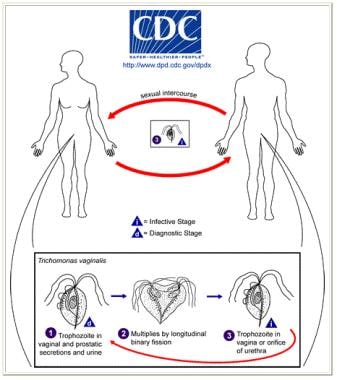 Life cycle of Trichomonas vaginalis. T vaginalis trophozoite resides in female lower genital tract and in male urethra and prostate (1), where it replicates by binary fission (2). The parasite does not appear to have a cyst form and does not survive well in the external environment. T vaginalis is transmitted among humans, the only known host, primarily via sexual intercourse (3). Image courtesy of Centers for Disease Control and Prevention.
T vaginalis destroys epithelial cells by direct cell contact and by the release of cytotoxic substances. It also binds to host plasma proteins, thereby preventing recognition of the parasite by the alternative complement pathway and host proteinases. [1] During infection, the vaginal pH increases, as does the number of polymorphonuclear leukocytes (PMNs). PMNs are the predominant host defense mechanism against T vaginalis and respond to chemotactic substances released by trichomonads. [1] The presence of antigen-specific peripheral blood mononuclear cells may also suggest that lymphocyte priming occurs during infection. [16] Antibody response to T vaginalis infection has been detected both locally and in serum.
Despite the immune system’s interaction with T vaginalis, infection produces an immunity that is only partially protective at best, and there is little evidence that a healthy immune system prevents infection. One study showed no association between trichomoniasis and the use of protease inhibitors or immune status in HIV-infected women. [20] Another showed that HIV seropositivity did not alter the rate of infection in males. [21]
Symptoms of trichomoniasis typically occur after an incubation period of 4-28 days. [16, 22] Infection generally persists for fewer than 10 days in males. The persistence of asymptomatic infection in women is unknown. Older women have been shown to have significantly higher rates of infection than younger women, which suggests that asymptomatic infection may persist for long durations in women. [23, 24]
Etiology
The risk of acquiring T vaginalis infections is based on engagement in high-risk sexual activity. Those who engage in the following sexual practices are at a greater risk for infection:
-
New or multiple partners
-
Exchanging sex for money or drugs
-
Sexual contact with an infected partner
-
Not using barrier protection
Several other factors may indicate a higher likelihood of T vaginalis infection but may not be directly or causally linked, as follows:
-
A history of certain STIs
-
Current STIs
-
A history of injection drug use
Even if not directly causal, these factors may be predictive. In a study that considered risk factors for trichomoniasis, injection drug use in the preceding 30 days was the most strongly associated with infection and with new infection observed during the study. [25]
Epidemiology
United States statistics
Trichomoniasis is one of the most common STIs in the United States, with a prevalence estimated at 8 million cases annually; however, exact numbers are difficult to obtain because the infection is not nationally reportable and many infections are asymptomatic. [26, 27, 28, 29] Prevalence is also thought to be underestimated owing to the low sensitivity of the commonly used wet mount technique.
Research in high-risk populations shows that the prevalence of trichomoniasis varies widely across the United States. In STI clinics, the prevalence of T vaginalis infection ranges from 15%-54%. [16, 30] In 2 samples of female prison inmates, the prevalence was on the higher end of that range, between 31.2% and 46.9%. [31, 32] In US men, trichomoniasis accounts for 10%-21% of urethritis cases not attributable to gonorrheal or chlamydial infection. [30]
International statistics
The World Health Organization estimates the worldwide incidence of trichomonas infection at over 220 million cases, although the accuracy of this estimate is highly uncertain. [33]
The incidence of trichomoniasis in Europe is similar to that in the United States. In Africa, the prevalence of trichomoniasis may be much higher. The prevalence of vaginal T vaginalis infection was estimated to be 11-25% among African study populations. [34, 35, 36]
Age-related demographics
The National Longitudinal Study of Adolescent Health Study found a prevalence of 2.3% among adolescents aged 18-24 years and 4% among adults 25 years and older. [37] A prevalence of 3.1% in females aged 14-49 years was observed based on a nationally representative sample of women in the National Health and Nutrition Examination Survey (NHANES) 2001-2004 study. [38] Despite this trend, trichomoniasis is still a concern in younger women. In female adolescents, trichomoniasis is more common than gonorrhea; particularly disconcerting given that it increases susceptibility to other infections. [39]
In a study of men attending an STI clinic in Denver, the prevalence of Trichomonas infection was 0.8% in men younger than 30 years and 5.1% in men 30 years and older. [40] This increase in prevalence is believed to result from age-related enlargement of the prostate gland.
Vertical transmission of T vaginalis during birth is possible and may persist up to 1 year, causing UTI, and, less commonly, respiratory infection. [10] Between 2% and 17% of female offspring of infected women acquire infection. [41]
Sex-related demographics
Although both women and men can be asymptomatic or symptomatic carriers of T vaginalis, trichomoniasis in men tends to be less clinically apparent and of shorter duration. In addition, multiple studies have found that T vaginalis infection is less prevalent in men than in women. [40, 42, 43] The NHANES 2001-2004 study conducted on a nationally representative sample of women aged 14-49 years found that 85% of women found to have trichomoniasis reported no symptoms. [38]
The reported incidence of trichomoniasis among men in various populations ranges from 0.8%-17%. [40, 42] This incidence may be underestimated, depending on the method of detection and the site of specimen collection. The use of multiple sites in the genitourinary tract (urine, urethral swab, and semen) in male patients has been shown to increase sensitivity. [44] In one study, T vaginalis was detected in 72% of male sexual partners of women with trichomoniasis. [45] Of these, 77% were asymptomatic.
Race-related demographics
In the National Longitudinal Study of Adolescent Health Study, significant differences in the prevalence of trichomoniasis among adolescents were noted by race: white, 1.2%; Asian, 1.8%; Latino, 2.1%; Native American, 4.1%; and African American, 6.9%. [37] Considerable differences were also observed in the national NHANES 2001-2004 study conducted among women ages 14-49: non-Hispanic whites, 1.2%; Mexican Americans, 1.5%; and non-Hispanic blacks, 13.5%. [38]
Evidence suggests that T vaginalis infection likely increases HIV transmission and that coinfection with HIV complicates treatment of trichomoniasis. [46] Control of T vaginalis may represent an important means of slowing HIV transmission, particularly among African Americans, in whom higher rates have been observed.
Daugherty et al screened a representative sample of men aged 18-59 years with RNA testing for T vaginalis and found that 0.49% were infected. [47]
Prognosis
Trichomoniasis can usually be treated quickly and effectively. Single-dose metronidazole regimens have produced a 90%-95% cure rate in randomized clinical trials, while single-dose tinidazole regimens have produced cure rates of 86%-100%. [48] Recurrent infections are common in sexually active patients. One study found that 17% of sexually active patients with T vaginalis infection were reinfected at 3-month follow-up. [49] Multiple randomized trials have found that this rate of reinfection can be significantly reduced through expedited partner therapy. [50, 51]
T vaginalis infection is also strongly associated with the presence of other STIs, including gonorrhea, [52] chlamydia, and sexually transmitted viruses. T vaginalis infection has even been shown to increase a patient’s susceptibility to sexually transmitted viruses, including herpes simplex virus, human papillomavirus, and HIV. [39, 46] Persons with trichomoniasis are twice as likely to develop HIV infection as the general population. [35] One potential explanation for this is that T vaginalis disrupts the epithelial monolayer, leading to increased passage of the HIV virus. [53] Another posits that T vaginalis induces immune activation, specifically lymphocyte activation and replication and cytokine production, leading to increased viral replication in HIV-infected cells. [54] Further research is needed to clarify the exact mechanism by which T vaginalis increases the risk of HIV infection.
Women may experience various complications associated with trichomoniasis. One study reported a higher risk of pelvic inflammatory disease in women with trichomoniasis. [55] Other studies have reported a 1.9-fold risk of tubal infertility in women with trichomoniasis. [56] Trichomoniasis may also play a role in cervical neoplasia and postoperative infections. [6]
Pregnant women with T vaginalis infection are at an especially high risk for adverse outcomes, which may include the following:
-
Preterm delivery
-
Low birth-weight offspring
-
Premature rupture of membranes
-
Intrauterine infection [1]
-
Respiratory or genital T vaginalis infection in the newborn [11]
T vaginalis infection may also increase the likelihood of vertical HIV transmission owing to disruption of the vaginal mucosa. [11]
Patient Education
Education concerning STI treatment and prevention is vital (see Prevention). Because T vaginalis infection is strongly associated with the presence of other STIs (gonorrhea, [52] chlamydia, and sexually transmitted viruses such as HIV), providers should provide appropriate counseling, testing, and treatment for such infections.
Upon diagnosis of trichomoniasis, healthcare providers should discuss treatment, including the adverse effects and interactions encountered with metronidazole and tinidazole. It is especially important to warn patients to abstain from alcohol when taking metronidazole and tinidazole. Providers should also address the treatment of sexual partners and, where allowed by law, employ expedited partner therapy. Individuals with trichomoniasis who notify partners of their infection help disrupt the transmission of trichomoniasis and other STIs. [57]
Providers should also discuss methods of preventing T vaginalis reinfection. It may be important to explain that T vaginalis infection may be longstanding and not due to a recent sexual encounter.
The CDC advises providers to consider rescreening sexually active women at 3 months after the completion of treatment. [48] Currently, the CDC makes no recommendation regarding the rescreening of sexually active men, but it may be desired if reinfection is likely. [11]
The CDC does not take a definitive stance on treating trichomoniasis during pregnancy. Studies have shown both positive and negative outcomes of treatment with a single 2-gram dose of metronidazole. Physician discretion is advised. [11] See the patient education fact sheet below.

-
Trichomonas vaginalis on a saline wet mount at 40X on the microscope. Several motile parasites transit through the field, surrounded by white blood cells and squamous epithelial cells.
-
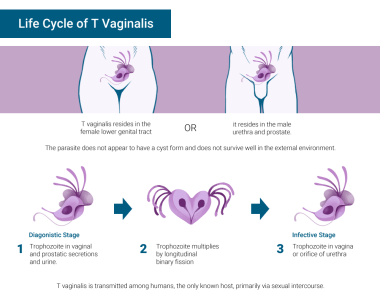
Life cycle of Trichomonas vaginalis. T vaginalis trophozoite resides in female lower genital tract and in male urethra and prostate (1), where it replicates by binary fission (2). The parasite does not appear to have a cyst form and does not survive well in the external environment. T vaginalis is transmitted among humans, the only known host, primarily via sexual intercourse (3). Image courtesy of Centers for Disease Control and Prevention.
-
Trichomonas vaginalis. (A) Two trophozoites of T vaginalis obtained from in vitro culture, stained with Giemsa. (B) Trophozoite of T vaginalis in vaginal smear, stained with Giemsa. Images courtesy of Centers for Disease Control and Prevention.
-
Trichomoniasis overview.
-
Trichomoniasis life cycle.
