
Practice Essentials
Colonic polyps are slow-growing overgrowths of the colonic mucosa (see the image below) that carry a small risk (< 1%) of becoming malignant. However, because colonic polyps are highly prevalent in the general population (especially with increasing age), they confer an important predisposition to colon cancer and are therefore removed when detected.
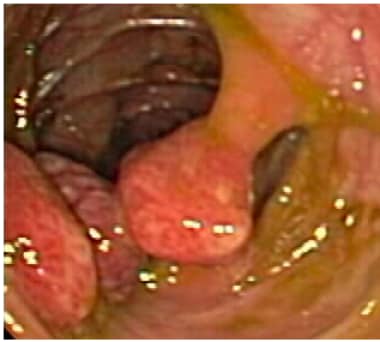 Multiple large polyps in the colon. The polyp in the center of the image is situated on a stalk. (Endoscopic image).
See Benign or Malignant: Can You Identify These Colonic Lesions?, a Critical Images slideshow, to help identify the features of benign lesions as well as those with malignant potential.
Signs and symptoms
Most patients with colonic polyps are asymptomatic. In symptomatic patients, the most common presenting symptom is rectal bleeding; chronic bleeding from colonic polyps may cause iron deficiency anemia. Other symptoms of polyps include diarrhea or constipation, often with decreased stool caliber.
Occult blood in stools (detected by guaiac and antibody-based tests) may be found in a minority of patients with colonic polyps.
Distal rectal polyps can be detected by digital rectal examination. Otherwise, physical examination findings are typically normal.
Villous adenomas of the rectum and distal colon can occasionally manifest as a syndrome of severe diarrhea with massive fluid and electrolyte loss.
See Presentation for more detail.
Diagnosis
Stool occult blood test
A stool occult blood test can detect a proportion (20%-40%) of colonic polyps that are larger than 10 mm in diameter, but this test also suggests the presence of other causes of gastrointestinal blood loss.
Flexible sigmoidoscopy
Flexible sigmoidoscopy is a good screening test for colonic polyps and is the only procedure or imaging modality to be validated by studies that document a decrease in colorectal cancer mortality. [1] However, this procedure does not examine the entire colon. Studies indicate that the majority of large adenomatous polyps in women will be missed by using flexible sigmoidoscopy alone.
Colonoscopy
Colonoscopy is the preferred test to detect colonic polyps, obtain biopsies, and/or perform endoscopic resection. [2] Sensitivities for large colonic polyps in the 80%-90% range have been reported.
Although flexible sigmoidoscopy and stool tests for occult blood have been the mainstays of screening to prevent colon cancer, some clinicians now favor colonoscopy as a primary screening tool. [1, 3]
Capsule endoscopy
An ingestible, camera-equipped capsule developed as a means of exploring the gastrointestinal tract received approval by the US Food and Drug Administration (FDA) in February 2014 for the detection of colon polyps in patents who have had an incomplete optical colonoscopy. [4, 5]
Stool DNA
Tests have been developed that detect mutant, fragmented, and/or methylated deoxyribonucleic acid (DNA) from exfoliated colon tumor cells in stool. This test was approved by the FDA in August 2014.
See Workup for more detail.
Management
Polypectomy
In patients with a solitary or a few pedunculated or sessile polyps, colonoscopic removal can be performed concurrently with the search for other lesions.
Colonic resection
In the case of multiple intestinal polyps associated with familial adenomatous polyposis (FAP), colon resection remains the only feasible option (see the image below). Surgical resection may be advocated for large, sessile polyps that are difficult to remove endoscopically or for advanced colonic polyps that recur despite adequate initial endoscopic treatment.
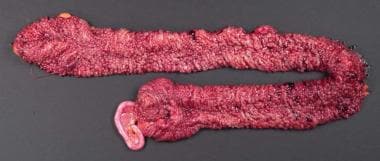 Familial adenomatous polyposis, total colectomy specimen. The colonic mucosa is studded with innumerable sessile and small pedunculated polyps, which involve the entire length of the specimen.
Colonic resection is also advocated for patients with long-standing ulcerative colitis who have developed high-grade dysplasia or a dysplasia-associated lesion or mass (DALM). [6]
Several surgical options should be discussed with the patient, including total colectomy, subtotal colectomy with rectal sparing, and segmental resection.
See Treatment and Medication for more detail.

Background
Colonic polyps are slow-growing overgrowths of the colonic mucosa that carry a small risk (< 1%) of becoming malignant. However, because colonic polyps are highly prevalent in the general population (especially with increasing age), they confer an important predisposition to colon cancer and are therefore removed when detected.
Patients with isolated colonic polyps are usually asymptomatic but can experience overt or occult colonic bleeding. Colonic polyps can occur as part of inherited polyposis syndromes in which their number is greater and the risk for malignant progression is much higher compared to the risk associated with isolated colonic polyps.
In the context of clinical studies of chemoprevention, efforts are being directed at suppressing colonic polyp formation (eg, by the use of sulindac) and/or at preventing their progression to colon cancer (eg, by the use of aspirin).
Pathophysiology
Colonic polyps, or adenomas, are benign epithelial neoplasms that arise from the epithelial cells lining the colon. Colonic polyps are traditionally divided into three groups, as follows: hyperplastic polyps, adenomas, and polyposis syndromes.
Hyperplastic polyps
Hyperplastic polyps comprise about 90% of all polyps and are benign protrusions. They are usually less than 0.5 cm in diameter. Hyperplastic polyps most commonly occur in the rectosigmoid region during adulthood.
Thought previously to be entirely clinically insignificant, hyperplastic polyps are now recognized to possess some malignant potential in the setting of hyperplastic polyposis syndrome. Patients who are affected have an occurrence of hyperplastic polyps proximal to the sigmoid colon, with (1) 5 or more serrated polyps proximal to the sigmoid colon with two or more that are larger than 10 mm in diameter, (2) a total of more than 20 polyps, or (3) a serrated polyp proximal to the sigmoid colon and a first-degree relative with the syndrome. The polyps in this syndrome may have adenomatous components; display a serrated, saw-tooth surface epithelium; and harbor BRAF mutations and methylation of specific target genes, including mismatch repair genes. [7]
Adenomas
Adenomas comprise approximately 10% of all polyps. Most polyps (approximately 90%) are small, usually less than 1 cm in diameter, and have a small potential for malignancy. The remaining 10% of adenomas are larger than 1 cm and approach a 10% chance of containing invasive cancer.
Adenomas are traditionally divided by histology into three types, as follows: tubular, tubulovillous, and villous. Tubular adenomas are the most common of the three types and can be found anywhere in the colon. Villous adenomas most commonly occur in the rectal area; tend to be larger than the other two types; and tend to be nonpedunculated, velvety, or cauliflowerlike in appearance.
Villous adenomas are associated with the highest morbidity and mortality rates of all polyps. They can cause hypersecretory syndromes characterized by hypokalemia and profuse mucous discharge and can harbor carcinoma in situ or invasive carcinoma more frequently than other adenomas. Serrated adenomas exhibit a mix of adenomatous and hyperplastic features, with regions of saw-toothed, serrated-surface epithelium. They have malignant potential.
The risk of progression to carcinoma is related to both the size and the histology of the adenoma. Adenomas that are greater than 1 cm, contain a substantial (>25%) villous component, or have high-grade dysplasia are commonly referred to as advanced neoplasms and carry an increased cancer risk.
The shape or gross structure of the polyp is also clinically significant. Those polyps with a stalk are called pedunculated. Those polyps without a stalk are called sessile. (See the image below.) Sessile polyps are more concerning than large pedunculated polyps for two reasons. First, the pathway for migration of invasive cells from the tumor into submucosal structures is shorter. Second, the complete endoscopic removal is more challenging and more difficult to ascertain.
Multiple large polyps in the colon. The polyp in the center of the image is situated on a stalk. (Endoscopic image).
Some premalignant neoplasia are now recognized to be flat, rather than protuberant. Such nonpolypoid neoplasia are more common in the setting of chronic colitis and may be detected more readily by nontraditional endoscopic imaging methods, such as narrow-band width imaging or mucosal staining.
Polyposis syndromes
Polyposis syndromes are hereditary conditions that include familial adenomatous polyposis (FAP), hereditary nonpolyposis (a misnomer) colorectal cancer (HNPCC)/Lynch syndrome, Gardner syndrome, Turcot syndrome, MUTYH polyposis, Peutz-Jeghers syndrome, Cowden disease, familial juvenile polyposis, and hyperplastic polyposis. Serrated polyposis syndrome is manifested by (1) 5 or more serrated polyps proximal to the sigmoid colon with two or more at least 10 mm in size, (2) a serrated polyp proximal to the sigmoid colon in the context of a family history of serrated polyposis, or (3) 20 or more serrated polyps throughout the colon.
Progress has been made in understanding some of the genetic factors contributing to the development of these syndromes. Some of the syndromes have extraintestinal features that help differentiate one syndrome from the other. For example, FAP is best understood in terms of the genetic basis and subsequent pathological and genetic events leading to carcinoma.
Two other types of benign polyps are hamartomatous polyps, consisting of a mixture of normal tissues, and inflammatory polyps, which contain an inflammatory epithelial reaction and are typically found in the context of colitis seen in inflammatory bowel disease.
Etiology
Environmental causes
Epidemiologic studies suggest that environmental causes contribute to the differences in colonic polyp incidence in geographically distinct populations, but the responsible factors have remained elusive.
Diet
Differences in the consumption of dietary fiber and antioxidants have been hypothesized to play a role in the development of colonic polyps, but these proposals have not been substantiated in recent studies. There is limited, circumstantial evidence that consumption of meat, fat, and alcohol may be risk factors. Conversely, consumption of calcium and folate may confer a modest protective effect, particularly in patients with a history of colonic polyps and low basal consumption levels.
Genetics
A number of polyposis syndromes have been described. These can be associated with specific extraintestinal manifestations as well as extraintestinal tumors.
Identification and characterization of the genetic factors leading to the various syndromes is progressing. Most of the mutant genes in these syndromes have been identified. Note the following:
-
At the genetic level, familial adenomatous polyposis (FAP) is understood the best. This is an autosomal dominant disorder caused by truncating mutations in the adenomatous polyposis coli (APC) gene.
-
Hereditary nonpolyposis colorectal cancer (HNPCC)/Lynch syndrome is an autosomal dominant disorder caused by mutations in the DNA mismatch repair proteins.
-
Cowden disease is associated with mutations in the phosphatase and tensin homology on chromosome 10 (PTEN) protein phosphatase.
-
MUTYH polyposis is a recessive disorder of base excision repair.
Epidemiology
United States statistics
Population and autopsy studies suggest that about 30% of middle-aged or elderly individuals have colonic polyps. In comparison, the incidence of familial adenomatous polyposis (FAP) in the United States is one case for every 6580-8300 persons.
International statistics
Accurate comparison of colonic polyp incidence and prevalence among countries is difficult because of the differences in the methods used for detection. Colonic polyp prevalence in patients older than 60 years appears to vary substantially within and among countries, but it appears to be greater than 10% in most areas.
Race-, sex-, and age-related demographics
Race per se is not a major risk factor for colonic polyps. However, studies indicate that black individuals have a somewhat higher incidence and an earlier onset of colorectal carcinoma. Task force guidelines from the US Multi-Society Task Force on Colorectal Cancer as well as those from the American Gastroenterological Association (AGA) recommend beginning colorectal cancer screening in black persons at age 45 years, rather than the standard age of 50 years. [8, 9]
Males appear to have a moderately higher colonic polyp incidence than females, with earlier onset observed in some studies. [10]
Colonic polyps are strongly associated with increasing age (typically after age 40 y), but they can occur early in patients with polyposis syndromes. For example, colonic polyps can be detected in adolescents with familial adenomatous polyposis and in patients aged 20-40 years with hereditary nonpolyposis colorectal cancer (HNPCC).
Prognosis
Colonic polyps are curable if removed. If not treated, the patient may develop complications, such as bleeding, and the condition may even be fatal if malignant transformation occurs.
Fortunately, colonic polyps grow slowly; cancer development is estimated to usually occur about 10 years after the formation of a small colonic polyp.
Hereditary nonpolyposis colorectal cancer (HNPCC) is an exception. Progression to cancer appears to be more rapid because of increased genetic instability in the lesion. Patients with HNPCC should undergo screening for colonic polyps at more frequent intervals (every 1-2 y) than patients at average risk.
Morbidity/mortality
Untreated, colonic polyps may progress to carcinoma over several years. Morbidity from colonic polyps is related to complications, such as bleeding, diarrhea, intestinal obstruction, and progression to cancer. Bleeding can be frank hematochezia but is often chronic and goes unnoticed by the patient. If uncompensated, intestinal blood loss can cause anemia, typically due to iron deficiency.
A study by Stryker et al suggests that the risk of cancer development from sporadic 1-cm colonic polyps is 8% at 10 years and 24% at 20 years. [11] The risk of cancer development depends on the size of the polyp, villous histology, and its association with polyposis syndromes. In familial adenomatous polyposis (FAP), cancer inevitably develops 10-20 years after the initial appearance of colonic polyps.
A more recent review by Calderwood et al reported similar findings: An increased risk of colonic neoplasia was associated with villous features, high-grade dysplasia, and increased adenoma size, as well as the presence of three or more adenomas at baseline and/or serrated polyps in the proximal colon. [12]
Complications
Complications of colonic polyps include bleeding, obstruction, diarrhea, and the development of cancer.
Complications of polypectomy are uncommon but include bleeding and, rarely, intestinal perforation.
Patient Education
Patients with a family history of colonic polyps must be aware of the potential benefits of screening for colonic polyps
Patients with familial adenomatous polyposis (FAP) must be aware of the potential benefits of screening the upper gastrointestinal tract and screening family members, beginning at puberty, for the mutant APC gene. Screening is particularly important because of the inevitable development of colon cancer in affected individuals and the benefits associated with colonic resection.
Patients with hereditary nonpolyposis colorectal cancer (HNPCC)/Lynch syndrome should receive colon screening at frequent (1-2 y) intervals and are at risk for development of tumors at additional sites, including the uterus and the ovaries in female patients. These patients should consider screening for tumor development at such sites or prophylactic resection.
-
Familial adenomatous polyposis, total colectomy specimen. The colonic mucosa is studded with innumerable sessile and small pedunculated polyps, which involve the entire length of the specimen.
-
Multiple large polyps in the colon. The polyp in the center of the image is situated on a stalk. (Endoscopic image).
