Continually Updated Clinical Reference
 
 
  All Sources     eMedicine     Medscape     Drug Reference     MEDLINE
 
eMedicine - Fibromuscular Dysplasia : Article by

Quick Find
Authors & Editors
Introduction
Clinical
Differentials
Workup
Treatment
Medication
Follow-up
Miscellaneous
Multimedia
References

Related Articles
Moyamoya Disease

Neurosyphilis

Takayasu Arteritis

Varicella Zoster

Vasculitic Neuropathy


Patient Education
Brain and Nervous System Center

Brain Aneurysm Overview

Brain Aneurysm Causes

Brain Aneurysm Symptoms

Brain Aneurysm Treatment

Stroke Overview


Author: James A Wilson, MD, MSc, FRCPC, BSc(H), Neurologist and Clinical Neurophysiologist, Oconee Neurology Services

James A Wilson is a member of the following medical societies: American Academy of Neurology and Ontario Medical Association

Coauthor(s): Richard L Hughes, MD, Associate Professor, Department of Neurology, University of Colorado School of Medicine; Director, University of Colorado Affiliated Hospitals Stroke Project; Chief, Division of Neurology, Denver Health Medical Center

Editors: Jeffrey L Saver, MD, Director, Stroke Center, Professor, Department of Neurology, University of California at Los Angeles Medical Center; Francisco Talavera, PharmD, PhD, Senior Pharmacy Editor, eMedicine; Howard S Kirshner, MD, Professor of Neurology, Psychiatry and Hearing and Speech Sciences, Vice Chairman, Department of Neurology, Vanderbilt University School of Medicine; Director, Vanderbilt Stroke Center; Program Director, Stroke Service, Vanderbilt Stallworth Rehabilitation Hospital; Consulting Staff, Department of Neurology, Nashville Veterans Affairs Medical Center; Selim R Benbadis, MD, Professor, Director of Comprehensive Epilepsy Program, Departments of Neurology and Neurosurgery, University of South Florida School of Medicine, Tampa General Hospital; Helmi L Lutsep, MD, Associate Professor, Department of Neurology, Oregon Health and Science University; Associate Director, Oregon Stroke Center

Author and Editor Disclosure

Synonyms and related keywords: FMD, fibromuscular hyperplasia, medial hyperplasia, arterial fibrodysplasia, angiopathy, renal artery disease, stroke

Background

Fibromuscular dysplasia (FMD) was first observed in 1938 by Leadbetter and Burkland in a 5-year-old boy, and described as a disease of the renal arteries. Involvement of the craniocervical arteries was recognized in 1946 by Palubinskas and Ripley.

FMD is an angiopathy that affects medium-sized arteries predominantly in young women of childbearing age. FMD most commonly affects the renal arteries and can cause refractory renovascular hypertension. Of patients with identified FMD, renal involvement occurs in 60-75%, cerebrovascular involvement occurs in 25-30%, visceral involvement occurs in 9%, and arteries of the limbs are affected in about 5%.1, 2 Case reports have shown FMD in most other medium-to-large arteries as well, including the coronary arteries3, the pulmonary arteries4, and the aorta5. In 26% of patients, disease is found in more than one arterial region6.

In patients with identified cephalic FMD, 95% have internal carotid artery involvement and 12-43% have vertebral artery involvement. Although FMD can affect arteries of any size7, involvement of smaller ones, including intracranial vessels, is rare. Although an early autopsy series of 819 consecutive patients found the prevalence of FMD in the internal carotid arteries to be 1%8, a larger, more recent autopsy series of 20,244 patients recently identified the overall prevalence of FMD of the internal carotid arteries to be only 0.02%9. From a neurologic perspective, FMD is an important cause of stroke in young adults.

Pathophysiology

The etiology of FMD is not known, although the histopathologic findings have been described in detail (see Histologic Findings).

Although the etiology of FMD is unknown, several other associated vascular pathologies have been identified. In 1982, Mettinger and Ericson10 scrutinized 4000 consecutively performed cerebral angiographies and found 37 that were consistent with FMD. Of these, 19 patients had aneurysms. In 1988, Cloft et al performed a meta-analysis including 498 FMD patients as well as examined 117 of their own patients and found a combined prevalence of aneurysms to be 7.3%.11

In 1975, Stanley et al found that 8 of their 17 cerebrovascular FMD cases had intracranial aneurysms, and they proposed a classification system that includes a "medial fibroplasias with aneurysms" subtype.12 The beadlike dilatations observed within FMD lesions share gross and histologic characteristics of aneurysms. The casual link between FMD and aneurysms is less clear but is possibly related to an underlying connective tissue problem that results in loss of arterial wall strength. This wall weakness may allow for vessel dilation (aneurysm formation and beading in FMD) as well as injury, which then causes compensatory fibroplasia. Besides aneurysms, many case series and reports have identified FMD in patients presenting with arterial dissection.13, 14

FMD is a predisposing factor in 15% of spontaneous cervical carotid dissections (Saver, 1998). Dissections in FMD are more commonly multiple than in patients without an identified underlying arteriopathy.

FMD lesions likely predispose the artery to dissection through weakening of the arterial wall. Although the multiple manifestations of a structural arteriopathy in FMD hint of a genetic cause, such as collagen or elastin mutation, epidemiologic data suggesting familial transmission are generally weak.

The increased incidence of FMD in women as compared with men suggests a possible hormonal or genetic influence. Some authors have proposed the sex difference to be related to immune system functioning, but overt inflammation, as is observed in most classic autoimmune diseases, is histologically lacking.

Many reports exist of familial occurrences of FMD, mostly in siblings. Some studies have even suggested that familial occurrence is relatively common. For example, Rushton in 1980 suggested familial occurrences in relatives of 12 out of 20 identified probands.15 However, histologic proof was established in only the index cases, and vascular events such as early strokes and hypertension were used to identify the other affected family members. Most large series have reported that the great preponderance of FMD cases are sporadic. Bilateral renal FMD has been noted in a pair of identical twins.16

In case reports, FMD has been associated with mutations in collagen17, with cutis laxa18, and with alpha1-antitrypsin deficiency19. Associative links to neurofibromatosis, Alport syndrome, and pheochromocytoma have also been suggested.2

Frequency

United States

Although early autopsy and radiologic series suggested that FMD involving the craniocervical arteries occurs at a frequency of approximately 1%, a more recent large series looking at FMD in the carotid arteries only suggests a lower frequency, on the order of 0.02%.9

International

The frequency is unknown.

Mortality/Morbidity

FMD generally follows a benign course and is frequently an incidental finding. However, cranial involvement bears worse prognosis because of the occurrence of dissection and strokes and the coexistence of saccular aneurysms. Specific mortality and morbidity data are lacking. 

Regarding the risk of recurrent carotid artery dissection, de Bray et al prospectively reviewed 103 consecutive patients with carotid artery dissection with follow-up for an average of 4 years. Of those, 5 had recurrent dissections and 4 of the 5 patients with recurrent dissections were diagnosed with FMD. If considering the presentation of recurrent dissection of the carotid artery, FMD was associated in 80% of their series.20

Race

Whites are considered to be more commonly affected than blacks, although specific statistics on racial predilection are not available.

Sex

FMD occurs more frequently in women, at a ratio of approximately 3:1 to 4:1.

Age

FMD most commonly presents in young to middle-aged adults. One angiographic series found a mean age of 48 years with a range of 24-70 years.10 Cases have even been described in the pediatric population, including infantile-onset cases.21


History

Most patients with craniocervical FMD are asymptomatic. Others report nonspecific problems such as headache, lightheadedness, vertigo, and tinnitus. Neck pain or carotidynia may be an initial presenting symptom due to arterial dissection. The symptoms of stroke can be varied but most often involve the anterior circulation because of the predilection of FMD to affect the extracranial carotid arteries.

Patients may provide a history of transient or permanent neurologic deficits of the face or extremities such as weakness or numbness, or they may experience visual changes or speech difficulties. No particular symptoms are pathognomonic for FMD, and any history compatible with a stroke in younger individuals may indicate underlying FMD. The family history should include information about relatives who have had vascular events at a young age.

One report notes an extremely unfortunate case of locked-in syndrome due to autopsy-proven basilar artery FMD.13 FMD may be complicated by stroke because of direct effects of craniocervical stenosis, dissection, or intracranial aneurysm, or the indirect effects of concomitant renovascular hypertension.

Symptoms compatible with a sentinel bleed, namely a sudden explosive headache followed later by neck stiffness, may signify the existence of an aneurysm, which in turn, may be associated with FMD.

A review of symptoms may provide clues of noncraniocervical FMD. Long-standing involvement of the renal arteries may lead to a history of hypertension. Rarely, abdominal pains, and even a history of ischemic bowel, may indicate mesenteric or visceral artery involvement. Vascular compromise of the limbs by FMD lesions may cause ischemic symptoms such as intermittent leg claudication.

Physical

Because of the broad possibilities of neurologic dysfunction due to stroke caused by FMD, a thorough neurologic examination should be performed. Findings may include anything from cranial nerve deficits to weakness, numbness, and coordination difficulties.

Sensitive signs of motor dysfunction such as pronator drift and plantar responses may yield deficits when formal power assessment does not. The neurovascular examination would not be complete without auscultation for carotid and vertebral artery bruits. If a headache history is provided, assessment for meningismus (eg, nuchal rigidity, Kernig sign, Brudzinski sign) may prove positive.

Because of the systemic nature of FMD, the general physical examination should include a search for signs of renal, visceral, and limb arterial involvement. These signs may include hypertension, decreased peripheral pulses, and even asymmetric limb pressures. Bruits may be found on auscultation of the renal, abdominal, iliac, or subclavian arteries.

Causes

The cause of FMD is unknown, despite some speculations related to its associations with some rare genetic conditions and predilection for young white females. Strokes can be caused by the FMD stenoses themselves, generally by thromboembolic events. Even without trauma, FMD lesions predispose the afflicted individual to arterial dissection, which in turn can cause embolic events or, rarely, local thrombosis and massive hemispheric stroke. Hypertension due to renovascular FMD may be a risk factor for lacunar and large vessel infarcts and even intracerebral hemorrhage.


Moyamoya Disease
Neurosyphilis
Takayasu Arteritis
Varicella Zoster
Vasculitic Neuropathy

Other Problems to be Considered

Arterial dissection
Stroke
Atherosclerosis
Vasculitis
Vasospasm secondary to subarachnoid hemorrhage
Vasospasm secondary to angiographic contrast agent and/or catheter
Vasospasm secondary to stimulant use
Degos disease (malignant atrophic papulosis)
Varicella zoster virus (VZV) vasculitis
Other infectious vasculitis


Lab Studies

  • Although usually nonproductive, routine laboratory investigations may show renal impairment (eg, with high creatinine or BUN levels).

Imaging Studies

  • For a more focused analysis of imaging studies in FMD, please see Fibromuscular Dysplasia (Carotid Artery).
  • The history of stroke or transient ischemic attack in a young individual or a subarachnoid hemorrhage in a person of any age should prompt imaging of the cerebrovascular system. Further, any individual known to have FMD (eg, renal disease detected) should undergo cerebrovascular imaging to assess for craniocervical involvement and aneurysms.
  • Conventional angiography remains the criterion standard to detect FMD and its associated vascular lesions (eg, aneurysms, dissections).
    • FMD lesions typically show a beading pattern. With the most common subtype of FMD, medial fibroplasias, the dilated arterial segments are often larger in diameter than the original vessel. This is not the case with perimedial fibroplasias, in which the beads are up to, but not greater than, the caliber of the original vessel. On the other hand, the intimal fibroplasia and the medial hyperplasia subtypes tend to show long tubular stenoses.22
    • In the internal carotid arteries, these lesions are usually extracranial at the C1-2 level. Stenoses associated with arterial bifurcations, such as at the bifurcation of the common carotid, are more frequently atherosclerotic in nature. Four-vessel angiography should be performed because of the high incidence of multiple vessel involvement.
    • In 1986, Luscher et al identified 24 patients with cerebrovascular FMD and found that 17% had involvement of the vertebral arteries, 17% had brachiocephalic or subclavian involvement, and 4% had basilar artery disease.6
  • Conventional cerebrovascular ultrasonography is unlikely to depict the carotid lesions of FMD because they are typically sufficiently distal to the carotid bifurcation so as to avoid detection by standard carotid duplex investigation.
    • Submandibular insonation with a transcranial Doppler probe directed at the high cervical segments can be used to investigate the distal cervical artery and has moderate sensitivity for detecting FMD.
    • Doppler scanning of the vertebrobasilar system may reveal reversal of flow (including subclavian steal), but it is not in any way sensitive or specific for FMD.
  • To the authors' knowledge, no large studies have been conducted to assess the sensitivity or specificity of CT angiography (CTA), time-of-flight (TOF) magnetic resonance angiography (MRA), or contrast-enhanced MRA (CE MRA) in the diagnosis of craniocervical FMD. However, these modalities, especially CTA and CE MRA, can show surprising vascular detail and may be sufficiently sensitive for the confident detection of FMD. Due to the risk of conventional angiography, there is certainly a need to identify comparably sensitive noninvasive imaging techniques. Fortunately, we have some clues from the renal literature that the above noninvasive techniques could be comparable.
    • CTA is continuously improving in resolution and may be used to detect the stenosis associated with FMD, but only recent-generation CTA equipment reliably shows sufficient detail to identify the classic string of beads pattern of most FMD cases. de Monye advocates the use of CTA as a noninvasive modality to diagnose FMD, albeit with only a series of 2 patients.23 Regarding FMD of the renal arteries, the sensitivity of CTA has been compared directly with conventional angiography.24 In their series of 21 patients with 40 total lesions identified on conventional angiography, all lesions were identified using several modalities of CTA (multiplanar reformatted images, maximum intensity projections, and shaded-surface display). Suspecting that CTA of the carotid arteries shares similar sensitivity to conventional angiography in identifying craniocervical FMD would be reasonable.
    • Findings on TOF MRA often suggest vessel stenoses, but this study has insufficient resolution to demonstrate a string-of-beads pattern suggestive of FMD.
    • Contrast-enhanced MRA will likely perform better than TOF MRA, but this has not yet been studied in detail regarding craniocervical FMD. However, similar to CTA, the renal literature has looked at FMD of the renal arteries using CE MRA. In a series of 25 patients, Willoteaux found the sensitivity and specificity of CE MRA in renal FMD to be 97% and 93% respectively.25 They found 68% sensitivity in diagnosing stenosis, 95% in identifying the string of pearls, and 100% sensitivity in identifying an aneurysm. Thus, although CE MRA in craniocervical FMD has not specifically been assessed, it is likely that this modality is reasonably sensitive as compared with the more invasive criterion standard.
  • Conventional CT scanning and MRI may be useful in finding ischemic strokes caused by arterial dissection or the FMD lesions themselves.
    • These modalities can also be useful in detecting subarachnoid hemorrhage.
    • CTA and MRA can often detect aneurysms greater than about 0.3 cm.

Other Tests

  • No other tests are specifically indicated in the workup of FMD.

Procedures

  • In general, procedures are not indicated in the diagnosis of FMD.

Histologic Findings

Pathologically, FMD is a nonatherosclerotic noninflammatory narrowing of medium-sized arteries characterized by fibrodysplastic changes. In 1979, Bragin and Cherkasov described the ultrastructural changes that occur in FMD as smooth muscle assuming fibroblastic characteristics.26 FMD has been classified according to the arterial wall layer that is predominantly affected.27

The pathologic classification of FMD is as follows:27, 12, 28

  • Intimal fibroplasia
    • This accounts for fewer than 10% of all cases of renal FMD.
    • Collagen deposition occurs in the intima of the vessels.
    • Internal elastic lamina may be disrupted.
    • The lumen may be concentrically narrowed in a relatively short region, causing a ringlike stenosis on angiography, or it may be narrowed over a longer region as a smooth tubular stenosis.
  • Medial fibroplasia (3 subtypes)
    • Medial dysplasia
      • This accounts for 80% of renal cases and most carotid cases.
      • Regions of thick, fibrodysplastic, collagenized tunica media alternate with regions of thinned media.
      • The result is the classic string-of-beads appearance on angiography.
    • Perimedial fibroplasia
      • This accounts for 10-15% of all renal cases of FMD.
      • Patchy collagen deposition is observed in the outer media without disruption of the external elastic lamina.
      • This subtype can also result in the string-of-beads appearance on angiography, but the beads are not dilated to a larger diameter than that of the original vessel.
    • Medial hyperplasia
      • This accounts for 1-2% of all renal cases of FMD.
      • True smooth muscle concentric hyperplasia without fibrotic changes is noted.
      • The result is a smooth stenosis on radiographic study.
  • Adventitial fibroplasia
    • This form results in fewer than 1% of all renal cases of FMD.
    • Dense collagen replaces the normally loose connective tissue of the adventitia.

The percentage occurrence of each type of FMD is largely based on findings from large renal studies and may not reflect the distribution of FMD types in carotid disease. In fact, the medial dysplasia type may be even more predominant when carotid FMD is considered alone.

Staging

No formal staging system exists for FMD, although 4-vessel angiography of the cerebrovasculature is used to identify the extent of the craniocervical disease and the presence of comorbid dissections and aneurysms.


Medical Care

Partly because of the unknown etiology of FMD, no curative therapy exists. Fortunately, FMD is often benign when asymptomatic, and medical treatment is not indicated. Patients presenting with hypertension should be evaluated by a nephrologist and possibly considered for vascular intervention.

When FMD manifests as a transient ischemic attack or as an ischemic stroke, then initial management depends on many factors. If the patient presents in the emergency department with symptoms of stroke within 3 hours of onset, then they may be considered for intravenous (IV) tissue plasminogen activator (tPA) treatment (see Acute Stroke Management). Intra-arterial mechanical embolectomy and intra-arterial pharmacologic fibrinolysis may be considered to extend the acute treatment window to 6 hours. If TPA treatment is employed, then anticoagulants and antiplatelet agents are avoided for at least the ensuing 24 hours.

The diagnosis of FMD should be considered in any young individual presenting with a stroke or subarachnoid hemorrhage. Fortunately, cerebral angiography is the investigation of choice to detect not only FMD but also arterial dissection, vasculitis, and aneurysms, which are other major etiologies of stroke in this population. Thus, cerebral angiography should be performed if another cause for the stroke is not clear. The treatment options are influenced by the findings on angiography.

If only FMD is identified on angiography, medical treatment usually incorporates antiplatelet agents, similar to the treatment of atherosclerotic disease. Often, daily aspirin is considered first-line therapy, and another antiplatelet agent is substituted or added if another ischemic event occurs (such as clopidogrel or combination acetylsalicylic acid and extended-release dipyridamole).

If arterial dissection with FMD is identified with cerebral angiography, then initial treatment primarily addresses the dissection (see Dissection Syndromes). Although evidence from randomized trials is lacking, anticoagulation is often used after cerebral hemorrhage has been ruled out. Anticoagulation is with heparin initially, then Coumadin is administered on an outpatient basis for 3-6 months. Some neurologists advocate reassessment of the arteries for dissection before discontinuation of anticoagulation and initiation of an antiplatelet agent for life. Often, if the dissection could be observed with MRA or CTA, these modalities are used in follow-up because of its less invasive nature.

If the presentation is that of subarachnoid hemorrhage, then acute treatment is primarily focused on preventing rebleeding, and preventing arterial vasospasm and further ischemic cerebral injury. Aneurysms may be closed by endovascular coiling or surgical clipping. Nimodipine, a calcium channel blocker, is generally used to reduce vasospasm-mediated brain injury. See Cerebral Aneurysms for a more in-depth discussion of aneurysm management.

After the aneurysms have been dealt with, either surgically or through an endovascular approach, then unless further history is consistent with thromboembolic phenomena, management may be conservative. Antiplatelets are unnecessary if the FMD lesions themselves are asymptomatic and not causing emboli.

Surgical Care

Surgical vascular reconstruction of renal FMD has met with good success.29 However, because the end organ of cervicocranial FMD is the brain, more serious risks are involved. Thus, the role of surgery in carotid and vertebrobasilar FMD is not well understood.

Although medical management of stroke prophylaxis in FMD is quite similar to the management of atherosclerotic disease, the lesions in FMD are not amenable to endarterectomy. Thus, surgical management is used as a last resort in cases where stenosis is critical and global cerebral hypoperfusion is an issue or for ischemic events refractory to medical management. No trials exist comparing medical and surgical management of cerebrovascular FMD. However, many authors have published series of operative graduated dilatation of FMD stenosis and report good results.30, 31, 32  A few cases with vascular graft placements and surgical bypass of FMD lesions have been reported.

Aneurysms that may coexist with FMD should be managed in a similar manner to non-FMD–associated ones.

Because of the emergence of endoluminal angioplasty and stenting for cerebrovascular disease, interventional radiologic management of FMD lesions may be suitable for some patients, especially those who are not good surgical candidates. Again, no studies have assessed this management option as compared to more established medical or surgical treatment, but it may be deemed an appropriate option in some instances. One case report describes a good outcome after 9 months of follow-up in a patient with bilateral carotid stents placed for bilateral medically-refractory symptomatic lesions.33

Consultations

A stroke presentation, whether acute or not, is usually managed by a neurologist. If associated aneurysms or subarachnoid hemorrhages are detected, then a neurosurgeon and interventional radiologist should be consulted. If a history of chest pain is noted, this may signify FMD in the coronary arteries, and a cardiologist should be consulted. If blood pressure is elevated, then the renovasculature should be assessed and a nephrologist consulted if necessary. Symptoms of an ischemic gut should be managed by a general surgeon, and limb claudication should be assessed by a vascular surgeon.

Diet

No specific dietary modifications are indicated in FMD. If a stroke has occurred, then a swallowing assessment may be required and the diet modified accordingly.

Activity

Activity restrictions should be individualized depending on the clinical details and possible neurologic deficits. Neck trauma, including chiropractic manipulation, should be avoided if craniocervical FMD is established because of the possibility of dissection. If cerebral aneurysms exist, strenuous activity that would increase blood pressure should be avoided.


As discussed above, acute treatment of any ischemic stroke may involve tPA, regardless of the presence or absence of FMD.

Secondary prevention of stroke generally involves the use of antiplatelet agents, and failure of a first agent results in either the switch to another agent or the addition of a second antiplatelet agent. Selection of a particular antiplatelet agent is variable, depending on physician preference. The complication of arterial dissection is generally treated with anticoagulation, first intravenously then orally. Finally, subarachnoid hemorrhage due to aneurysm rupture precludes anticoagulation and indicates a need for antivasospastic medications.

Drug Category: Fibrinolytic agents

tPA exerts an effect on fibrinolytic system to convert plasminogen to plasmin. They are used for dissolving blood clots and have a role in the acute management of ischemic strokes.

Drug NameAlteplase (Activase)
DescriptionUsed in management of acute ischemic stroke, acute MI, and PE. Safety and efficacy with concomitant heparin or aspirin during first 24 h after symptom onset not investigated.
Adult Dose0.9 mg/kg IV over 60 min; 10% of total dose administered as initial IV bolus over 1 min; not to exceed 90 mg
Pediatric DoseNot established
ContraindicationsDocumented hypersensitivity, active internal bleeding, prior stroke or stroke within 2 mo, intracranial or intraspinal surgery or trauma, ICH (rule out with CT when used for stroke treatment), suspected subarachnoid hemorrhage, intracranial neoplasm, arteriovenous malformation or aneurysm, bleeding diathesis, severe uncontrolled hypertension
InteractionsAnticoagulants and antiplatelet agents may increase risk of bleeding; heparin with and after infusions to reduce risk of rethrombosis may increase risk of bleeding complications
PregnancyC - Fetal risk revealed in studies in animals but not established or not studied in humans; may use if benefits outweigh risk to fetus
PrecautionsMonitor for bleeding, especially at arterial puncture sites; frequently control and monitor BP during and after administration (in acute ischemic stroke); do not use >0.9 mg/kg to manage acute ischemic stroke; doses >0.9 mg/kg may cause ICH

Drug Category: Antiplatelet agents

These agents are used for secondary stroke prophylaxis after previous stroke or transient ischemic attack.

Drug NameAspirin (Anacin, Ascriptin, Bayer Aspirin, Bayer Buffered Aspirin)
DescriptionTreats mild to moderate pain and headache. Inhibits prostaglandin synthesis, which prevents formation of platelet-aggregating thromboxane A2. Generally considered first-line therapy in the secondary prophylaxis of cerebrovascular disease.
Adult Dose80 mg PO qd is generally sufficient; some suggest 325 mg qd
Pediatric DoseNot established
ContraindicationsDocumented hypersensitivity; liver damage; hypoprothrombinemia; vitamin K deficiency; bleeding disorders; asthma; use in children <16 y with flu (association with Reye syndrome)
InteractionsAntacids and urinary alkalinizers may decrease effects; corticosteroids decrease serum levels; additive hypoprothrombinemic effects and increased bleeding time may occur with coadministration of anticoagulants; may antagonize uricosuric effects of probenecid and increase toxicity of phenytoin and valproic acid; doses > 2 g/d may potentiate glucose-lowering effect of sulfonylurea drugs
PregnancyC - Fetal risk revealed in studies in animals but not established or not studied in humans; may use if benefits outweigh risk to fetus
D - Fetal risk shown in humans; use only if benefits outweigh risk to fetus
PrecautionsMay cause transient decrease in renal function and aggravate chronic kidney disease; avoid use in patients with severe anemia, those with history of blood coagulation defects, and those taking anticoagulants

Drug NameClopidogrel (Plavix)
DescriptionSelectively inhibits ADP binding to platelet receptor and subsequent ADP-mediated activation of glycoprotein GPIIb/IIIa complex, inhibiting platelet aggregation.
May have positive influence on several hemorrhagic parameters and may exert protection against atherosclerosis (inhibition of platelet function and changes in hemorrhagic profile).
Adult Dose75 mg PO qd
Pediatric DoseNot established
ContraindicationsDocumented hypersensitivity; active pathologic bleeding, such as peptic ulcer or intracranial hemorrhage
InteractionsCoadministration with naproxen associated with increased occult GI blood loss; clopidogrel prolongs bleeding time; safety with warfarin not established
PregnancyC - Fetal risk revealed in studies in animals but not established or not studied in humans; may use if benefits outweigh risk to fetus
PrecautionsCaution in patients at increased risk of bleeding from trauma, surgery, or pathologic conditions; caution in patients with lesions with propensity to bleed (eg, ulcers)

Drug NameTiclopidine (Ticlid)
DescriptionSecond-line antiplatelet therapy for patients who cannot tolerate acetylsalicylic acid therapy or for whom such therapy is unsuccessful. Rarely used because of serious adverse effects and replacement by newer agents.
Adult Dose250 mg PO bid
Pediatric DoseNot established
ContraindicationsDocumented hypersensitivity; neutropenia or thrombocytopenia; liver damage; active bleeding disorders
InteractionsCorticosteroids and antacids may decrease effects; toxicity increases with concurrent theophylline, cimetidine, aspirin, and NSAIDS
PregnancyB - Fetal risk not confirmed in studies in humans but has been shown in some studies in animals
PrecautionsDiscontinue if absolute neutrophil count <1200/mm3 or if platelet count <80,000/mm3

Drug NameAspirin 25 mg/Dipyridamole 200 mg (Aggrenox)
DescriptionDrug combination with antithrombotic action. Aspirin inhibits prostaglandin synthesis, preventing formation of platelet-aggregating thromboxane A2. May be used in low dose to inhibit platelet aggregation and improve complications of venous stasis and thrombosis. Dipyridamole is a platelet adhesion inhibitor that possibly inhibits RBC uptake of adenosine, itself an inhibitor of platelet reactivity. May also inhibit phosphodiesterase activity, leading to increased cyclic-3', 5'-adenosine monophosphate levels in platelets and formation of the potent platelet activator thromboxane A2.
Adult Dose1 tab PO bid
Pediatric DoseNot established
ContraindicationsDocumented hypersensitivity; liver damage; hypoprothrombinemia; vitamin K deficiency; bleeding disorders; asthma; use in children <16 y with flu (association with Reye syndrome)
InteractionsTheophylline may decrease hypotensive effects of dipyridamole; antiplatelet activity of dipyridamole may increase heparin toxicity; antacids and urinary alkalinizers may decrease aspirin effects; corticosteroids decrease salicylate serum levels; additive hypoprothrombinemic effects and increased bleeding time may occur with coadministration of anticoagulants; may antagonize uricosuric effects of probenecid and increase toxicity of phenytoin and valproic acid; doses > 2 g/d may potentiate glucose-lowering effect of sulfonylurea drugs
PregnancyC - Fetal risk revealed in studies in animals but not established or not studied in humans; may use if benefits outweigh risk to fetus
PrecautionsAspirin may cause transient decrease in renal function and aggravate chronic kidney disease; avoid use in patients with severe anemia, those with history of blood coagulation defects, or those taking anticoagulants; caution in hypotension; dipyridamole has peripheral vasodilating effects

Drug Category: Anticoagulants

The use of anticoagulation in the acute management of stroke has been under hot debate for many years. However, many neurologists advocate the use of heparin acutely in stroke in the setting of an arterial dissection. Heparin is used acutely in this case, followed by several months of warfarin.

Drug NameHeparin
DescriptionAugments activity of antithrombin III and prevents conversion of fibrinogen to fibrin. Does not actively lyse but is able to inhibit further thrombogenesis. Prevents reaccumulation of clot after spontaneous fibrinolysis.
Most centers have protocols to titrate heparin rate to achieve specific anticoagulation levels on blood work.
Adult DoseStarting does: <60 U/kg (maximum, 4000 U) IV bolus followed by a maintenance infusion of <12 U/kg/h (maximum, 1000 U/h) then adjust to PTT
Pediatric DoseNot established
ContraindicationsDocumented hypersensitivity; subacute bacterial endocarditis; active bleeding; history of heparin-induced thrombocytopenia
InteractionsDigoxin, nicotine, tetracycline, and antihistamines may decrease effects; NSAIDs, acetylsalicylic acid, dextran, dipyridamole, and hydroxychloroquine may increase heparin toxicity
PregnancyC - Fetal risk revealed in studies in animals but not established or not studied in humans; may use if benefits outweigh risk to fetus
PrecautionsIn neonates, preservative-free heparin recommended to avoid possible toxicity (gasping syndrome) by benzyl alcohol (preservative); caution in severe hypotension and shock; monitor for bleeding in peptic ulcer disease, menstruation, increased capillary permeability, and IM injections

Drug NameWarfarin (Coumadin)
DescriptionInterferes with hepatic synthesis of vitamin K–dependent coagulation factors. Used for prophylaxis and treatment of venous thrombosis, pulmonary embolism, and thromboembolic disorders.
Adult Dose3-15 mg/d PO qd for 2-5 d; adjust dose to desired INR (for dissection, INR = 2-3)
Pediatric DoseAdminister weight-based dose of 0.05-0.34 mg/kg/d PO; adjust dose to desired INR
ContraindicationsDocumented hypersensitivity; severe liver or kidney disease; open wounds or GI ulcers
InteractionsDrugs that may decrease anticoagulant effects include griseofulvin, carbamazepine, glutethimide, estrogens, nafcillin, phenytoin, rifampin, barbiturates, cholestyramine, colestipol, vitamin K, spironolactone, PO contraceptives, and sucralfate; medications that may increase anticoagulant effects of warfarin include PO antibiotics, capecitabine, phenylbutazone, salicylates, sulfonamides, chloral hydrate, clofibrate, diazoxide, anabolic steroids, ketoconazole, ethacrynic acid, miconazole, nalidixic acid, sulfonylureas, allopurinol, chloramphenicol, cimetidine, disulfiram, metronidazole, phenylbutazone, phenytoin, propoxyphene, sulfonamides, gemfibrozil, acetaminophen, and sulindac
PregnancyX - Contraindicated; benefit does not outweigh risk
PrecautionsUse caution and increase monitoring if switching brands after achieving therapeutic response; caution in active tuberculosis or diabetes mellitus; patients with protein C or S deficiency are at risk for skin necrosis

Drug Category: Calcium channel blockers

These agents are used in cases of subarachnoid hemorrhage.

Drug NameNimodipine (Nimotop)
DescriptionTo improve neurologic impairments resulting from vasospasm after subarachnoid hemorrhage caused by a ruptured congenital intracranial aneurysm in patients who are in good neurologic condition postictus.
Studies show benefit on the severity of neurologic deficits caused by cerebral vasospasm after subarachnoid hemorrhage, but no evidence indicates that the drug either prevents or relieves spasm of the cerebral arteries. Actual mechanism of action unknown, and a neuroprotective effect is suggested.
Therapy should start within 96 h of the subarachnoid hemorrhage. If capsule cannot be swallowed because patient is undergoing surgery or unconscious, a hole can be made at both ends of the capsule with an 18-gauge needle and the contents extracted into a syringe and emptied into the patient's in situ nasogastric tube and flush with 30-mL isotonic saline.
Adult Dose60 mg PO q4h for 21 consecutive d
Pediatric DoseNot established
ContraindicationsDocumented hypersensitivity; <90 mm Hg systolic pressure; sick sinus syndrome; second- or third-degree AV block except when using a pacemaker
InteractionsAlthough advantageous in some patients, coadministration with beta-blockers may increase adverse effects because of depressant effects on myocardial contractility or AV conduction; when administered with fentanyl, severe hypotension or increased fluid volume requirements may occur in patients receiving calcium blockers; cimetidine may increase blood levels of nimodipine
PregnancyC - Fetal risk revealed in studies in animals but not established or not studied in humans; may use if benefits outweigh risk to fetus
PrecautionsRare cases of elevated LDH, alkaline phosphatase, and ALT levels may occur


Further Inpatient Care

  • Physical and occupational therapy and speech therapy may be important aspects of patient care should neurologic deficits exist.

Further Outpatient Care

  • Neurorehabilitation generally helps to recover function if any residual neurologic deficits are present.

In/Out Patient Meds

  • As mentioned above, life-long antiplatelet agents are generally suggested if a stroke occurred because of their benefit in reducing stroke and their relatively low morbidity.
  • Given the potential pro-coagulant effects of estrogen, especially in smokers, oral contraceptives and hormonal replacement therapy is often avoided. No data exists to support or refute this strategy.

Deterrence/Prevention

  • Lifestyle changes that minimize the risk of vascular disease should be stressed.
  • These changes include quitting smoking, weight control, doing exercise, and eating a healthy diet.

Complications

  • The complications of FMD can be diverse, notably because it is a systemic vascular disease. Fortunately, most patients have relatively isolated disease, and invasive measures during follow-up are not required.
  • Blood pressure should be monitored carefully throughout the patient's lifetime because of the possibility of renovascular hypertension.
  • Any symptoms compatible with ischemia and angiographic findings should prompt consideration of FMD as the underlying etiology. Symptoms include neurologic deficits, angina pectoris, limb claudication, and abdominal pain.

Prognosis

  • Statistics on the natural course of cerebrovascular FMD are not available, especially because most cases are symptomatic and relatively benign.
  • Case series tend to present a relatively favorable picture of long-term stroke-free survival, both in medically and in surgically managed patients. For example, in a 1981 report, Collins et al monitored 18 patients after surgical dilatation for a mean of just over 4 years, and none had strokes.32 They monitored 5 patients with global symptoms (eg, hypoperfusion and not embolic events) and conservative therapy for a mean of 42 months, and none had strokes.
  • Saccular aneurysm rupture has such a high mortality that autopsy series may be biased in their detection of FMD. The presence of saccular aneurysms likely poses the greatest morbidity and mortality threat, especially if blood pressure is not controlled.
  • In a prospective series of patients with carotid artery dissection observed for an average of 4 years, of those with recurrence (5 of 103), 80% had FMD.20

Patient Education

  • Patients with FMD who have experienced strokes should receive proper education in this regard. Further education regarding FMD should help patients recognize further symptoms that may indicate disease progression or complications.
  • Education regarding other risk factors for stroke should be provided where applicable. Topics should include abstinence from smoking, the benefits of a healthy diet, and good glycemic control.
  • Patients should be informed about the risk of dissection and cautioned to avoid neck trauma and rigorous neck manipulations.
  • For excellent patient education resources, visit eMedicine's Brain and Nervous System. Also, see eMedicine's patient education articles Aneurysm, Brain and Stroke.


Medical/Legal Pitfalls

  • The medicolegal issues in FMD stem from the fact that this disease entity is rare and that large prospective studies are lacking to guide management.
  • Some authors suggest more aggressive management such as early surgery, while others favor a more conservative approach.
  • Retrospective studies suggest a favorable outcome in both treatment pathways, but unexpected bad outcomes occasionally occur.
  • Therefore, educating the patient regarding what is known about FMD and what treatment strategies are available is especially important. This allows them to make an informed decision based on the risks and benefits involved in each strategy.

Special Concerns

  • FMD can progress to cause a variety of systemic ischemic problems.
  • An individual with known FMD of any artery should be monitored for symptoms and signs of ischemic events in all vascular distributions (see the Clinical section above).


Media file 1:  Fibromuscular dysplasia (FMD). Digital subtraction angiogram of the right internal carotid artery demonstrates an irregular extracranial portion that is consistent with FMD.
Click to see larger pictureClick to see detailView Full Size Image
Media type:  X-RAY

Media file 2:  Fibromuscular dysplasia (FMD). Conventional angiogram of the left carotid artery demonstrates a 1.5-cm, long, smooth, severe stenosis of the extracranial internal carotid artery. Note that the artery is not completely occluded and a thin continuous string of contrast is present along the length of the stenosis. This smooth tubular stenosis is suggestive of the intimal fibroplasia form of FMD but can be observed with any of the subtypes.
Click to see larger pictureClick to see detailView Full Size Image
Media type:  X-RAY

Media file 3:  Fibromuscular dysplasia (FMD). Cerebral angiogram of the left carotid artery territory demonstrates a long, irregular stenosis with a string-of-beads appearance along the entire extracranial length of the internal carotid artery (ICA). This is consistent with the most common medial dysplasia form of fibromuscular dysplasia. Also note similar involvement of the first 3 cm of the external carotid artery (ECA). Such extensive ICA involvement, as well as ECA involvement, is atypical. Note sparing of the carotid bulb.
Click to see larger pictureClick to see detailView Full Size Image
Media type:  X-RAY

Media file 4:  Fibromuscular dysplasia (FMD). Lateral view of a right carotid angiogram demonstrates multiple stenoses of FMD of the internal carotid artery. The string of beads appearance is suggestive of the medial dysplasia form of FMD.
Click to see larger pictureClick to see detailView Full Size Image
Media type:  X-RAY

Media file 5:  Fibromuscular dysplasia (FMD). Anteroposterior view of a right carotid angiogram demonstrates FMD of the extracranial portion of the right internal carotid artery.
Click to see larger pictureClick to see detailView Full Size Image
Media type:  X-RAY

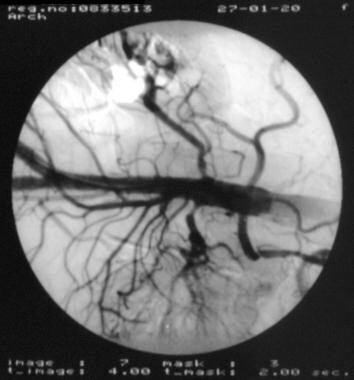
Media file 6:  Fibromuscular dysplasia (FMD). Angiogram of the descending aorta demonstrates the stenoses of FMD in the renal arteries bilaterally.
Click to see larger pictureClick to see detailView Full Size Image
Media type:  X-RAY

Media file 7:  Fibromuscular dysplasia (FMD). Angiogram of the right vertebral artery demonstrating irregular stenoses of fibromuscular dysplasia at the level of C2-3.
Click to see larger pictureClick to see detailView Full Size Image
Media type:  X-RAY

Media file 8:  Fibromuscular dysplasia (FMD). Cartoon illustrates the operative approach of graduated dilatation of the internal carotid artery (ICA). The common carotid and external carotid arteries are cross-clamped, and the superior thyroid artery is clipped while the ICA is isolated, opened, and dilated with progressively larger dilators. This technique has been shown to be successful in the management of medically refractive FMD stenoses.
Click to see larger pictureClick to see detailView Full Size Image
Media type:  Image

Media file 9:  Fibromuscular dysplasia (FMD). Illustration depicts the intraluminal appearance of graduated dilatation of the stenoses of FMD. The dilator is passed into the vessel and opens the bandlike narrowings.
Click to see larger pictureClick to see detailView Full Size Image
Media type:  Image

Media file 10:  Fibromuscular dysplasia (FMD). Illustration depicts the locations of FMD lesions, which differentiate regions with typical and atypical angiographic appearances of this disease.
Click to see larger pictureClick to see detailView Full Size Image
Media type:  Image

Media file 11:  Fibromuscular dysplasia (FMD). Digital subtraction angiography of the left internal carotid artery distribution demonstrates a large 1.5-cm-diameter aneurysm of the right anterior communicating artery. Aneurysms may be associated with systemic vasculopathies such as FMD.
Click to see larger pictureClick to see detailView Full Size Image
Media type:  X-RAY

Media file 12:  Small infarct in woman with fibromuscular dysplasia from dissected vertebral artery. An incidental aneurysm, or ovoid diverticula, is noted in the supraclinoid left internal carotid artery.
Click to see larger pictureClick to see detailView Full Size Image
Media type: 

Media file 13:  Small infarct in woman with fibromuscular dysplasia from dissected vertebral artery. An incidental aneurysm, or ovoid diverticula, is noted in the supraclinoid left internal carotid artery. Dissected vertebral artery.
Click to see larger pictureClick to see detailView Full Size Image
Media type: 

Media file 14:  Small infarct in woman with fibromuscular dysplasia from dissected vertebral artery. An incidental aneurysm, or ovoid diverticula, is noted in the supraclinoid left internal carotid artery. Internal carotid angiogram.

Click to see larger pictureClick to see detailView Full Size Image
Media type: 


  1. Luscher TF, Lie JT, Stanson AW, et al. Arterial fibromuscular dysplasia. Mayo Clin Proc. Oct 1987;62(10):931-52. [Medline].
  2. Gray GH, Young JR, Olin JW. Miscellaneous arterial diseases. In: Young JR, Olin JW, Bartholomew J, eds. Peripheral Vascular Diseases. 2nd ed. St Louis: Mosby-Yearbook; 1996:425-40.
  3. James TN. Morphologic characteristics and functional significance of focal fibromuscular dysplasia of small coronary arteries. Am J Cardiol. Apr 3 1990;65(14):12G-22G. [Medline].
  4. Campman SC, Holmes JF, Sokolove PE, et al. Pulmonary arterial fibromuscular dysplasia: a rare cause of fulminant lunghemorrhage. Am J Forensic Med Pathol. Mar 2000;21(1):69-73. [Medline].
  5. Maresi E, Becchina G, Ottoveggio G, et al. Arrhythmic sudden cardiac death in a 3-year-old child with intimal fibroplasia of coronary arteries, aorta, and its branches. Cardiovasc Pathol. Jan-Feb 2001;10(1):43-8. [Medline].
  6. Luscher TF, Keller HM, Imhof HG, et al. Fibromuscular hyperplasia: extension of the disease and therapeutic outcome. Results of the University Hospital Zurich Cooperative Study on Fibromuscular Hyperplasia. Nephron. 1986;44 Suppl 1:109-14. [Medline].
  7. Hill LD, Antonius JI. Arterial dysplasia: an important surgical lesion. Arch Surg. Apr 1965;90:585-95. [Medline].
  8. Heffelfinger MJ, Holley KE, Havrison EG. Arterial fibromuscular dysplasia studied at autopsy [abstract]. Am J Clin Pathol. 1970;54:274.
  9. Schievink WI, Bjornsson J. Fibromuscular dysplasia of the internal carotid artery: a clinicopathological study. Clin Neuropathol. Jan-Feb 1996;15(1):2-6. [Medline].
  10. Mettinger KL, Ericson K. Fibromuscular dysplasia and the brain. I. Observations on angiographic, clinical and genetic characteristics. Stroke. Jan-Feb 1982;13(1):46-52. [Medline].
  11. Cloft HJ, Kallmes DF, Kallmes MH, et al. Prevalence of cerebral aneurysms in patients with fibromuscular dysplasia:a reassessment. J Neurosurg. Mar 1998;88(3):436-40. [Medline].
  12. Stanley JC, Gewertz BL, Bove EL, et al. Arterial fibrodysplasia. Histopathologic character and current etiologic concepts. Arch Surg. May 1975;110(5):561-6. [Medline].
  13. Arunodaya GR, Vani S, Shankar SK, et al. Fibromuscular dysplasia with dissection of basilar artery presenting as "locked-in-syndrome". Neurology. Jun 1997;48(6):1605-8. [Medline].
  14. Eachempati SR, Sebastian MW, Reed RL 2nd. Posttraumatic bilateral carotid artery and right vertebral artery dissections in a patient with fibromuscular dysplasia: case report and review of the literature. J Trauma. Feb 1998;44(2):406-9. [Medline].
  15. Rushton AR. The genetics of fibromuscular dysplasia. Arch Intern Med. Feb 1980;140(2):233-6. [Medline].
  16. Bigazzi R, Bianchi S, Quilici N, et al. Bilateral fibromuscular dysplasia in identical twins. Am J Kidney Dis. Dec 1998;32(6):E4. [Medline].
  17. Tromp G, Wu Y, Prockop DJ, et al. Sequencing of cDNA from 50 unrelated patients reveals that mutations inthe triple-helical domain of type III procollagen are an infrequent causeof aortic aneurysms. J Clin Invest. Jun 1993;91(6):2539-45. [Medline].
  18. McKusick VA. Heritable Disorders of Connective Tissue. 4th ed. St Louis: Mosby-Yearbook; 1972:382-6.
  19. Schievink WI, Meyer FB, Parisi JE, Wijdicks EF. Fibromuscular dysplasia of the internal carotid artery associated with alpha1-antitrypsin deficiency. Neurosurgery. Aug 1998;43(2):229-33; discussion 233-4. [Medline].
  20. de Bray JM, Marc G, Pautot V, Vielle B, Pasco A, Lhoste P. Fibromuscular dysplasia may herald symptomatic recurrence of cervical artery dissection. Cerebrovasc Dis. 2007;23(5-6):448-52. [Medline].
  21. Lee EK, Hecht ST, Lie JT. Multiple intracranial and systemic aneurysms associated withinfantile-onset arterial fibromuscular dysplasia. Neurology. Mar 1998;50(3):828-9. [Medline].
  22. Mettinger KL. Fibromuscular dysplasia and the brain. II. Current concept of the disease. Stroke. Jan-Feb 1982;13(1):53-8. [Medline].
  23. de Monyé C, Dippel DW, Dijkshoorn ML, Tanghe HL, van der Lugt A. MDCT detection of fibromuscular dysplasia of the internal carotid artery. AJR Am J Roentgenol. April 2007;188(4):W367-9. [Medline].
  24. Sabharwal R, Vladica P, Coleman P. Multidetector spiral CT renal angiography in the diagnosis of renal artery fibromuscular dysplasia. Eur J Radiol. March 2007;61(3):520-7. [Medline].
  25. Willoteaux S, Faivre-Pierret M, Moranne O, Lions C, Bruzzi J, Finot M, et al. Fibromuscular dysplasia of the main renal arteries: comparison of contrast-enhanced MR angiography with digital subtraction angiography. Radiology. December 2006;241(3):922-9. [Medline].
  26. Bragin MA, Cherkasov AP. [Morphogenesis of fibromuscular dysplasia of the renal arteries (anultrastructural study)]. Arkh Patol. 1979;41(2):46-52. [Medline].
  27. Harrison EG Jr, McCormack LJ. Pathologic classification of renal arterial disease in renovascular hypertension. Mayo Clin Proc. Mar 1971;46(3):161-7. [Medline].
  28. Begelman SM, Olin JW. Fibromuscular dysplasia. Curr Opin Rheumatol. Jan 2000;12(1):41-7. [Medline].
  29. Reiher L, Pfeiffer T, Sandmann W. Long-term results after surgical reconstruction for renal artery fibromuscular dysplasia. Eur J Vasc Endovasc Surg. Dec 2000;20(6):556-9. [Medline].
  30. Van Damme H, Sakalihasan N, Limet R. Fibromuscular dysplasia of the internal carotid artery. Personal experience with 13 cases and literature review. Acta Chir Belg. Aug 1999;99(4):163-8. [Medline].
  31. Chiche L, Bahnini A, Koskas F, Kieffer E. Occlusive fibromuscular disease of arteries supplying the brain: results of surgical treatment. Ann Vasc Surg. Sep 1997;11(5):496-504. [Medline].
  32. Collins GJ Jr, Rich NM, Clagett GP, et al. Fibromuscular dysplasia of the internal carotid arteries. Clinical experience and follow-up. Ann Surg. Jul 1981;194(1):89-96. [Medline].
  33. Finsterer J, Strassegger J, Haymerle A, Hagmüller G. Bilateral stenting of symptomatic and asymptomatic internal carotid artery stenosis due to fibromuscular dysplasia. J Neurol Neurosurg Psychiatry. Nov 2000;69(5):683-6. [Medline].
  34. Leadbetter WF, Burkland CD. Hypertension in unilateral renal disease. J Urol. 1938;39:611-26.
  35. Leary MC, Finley A, Caplan LR. Cerebrovascular Complications of Fibromuscular Dysplasia. Curr Treat Options Cardiovasc Med. Jun 2004;6(3):237-248. [Medline].
  36. Palubinskas AJ, Ripley HR. Fibromuscular hyperplasia in extrarenal arteries. Radiology. 1946;82:451-55.
  37. Vuong PN, Desoutter P, Mickley V. Fibromuscular dysplasia of the renal artery responsible for renovascular hypertension: a histological presentation based on a series of 102 patients. Vasa. Feb 2004;33(1):13-8.