Continually Updated Clinical Reference
 
 
  All Sources     eMedicine     Medscape     Drug Reference     MEDLINE
 
eMedicine - N-Acetylglutamate Synthetase Deficiency : Article by

Quick Find
Authors & Editors
Introduction
Clinical
Differentials
Workup
Treatment
Medication
Follow-up
Miscellaneous
Multimedia
References

Related Articles
Arginase Deficiency

Argininosuccinate Lyase Deficiency

Carbamoyl Phosphate Synthetase Deficiency

Citrullinemia

Hyperammonemia

Hyperammonemia-Hyperornithinemia-Homocitrullinemia Syndrome

Ornithine Transcarbamylase Deficiency


Patient Education
Click here for patient education.


Author: Karl S Roth, MD, Professor and Chair, Department of Pediatrics, Creighton University School of Medicine

Karl S Roth is a member of the following medical societies: Alpha Omega Alpha, American Academy of Pediatrics, American College of Nutrition, American Pediatric Society, American Society for Clinical Nutrition, American Society of Nephrology, Association of American Medical Colleges, Medical Society of Virginia, New York Academy of Sciences, Sigma Xi, Society for Pediatric Research, and Southern Society for Pediatric Research

Editors: Uri S Alon, MD, Director of Research and Education, Department of Pediatrics, Division of Pediatric Nephrology, Children's Mercy Hospital of Kansas City; Professor, University of Missouri at Kansas City; Mary L Windle, PharmD, Adjunct Assistant Professor, University of Nebraska Medical Center College of Pharmacy, Pharmacy Editor, eMedicine.com, Inc; Robert Anthony Saul, MD, Clinical Professor, Department of Pediatrics, University of South Carolina; Senior Clinical Geneticist, Greenwood Genetic Center; Paul D Petry, DO, FACOP, FAAP, Consulting Staff, Freeman Pediatric Care, Freeman Health System; Bruce Buehler, MD, Professor, Department of Pediatrics, Pathology and Microbiology, Executive Director, Hattie B Munroe Center for Human Genetics and Rehabilitation, University of Nebraska Medical Center

Author and Editor Disclosure

Synonyms and related keywords: N-acetylglutamate synthetase deficiency, NAGS, NAGS deficiency, acetyl-coenzyme A, acetyl-CoA, carbamyl phosphate synthetase, CPS, hyperammonemia, urea cycle defect, anorexia, coma, apnea, respiratory failure, seizures, dysdiadochokinesia, hypothermia, respiratory alkalosis, arginase deficiency, hyperammonemia-hyperornithinemia-homocitrullinemia syndrome

Background

Normal enzyme function of N-acetylglutamate synthetase (NAGS) deficiency is confined to the hepatic mitochondria and mediates the reaction acetyl-coenzyme A (CoA) + glutamate ® N-acetylglutamate + CoA. As a mitochondrial reaction, each of the substrates is normally omnipresent. Acetyl-CoA is a cofactor in many mitochondrial reactions, and glutamate is the transamination product of a-ketoglutarate and alanine; a-ketoglutarate is produced by the Krebs cycle.

The normal function of N-acetylglutamate (NAG), the reaction product, is to act as an activator of carbamyl phosphate synthetase (CPS) (see Media file 1), which is also a mitochondrial enzyme. The activation process requires physical binding of NAG to the CPS enzyme, in turn, causing the inactive form of CPS to convert to an active state. Thus, CPS activity is regulated by the relationship of available NAG to inactive CPS enzyme protein.

The biochemical effect of NAGS deficiency is an inability to form adequate NAG; this results in failure to activate the enzyme responsible for the reaction NH4+ + CO2 + ATP ® H2N-CO-PO32- + ADP, which is the entry step into the urea cycle (see Carbamyl Phosphate Synthetase Deficiency).

Clinical signs and symptoms of NAGS deficiency occur when ammonia fails to fix into carbamoyl phosphate (CP) effectively, thus disabling the urea cycle. This leads to accumulation of alanine and glutamine (transamination products of pyruvate and glutamate, respectively) and, finally, of ammonia. The condition is progressive without intervention.

Pathophysiology

Overall, the hepatic urea cycle is the major route for waste nitrogen disposal, generation of which is chiefly from protein and amino acid metabolism. Low-level synthesis of certain cycle intermediates in extrahepatic tissues makes a small contribution to waste nitrogen disposal as well. A portion of the cycle is mitochondrial in nature; mitochondrial dysfunction may impair urea production and result in Hyperammonemia. Overall, activity of the cycle is regulated by the rate of synthesis of NAG, the enzyme activator that initiates incorporation of ammonia into the cycle.

Frequency

United States

Too few cases have been reported to cite any incidence figures. However, recognition of affected patients is increasing. Because the clinical presentation is indistinguishable from that of CPS deficiency and because the diagnosis is difficult, requiring an open liver biopsy, the true incidence may be underestimated. This is further emphasized by the fact that genetically affected individuals may remain asymptomatic for many years.

International

Only a handful of cases have been reported worldwide.

Mortality/Morbidity

NAGS deficiency is associated with significant morbidity and mortality. Patients who present with hyperammonemia are at risk for cerebral edema and death if treatment is not immediately begun. Survivors of hyperammonemic coma are likely to suffer brain damage and resulting developmental delays, learning disabilities, and/or mental retardation.

Sex

Case reports of NAGS deficiency have shown the condition to occur in both sexes; because the mutation is inherited as an autosomal recessive trait, this is to be expected.

Age

NAGS deficiency can present at any age. As with many inherited metabolic diseases, the most likely time of presentation is in the newborn period.


History

  • The multiple primary causes of hyperammonemia, specifically those due to urea cycle enzyme deficiencies, somewhat vary in presentation, diagnostic features, and treatment. For these reasons, the family of urea cycle defects is considered individually in this article; however, the common denominator, hyperammonemia, can be manifested clinically by some or all of the following:
    • Anorexia
    • Irritability
    • Heavy or rapid breathing
    • Lethargy
    • Vomiting
    • Disorientation
    • Somnolence
    • Asterixis (rare)
    • Combativeness
    • Obtundation
    • Coma
    • Cerebral edema
    • Death, if treatment is not forthcoming or effective
  • As a consequence, the most striking clinical findings of each urea cycle disorder relate to this constellation of symptoms and rough temporal sequence of events.

Physical

  • General
    • Signs of severe hyperammonemia may be present.
    • Poor growth may be evident.
  • Head, ears, eyes, nose, and throat (HEENT): Papilledema may be present if cerebral edema and increased intracranial pressure have ensued.
  • Pulmonary
    • Tachypnea or hyperpnea may be present.
    • Apnea and respiratory failure may occur in later stages.
  • Abdominal: Hepatomegaly may be present and is usually mild.
  • Neurologic
    • Poor coordination
    • Dysdiadochokinesia
    • Hypotonia or hypertonia
    • Ataxia
    • Tremor
    • Seizures and hypothermia
    • Lethargy progressing to combativeness to obtundation to coma
    • Decorticate or decerebrate posturing

Causes

  • The pedigree distribution of reported cases supports an autosomal recessive inheritance pattern, and the growing numbers of reported cases confirm that this is the case.
  • The NAGS gene was the last one of the urea cycle to be cloned. The gene locus is 17q21.31, spans 4.5 kb, and contains 6 introns and 7 exons. The 534 amino acid residues contained in the ribosomal protein are reduced to 486 by cleavage at the N-terminus upon import to the mitochondrion. A total of 21 mutations have been reported, 10 of which were associated with acute neonatal presentation.1 Interestingly, no mutations were found in exon 1, which is believed to code for the 50 amino acid mitochondrial-targeting segment that is cleaved.
  • Urea cycle defects with resulting hyperammonemia are due to deficiencies of the enzymes involved in the metabolism of waste nitrogen. The enzyme deficiencies lead to disorders with nearly identical clinical presentations. The exception is arginase, the last enzyme of the cycle; arginase deficiency causes a somewhat different set of signs and symptoms.


Arginase Deficiency
Argininosuccinate Lyase Deficiency
Carbamoyl Phosphate Synthetase Deficiency
Citrullinemia
Hyperammonemia
Hyperammonemia-Hyperornithinemia-Homocitrullinemia Syndrome
Ornithine Transcarbamylase Deficiency

Other Problems to be Considered

Lysinuric protein intolerance
Reye syndrome


Lab Studies

  • Affected newborns may experience fulminant hyperammonemia, which remains undetected unless index of suspicion is high.
  • No routine laboratory tests provide definitive clues.
    • The BUN level may be low, but this is an unreliable index of high blood ammonia.
    • A respiratory alkalosis may be present.
    • Urine orotic acid levels are within reference ranges.
  • Plasma alanine and glutamine levels are elevated.
  • Urine amino acids are nondiagnostic in N-acetylglutamate synthetase (NAGS) deficiency but are important in order to help rule out hyperammonemia-hyperornithinemia-homocitrullinemia (HHH) or lysinuric protein intolerance (LPI) (see Differentials).
  • Urine organic acids are within reference ranges in NAGS deficiency. Ruling out organic acid disorders, which can present with similar signs and symptoms and hyperammonemia, is important.

Imaging Studies

  • Imaging studies generally are not helpful, with the exception of brain imaging when cerebral edema is suspected. Documenting a finding of cerebral edema is important.

Procedures

  • A liver biopsy, best performed when the patient is stable, is essential for definitive diagnosis.
  • As a mitochondrial enzyme, it is quite labile; therefore, handle the specimen with scrupulous care and identify a laboratory that is capable of performing the enzymatic testing prior to scheduling the biopsy.


Medical Care

  • Immediate cessation of protein intake is mandatory in the face of high blood ammonia levels with provision of supplementary nonprotein energy to close the caloric gap. In most cases of severe hyperammonemia, the patient is given nothing enterally until the hyperammonemia is well controlled.
  • Treatment of severe hyperammonemia is a true emergency.
    • Reduction of blood ammonia can usually be achieved with intravenous sodium benzoate and phenylacetate. Intravenous sodium benzoate and phenylacetate (Ammonul) was approved in the United States in February, 2005.
    • Alternatively, hemodialysis is usually effective in bringing down the ammonia level, especially with the initial presentation.
    • Exchange transfusion is ineffective and is not generally recommended.
    • Intravenous fluids with glucose and sometimes arginine hydrochloride (HCl) added may be indicated.
    • Maintaining as high of an energy intake as possible is important.
  • Specific therapy of N-acetylglutamate synthetase (NAGS) deficiency following diagnosis depends on dietary protein restriction and provision of arginine to enhance availability of ornithine and administration of carbamylglutamate (which is not widely available), a functional analogue of NAG. Some patients have done well using this regimen. Whether or not oral sodium phenylbutyrate is helpful in this condition is unclear.

Consultations

  • NAGS deficiency is an extremely rare disorder with complex treatment.
  • Consultation with a metabolic disease/medical genetic specialist is usually necessary for assistance with laboratory diagnosis and clinical care. Contact these consultants by telephone if they are not locally available.

Diet

  • A low-protein diet is generally recommended with dietary supervision under the direction of a dietitian experienced in the care of patients with metabolic disease.


Drug Category: Metabolic analogue

In the absence of any ability to fix nitrogen generated from endogenous catabolism of protein, the urea cycle is of no use whatsoever to the homeostasis of nitrogen metabolism. In order to stimulate urea cycle action, investigators have used N-carbamoyl-L-glutamate as an analogue of N-acetyl-L-glutamate to activate CPS.

Drug NameCarbamylglutamic acid (Carbaglu)
DescriptionAlso called N-carbamoyl-L-glutamate, carglumic acid, or carglutamic acid. Structural analogue of N-acetylglutamate, which enters cells and enables activation of CPS I in vitro. The compound is also resistant to enzymatic degradation. Orphan drug available as a 200-mg dispersible tab. The tab is scored and can be split to provide accurate dose.
Pediatric Dose80-100 mg/kg/d PO divided tid/qid initially; disperse tab in at least 5-10 mL of water and administer on an empty stomach
Alternatively, 2.2 g/m2/d PO divided qid
May increase dose if needed, not to exceed 250 mg/kg/d; over time, some individuals require only a small dose (as low as 10 mg/kg/d)
ContraindicationsDocumented hypersensitivity
InteractionsLimited data available; none reported
PregnancyC - Fetal risk revealed in studies in animals but not established or not studied in humans; may use if benefits outweigh risk to fetus
PrecautionsLimited data available, monitor ammonia and amino acids, plasma levels, blood parameters, and hepatic, renal, and cardiovascular function; clinical experience of 90 patient-years showed increased sweating (2 patients) and increased transaminases (1 patient)

Drug Category: Metabolic agents

These agents assist in the excretion of nitrogen and serve as an alternative to urea to reduce waste nitrogen levels. Administer only in a large medical facility with close laboratory monitoring available.

Drug NameArginine (R-Gene 10)
DescriptionEnhances production of ornithine, which facilitates incorporation of waste nitrogen into the formation of citrulline and argininosuccinate. Provides 1 mol of urea plus 1 mol ornithine per mol arginine when cleaved by arginase. Pituitary stimulant for the release of human growth hormone (HGH). Often induces pronounced HGH levels in patients with intact pituitary function.
Pediatric DoseHyperammonemic crisis: 0.66 g/kg/dose IV infused over 24 h; dilute in 25-35 mL dextrose 10%
Maintenance treatment in a stable child: (administer as the free base) 0.4-0.7 g/kg/d PO
ContraindicationsDocumented hypersensitivity
InteractionsCoadministration with amphotericin, triamterene, amiloride, or spironolactone may increase risk of hyperkalemia
PregnancyB - Fetal risk not confirmed in studies in humans but has been shown in some studies in animals
PrecautionsRenal impairment; diagnostic aid not intended for therapeutic use; may cause nausea, vomiting, headache, hyperkalemia, hyperglycemia, or venous irritation during IV administration

Drug NameSodium phenylacetate and sodium benzoate (Ammonul)
DescriptionBenzoate combines with glycine to form hippurate, which is excreted in urine. 1 mol of benzoate removes 1 mol of nitrogen. Phenylacetate conjugates (via acetylation) glutamine in the liver and kidneys to form phenylacetylglutamine, which is excreted by the kidneys. The nitrogen content of phenylacetylglutamine per mol is identical to that of urea (2 mol of nitrogen). Ammonul must be administered with arginine for CPS, ornithine transcarbamylase (OTC), argininosuccinate synthetase, or argininosuccinate lyase (ASL) deficiencies. Indicated as adjunctive treatment of acute hyperammonemia associated with encephalopathy caused by urea cycle enzyme deficiencies. Serves as an alternative to urea to reduce waste nitrogen levels.
Adult DoseLoading dose: 55 mL (5.5 g)/m2 IV over 90-120 min via central line
Maintenance dose: 55 mL (5.5 g)/m2/d IV over 24 h via central line
Must dilute IV dose in at least 25 mL/kg of dextrose 10% before administration
Pediatric Dose<20 kg:
Loading dose: 2.5 mL (250 mg)/kg IV over 90-120 min via central line
Maintenance dose: 2.5 mL (250 mg)/kg/d IV over 24 h via central line
Must dilute IV dose in at least 25 mL/kg of dextrose 10% before administration
>20 kg: Administer as in adults
ContraindicationsDocumented hypersensitivity
InteractionsPenicillin may decrease effects of sodium benzoate/sodium phenylacetate; probenecid may inhibit renal excretion of products of sodium benzoate and sodium phenylacetate; valproate may antagonize efficacy of sodium benzoate and sodium phenylacetate; corticosteroids may increase body protein metabolism, thereby increasing plasma ammonia levels; do not use concomitantly with PO sodium phenylbutyrate (Buphenyl) because of additive effects
PregnancyC - Fetal risk revealed in studies in animals but not established or not studied in humans; may use if benefits outweigh risk to fetus
PrecautionsCaution when administering to patients with neonatal hyperbilirubinemia (competes for bilirubin binding sites on albumin); because of sodium content, exercise caution when giving to patients with congestive heart failure, severe renal dysfunction, and sodium retention with edema; common adverse effects include nausea, vomiting, tinnitus, and visual disturbance; IV must be diluted with dextrose 10% and administered via central line; phenylacetate may cause neurotoxicity; typically administered with antiemetic to prevent common occurrence of nausea and vomiting; caution in severe congestive heart failure or severe renal insufficiency since it contains large amount of sodium (30.5 mg/mL in undiluted IV product)


Further Outpatient Care

  • The patient should be under the care of a biochemical geneticist (metabolic disease specialist) who is an expert in the care of patients with urea cycle defects.
  • Make medication adjustments on the basis of continued growth and frequently measured plasma amino acids; include the input of a highly trained nutritionist.

Transfer

  • Consider transferring the patient to a facility equipped for emergent hemodialysis (if the patient is a neonate) and where the appropriate consultants (see Consultations) are immediately available.

Complications

  • Possible complications include cerebral edema with resulting brain damage or death.

Prognosis

  • Long-term prognosis is unclear; most likely, the future intelligence quotient score depends on the severity of the initial presentation and the subsequent hyperammonemic episodes suffered.

Patient Education

  • Inform parents of their obligate heterozygote status given the likelihood that this is an autosomal recessive trait.
  • Parents must understand that the chance of recurrence is 1:4 (25%) with each subsequent pregnancy.
  • Advise parents to seek early medical attention for the patient in the event of intercurrent illness.


Medical/Legal Pitfalls

  • Always measure an ammonia level immediately in a patient of any age with unexplained lethargy or coma.
  • Treat new onset hyperammonemia aggressively and immediately with advice from experts.
  • Usual treatments for hyperammonemia, such as lactulose, are totally ineffective in patients with urea cycle disorders.


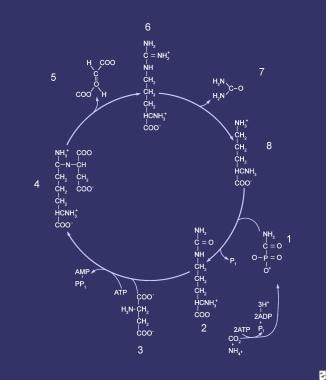
Media file 1:  Compounds comprising the urea cycle are numbered sequentially, beginning with carbamyl phosphate (1). At this step, the first waste nitrogen is incorporated into the cycle; at this step, N-acetylglutamate exerts its regulatory control on the mediating enzyme, carbamyl phosphate synthetase (CPS). Compound 2 is citrulline, the product of condensation between carbamyl phosphate (1) and ornithine (8); the mediating enzyme is ornithine transcarbamylase. Compound 3 is aspartic acid, which is combined with citrulline to form argininosuccinic acid (ASA) (4); the reaction is mediated by ASA synthetase. Compound 5 is fumaric acid generated in the reaction that converts ASA to arginine (6), which is mediated by ASA lyase.

Click to see larger pictureClick to see detailView Full Size Image
Media type:  Graph


  1. Caldovic L, Morizono H, Tuchman M. Mutations and polymorphisms in the human N-acetylglutamate synthase (NAGS) gene. Hum Mutat. Aug 2007;28(8):754-9. [Medline].
  2. Bachmann C, Colombo JP, Jaggi K. N-acetylglutamate synthetase (NAGS) deficiency: diagnosis, clinical observations and treatment. Adv Exp Med Biol. 1982;153:39-45. [Medline].
  3. Caldovic L, Morizono H, Panglao MG, et al. Late onset N-acetylglutamate synthase deficiency caused by hypomorphic alleles. Hum Mutat. Mar 2005;25(3):293-8. [Medline].
  4. Caldovic L, Morizono H, Panglao MG, et al. Null mutations in the N-acetylglutamate synthase gene associated with acute neonatal disease and hyperammonemia. Hum Genet. Apr 2003;112(4):364-8. [Medline].
  5. Elpeleg O, Shaag A, Ben-Shalom E, Schmid T, Bachmann C. N-acetylglutamate synthase deficiency and the treatment of hyperammonemic encephalopathy. Ann Neurol. Dec 2002;52(6):845-9. [Medline].
  6. Elpeleg ON, Colombo JP, Amir N, et al. Late-onset form of partial N-acetylglutamate synthetase deficiency. Eur J Pediatr. Jun 1990;149(9):634-6. [Medline].
  7. Guffon N, Schiff M, Cheillan D, et al. Neonatal hyperammonemia: the N-carbamoyl-L-glutamic acid test. J Pediatr. Aug 2005;147(2):260-2. [Medline].
  8. Guffon N, Vianey-Saban C, Bourgeois J, et al. A new neonatal case of N-acetylglutamate synthase deficiency treated by carbamylglutamate. J Inherit Metab Dis. 1995;18(1):61-5. [Medline].
  9. Haberle J, Koch HG. Genetic approach to prenatal diagnosis in urea cycle defects. Prenat Diagn. May 2004;24(5):378-83. [Medline].
  10. Plecko B, Erwa W, Wermuth B. Partial N-acetylglutamate synthetase deficiency in a 13-year-old girl: diagnosis and response to treatment with N-carbamylglutamate. Eur J Pediatr. Dec 1998;157(12):996-8. [Medline].

N-Acetylglutamate Synthetase Deficiency excerpt

Article Last Updated: Aug 4, 2008