You are in: eMedicine Specialties >
Pediatrics: General Medicine > Endocrinology
Hypogonadism
Article Last Updated: Nov 16, 2007
AUTHOR AND EDITOR INFORMATION
Section 1 of 10
Author: Stephen Kemp, MD, PhD, Professor, Department of Pediatrics, Section of Pediatric Endocrinology, University of Arkansas and Arkansas Children's Hospital
Stephen Kemp is a member of the following medical societies: American Academy of Pediatrics, American Association of Clinical Endocrinologists, American Pediatric Society, Endocrine Society, Phi Beta Kappa, Southern Medical Association, and Southern Society for Pediatric Research
Editors: Phyllis Speiser, MD, Professor, Department of Pediatrics, Division of Pediatric Endocrinology, New York University School of Medicine; Chief, Schneider Children's Hospital; Mary L Windle, PharmD, Adjunct Assistant Professor, University of Nebraska Medical Center College of Pharmacy, Pharmacy Editor, eMedicine.com, Inc; Barry B Bercu, MD, Professor, Departments of Pediatrics, Molecular Pharmacology and Physiology, University of South Florida College of Medicine, All Children's Hospital; Merrily P M Poth, MD, Professor, Department of Pediatrics and Neuroscience, Uniformed Services University of the Health Sciences; Bruce Buehler, MD, Professor, Department of Pathology and Microbiology, Director, Hattie B Munroe Center for Human Genetics, Chairman, Department of Pediatrics, University of Nebraska Medical Center
Author and Editor Disclosure
Synonyms and related keywords:
hypogonadism, ovarian failure, testicular failure, gonadal failure, eunuchoidism, primary amenorrhea, secondary amenorrhea, decreased sexual function, sparse body hair, delayed epiphyseal closure, hypergonadotropic hypogonadism, hypogonadotropic hypogonadism, gonadotropin deficiency, Turner syndrome, Turner's syndrome, Klinefelter syndrome, Klinefelter's syndrome, infertility, sexual dysfunction, decreased muscular strength, primary hypogonadism, sexual ambiguity, Kallmann syndrome, Kallmann's syndrome, genital abnormality, hypospadias, cryptorchidism, micropenis
Background
Hypogonadism manifests differently in males and in females before and after the onset of puberty. If onset is in prepubertal males and testosterone replacement is not instituted, the individual has features of eunuchoidism, which include sparse body hair, poor development of skeletal muscles, and delay in epiphyseal closure, resulting in long arms and legs. When hypogonadism occurs in postpubertal males, lack of energy and decreased sexual function are the usual concerns. In females with hypogonadism before puberty, failure to progress through puberty or primary amenorrhea is the most common presenting feature. When hypogonadism occurs in postpubertal females, secondary amenorrhea is the usual concern.
Pathophysiology
The gonad (ovary or testis) functions as part of the hypothalamic-pituitary-gonadal axis. A hypothalamic pulse generator resides in the arcuate nucleus, which releases luteinizing hormone-releasing hormone (LHRH; also termed gonadotropin-releasing hormone [GnRH]) into the hypothalamic-pituitary portal system. Recent data suggest that a gene named KISS is important in the development of the LHRH secreting cells.1
In response to these pulses of LHRH, the anterior pituitary secretes follicle-stimulating hormone (FSH) and luteinizing hormone (LH), which, in turn, stimulate gonadal activity. The increase in gonadal hormones results in lowered FSH and LH secretion at the pituitary level, completing the feedback loop. In the testes, LH stimulates Leydig cells to secrete testosterone, whereas FSH is necessary for tubular growth. In the ovaries, LH acts on theca and interstitial cells to produce progestins and androgens, and FSH acts on granulosa cells to stimulate aromatization of these precursor steroids to estrogen. Hypogonadism may occur if the hypothalamic-pituitary-gonadal axis is interrupted at any level. Hypergonadotropic hypogonadism (primary hypogonadism) results if the gonad does not produce the amount of sex steroid sufficient to suppress secretion of LH and FSH at normal levels. Hypogonadotropic hypogonadism may result from failure of the hypothalamic LHRH pulse generator or from inability of the pituitary to respond with secretion of LH and FSH. Hypogonadotropic hypogonadism is most commonly observed as one aspect of multiple pituitary hormone deficiencies resulting from malformations (eg, septooptic dysplasia, other midline defects) or lesions of the pituitary that are acquired postnatally. In 1944, Kallmann and colleagues first described familial isolated gonadotropin deficiency. Recently, many other genetic causes for hypogonadotropic hypogonadism have been identified.
Frequency
International
In women with hypergonadotropic hypogonadism (ie, gonadal failure), the most common cause of hypogonadism is Turner syndrome, which has an incidence of 1 case per 2,500-10,000 live births. In men with hypergonadotropic hypogonadism, the most common cause is Klinefelter syndrome, which has an incidence of 1 case per 500-1000 live births. Hypogonadotropic hypogonadism is more rare.
Mortality/Morbidity
No increase in mortality is observed in patients with hypogonadism. Morbidity for men and women includes infertility and an increased risk of osteoporosis. In women, an increased risk of severe osteoporosis is noted. In men, hypogonadism causes decreased muscle strength and sexual dysfunction.
Race
No racial predilection has been described.
Sex
Hypergonadotropic hypogonadism is more common in males than in females because the incidence of Klinefelter syndrome (the most common cause of primary hypogonadism in males) is higher than the incidence of Turner syndrome (the most common cause of hypogonadism in females). Incidence of hypogonadotropic hypogonadism is equal in males and females.
Age
Hypogonadism may occur at any age; however, consequences differ according to the age at onset. If hypogonadism occurs prenatally (even if incomplete), sexual ambiguity may result. If hypogonadism occurs before puberty, puberty does not progress. If hypogonadism occurs after puberty, infertility and sexual dysfunction result.
History
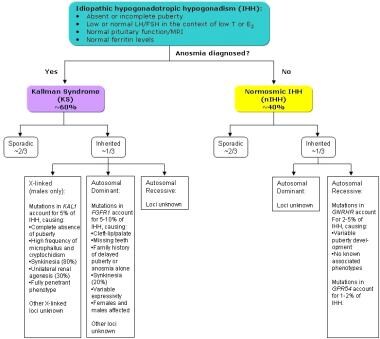
For both males and females, determining whether evidence of a genital abnormality is present at birth or determining the timing and extent of puberty is important. In addition, because Kallmann syndrome (hypogonadotropic hypogonadism and anosmia [ie, lack of a sense of smell]) is a common cause of hypogonadotropic hypogonadism, inquiring about the sense of smell is important.
- Males
- Specific issues include the presence of developmental anomalies associated with the genital system (eg, hypospadias, micropenis, cryptorchidism).
- For postpubertal males, inquire about the rate of beard growth, libido and sexual function, muscle strength, and energy levels.
- Investigate possible causes of acquired testicular failure (eg, mumps orchitis, trauma, radiation exposure of the head or testes, chemotherapy). Drugs that may interrupt testicular function include agents that interfere with testosterone synthesis, such as spironolactone, cyproterone, marijuana, heroin, and methadone.
- Females
- Ask about specific signs associated with Turner syndrome, such as lymphedema, cardiac or renal congenital anomalies, and short growth pattern.
- Determine the age of menarche. Menstrual history is important in postpubertal females.
Physical
- Males
- Evaluation of the testes is the most important feature of the physical examination. Determine whether both testes are palpable, their position in the scrotum, and their consistency. Testes size can be quantitated by comparison with testicular models (orchidometer), or their length and width may be measured. Before puberty, testes usually are 1-3 cm3 in volume (approximately 2 cm in length). During puberty, testes grow up to 25 cm3 in size.
- Examining the genitalia for hypospadias is the next important step. Check the scrotum to see if it is completely fused. Finally, evaluate the extent of virilization.
- Puberty should be staged using the Tanner criteria for genitalia, pubic hair, and axillary hair.
- Look for signs of Klinefelter syndrome, such as tall stature (especially if legs are disproportionately long), gynecomastia, small or soft testes, and a eunuchoid body habitus.
- Females
- Examination of the genitalia is important.
- Determine the extent of androgenization, which may be adrenal or ovarian in origin and is demonstrated in pubic and axillary hair.
- Determine the extent of estrogenization, as evidenced by breast development and maturation of the vaginal mucosa.
- Look for signs of Turner syndrome, such as short stature, webbing of the neck (eg, pterygium colli), a highly arched palate, short fourth metacarpals, widely spaced nipples, or multiple pigmented nevi.
Causes
- Hypogonadotropic hypogonadism
- CNS disorders
- Tumors
- Craniopharyngioma
- Germinoma
- Other germ cell tumors
- Hypothalamic and optic glioma
- Astrocytoma
- Pituitary tumor
- Miscellaneous causes
- Langerhans histiocytosis
- Postinfectious lesions of the CNS
- Vascular abnormalities of the CNS
- Radiation therapy
- Congenital malformations (especially associated with craniofacial anomalies)
- Head trauma
- Genetic causes (see Genetics of hypogonadotropic hypogonadism)
- Kallmann syndrome (mutation in the KAL [anosmin] gene), with hyposmia or anosmia or without anosmia
- Congenital adrenal hypoplasia (mutation in the DAX1 gene)
- Mutations in the PROP1 and HESX1 genes
- Mutations in the gene coding for the GnRH (LHRH) receptor
- Isolated LH deficiency
- Isolated FSH deficiency
- Idiopathic and genetic forms of multiple hormone deficiencies
- Chronic systemic disease and malnutrition
- Exercise-induced amenorrhea
- Miscellaneous disorders, including Prader-Willi syndrome, Laurence-Moon syndrome, Bardet-Biedl syndrome, functional gonadotropin deficiency (psychogenic amenorrhea, hypothyroidism, diabetes mellitus, Cushing syndrome), hyperprolactinemia, marijuana use, and Gaucher disease
- Hypergonadotropic hypogonadism in males
- Klinefelter syndrome
- Inactivating mutations
- LH beta subunit
- FSH beta subunit
- LH receptor
- FSH receptor
- Other causes of primary testicular failure
- Chemotherapy
- Radiation therapy
- Testicular biosynthetic defects
- Sertoli-cell-only syndrome
- LH resistance
- Anorchism and cryptorchidism
- Hypergonadotropic hypogonadism in females
- Turner syndrome
- Inactivating mutations
- LH beta subunit
- FSH beta subunit
- LH receptor
- FSH receptor
- XX and XY gonadal dysgenesis
- Familial and sporadic XX gonadal dysgenesis and its variants
- Familial and sporadic XY gonadal dysgenesis and its variants
- Other causes of primary ovarian failure
- Premature menopause
- Radiation therapy
- Chemotherapy
- Autoimmune oophoritis
- Resistant ovary
- Galactosemia
- Glycoprotein syndrome type 1
- FSH-receptor gene mutations
- LH/human chorionic gonadotropin (hCG) resistance
- Polycystic ovarian disease
- Noonan syndrome
- Genetics of hypogonadotropic hypogonadism: To date, a number of genes have been identified as causes of hypogonadotropic hypogonadism. The genes include the following:
- KAL is located on the X chromosome, just below the pseudoautosomal region. An abnormality in this gene results in Kallmann syndrome, which is characterized by anosmia and hypogonadotropic hypogonadism.
- The DAX1 gene is associated with X-linked adrenal hypoplasia congenita (hypogonadotropic hypogonadism and adrenal insufficiency).
- GNRHR is the gene associated with the GnRH (LHRH) receptor.
- PC1 is the gene for prohormone convertase 1. Abnormality of this gene causes hypogonadotropic hypogonadism and defects in prohormone processing.
- In addition, mutations in the PROP1 gene have resulted in absence of several pituitary hormones, including growth hormone, thyroid-stimulating hormone, prolactin, and gonadotropins. PROP1 encodes a protein expressed in the embryonic pituitary, which is necessary for function of POU1F1 (formerly PIT1), which codes for a pituitary transcription factor.
- In addition, mutation of the gene HESX1 has been associated with septooptic dysplasia, which may include poor development of the pituitary.
3-Beta-Hydroxysteroid Dehydrogenase Deficiency
5-Alpha-Reductase Deficiency
Adrenal Hypoplasia
Adrenal Insufficiency
Ambiguous Genitalia and Intersexuality
Amenorrhea
Androgen Insensitivity Syndrome
CHARGE Syndrome
Congenital Adrenal Hyperplasia
Denys-Drash Syndrome
Eating Disorder: Anorexia
Growth Failure
Hypopituitarism
Hypothyroidism
Klinefelter Syndrome
Malnutrition
Menstruation Disorders
Turner Syndrome
Lab Studies
- Males
- Determine FSH, LH, prolactin, and testosterone levels and obtain thyroid function test results.
- Examination of seminal fluid, karyotyping, and testicular biopsy may be helpful.
- Females
- Determine LH, FSH, prolactin, and estradiol levels and obtain thyroid function test results.
- Karyotyping may be helpful. If gonadotropin levels are elevated, measure antiovarian antibody levels.
Imaging Studies
- Pelvic ultrasonography may be helpful in females.
Other Tests
- Adrenocorticotropic hormone (ACTH) stimulation testing: In patients in whom a form of congenital adrenal hyperplasia is suspected, adrenal steroid synthesis is best evaluated by performing a cosyntropin (ACTH 1-24) stimulation test. Baseline serum adrenocortical hormone levels are measured, then 0.25 mg of cosyntropin is intravenously injected, and serum hormone levels are remeasured after 60 minutes. Precursor product ratios are compared with those in age-matched control subjects to determine whether a steroidogenic defect is involved in sex hormone synthesis.
- LHRH stimulation testing: To distinguish between true hypogonadotropic hypogonadism and constitutional delay in growth and maturation, performing a stimulation test with LHRH may be helpful.
- LHRH is intravenously injected, and LH and FSH levels are determined at 15-minute intervals following LHRH administration.
- A shortened version of the study has been used, in which LHRH is subcutaneously injected, and the specimen for LH and FSH levels is taken at 30-40 minutes.
- Testicular tissue testing: If testes are not palpable and whether any testicular tissue is present is unclear, administering hCG and measuring testosterone response may be helpful.
Procedures
- Bone age may be helpful in distinguishing hypogonadism from constitutional delay in growth and maturation. Timing of onset of puberty is related more to bone age than to chronologic age. Distinguishing hypogonadism from constitutional delay in growth and maturation is often difficult until the bone age is at a point adequate for pubertal development.
- Occasionally, testicular biopsy findings are helpful, particularly if azoospermia or oligospermia is present.
Medical Care
In prepubertal patients, treatment is directed at initiating pubertal development at the appropriate age. All such treatment is hormonal replacement therapy. Although the simplest and most successful treatment for both males and females with either hypergonadotropic or hypogonadotrophic hypogonadism is replacement of sex steroids, in hypogonadotropic hypogonadism, the therapy does not confer fertility or, in men, stimulate testicular growth.
- An alternative for men with hypogonadotropic hypogonadism has been treatment with pulsatile LHRH or hCG, either of which can stimulate testicular growth. Because such treatment is more complex than testosterone replacement, and because treatment with testosterone does not interfere with later therapy to induce fertility, most male patients with hypogonadotropic hypogonadism prefer to initiate and maintain virilization with testosterone. At a time when fertility is desired, it may be induced with either pulsatile LHRH or (more commonly) with a schedule of injections of hCG and FSH.
- In patients with hypergonadotropic hypogonadism, fertility is not possible.
Surgical Care
The only issue of surgical relevance is whether gonadal tissue should be removed.
- Because of the significant risk of gonadoblastoma and carcinoma, gonadal tissue should be removed in females with karyotypes containing a Y chromosome. This situation is observed in females with XY gonadal dysgenesis or in patients with Turner syndrome who have a karyotype that contains a Y chromosome (usually in 1 of 2 or more mosaic karyotypes).
- Males with nonfunctioning testicular tissue should undergo orchiectomy and replacement with prostheses.
Consultations
Consultation with a reproductive endocrinologist is required for patients who would like to become fertile. Administration of pulsatile LHRH in adolescents before fertility is desired carries no benefit.
Treatment of patients with hypergonadotropic hypogonadism involves replacement of sex steroids in both males and females. For treatment of patients with hypogonadotropic hypogonadism, the usual approach is replacement of sex steroids that initiate development and maintain secondary sex characteristics. Sex steroid replacement does not result in increased testicular size in males or fertility in either males or females. Gonadotropin or GnRH replacement is offered to the patient when fertility is desired. Many oral contraceptives can provide estrogen and progesterone in a combination that meets the replacement needs of the patient. Selection of a specific oral contraceptive agent needs to be individualized. All of the contraindications, cautions, and drug interactions for estrogens and progesterones apply, as listed in the tables below.
Drug Category: Testosterone agents
These agents are used for sex steroid replacement in males. All testosterone preparations are regulated as Schedule III controlled substances according to the Anabolic Steroids Control Act.
| Drug Name | Testosterone (Andro-LA, Depo-Testosterone) |
| Description | Several testosterone salts (eg, enanthate, cypionate) are available in a long-acting oil-based preparations. Promotes and maintains secondary sex characteristics in androgen-deficient males. |
| Adult Dose | 200-400 mg/mo IM; usually divided q2wk |
| Pediatric Dose | Initial dose (to initiate puberty): 100 mg/mo IM Can increase up to adult maintenance dose |
| Contraindications | Documented hypersensitivity; severe cardiac or renal disease; benign prostatic hypertrophy with obstruction; males with breast carcinoma; undiagnosed genital bleeding; for use only in males |
| Interactions | Glucose metabolism altered with insulin; clotting factor metabolism altered with warfarin |
| Pregnancy | X - Contraindicated; benefit does not outweigh risk
|
| Precautions | Too frequent or persistent penis erections; impaired liver or renal function |
| Drug Name | Testosterone patch (Androderm) |
| Description | Recent addition to the options for testosterone replacement. Several preparations are available, including a scrotal patch (Testoderm) and several patches that may be applied at other sites (Testoderm TTS, Androderm). Patches are changed daily. |
| Adult Dose | Topical patch: 2.5-6 mg/d |
| Pediatric Dose | Initial dose: 2.5-6 mg/d; dose should start with topical patch that releases 2.5 mg/d in boys who have had minimal prior testosterone exposure; increase gradually to adult dose |
| Contraindications | Documented hypersensitivity; breast or prostate carcinoma; severe liver, renal, or cardiac disease; hypercalcemia; for use only in males |
| Interactions | Glucose metabolism altered with insulin; clotting factor metabolism altered with warfarin |
| Pregnancy | X - Contraindicated; benefit does not outweigh risk
|
| Precautions | Too frequent or persistent penis erections; impaired liver or renal function (seen less often with transcutaneous testosterone than with oral or parenteral preparations); monitor serum testosterone levels, growth, and bone age |
| Drug Name | Testosterone gel (AndroGel) |
| Description | An androgenic anabolic steroid. The preparation topically is administered as gel. |
| Adult Dose | 5-10 g (delivers approximately 50-100 mg) applied topically every am to shoulders, upper arms, and abdomen |
| Pediatric Dose | Not established |
| Contraindications | Documented hypersensitivity; breast or prostate carcinoma; female patients; boys <18 y; just after application, avoid direct contact with women who are pregnant |
| Interactions | None reported |
| Pregnancy | X - Contraindicated; benefit does not outweigh risk
|
| Precautions | Impaired liver function (seen less often with transcutaneous testosterone compared to oral or parenteral preparations); congestive heart failure; elderly patients; benign prostatic hypertrophy |
Drug Category: Estrogen agents
These agents are used for sex steroid replacement in females.
| Drug Name | Ethinyl estradiol (Estrace) |
| Description | May initiate puberty in girls. A small unopposed dose (0.02 mg) is administered daily for 3-6 mo, then the dose is increased and cycled. After the first 6 mo, adding progestogen is often helpful. |
| Adult Dose | 0.02-0.1 mg/d PO alone for first 14-20 d of theoretical menstrual cycle, followed by 12-14 d of additional progesterone preparation |
| Pediatric Dose | 0.02-0.1 mg/d PO May be administered unopposed initially; after 6-12 mo, should be administered alone for first 14-20 d of cycle, followed by addition of 12-14 d of progesterone |
| Contraindications | Documented hypersensitivity; known or suspected pregnancy; breast cancer; undiagnosed abnormal genital bleeding; active thrombophlebitis or thromboembolic disorders; history of thrombophlebitis, thrombosis, or thromboembolic disorders associated with previous estrogen use (except when used in treatment of breast or prostatic malignancy); for females only; smoking cigarettes |
| Interactions | May reduce hypoprothrombinemic effects of anticoagulants; estrogen levels may be reduced with coadministration of barbiturates, rifampin, and other agents that induce hepatic microsomal enzymes; an increase in corticosteroid levels may occur when administered concurrently with ethinyl estradiol; use of ethinyl estradiol with hydantoins may cause spotting, breakthrough bleeding, and pregnancy; increase in fluid retention caused by estrogen intake may reduce seizure control |
| Pregnancy | X - Contraindicated; benefit does not outweigh risk
|
| Precautions | Caution in hepatic impairment, migraine, seizure disorders, cerebrovascular disorders, breast cancer, or thromboembolic disease |
| Drug Name | Estradiol, transdermal (Climara, Vivelle, Esclim, Alora, FemPatch) |
| Description | May initiate puberty in girls. Initially, a 0.05-mg patch may be applied 1-2 times/wk. After 6-12 mo, dose may be increased and cycled. After first 6 mo, adding progestogen is often helpful. A very low starting dose of estrogen is desired in young girls with bone ages at or below 12-13 y. Starting at higher doses may cause rapid epiphyseal maturation. If necessary, patches with a matrix-release mechanism (eg, Climara, Vivelle) may be cut to deliver a smaller dose. In the case of the Vivelle dot, half of the dot may be covered in order to lower the amount of estrogen absorbed. |
| Adult Dose | Apply topical patch that delivers estradiol at rate of 0.025-0.1 mg/d; replace qwk or 2 times/wk according to specific patch directions |
| Pediatric Dose | Administer as in adults; start with lowest dose |
| Contraindications | Documented hypersensitivity; known or suspected pregnancy; breast cancer; undiagnosed abnormal genital bleeding; active thrombophlebitis or thromboembolic disorders; history of thrombophlebitis, thrombosis, or thromboembolic disorders associated with previous estrogen use (except when used in treatment of breast or prostatic malignancy); for females only; smoking cigarettes |
| Interactions | May reduce hypoprothrombinemic effect of anticoagulants; coadministration of barbiturates, rifampin, and other agents that induce hepatic microsomal enzymes may reduce estrogen levels; pharmacologic and toxicologic effects of corticosteroids may occur because of estrogen-induced inactivation of hepatic P-450 enzyme; loss of seizure control has been noted when administered concurrently with hydantoins |
| Pregnancy | X - Contraindicated; benefit does not outweigh risk
|
| Precautions | Certain patients may develop undesirable manifestations of excessive estrogenic stimulation, such as abnormal or excessive uterine bleeding or mastodynia; estrogens may cause some degree of fluid retention (exercise caution); prolonged unopposed estrogen therapy may increase risk of endometrial hyperplasia |
| Drug Name | Conjugated estrogen (Premarin) |
| Description | May initiate puberty in girls. A small unopposed dose is administered for 3-6 mo, then the dose is increased. After the first 6 mo, adding progestogen is often helpful. |
| Adult Dose | 0.625-1.25 mg/d PO |
| Pediatric Dose | May be administered PO to initiate pubertal development in girls starting at lower dose (0.3 mg/d) and advancing to higher dose (0.625 mg/d) When dose is increased, may add progesterone After 1-2 y, may increase to adult dose (1.25 mg/d on days 1-21 of cycle) |
| Contraindications | Documented hypersensitivity; known or suspected pregnancy; breast cancer; undiagnosed abnormal genital bleeding; active thrombophlebitis or thromboembolic disorders; history of thrombophlebitis, thrombosis, or thromboembolic disorders associated with previous estrogen use (except when used in treatment of breast or prostatic malignancy); for females only; smoking cigarettes |
| Interactions | May reduce hypoprothrombinemic effect of anticoagulants; coadministration of barbiturates, rifampin, and other agents that induce hepatic microsomal enzymes may reduce estrogen levels; pharmacologic and toxicologic effects of corticosteroids may occur because of estrogen-induced inactivation of hepatic P-450 enzyme; loss of seizure control has been noted when administered concurrently with hydantoins |
| Pregnancy | X - Contraindicated; benefit does not outweigh risk
|
| Precautions | Certain patients may develop undesirable manifestations of excessive estrogenic stimulation, such as abnormal or excessive uterine bleeding or mastodynia; estrogens may cause some degree of fluid retention (exercise caution); prolonged unopposed estrogen therapy may increase risk of endometrial hyperplasia |
Drug Category: Progesterone agents
These agents are added during the last 12-14 days of the menstrual cycle.
| Drug Name | Norethindrone (Aygestin) |
| Description | Transforms proliferative into secretory endometrium. |
| Adult Dose | 5 mg/d PO during final 12-14 d of menstrual cycle |
| Pediatric Dose | Administer as in adults |
| Contraindications | Documented hypersensitivity; thromboembolic disorders; pregnancy; missed abortion; breast cancer; undiagnosed vaginal bleeding |
| Interactions | Hepatic metabolism induced with aminoglutethimide or rifampin |
| Pregnancy | X - Contraindicated; benefit does not outweigh risk
|
| Precautions | During lactation, impaired liver function, congestive heart failure, or hypertension; fluid retention, depression, glucose intolerance, and thromboembolic phenomena may occur; perform follow-up testing with Papanicolaou smears |
| Drug Name | Medroxyprogesterone (Provera, Amen, Cycrin) |
| Description | Transforms proliferative into secretory endometrium. |
| Adult Dose | 5-10 mg/d PO during last 12-14 d of menstrual cycle |
| Pediatric Dose | Administer as in adults |
| Contraindications | Documented hypersensitivity; cerebral apoplexy; undiagnosed vaginal bleeding; thrombophlebitis; liver dysfunction |
| Interactions | Hepatic metabolism induced with aminoglutethimide or rifampin |
| Pregnancy | X - Contraindicated; benefit does not outweigh risk
|
| Precautions | During lactation, impaired liver function, congestive heart failure, or hypertension; fluid retention, depression, glucose intolerance, and thromboembolic phenomena may occur; perform follow-up testing with Papanicolaou smears |
Further Outpatient Care
- Reevaluate patients receiving hormone replacement therapy every 6-12 months.
Complications
- In men, complications of untreated hypogonadism include loss of libido, failure to achieve physical strength, the social implications of failing to go through puberty with peers (if hypogonadism occurs before puberty), and osteoporosis. In addition, if hypogonadism occurs before epiphyseal closure, the result is usually tall stature with a eunuchoid body habitus. Even treated males with primary hypogonadism are infertile. However, men who have hypogonadism due to hypothalamic or pituitary dysfunction can potentially become fertile with administration of gonadotropins.
- In women with hypogonadism, complications include the social implication of failing to go through puberty with peers (if hypogonadism occurs before puberty). An additional concern for untreated women is osteoporosis, which can be avoided with estrogen replacement. Women who have hypogonadism because of hypothalamic or pituitary dysfunction can potentially become fertile with administration of gonadotropins. Women with primary hypogonadism are infertile; however, with in vitro fertilization using a donor ovum, these women can carry an infant to term.
- Osteoporosis has an earlier onset in individuals with hypogonadism; hence, bone mineral density should be compared with age-matched normative standards, and followed longitudinally. Prescribe treatment using appropriate therapeutic interventions.
Prognosis
- Men and women with hypogonadism can lead a normal life with hormone replacement.
- Approximately 20-25% of females with Turner syndrome have some spontaneous puberty. Spontaneous estrogenization occurs more commonly in women with mosaic karyotypes and those karyotypes with an abnormal second X chromosome, such as 46,XXiq or 46,XXip. Reports exist of women with mosaic Turner syndrome becoming pregnant without in vitro fertilization.
Patient Education
Special Concerns
- Both males and females with hypogonadotropic hypogonadism (hypogonadism at the pituitary or hypothalamic level) can potentially become fertile. Induction of fertility requires involvement of a specialist in reproductive endocrinology.
- Murphy KG. Kisspeptins: regulators of metastasis and the hypothalamic-pituitary-gonadal axis. J Neuroendocrinol. Aug 2005;17(8):519-25. [Medline].
- Achermann JC, Gu WX, Kotlar TJ, et al. Mutational analysis of DAX1 in patients with hypogonadotropic hypogonadism or pubertal delay. J Clin Endocrinol Metab. Dec 1999;84(12):4497-500. [Medline].
- Bhagavath B, Podolsky RH, Ozata M, et al. Clinical and molecular characterization of a large sample of patients with hypogonadotropic hypogonadism. Fertil Steril. Mar 2006;85(3):706-13. [Medline].
- Bouvattier C, Tauber M, Jouret B, et al. Gonadotropin treatment of hypogonadotropic hypogonadal adolescents. J Pediatr Endocrinol Metab. Apr 1999;12 Suppl 1:339-44. [Medline].
- Carey PO, Howards SS, Vance ML. Transdermal testosterone treatment of hypogonadal men. J Urol. Jul 1988;140(1):76-9. [Medline].
- Kaneko N, Kawagoe S, Hiroi M. Turner's syndrome--review of the literature with reference to a successful pregnancy outcome. Gynecol Obstet Invest. 1990;29(2):81-7. [Medline].
- Lamberts SW, de Jong FH, Birkenhager JC. Evaluation of a therapeutic regimen in Cushing's disease. The predictability of the result of unilateral adrenalectomy followed by external pituitary irradiation. Acta Endocrinol (Copenh). Sep 1977;86(1):146-55. [Medline].
- Lee PA. Disorders of puberty. In: Lifshitz F, ed. Pediatric Endocrinology. 3rd ed. Marcel Dekker; 1996:175-95.
- Mazer N, Bell D, Wu J, et al. Comparison of the steady-state pharmacokinetics, metabolism, and variability of a transdermal testosterone patch versus a transdermal testosterone gel in hypogonadal men. J Sex Med. Mar 2005;2(2):213-26. [Medline].
- Muscatelli F, Strom TM, Walker AP, et al. Mutations in the DAX-1 gene give rise to both X-linked adrenal hypoplasia congenita and hypogonadotropic hypogonadism. Nature. Dec 15 1994;372(6507):672-6. [Medline].
- Navot D, Laufer N, Kopolovic J, et al. Artificially induced endometrial cycles and establishment of pregnancies in the absence of ovaries. N Engl J Med. Mar 27 1986;314(13):806-11. [Medline].
- Pozo J, Argente J. Ascertainment and treatment of delayed puberty. Horm Res. 2003;60 Suppl 3:35-48. [Medline].
- Rogol AD. Pubertal androgen therapy in boys. Pediatr Endocrinol Rev. Mar 2005;2(3):383-90. [Medline].
- Rosenbloom AL, Almonte AS, Brown MR, et al. Clinical and biochemical phenotype of familial anterior hypopituitarism from mutation of the PROP1 gene. J Clin Endocrinol Metab. Jan 1999;84(1):50-7. [Medline].
- Saenger P. Clinical review 48: The current status of diagnosis and therapeutic intervention in Turner's syndrome. J Clin Endocrinol Metab. Aug 1993;77(2):297-301. [Medline].
- Seminara SB, Oliveira LM, Beranova M, et al. Genetics of hypogonadotropic hypogonadism. J Endocrinol Invest. Oct 2000;23(9):560-5. [Medline].
- Snyder PJ, Lawrence DA. Treatment of male hypogonadism with testosterone enanthate. J Clin Endocrinol Metab. Dec 1980;51(6):1335-9. [Medline].
- Thomas PQ, Dattani MT, Brickman JM, et al. Heterozygous HESX1 mutations associated with isolated congenital pituitary hypoplasia and septo-optic dysplasia. Hum Mol Genet. Jan 1 2001;10(1):39-45. [Medline].
Hypogonadism excerpt Article Last Updated: Nov 16, 2007
|