| Patient Education |
|
Click here for patient education.
|
|
You are in: eMedicine Specialties >
Pediatrics: General Medicine > Gastroenterology
Intestinal Malrotation
Article Last Updated: Jul 6, 2006
AUTHOR AND EDITOR INFORMATION
Section 1 of 11
Author: Anjali Parish, MD, Assistant Professor of Pediatrics, Department of Neonatology, Medical College of Georgia
Anjali Parish is a member of the following medical societies: American Academy of Pediatrics and American Medical Association
Coauthor(s):
Robyn Hatley, MD, Professor, Departments of Surgery and Pediatrics, Medical College of Georgia
Editors: Jeffrey J DuBois, MD, Consulting Staff, Division of Pediatric Surgery, Kaiser Permanente, North Sacramento Medical Center; Mary L Windle, PharmD, Adjunct Assistant Professor, University of Nebraska Medical Center College of Pharmacy, Pharmacy Editor, eMedicine.com, Inc; David Piccoli, MD, Chief, Division of Gastroenterology and Nutrition, Department of Pediatrics, The Children's Hospital of Philadelphia; Professor, University of Pennsylvania School of Medicine; Steven M Schwarz, MD, FAAP, FACN, AGAF, Professor of Pediatrics, State University of New York, Downstate Medical Center College of Medicine; Distinguished Lecturer, New York Medical College, School of Public Health; Steven M Altschuler, MD, President and CEO, Children's Hospital Foundation, Children's Hospital of Philadelphia
Author and Editor Disclosure
Synonyms and related keywords:
intestinal malrotation, intestinal nonrotation, incomplete intestinal rotation, anomalies of intestinal fixation
Background
Many authors define intestinal malrotation as intestinal nonrotation or incomplete rotation around the superior mesenteric artery (SMA). It involves anomalies of intestinal fixation as well. Interruption of typical intestinal rotation and fixation during fetal development can occur at a wide range of locations, and this leads to a variety of both acute and chronic presentations of disease. The most common type found in pediatric patients is incomplete rotation predisposing to midgut volvulus, which can result in short-bowel syndrome or even death.
Case reports of malrotation exist prior to the 1900s. During the 20th century, understanding of the embryology and anatomy of malrotation became more complete, along with changes in surgical approaches to the problems. In 1936, William E. Ladd wrote the classic article on treatment of malrotation, and his surgical approach (ie, Ladd procedure) remains the cornerstone of practice today.
Pathophysiology
See Causes.
Frequency
United States
Intestinal malrotation occurs at a rate of 1 in 500 live births. Most infants with gastroschisis, omphalocele, or congenital diaphragmatic hernia present with intestinal malrotation. Approximately 50% of patients with duodenal atresia and 33% of patients with jejunoileal atresia have a malrotation as well. Also, intestinal malrotation occurs in association with Hirschsprung disease, gastroesophageal reflux, intussusception, persistent cloaca, anorectal malformations (imperforate anus), and extrahepatic anomalies.
Mortality/Morbidity
Younger patients have higher rates of morbidity and mortality. In infants, the mortality rate ranges from 2-24%. The presence of necrotic bowel at surgery increases the mortality rate by 25 times for infants, and the presence of other anomalies increases the risk by 22 times.
Sex
Male predominance exists in neonatal presentations at a male-to-female ratio of 2:1. No sexual predilection exists in patients older than 1 year.
Age
Up to 40% of patients with malrotation present within the first week of life. This condition is diagnosed in 50% of patients by age 1 month, and it is diagnosed in 75% by age 1 year. The remaining 25% of patients present after age 1 year and into late adulthood, many are recognized intraoperatively during other procedures or at autopsy.
History
History of present illness varies according to acute or chronic presentation as well as according to type of rotational defect.
- Acute midgut volvulus
- Most patients present in the first year of life.
- The primary presenting sign of acute midgut volvulus is sudden onset of bilious emesis.
- Chronic midgut volvulus
- Chronic midgut volvulus is due to intermittent or partial twisting that results in lymphatic and venous obstruction.
- Multiple case reports show that 2 of the main presenting features are recurrent abdominal pain and malabsorption syndrome.
- Several patients presented with acute midgut volvulus, but further history revealed they had had chronic symptoms with misdiagnoses.
- Other clinical features include recurrent bouts of diarrhea alternating with constipation, intolerance of solid food, obstructive jaundice (1 case), and gastroesophageal reflux.
- Acute duodenal obstruction
- This anomaly usually is recognized in infants and is due to compression or kinking of the duodenum by peritoneal bands (Ladd bands).
- Patients present with forceful vomiting, which may or may not be bile stained depending on location of the obstruction with respect to the entrance of the common bile duct (ampulla of Vater).
- Chronic duodenal obstruction
- The typical age at diagnosis ranges from infancy to preschool.
- The most common symptom is vomiting, which is usually bilious.
- Patients may also have failure to thrive and intermittent abdominal pain (frequently diagnosed as colic).
- Internal herniation
- Internal herniation usually has a chronic picture.
- Patients have recurrent abdominal pain, which may progress from intermittent to constant.
- They experience vomiting as well as constipation at times.
- They are often diagnosed with psychosocial problems.
Physical
Physical examination findings may vary depending on the type of rotational defect. Acute and chronic presentations also differ. Each is discussed below.
- Acute midgut volvulus
- Abdominal distention is frequently present, and the infant appears in acute pain.
- As vascular compromise persists, intraluminal bleeding may occur, which leads to blood per rectum and sometimes hematemesis.
- Abdominal guarding is usually present and prevents palpation of intestinal loops.
- As symptoms persist, the infant may develop signs of shock, including poor perfusion, decreased urine output, and hypotension.
- Patients also have signs of peritonitis, including abdominal tenderness and discoloration of the skin.
- Chronic midgut volvulus
- Physical examination results may be completely normal if the patient presents during a period when the obstruction is relieved.
- If partial twisting is present at the time of examination, the patient may have signs and symptoms equivalent to those of acute midgut volvulus.
- Abdominal tenderness and guarding is usually present, as well as abdominal distention.
- Acute duodenal obstruction
- Abdominal distention and gastric waves may be present.
- Passage of meconium or stool can be present.
- These patients usually do not have signs of peritonitis or shock unless volvulus is also present distal to the obstruction.
- Chronic duodenal obstruction
- Physical examination results may be completely normal at the time of presentation.
- Abdominal distention and tenderness may be present.
- Diagnosis is usually made by history and enough suspicion to obtain radiologic studies; physical examination findings are very unreliable.
- Internal herniation
- Physical examination findings can be unremarkable, and diagnosis is made by radiologic studies and index of suspicion only.
- Patients with left mesentericoparietal hernias may have findings related to venous obstruction, such as hematochezia, hemorrhoids, and dilated anterior abdominal veins.
- If the bowel of the patient is obstructed at the time of presentation, abdominal tenderness and guarding may be present, and a soft globular mass may be palpated at the location of the hernia.
Causes
The cause of intestinal malrotation is disruption in the normal embryological development of the bowel. Clinical features depend on the stage of disruption and are discussed as follows. A full understanding of normal development aids in understanding the etiology of malrotation.
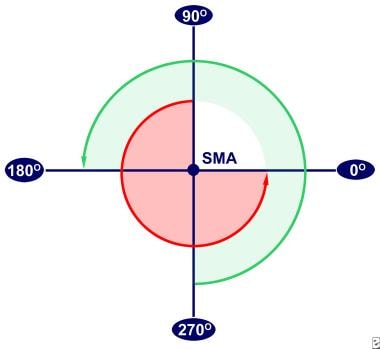
- Normal embryology: Normal rotation takes place around the SMA as the axis. It is described by referring to 2 ends of the alimentary canal, the proximal duodenojejunal loop and the distal cecocolic loop, and usually is divided into 3 stages. Both loops make a total of 270° in rotation during normal development. Both loops start in a vertical plane parallel to the SMA and end in a horizontal plane (see Image 1).
- Stage I occurs between the 5th and 10th weeks of gestation. It is the period of physiologic herniation of the bowel into the base of the umbilical cord. The duodenojejunal loop begins superior to the SMA at a 90° position and rotates 180° in a counterclockwise direction. At 180°, the loop is to the anatomical right of the SMA, and by 270°, it is beneath the SMA. The cecocolic loop begins beneath the SMA at 270°. It rotates 90° in a counterclockwise manner and ends at the anatomical left of the SMA at a 0° position. Both loops maintain these positions until the bowel returns to the abdominal cavity. Also during this period, the mid gut lengthens along the SMA, and, as rotation continues, a very broad pedicle is formed at the base of the mesentery. This broad base protects against midgut volvulus.
- Stage II occurs during the 10th week of gestation, the period when the bowel returns to the abdominal cavity. As it returns, the duodenojejunal loop rotates an additional 90° to end at the anatomical left of the SMA, the 0° position. The cecocolic loop turns 180° more as it reenters the abdominal cavity. This turn places it to the anatomical right of the SMA, a 180° position.
- Stage III lasts from 11 weeks' gestation until term. It involves the descent of the cecum to the right lower quadrant and fixation of the mesenteries.
- Nonrotation: Arrest in development at stage I results in nonrotation. Subsequently, the duodenojejunal junction does not lie inferior and to the left of the SMA, and the cecum does not lie in the right lower quadrant. The mesentery in turn forms a narrow base as the gut lengthens on the SMA without rotation, and this narrow base is prone to clockwise twisting leading to midgut volvulus. The width of the base of the mesentery is different in each patient, and not every patient develops midgut volvulus.
- Incomplete rotation: Stage II arrest results in incomplete rotation and is most likely to result in duodenal obstruction. Typically, peritoneal bands running from the misplaced cecum to the mesentery compress the third portion of the duodenum. Depending on how much rotation was completed prior to arrest, the mesenteric base may be narrow and, again, midgut volvulus can occur. Internal herniations may also occur with incomplete rotation if the duodenojejunal loop does not rotate but the cecocolic loop does rotate. This may trap most of the small bowel in the mesentery of the large bowel, creating a right mesocolic (paraduodenal) hernia.
- Incomplete fixation: Potential hernial pouches form when the mesentery of the right and left colon and the duodenum do not become fixed retroperitoneally. If the descending mesocolon between the inferior mesenteric vein and the posterior parietal attachment remains unfixed, the small intestine may push out through the unsupported area as it migrates to the left upper quadrant. This creates a left mesocolic hernia with possible entrapment and strangulation of the bowel. If the cecum remains unfixed, volvulus of the terminal ileum, cecum, and proximal ascending colon may occur.
Bowel Obstruction in the Newborn
Duodenal Atresia
Gastroesophageal Reflux
Intestinal Volvulus
Necrotizing Enterocolitis
Neonatal Sepsis
Other Problems to be Considered
Ileal atresia Functional ileus due to sepsis, pneumonia, and other causes
Lab Studies
- Complete blood cell count
- An elevated or decreased WBC count may indicate sepsis as a reason for abdominal distention and bilious emesis.
- A decreased platelet count may indicate a platelet consumptive process, eg, necrotizing enterocolitis (NEC).
- A decreased hemoglobin/hematocrit gives evidence of blood loss, possibly through GI bleeding.
- Arterial, capillary, or venous blood gas: Metabolic acidosis provides evidence for ongoing ischemia as observed with NEC or strangulated bowel (volvulus).
- Blood chemistries
- Correct any electrolyte imbalances if possible prior to surgery.
- Ongoing sodium, chloride, and bicarbonate losses occur through suctioned GI secretions.
- Furthermore, patients may have increased potassium levels due to metabolic acidosis and hemolysis.
- Urinalysis and urine culture: Complete these tests only if abdominal distention is suspected because of another ongoing infectious process and not because of GI rotational or obstructive malformations.
- Type and screen: Keep this test current because these infants often need emergent surgery and may need blood replacement.
- Prothrombin time (PT) and activated partial thromboplastin time (aPTT): Perform clotting studies in older infants and children in whom surgery is highly likely.
Imaging Studies
- Plain abdominal radiography
- Plain radiography has limited use for defining obstruction because infants may have a gasless abdomen or one that is almost normal.
- The classic pattern for duodenal obstruction, if present, is the double-bubble sign produced by an enlarged stomach and proximal duodenum with little gas in the remainder of the bowel.
- Distended bowel loops and possibly pneumatosis intestinalis may be observed if NEC is present.
- If concern for free air in the abdomen exists, order a left lateral decubitus radiograph as well.
- Upper gastrointestinal series
- Upper GI series is the study of choice in patients who are stable and is best interpreted by a pediatric radiologist or a pediatric surgeon.
- Normal rotation is present if the duodenal C-loop crosses the midline and places the duodenojejunal junction to the left of the spine at a level greater than or equal to the pylorus.
- If contrast ends abruptly or tapers in a corkscrew pattern, midgut volvulus or some other form of proximal obstruction may be present.
- Barium is the contrast of choice in patients who are stable or have chronic symptoms. Contrast studies may not be possible in patients who are actively vomiting or are otherwise unstable and need immediate surgical exploration. Water-soluble agents should be used if the study must be performed prior to imminent surgery (see Image 2).
- Lower gastrointestinal series (contrast enema)
- Occasionally, upper GI series findings may be indeterminate for the location of the duodenojejunal junction. In these cases, lower GI series may be used to identify location of the cecum.
- Lower GI series can also rule out colonic obstruction and ileal atresia. However, a normally placed cecum does not unequivocally rule out a malrotation, and clinical judgment must be exercised (see Image 3).
- Ultrasonography
- In the hands of experienced ultrasonographers, ultrasonography has been shown to be very sensitive (approximately 100%) in detecting neonatal malrotation.
- Highest sensitivity is achieved when inversion of the SMA and the superior mesenteric vein (SMV) is shown.
- Other diagnostic findings are fixed midline bowel loops and duodenal dilation with distal tapering.
- Also, volvulus is highly probable if the SMV is shown to be coiling around the SMA.
- All features are enhanced if water is instilled first by nasogastric (NG) tube.
- The presence of ascites and thickened bowel wall were not found to be statistically significant predictors of malrotation with midgut volvulus.
- Computed tomography scanning
- CT scanning is not well developed for diagnosing malrotation and midgut volvulus.
- Scattered case reports of its use exist, but it is not recommended as the principal diagnostic tool.
Procedures
- Nasogastric tube insertion
- Insert an NG tube in all patients with bilious emesis and suspected malrotation.
- Adjust the NG tube to low intermittent suction in order to decompress the bowel proximal to any obstruction that may be present.
- Central venous catheter placement
- Most patients require long-term intravenous access after surgery, especially if midgut volvulus is present.
- Because intravenous nutrition is likely to be necessary, central line access is preferable over peripheral access so that higher rates of nutrition can be delivered.
Medical Care
Medical care is directed toward stabilizing the patient.
- Where malrotation with volvulus or obstruction is suspected, seek immediate pediatric surgical consultation.
- Maintain patients on nothing by mouth (NPO) and adjust NG or orogastric tube to low intermittent suction.
- Correct fluid and electrolyte deficits.
- Administer broad-spectrum antibiotics prior to surgery, if possible.
- If a patient has signs of shock, administer appropriate fluids, blood products, and vasopressor medications to improve hypotension. At the authors' institution, dopamine is used as first-line therapy because of its possible effects to increase splanchnic blood flow. Furthermore, the authors routinely start dopamine at 3 mcg/kg/min and continue it postoperatively even if the patient is not hypotensive.
- If the patient is unstable, do not delay surgical intervention for upper GI and laboratory studies. Quick surgical intervention, not prolonged medical management, produces the best results if midgut volvulus is suspected.
Surgical Care
The Ladd procedure remains the cornerstone of surgical treatment for malrotation today. Prior to William Ladd's publication in 1936, surgical treatment for malrotation with or without volvulus had a mortality rate higher than 90%. In fact, at Ladd's own institution, the mortality rate was 100% before the development of his new technique. A classic Ladd procedure is described as reduction of volvulus (if present), division of mesenteric bands, placement of small bowel on the right and large bowel on the left of the abdomen, and appendectomy. Published reports for laparoscopic Ladd procedure are now appearing in the literature as well.
- Midgut volvulus
- If midgut volvulus is present, the entire small intestine along with the transverse colon is delivered out of the abdominal incision, where the volvulus can be reduced.
- Because the volvulus usually twists in a clockwise direction, reduction is accomplished by twisting in a counterclockwise direction.
- After the blood supply has been restored by detorsion, the surgeon must make a decision about viability of the involved bowel. The outcome is better when no gangrenous bowel is present or when a small localized gangrenous segment is present, which can be resected and a primary anastomosis performed.
- Enterostomy is performed when questionable viability exists at the ends of a gangrenous area that is resected.
- If multiple areas of questionable viability are present, many surgeons choose to leave the areas and perform a second-look operation in 12-24 hours if the patient is not showing clinical recovery (see Image 4).
- Duodenal obstruction
- After the volvulus is reduced or if no volvulus was present, identify any extrinsic obstruction to the duodenum.
- If peritoneal bands crossing the duodenum are found, ligate them with careful attention to protecting the superior mesenteric vessels. The bands may also obstruct the ileum or the jejunum and sometimes run to the gallbladder and liver.
- Extrinsic obstruction may also be due to the cecum, colon, or SMA impinging on the duodenum; relief is obtained by placing the cecum with its mesentery in the left upper quadrant and exposing the anterior duodenum through its entire length.
- After extrinsic obstruction has been relieved, determine that no intrinsic obstruction exists by passing an NG tube through the duodenum.
- Appendectomy
- Frequently, dissection of the peritoneal bands causes damage to the appendiceal vessels. Therefore, all pediatric surgeons perform an appendectomy prior to closure.
- Appendectomy is also advisable because the normal anatomical placement of the appendix is disrupted when the cecum is placed on the left side of the abdomen.
- Laparoscopy
- Laparoscopy has been used to repair malrotation with signs of duodenal obstruction but no midgut volvulus.
- The Ladd procedure, including widening of the mesenteric base and dissection of peritoneal bands, has been performed successfully and has resulted in shorter hospital stays.
- Laparoscopic Ladd procedure is still young in its development and not widely used.
Consultations
- Pediatric surgeon: The only definitive treatment for malrotation is surgical in nature.
- Dietary/intravenous nutrition team: In hospitals where available, include a nutritionist in the medical team to monitor total parenteral nutrition to ensure optimal levels are being achieved.
- Physical therapist
- A physical therapist (PT) can help with range of motion exercises and strength conditioning while patients are bedridden.
- Frequent repositioning also helps prevent decubitus pressure and head molding (in infants).
- Occupational therapist
- An occupational therapist (OT) also helps with range of motion exercises.
- Occupational therapists can also assist with splinting of extremities that contain central lines to prevent contractures.
- Speech therapist
- A speech therapist (ST) can help with oral stimulation while patients are not being fed. This stimulation can prevent feeding aversion and dyscoordination when oral feeds are restarted.
- Especially in infants, speech therapy can help prepare the palate for when bottle feedings are started.
Diet
- Maintain all patients NPO until bowel function is recovered after surgery.
- Optimize nutrition parenterally until enteral feedings are restarted.
- Resuming enteral feedings is discussed under Further Inpatient Care.
Drug Category: Vasopressors
These agents are the first-line therapy because of their possible effects to increase splanchnic blood flow.
| Drug Name | Dopamine (Intropin) |
| Description | Stimulates both adrenergic and dopaminergic receptors. Hemodynamic effect is dependent on the dose. Lower doses predominantly stimulate dopaminergic receptors that in turn produce renal and mesenteric vasodilation. Cardiac stimulation and renal vasodilation are produced by higher doses. |
| Pediatric Dose | 3 mcg/kg/min IV; not to exceed 50 mcg/kg/min |
| Contraindications | Documented hypersensitivity; pheochromocytoma; ventricular fibrillation |
| Interactions | Phenytoin, alpha- and beta-adrenergic blockers, general anesthesia, and MAOIs increase and prolong effects of dopamine |
| Pregnancy | C - Safety for use during pregnancy has not been established.
|
| Precautions | Closely monitor urine flow, cardiac output, pulmonary wedge pressure, and BP during infusion; prior to infusion, correct hypovolemia with either whole blood or plasma, as indicated; monitoring central venous pressure or left ventricular filling pressure may be helpful in detecting and treating hypovolemia |
Further Inpatient Care
- Immediate postoperative care
- Volume status is a major issue in the immediate postoperative period. Patients typically have lost some blood during surgery, and the bowel tends to become edematous because of reperfusion of previously ischemic areas.
- Administer rapid infusions of volume expanders if the patient has poor perfusion or hypotension. However, take care not to cause volume overload in these patients because this could be detrimental to wound healing and bowel healing if edema and ascites worsen. Infuse blood products as needed.
- Furthermore, continue broad-spectrum antibiotics at the surgeon's discretion.
- NG tube decompression is typically required postoperatively, and the clinician must replace ongoing fluid and electrolyte losses from this source.
- Return of bowel function
- The primary indicator of improvement in bowel function is decreasing amounts of fluid obtained from NG suctioning. Infants tend to require more days with suctioning than older children, and patients with midgut volvulus also take longer to recover bowel function. One retrospective study found infants younger than 1 year had an average of 6.7 days on NG suctioning with a range from 1.5-16 days, and older children had 4.3 days of suctioning with a range from 2-8 days. With the presence of midgut volvulus, NG suctioning was required for an average of 8.4 days (no range reported).
- Many clinicians also wait until first postoperative defecation to resume feedings.
- Nutrition
- Patients require central venous catheter access for total parenteral nutrition until full oral feedings can be reestablished.
- Furthermore, most of these patients have some degree of protein calorie malnutrition prior to surgery.
- Achieve positive nitrogen balance as soon as possible by use of intravenous amino acid solutions.
- Studies have shown that more malnourished patients are more likely to have ischemic bowel at surgery and need longer recovery times.
- Appropriate nutrition is also necessary for wound healing and for protection from bacterial overgrowth in the GI tract.
- Maintain maximum total parenteral nutrition until the patient is able to consume at least 50% of daily caloric requirement. Parenteral nutrition can then be weaned slowly as full enteral intake is being achieved.
- Resuming GI feedings
- If the patient required partial bowel resection, resuming feedings is more difficult. These patients are said to have short-bowel syndrome and do better if they have at least 40 cm of bowel preserved.
- The presence of the ileocecal valve also aids in refeeding to help protect against dumping syndrome, which is a significant clinical challenge in patients with ostomies.
- Most physicians resume enteral feedings with an elemental formula because absorptive surface area and enzyme activity are decreased at first. As these areas improve in function, volume and concentration of feedings can be advanced until full enteral feedings are achieved.
- In the case of short-bowel syndrome, this process can take months, with multiple complications from long-term intravenous access and parenteral nutrition. Complications include hepatic dysfunction, metabolic bone disease, and infection to name a few.
Further Outpatient Care
- Growth and nutrition
- Patients with short-bowel syndrome are at high risk for failure to thrive. Frequently monitor growth parameters during the immediate discharge period to ensure that adequate weight, length, and head circumference gains continue once the patient is home.
- Patients may require iron supplementation for anemia because of frequent laboratory blood sampling while hospitalized; furthermore, they may have deficiencies in iron, folate, and vitamin B-12, depending on which areas of bowel they have lost.
- Individualize follow-up care according to each patient's surgery and hospital course.
- Development
- Patients requiring long hospitalizations may need aggressive physical, occupational, and speech therapy to help catch up any developmental delays.
- Patients may have poor truncal control because they are in the supine position most of the time while hospitalized.
- Furthermore, they may have contractures in extremities where lines were placed and in places where line infiltrations occurred.
- Feeding aversion can develop in patients forced to be NPO or fed by NG tube for long periods of time.
- Closely monitor all developmental issues during both inpatient and outpatient settings, and intervene as early as possible if delays are found.
Transfer
- Immediately transfer any patient suspected of having malrotation with or without midgut volvulus to a facility with pediatric surgical support.
- Furthermore, any child with bilious emesis is assumed to have a surgical problem until proven otherwise.
Complications
- Short-bowel syndrome: Short-bowel syndrome is the most common complication of midgut volvulus. These patients have longer delays to recovery of bowel motility and function. They are at high risk for malabsorption and can require very long-term parenteral nutrition. Furthermore, they have more complications from treatment and much longer hospital stays than patients with malrotation and no volvulus.
- Infection: Wound infections and sepsis can occur in the immediate postoperative period, requiring extended treatment with intravenous antibiotics. Patients may also have infection because of long-term placement of central venous catheters. Translocation of enteric bacteria and superimposed candidal infection further complicate the hospital course.
- Reoperation: In a series of 57 patients, 8 required reoperation for various complications, including volvulus of the cecum (1), recurrence of midgut volvulus (1), bowel obstruction due to adhesions (3), insertion of central venous catheter (2), abdominal wall cyst (1), and wound dehiscence (1).
- Persistent GI symptoms: In the same series of 57 patients, 13 had persistent (>6 mo) GI symptoms, including constipation (6), intractable diarrhea (1), abdominal pain (2), vomiting (3), and feeding difficulties (1).
Prognosis
- In general, older children do better than infants.
- The presence of midgut volvulus prolongs hospitalization, and prognosis is based on how much bowel is preserved.
- Because of the morbidity involved with midgut volvulus, immediate referral for pediatric surgical care can improve outcome more than any other medical intervention.
Medical/Legal Pitfalls
- The biggest pitfall is delay in diagnosis of midgut volvulus. The quicker a patient is taken to surgery, the better the chance for full bowel recovery. Rule out malrotation with midgut volvulus as quickly as possible in any pediatric patient with bilious emesis. If any doubt exists, refer the patient to an institution with pediatric surgical support for consultation.
- Chronic duodenal atresia is frequently misdiagnosed as colic in patients who present with intermittent abdominal pain and failure to thrive. Upper gastrointestinal series should be performed to confirm appropriate placement of the duodenojejunal junction.
| Media file 1:
Normal rotation of the intestines during development. The superior mesenteric artery (SMA) is the axis. The duodenojejunal loop (red arrow) begins superior to the SMA, and the cecocolic loop (green arrow) begins inferior to the SMA. |
 | View Full Size Image | |
Media type: Image
|
| Media file 2:
In this upper gastrointestinal series with abnormal results, the duodenum does not cross the midline, and the small bowel is present only in the right side of the abdomen. |
 | View Full Size Image | |
Media type: X-RAY
|
| Media file 3:
These 2 lower gastrointestinal series show the cecum (arrows) in the right upper quadrant, indicative of malrotation. |
 | View Full Size Image | |
Media type: X-RAY
|
| Media file 4:
This patient had malrotation with midgut volvulus. The gut is darkened in color because of ischemia. |
 | View Full Size Image | |
Media type: Photo
|
- Ai VH, Lam WW, Cheng W, et al. CT appearance of midgut volvulus with malrotation in a young infant. Clin Radiol. Oct 1999;54(10):687-9. [Medline].
- Bass KD, Rothenberg SS, Chang JH. Laparoscopic Ladd''s procedure in infants with malrotation. J Pediatr Surg. Feb 1998;33(2):279-81. [Medline].
- Chao HC, Kong MS, Chen JY, et al. Sonographic features related to volvulus in neonatal intestinal malrotation. J Ultrasound Med. Jun 2000;19(6):371-6. [Medline].
- Estrada RL. Anomalies of Intestinal Rotation and Fixation. Springfield, Ill:. Charles C Thomas;1958.
- Feitz R, Vos A. Malrotation: the postoperative period. J Pediatr Surg. Sep 1997;32(9):1322-4. [Medline].
- Guzzetta PC, Anderson KD, Eichelberger MR. General Surgery. In: Avery GB, Fletcher MA, MacDonald MG, eds. Neonatology: Pathophysiology and Management of the Newborn. Philadelphia, Pa:. Lippincott Williams & Wilkins;1994:931-932.
- Howell CG, Vozza F, Shaw S, et al. Malrotation, malnutrition, and ischemic bowel disease. J Pediatr Surg. Oct 1982;17(5):469-73. [Medline].
- Irish MS, Pearl RH, Caty MG, Glick PL. The approach to common abdominal diagnosis in infants and children. Pediatr Clin North Am. Aug 1998;45(4):729-72. [Medline].
- Janik JS, Ein SH. Normal intestinal rotation with non-fixation: a cause of chronic abdominal pain. J Pediatr Surg. Dec 1979;14(6):670-4. [Medline].
- Kamal IM. Defusing the intra-abdominal ticking bomb: intestinal malrotation in children. CMAJ. May 2 2000;162(9):1315-7. [Medline].
- Kullendorff CM, Mikaelsson C, Ivancev K. Malrotation in children with symptoms of gastrointestinal allergy and psychosomatic abdominal pain. Acta Paediatr Scand. Mar 1985;74(2):296-9. [Medline].
- Kumar D, Brereton RJ, Spitz L, Hall CM. Gastro-oesophageal reflux and intestinal malrotation in children. Br J Surg. Jun 1988;75(6):533-5. [Medline].
- Ladd WE. Surgical Diseases of the Alimentary Tract in Infants. N Engl J Med. 1936;215:705-8.
- Ladd WE. Congenital Obstruction of the Duodenum in Children. N Engl J Med. 1932;206:277-80.
- Mazziotti MV, Strasberg SM, Langer JC. Intestinal rotation abnormalities without volvulus: the role of laparoscopy. J Am Coll Surg. Aug 1997;185(2):172-6. [Medline].
- Smith EI. Malrotation of the Intestine. In: Welch KJ, Randolph JG, Ravitch MN, et al, eds. Pediatric Surgery. 4th ed. Vol 2. St Louis, Mo:. Mosby-Year Book;1986:882-95.
- Spigland N, Brandt ML, Yazbeck S. Malrotation presenting beyond the neonatal period. J Pediatr Surg. Nov 1990;25(11):1139-42. [Medline].
- Spitz L, Orr JD, Harries JT. Obstructive jaundice secondary to chronic midgut volvulus. Arch Dis Child. May 1983;58(5):383-5. [Medline].
Intestinal Malrotation excerpt Article Last Updated: Jul 6, 2006
|