
Overview of Pediatric TSS
Toxic shock syndrome (TSS) is a multisystem disease manifested by sudden onset of fever, chills, hypotension, and rash. Multisystem involvement may cause vomiting, diarrhea, myalgia, mucous membrane hyperemia, mental confusion, renal dysfunction, hepatic abnormalities, and thrombocytopenia.
TSS is caused by toxin-producing strains of staphylococci (staphylococcal TSS) and streptococci (streptococcal TSS). Both causes are discussed in this article. Todd et al first described staphylococcal toxic shock syndrome in 1978. [1] The association of TSS with menstruation and tampon use was established in 1980. Cases of TSS caused by streptococci were first reported in the mid-1980s.
The following table summarizes key distinctions between staphylococcal and streptococcal TSS.
Table. Features of Staphylococcal and Streptococcal Toxic Shock Syndrome (Open Table in a new window)
Findings |
Staphylococcal Toxic Shock Syndrome |
Streptococcal Toxic Shock Syndrome |
Age |
15-35 y |
20-50 y |
Sex |
More common in females |
Males and females |
Local invasive disease |
Absent |
Present |
Generalized erythroderma |
Present |
Absent |
Nausea, vomiting, or diarrhea |
>90% of patients |
Uncommon |
Bacteremia |
Uncommon |
60% of patients |
Toxins implicated |
TSST-1; enterotoxins B and C |
Streptococcal pyrogenic exotoxins A and B |
Mortality rate |
3.3% |
30% |
The goal of medical therapy is to eradicate infection and to prevent complications. Seriously ill patients may require care in the intensive care unit (ICU). Surgical removal of tampons or other foreign bodies or surgical debridement of necrotic tissue may be required.
Go to Toxic Shock Syndrome, Septic Shock, and Pediatric Sepsis for complete information on these topics.

Pathophysiology and Etiology
Staphylococcal TSS
Staphylococcal toxic shock syndrome (TSS) is caused by certain toxin-producing strains. Toxic shock syndrome toxin-1 (TSST-1) is implicated in 75% of patients with TSS, enterotoxin B is implicated in 23% of patients with TSS, and enterotoxin C is implicated in 2% of patients with TSS. Evidence implicating Staphylococcus aureus in TSS is as follows:
-
More than 90% of females with menses-associated TSS have vaginal colonization by S aureus, compared with a 10% carriage rate in healthy control subjects.
-
Toxin-producing staphylococci can be recovered in the vast majority of patients with nonmenstrual TSS.
-
TSS recurs more frequently in the absence of antistaphylococcal therapy.
-
TSST-1 produced by most S aureus strains is detected in patients with TSS using titers of TSST-1 antibodies.
-
The vaginal microbiome influences production of TSST-1 by S aureus [2]
TSST-1 and the enterotoxins are superantigens. They result in nonspecific T-lymphocyte stimulation without normal antigenic recognition. This massive activation of lymphocytes leads to release of cytokines that contribute to the development of toxic shock syndrome. [3]
Staphylococcal TSS has been associated with menstruation and the following nonmenstrual conditions:
-
Vaginal – Postpartum or following abortion
-
Surgical wounds, such as hernia repair, mammoplasty, and arthroscopy
-
Respiratory infections
-
Varicella infection [4]
-
Nasal packing
-
Burns [5]
Use of hyperabsorbent tampons creates conditions conducive to the production of staphylococcal TSS. Tampons increase the vaginal partial pressure of oxygen, stimulating toxin synthesis. They supply surfactants that can increase toxin production. Tampons also bind magnesium and shift the growth kinetics of S aureus to increase toxin production.
Toxic shock syndrome (TSS) caused by methicillin-resistant Staphylococcus aureus (MRSA) nosocomial infection is a growing concern in both adult and pediatric patients. A study suggested a potential role of testing for TSST-1 antibody in the clinical setting might help to predict and prevent the appearance of TSS caused by nosocomial MRSA infection [6]
Streptococcal TSS
Streptococcal toxic shock syndrome (STSS) is a serious complication caused by exotoxins of Group A Streptococcus (GAS). It presents with fulminant shock and rash, is rapidly progressive with multi-organ dysfunction syndrome. [7] Streptococcal TSS is caused by streptococci that produce streptococcal pyrogenic exotoxin A (SPEA) (which has a 50% amino acid homology to staphylococcal enterotoxins B and C), streptococcal pyrogenic exotoxin B (SPEB), or both. SPEA-producing organisms are more common in the United States, whereas SPEB-producing streptococci are recovered more frequently from patients with streptococcal TSS in Sweden and the United Kingdom.
The predominant streptococcal serotype that produces TSS is M-1 (80% of strains in Sweden), although other serotypes, such as M-2, M-3, M-12, and M-28, may also produce this syndrome.
SPEA and SPEB trigger a cascade of inflammatory cytokines, such as tumor necrosis factor-alpha, interleukin (IL)-2, and IL-6, leading to multiorgan injury and shock. Inflammatory cytokines may also be produced by other streptococcal components, such as peptidoglycan and lipoteichoic acid. Recently, streptococcal superantigen (SSA), a novel pyrogenic exotoxin, was isolated from an M-3 strain.
Streptococcal TSS has been associated with the following conditions:
-
Skin infections
-
Surgical wounds
-
Pharyngitis [8]
-
Varicella infection
-
Influenza virus infection
-
Nonsteroidal anti-inflammatory drugs (NSAIDs): The use of NSAIDs has been associated with streptococcal TSS, which is presumably caused by suppressing the early signs of streptococcal infection, thus delaying more specific antibacterial therapy.
Most patients with streptococcal TSS do not have any underlying disease. Person-to-person spread of streptococcal TSS has been described.
Epidemiology of Pediatric TSS
The annual incidence of staphylococcal toxic shock syndrome (TSS) in the United States is 1-5 cases per 100,000 menstruating women. An estimated 77-93% of cases occur in women (41% occur in females aged 13-19 y). The incidence of menstrual TSS has decreased since the discontinuation of hyperabsorbent tampon marketing. The incidence of menstrual TSS is currently estimated to be 0.5-1.0 per 100,000 population. [9] The annual incidence of streptococcal TSS is 5-10 cases per 100,000 population.
Staphylococcal TSS is common in people aged 15-35 years. More than 90% of cases in women occur in those aged 15-19 years. Streptococcal TSS is seen in all age groups; however, most cases occur in people aged 20-50 years.
Staphylococcal TSS is more common in females during menstruation. Nonmenstrual TSS is 3 times more common in females than in males. Streptococcal TSS affects males and females equally.
There are significant racial/ethnic, socioeconomic, and comorbid disparities in the incidence and mortality of TSS in adults and children in the USA.
In an analysis of 4491 hospitalizations with a diagnosis of TSS from the 2003-2012 Nationwide Inpatient Sample, TSS was associated with female sex (adjusted odds ratio [95% confidence interval], 1.54 [1.48-1.60]), younger age (0-17 years, 2.17 [2.06-2.29]; 40-59: 0.53 [0.50-0.56]; 60-79: 0.28 [0.26-0.30]; 80+: 0.13 [0.11-0.14] compared with 18-39) and race/ethnicity (black, 0.63 [0.59-0.67]; Hispanic: 0.60 [0.56-0.64]; Asian, 1.11 [1.00-1.11]; and other, 0.83 [0.75-0.92] compared with white). [10]
Clinical Presentation of Pediatric TSS
Patient history
Staphylococcal toxic shock syndrome (TSS) is frequently seen in women during menstruation. More recently, with the decline in use of hyperabsorbent tampons, recognition of nonmenstrual TSS has been increasing. Sources of TSS include postsurgical wounds, postpartum, postabortion, burns, soft tissue injuries, pharyngitis, and focal infections. Several type of wounds, many appearing relatively benign, may harbor toxin-producing staphylococci. Thus, herniorrhaphy, mammoplasty, arthroscopy, and other surgical wound infections may be complicated by the development of TSS. Manifestations of the syndrome usually begin 2 days after surgery.
The onset of staphylococcal TSS is usually abrupt. Symptoms include fever, chills, myalgia, malaise, headache, sore throat, muscle tenderness, fatigue, vomiting, watery diarrhea, and abdominal discomfort. In a review of staphylococcal TSS by Davis and colleagues (1982), clinical findings included the following [11] :
-
Fever - 100%
-
Erythroderma - 100%
-
Diarrhea - 98%
-
Myalgia - 96%
-
Vomiting - 92%
-
Temperature higher than 40°C - 87%
-
Headache - 77%
-
Sore throat - 75%
-
Conjunctival hyperemia - 57%
-
Decreased sensorium - 40%
-
Vaginal hyperemia - 33%
-
Vaginal discharge - 28%
-
Rigors - 25%
Staphylococcal TSS associated with menstruation occurs more frequently in communities without a history of prior antibiotic exposure and is caused primarily by organisms that produce toxic shock syndrome toxin-1 (TSST-1). By contrast, nonmenstrual staphylococcal TSS is more common in hospitalized patients who have received prior antibiotic therapy; TSST-1 production is noted in only 50% of the patients. Enterotoxin B and C production is associated with the remainder of nonmenstrual staphylococcal TSS cases.
The onset of streptococcal TSS is typically abrupt as well. An influenzalike syndrome, consisting of fever, chills, myalgia, nausea, vomiting, and diarrhea, may be noted in 20% of patients.
Physical examination
In patients with staphylococcal TSS, rash, hypotension, and hyperemic conjunctival, pharyngeal, and vaginal mucosae are seen. Diffuse erythroderma, cyanosis, and edema of extremities may be noted. Desquamation, especially of the palms and soles, may follow (see the images below). Alteration in mental status may result in somnolence, agitation, disorientation, and obtundation.
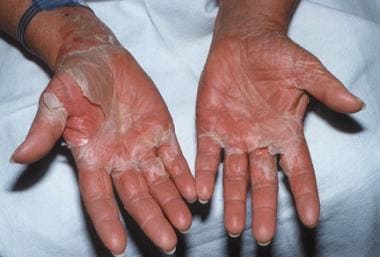 Desquamative erythroderma. Reproduced with permission from Drage, LE. Life-threatening rashes: dermatologic signs of four infectious diseases. Mayo Clin Proc. 1999;74:68-72.
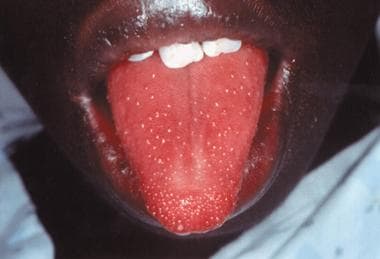 Strawberry tongue. Reproduced with permission from Drage, LE. Life-threatening rashes: dermatologic signs of four infectious diseases. Mayo Clin Proc. 1999;74:68-72.
In patients with streptococcal TSS, fever is the most common early sign, although hypothermia may be present in patients with shock. Almost 50% of patients may have normal blood pressure (systolic pressure >110 mm Hg) upon admission but develop hypotension within the subsequent 4 hours. In virtually all patients, shock is apparent at the time of admission or within 4-8 hours. A diffuse scarlatina-like erythema occurs in only 10% of patients.
Soft tissue infection occurs in 80% of patients and may progress from localized swelling and erythema to necrotizing fasciitis (see the image below) or myositis in 70% of these patients. Pain is abrupt at onset and is usually preceded by tenderness or other localized physical findings.
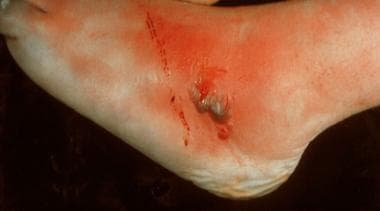 Necrotizing fasciitis. Reproduced with permission from Drage, LE. Life-threatening rashes: dermatologic signs of four infectious diseases. Mayo Clin Proc. 1999;74:68-72.
Non–soft tissue infections occur in 20% of patients and may include endophthalmitis, myositis, perihepatitis, peritonitis, and myocarditis. Confusion (55% of patients), coma, or combativeness may be noted.
Complications
Complications of staphylococcal TSS include the following:
-
Renal failure
-
Gangrenous/cyanotic extremities
-
Neuropsychiatric manifestations, such as memory loss and lack of concentration
Complications of streptococcal TSS include the following:
-
Renal dysfunction progressing or persisting in all patients for 48-72 hours despite treatment (patients may require dialysis)
-
Acute respiratory distress syndrome (ARDS) in 55% of patients
-
Death in 30% of patients
Rarely, other complications may be noted, such as myocardial failure and pulmonary edema.
Diagnosis of Pediatric TSS
Diagnostic considerations
Staphylococcal toxic shock syndrome (TSS) is defined by the following criteria:
Clinical Criteria
- Fever: temperature ≥102.0°F (38.9°C)
- Rash: diffuse macular erythroderma
- Desquamation: 1-2 weeks after onset of rash
- Hypotension: systolic blood pressure ≤90 mm Hg for adults or less than fifth percentile by age for children aged less than 16 years
- Multisystem involvement (three or more of the following organ systems):
- Gastrointestinal: vomiting or diarrhea at onset of illness
- Muscular: severe myalgia or creatine phosphokinase level at least twice the upper limit of normal
- Mucous membrane: vaginal, oropharyngeal, or conjunctival hyperemia
- Renal: blood urea nitrogen or creatinine at least twice the upper limit of normal for laboratory or urinary sediment with pyuria (greater than or equal to 5 leukocytes per high-power field) in the absence of urinary tract infection
- Hepatic: total bilirubin, alanine aminotransferase enzyme, or aspartate aminotransferase enzyme levels at least twice the upper limit of normal for laboratory
- Hematologic: platelets less than 100,000/mm3
- Central nervous system: disorientation or alterations in consciousness without focal neurologic signs when fever and hypotension are absent
Laboratory Criteria
-
Negative results of the serologic tests for Rocky Mountain spotted fever, leptospirosis, and measles are also indicated when appropriate.
The diagnosis of TSS is considered confirmed if the laboratory criteria are met and all five of the clinical criteria described above are present.
The diagnosis of TSS is considered probable if the laboratory criteria are met and four of five clinical criteria are met.
Streptococcal TSS is defined by the following criteria:
A: Isolation of group A streptococci
- From a sterile site, such as blood, cerebrospinal fluid (CSF), pleural fluid, peritoneal fluid, or a tissue biopsy specimen
- From a nonsterile body site, such as the throat, vagina, sputum, or superficial skin lesions
B: Clinical signs of severity
- Hypotension - In adults, systolic blood pressure lower than or equal to 90 mm Hg; in children, systolic blood pressure lower than the fifth percentile for age
- Clinical and abnormal laboratory test results (requires 2 or more of the following criteria):
See the list below:
-
Renal impairment: Creatinine greater than or equal to 2 mg/dL (greater than or equal to 177 µmol/L) for adults or greater than or equal to twice the upper limit of normal for age. In patients with preexisting renal disease, a greater than twofold elevation over the baseline level.
-
Coagulopathy: Platelets less than or equal to 100,000/mm3 (less than or equal to 100 x 106/L) or disseminated intravascular coagulation, defined by prolonged clotting times, low fibrinogen level, and the presence of fibrin degradation products.
-
Liver involvement: Alanine aminotransferase, aspartate aminotransferase, or total bilirubin levels greater than or equal to twice the upper limit of normal for the patient's age. In patients with preexisting liver disease, a greater than twofold increase over the baseline level.
-
Acute respiratory distress syndrome: defined by acute onset of diffuse pulmonary infiltrates and hypoxemia in the absence of cardiac failure or by evidence of diffuse capillary leak manifested by acute onset of generalized edema, or pleural or peritoneal effusions with hypoalbuminemia.
-
A generalized erythematous macular rash that may desquamate.
-
Soft-tissue necrosis, including necrotizing fasciitis or myositis, or gangrene.
The diagnosis of streptococcal TSS is definite when criteria A1, B1, and B2 are met. The diagnosis of streptococcal TSS is probable when criteria A2, B1, and B2 are met.
Note that failure to diagnose a mild case of TSS may result in legal liability.
Differentials
The differential diagnosis of pediatric TSS includes the following:
Other problems to be considered are as follows:
-
Adenovirus infection
-
Drug eruption
-
Erythema multiforme
-
Toxic epidermal necrolysis
Laboratory Studies
Microbiologic studies should be performed to recover the organisms from appropriate samples, such as blood, surgical wounds, vagina, throat, or soft tissue aspirates.
In a review of staphylococcal toxic shock syndrome (TSS) by Davis and colleagues, the frequencies of abnormal laboratory results were as follows [11] :
-
Elevated serum creatinine levels - 69%
-
Thrombocytopenia - 59%
-
Hypocalcemia - 58%
-
Azotemia - 57%
-
Hyperbilirubinemia - 54%
-
Elevated levels of hepatic enzymes - 50%
-
Leukocytosis - 48%
-
Abnormal urinary sediment - 46%
-
Elevated creatine kinase levels - 41%
-
Immature leukocytes - 36%
Abnormal laboratory findings in patients with streptococcal TSS include the following:
-
Elevated serum creatinine levels
-
Hemoglobinuria
-
Hypoalbuminemia
-
Hypocalcemia
-
Elevated creatine kinase levels (suggesting necrotizing fasciitis or myositis)
-
Leukocytosis (with increased band forms)
-
Positive blood cultures in 60% of patients
Coagulation studies should be obtained, including prothrombin time, activated partial thromboplastin time, platelet count, fibrinogen split products, and D-dimer. Appropriate serologic analysis may be necessary to evaluate other possible differential diagnoses.
Other Studies
Imaging studies
Soft tissue radiography, computed tomography (CT) scanning, or magnetic resonance imaging (MRI) may help delineate the deeper tissue involvement in patients with necrotizing fasciitis and streptococcal toxic shock syndrome (TSS).
Lumbar puncture
If central nervous system infection (eg, meningitis) is possible, lumbar puncture should be performed to sample cerebrospinal fluid for analysis and culture as appropriate.
Histologic Findings
Histopathologic findings in patients with staphylococcal toxic shock syndrome (TSS) include desquamation of vaginal and cervical mucosa, periportal hepatic inflammation, acute tubular necrosis, and the abnormal pulmonary findings of acute respiratory distress syndrome (ARDS).
Treatment of Pediatric TSS
Medical care
TSS is a potentially deadly disease requiring prompt recognition and treatment. Focused history, physical examination, and laboratory testing are important for the diagnosis and management of this disease. The goal of medical therapy is to eradicate infection and to prevent complications. Seriously ill patients may require care in the intensive care unit (ICU), including dialysis for renal failure, ventilatory support for acute respiratory distress syndrome (ARDS), and correction of coagulopathy using plasma and blood products as necessary [12] .
The treatment regimen for staphylococcal toxic shock syndrome (TSS) includes the following:
-
Aggressive fluid support with normal saline or colloids
-
Vasopressor/inotrope infusion as necessary
-
Antistaphylococcal antibiotics (nafcillin and clindamycin or vancomycin and clindamycin in patients with penicillin allergy). In view of increased prevalence of Community-acquired methicillin-resistant Staphylococcus aureus, empiric therapy of Staphylococcus aureus infections should be directed at this organism. In the absence of effective antistaphylococcal therapy, staphylococcal TSS may recur.
-
Removal of tampons, nasal packing, and other foreign objects
-
Intravenous immunoglobulin (IVIG) therapy (sporadically reported to have salutary effects; controlled trials are inconclusive)
-
Aggressive supportive care in an ICU
The treatment regimen for streptococcal TSS includes administration of normal saline or colloids. Intractable hypotension that results from diffuse capillary leaking may require large amounts of these fluids. Albumin replacement may be necessary in patients in whom albumin levels drop lower than 2 g/dL. Vasopressor/inotrope infusion should be performed as necessary. Aggressive supportive care in an ICU is needed.
Penicillin should be given in conjunction with clindamycin for antibiotic treatment. Clindamycin therapy for streptococcal TSS produces better results than penicillin alone for the following reasons:
-
Clindamycin is affected less by the growth stage of an organism than penicillin, which acts only on organisms in the growth phase and not on those in the stationary phase.
-
Clindamycin suppresses toxin production by the organism.
-
Clindamycin suppresses cytokine production by monocytes.
-
Clindamycin inhibits the synthesis of penicillin-binding proteins.
-
Clindamycin has a longer postantibiotic effect than do beta-lactam antibiotics.
Some studies have suggested a salutary effect of IVIG therapy for streptococcal TSS. In one such comparative observational study of patients treated with IVIG, the mortality rate decreased to 34%, compared with a mortality rate of 67% in historical control subjects. [13] . In a Swedish surveillance study conducted between April 2002 and December 2004 concluded that IVIG contributed to a significantly improved survival in patients with streptococcal TSS [14] .A multicenter, retrospective, cohort study suggested that use of IVIG added to the cost of hospitalization but did not improve outcomes in streptococcal TSS. [15] . There is paucity of well-designed studies on the use of Intravenous immunoglobulin (IVIG) for the treatment of TSS. The use of IVIG for its treatment remains controversial [16] . In the future, double-blind trials may further clarify the role of IGIV in streptococcal TSS. [17, 18] .
Early recognition of TSS, intensive care management, which includes the use of adjunctive therapy with intravenous immunoglobulin and clindamycin [19] . The role of hyperbaric oxygen in streptococcal TSS remains uncertain in the absence of any comparative clinical trials.
Surgical care
Prompt surgical debridement of any necrotizing skin lesion, such as may be seen in patients with necrotizing fasciitis and streptococcal TSS, is mandatory. Failure to debride necrotic tissue promptly may lead to poor outcome.
Any tampons or other implicated foreign materials present in patients with staphylococcal TSS should be removed. Failure to do so may cause legal liability.
Consultations
Appropriate consultations include an infectious diseases specialist; a surgeon, if debridement is considered; and other specialists and subspecialists, as the clinical situation dictates.
Further inpatient care
Patients with TSS should be transferred to the ICU for closer observation and aggressive therapy for hypotension and other complications. [20] Patients with ARDS may require ventilatory support. Those with severe renal failure may require dialysis.
Deterrence/prevention
Scrupulous wound care and appropriate early treatment of wounds should minimize TSS as a complication of staphylococcal and streptococcal infections. Effective antistaphylococcal therapy for staphylococcal TSS decreases recurrence.
Female patients with staphylococcal TSS should be warned against the use of tampons. Use of other intravaginal devices should be avoided in patients with TSS.
Active immunization with a TSST-1 vaccine is under investigation. In a phase II trial to assess the safety, tolerability, and immunogenicity of a recombinant detoxified toxic shock syndrome toxin-1 variant (rTSST-1v) vaccine in adult volunteers the vaccin was safe, well-tolerated, and immunogenic. [21] This is an important step in vaccine development to prevent TSS.
Prognosis of Pediatric TSS
The vast majority of patients with staphylococcal toxic shock syndrome (TSS) recover uneventfully. Since the discontinuation of hyperabsorbent tampon marketing, the mortality rate, already low, has declined from 5.6% to 3.3%. Staphylococcal toxic shock syndrome can recur, particularly in the absence of antistaphylococcal therapy and with continued use of tampons. Neuropsychiatric manifestations, such as memory loss and lack of concentration, may persist in some patients.
Compared with non-TSS septic shock, TSS has significantly lower fatality rates, disease severity, and length of hospital stay [22] . In a study of TSS, predictors of in-hospital mortality included respiratory failure (13.66 [11.37-16.43]), liver disease/failure (3.36 [2.59-4.34]), chickenpox (91.26 [27.74-300.25]), coagulopathy (2.14 [1.85-2.48]), and higher age [10] . Streptococcal TSS is associated with poorer outcomes than staphylococcal TSS. [22] The mortality rate in streptococcal TSS is 30%.
A retrospective study conducted in a pediatric intensive care unit in India reported a mortality of 27% among children admitted with TSS. The patients in the study who did not survive were more likely to have central nervous system involvement, transaminitis, thrombocytopenia, coagulopathy, and acute kidney injury and to require mechanical ventilation and blood products. [23]
-
Desquamative erythroderma. Reproduced with permission from Drage, LE. Life-threatening rashes: dermatologic signs of four infectious diseases. Mayo Clin Proc. 1999;74:68-72.
-
Necrotizing fasciitis. Reproduced with permission from Drage, LE. Life-threatening rashes: dermatologic signs of four infectious diseases. Mayo Clin Proc. 1999;74:68-72.
-
Strawberry tongue. Reproduced with permission from Drage, LE. Life-threatening rashes: dermatologic signs of four infectious diseases. Mayo Clin Proc. 1999;74:68-72.
Tables
Findings |
Staphylococcal Toxic Shock Syndrome |
Streptococcal Toxic Shock Syndrome |
Age |
15-35 y |
20-50 y |
Sex |
More common in females |
Males and females |
Local invasive disease |
Absent |
Present |
Generalized erythroderma |
Present |
Absent |
Nausea, vomiting, or diarrhea |
>90% of patients |
Uncommon |
Bacteremia |
Uncommon |
60% of patients |
Toxins implicated |
TSST-1; enterotoxins B and C |
Streptococcal pyrogenic exotoxins A and B |
Mortality rate |
3.3% |
30% |
