
Continually Updated Clinical Reference
 
 
  All Sources     eMedicine     Medscape     Drug Reference     MEDLINE
 
eMedicine - Double Outlet Right Ventricle, With Transposition : Article by

Quick Find
Authors & Editors
Introduction
Clinical
Differentials
Workup
Treatment
Medication
Follow-up
Miscellaneous
Multimedia
References

Related Articles
Truncus Arteriosus

Ventricular Septal Defect, General Concepts


Patient Education
Click here for patient education.


Author: M Silvana Horenstein, MD, Associate in Pediatric and Fetal Cardiac Diagnostic, Diagnostico Gineco-Obstetrico, PC; Associate Director, Legacy Department, Best Doctors, Inc

M Silvana Horenstein is a member of the following medical societies: American Academy of Pediatrics, American College of Cardiology, and American Medical Association

Coauthor(s): Michael L Epstein, MD, Director, Division of Pediatric Cardiology, Department of Pediatrics, Children's Hospital of Michigan; Professor, Wayne State University School of Medicine

Editors: Juan Carlos Alejos, MD, Associate Clinical Professor, Department of Pediatrics, Division of Cardiology, University of California at Los Angeles; Mary L Windle, PharmD, Adjunct Assistant Professor, University of Nebraska Medical Center College of Pharmacy, Pharmacy Editor, eMedicine.com, Inc; Julian M Stewart, MD, PhD, Director of Center for Pediatric Hypotension, Professor, Departments of Pediatrics and Physiology, Division of Pediatric Cardiology, Westchester Medical Center and New York Medical College; Gilbert Herzberg, MD, Assistant Professor, Department of Pediatrics, Section of Pediatric Cardiology, New York Medical College; Steven R Neish, MD, SM, Director of Pediatric Cardiology Fellowship Program, Department of Pediatrics, Baylor College of Medicine

Author and Editor Disclosure

Synonyms and related keywords: double outlet right ventricle with transpositions of the great arteries, DORV with TGA, Taussig-Bing deformity, ventricular septal defect, VSD

Background

Double outlet right ventricle (DORV) is a type of ventriculoarterial connection in which both the aorta (AO) and pulmonary artery (PA) arise entirely or predominantly from the right ventricle (RV). The only outlet from the left ventricle (LV) is a ventricular septal defect (VSD).
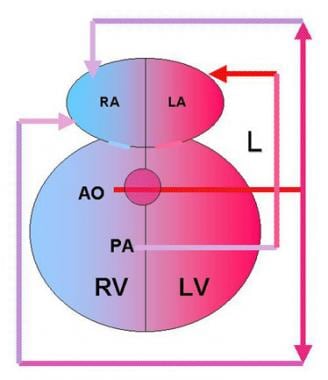
DORV is usually associated with concordant atrioventricular (AV) connections (ie, the right atrium drains into the RV and the left atrium drains into the LV). Fibrous discontinuity is present between the mitral and semilunar valves, which is referred to as subpulmonic and subaortic conus.

DORV is virtually always associated with a VSD and occasionally with an atrial septal defect. Patients with DORV may also present with varying degrees of left ventricular hypoplasia and mitral valve anomalies such as stenosis or atresia. Straddling of the AV valves across the VSD may be present. The aortic valve may be stenosed, and the aortic arch may show coarctation or even interruption. Anomalies of the coronary arteries (CA) such as those that occur in patients with dextro-transposition of the great arteries (D-TGA) may be present. These include the left circumflex arising from the right main, a single right CA, a single left CA, and inverted origin of the CA.

The AV node and His-Purkinje fibers may be displaced in DORV because of the anatomic characteristics of these hearts.

In DORV, the great arteries may take different relationships as follows:

  • In 64% of cases of DORV, the great arteries lie side by side with the AO to the right of the PA and both semilunar valves lying in the same transverse and coronal plane (physiologically similar to tetralogy of Fallot [TOF]).
  • In 26% of cases of DORV, the AO is anterior and to the right of the PA, physiologically resembling transposition of the great arteries (TGA), ie, D-TGA, with a VSD.
  • In 7% of cases of DORV, the AO is anterior and to the left of the PA (left-transposition of the great arteries [L-TGA]).
  • Only 3% of cases of DORV have a normal great artery relationship with the AO arising posterior and to the right of the PA.

Pathophysiology

The pathophysiology of DORV is variable, irrespective of the great arterial relationship (ie, side by side, D-TGA, L-TGA, normally related). Clinical manifestations may range from that of a large VSD to that of TGA and depend mostly on the position of the VSD in relation to the great vessels (whether it is subpulmonary or subaortic) and the presence or absence of pulmonary valve stenosis (PS). Both of these factors contribute substantially to the hemodynamics of this congenital heart defect.

In cases of a subaortic VSD, which occurs in 60-70% of patients, the VSD is closer to the aortic valve, thus oxygenated blood from the LV is directed to the AO and desaturated blood from the right atrium (RA) is directed primarily to the PA (see Image 1). PS occurs commonly and directs some desaturated blood into the AO. Because of the large VSD, the RV and the LV as well as the AO handle equal systolic pressures. When PS is present, this poses a restriction to flow to the pulmonary circuit, and thus, systolic pressure in the pulmonary arteries is lower. This physiology resembles that of TOF with cyanosis and no congestive heart failure (CHF).

In cases of a subaortic VSD with no PS, systolic pressure in both great vessels as well as in both ventricles is equal; thus, blood follows the path of least resistance (ie, usually towards the lungs) and the clinical picture is that of a large VSD. The degree of blood oxygenation in the systemic as well as the pulmonary circuits is determined by degree of mixing in the systemic (ie, right) ventricle, which in turn depends on the degree of resistance upstream of the pulmonary valve.

All patients with elevated pulmonary blood flow (PBF) at systemic or near systemic pressures are at increased risk of developing early pulmonary obstructive vascular disease regardless of their arterial oxygen saturation (ie, presence or absence of cyanosis).

With a subpulmonary VSD (Taussig-Bing anomaly), which occurs in 10% of patients, oxygenated blood from the LV is directed to the PA and desaturated blood from the RA is directed to the AO. This physiology resembles TGA with a VSD; thus, the patient presents with cyanosis and CHF.

In cases of a doubly committed VSD, the left ventricular outflow is not committed preferentially to either semilunar valve. In the presence of PS, the physiology resembles that of TOF, and in the absence of PS, it is that of a large VSD.

In remote VSD, the VSD is far from both semilunar valves. It is most commonly an AV canal-type VSD. Again, the physiology is that of TOF in cases involving PS and is that of a large VSD when flow through the pulmonary valve is not restricted (ie, absence of PS).

Frequency

United States

Congenital heart disease (CHD) occurs in fewer than 1% of all newborns, and DORV is present in 0.5-1.5% of all patients with CHD. The estimated frequency of DORV is 1 case per 10,000 live births.

Mortality/Morbidity

Mortality and morbidity are dependent not only on the overall clinical condition of the patient but also on the type and severity of associated anomalies.

  • Irrespective of the great vessel relationship, the mortality rate is less than 5% for simple subaortic VSD and is somewhat higher for a doubly committed VSD.
  • In cases of subpulmonary VSD (Taussig-Bing anomaly), morbidity and mortality depend on whether the patient has already developed pulmonary vascular obstructive disease and also on the type of surgery that is required. In cases of DORV with D-TGA, creation of an intraventricular tunnel between the VSD and the AO carries a mortality risk of 10-15%. In subpulmonary VSD with PS (ie, TOF-type physiology), an intraventricular tunnel between the VSD and the AO in addition to relief of PS by a patch graft also carries a mortality risk of 10-15%. In cases of remote VSD, the preferred surgical repair is creation of an interventricular tunnel between the VSD and the AO. However, it carries a mortality rate as high as 30-40%.
  • When the above surgical procedures cannot be performed (ie, hypoplastic LV, inadequate anatomy for an intracardiac conduit between the LV and the AO, hypoplastic AO, hypoplastic mitral valve), a Fontan-type operation is the choice; the mortality rate has decreased to approximately 5%.

Sex

No sex predilection is reported.

Age

Newborns usually present with this entity; however, in some circumstances such as subaortic VSD with mild-to-moderate PS, the diagnosis may not be made until later in infancy.


History

History of fetal bradycardia heart block during the first trimester of pregnancy has been associated with DORV (as opposed to autoimmune causes of fetal heart block, which occur after the second and third trimesters). Fetal heart block can be diagnosed ultrasonographically depending on the subtype of DORV (eg, with or without TGA); clinical history differs. In patients with DORV and TGA, the clinical presentation depends on the location of the VSD and the presence of PS, the degree of PS, or both.

  • If the VSD is subpulmonic, the physiology resembles that of TGA with VSD. Patients with this anatomy usually present in the newborn period or within the first few weeks of life with cyanosis and signs of pulmonary overcirculation.
  • If the VSD is subaortic, the patient may be only mildly cyanotic and may present primarily with pulmonary overcirculation at 3-6 weeks of life when pulmonary vascular resistance drops. If PS is present (which is often the case in DORV with subaortic VSD), the degree of PS greatly affects clinical presentation.
    • If PS is mild or moderate, the patient may present with mild cyanosis and little or no pulmonary overcirculation.
    • If PS is severe, clinical presentation resembles that of TOF. Cyanosis from diminished PBF is likely to be the major clinical feature.
  • In patients with DORV and TGA (both uncommon lesions), the VSD may be doubly committed or remote from the great arteries.
    • If the VSD is doubly committed, the conus septum is deficient and the VSD usually lies above the crista supraventricularis closely related to both semilunar valves. Clinical presentation is often that of DORV with a subpulmonic VSD, although the patient may have slightly higher systemic oxygen saturation.
    • In DORV with TGA and remote VSD, many variables determine clinical presentation. If the VSD is remote from both semilunar valves, it often is part of an AV canal-type defect, in which case many other anomalies are likely.
    • Alternatively, multiple muscular VSDs may be remote from the semilunar valves. Clinical presentation depends on factors such as the location of the VSDs, the presence or absence of PS (right ventricular outflow tract obstruction), and the direction of streaming of blood flow through VSDs.

Physical

Physical findings vary, depending on the location of the VSD and the presence or absence of PS.

  • With a subaortic VSD and no PS, cyanosis is mild or absent.
    • PBF is increased, thereby producing CHF.
    • The precordium is hyperactive with a loud second heart sound, which may appear to be single.
    • Harsh regurgitant systolic murmur is heard as pulmonary vascular resistance decreases.
    • Clinically, these patients resemble those with a large VSD.
  • In DORV with subaortic VSD and PS, physical findings depend on the degree of PS.
    • If PS is mild, little cyanosis and only mild CHF may be present.
    • These patients present with a murmur from PS (systolic ejection murmur), from the VSD (regurgitant murmur), or both.
    • If PS is moderate or severe, cyanosis is prominent because of decreased PBF (resembling TOF).
    • If uncorrected, cyanosis leads to late findings such as polycythemia and digital clubbing.
  • In those patients with subpulmonic VSD (PS is rare in these patients), PBF increases as vascular resistance falls.
    • These patients present similarly to those with TGA and VSD.
    • Cyanosis is prominent early, and pulmonary overcirculation develops.
    • Failure to thrive is likely to develop if treatment is not instituted.
    • The second heart sound is loud and possibly single, and a regurgitant systolic murmur develops.
    • If increased pulmonary vascular resistance occurs, signs of CHF diminish and the murmur decreases.
    • An ejection click may appear along with a diastolic murmur of pulmonary valve insufficiency (late findings).
  • Patients with doubly committed VSD also present similarly to those with TGA and VSD.
    • Cyanosis may be mild.
    • Signs of CHF, including tachypnea, tachycardia, and hepatomegaly, lead to failure to thrive.

Causes

DORV is thought to be the result of a malformation in the outlet portion of the embryonic ventricular loop during the third to fourth week post conception. Although mostly sporadic, familial cases have been reported.

  • Fluorescence in situ hybridization (FISH) analysis has shown deletions in the 22q11.2 region in certain individuals with TOF, DORV, TGA, and VSD associated with other CHD. As a matter of fact, DORV may be part of complex CHD in patients with DiGeorge, velocardiofacial, and conotruncal anomaly–face syndromes.
  • It has also been associated with trisomies 13 and 18 and tetrasomy 8p.
  • DORV has also been reported in patients with mutations in human cardiac transcription factor NKX2.5.
  • DORV and truncus arteriosus occur with a higher incidence in the offspring of mothers with diabetes mellitus than in the general population. Teratogenic mechanisms involved are obscure, although in pregnant diabetic rats, antioxidant supplementation with vitamin E reduced the severity of malformations in their offspring.
  • DORV has been reported to occur in mouse embryos homozygous for the JMJ mutation, which affects the nuclear protein jmj coded by chamber-specific genes.
  • Studies using animal models described a transcription factor that plays a critical role in directing cardiac asymmetric morphogenesis, known as Pitx2. Specifically, ectopic Pitx2c expression in the developing myocardium was found to correlate with the development of DORV. Whereas loss of function of the Pitx2 caused atrial isomerism, double inlet left ventricle, TGA, persistent truncus arteriosus, and abnormal aortic arch remodeling.
  • Most recently, hearts with persistent truncus arteriosus, DORV, and transposition of the great arteries, have been postulated to have rotation of the myocardial wall of the outflow tract that is arrested or fails to initiate.


Truncus Arteriosus
Ventricular Septal Defect, General Concepts

Other Problems to be Considered

Distinguish DORV (with or without TGA) and subaortic VSD from VSD.
PS may have a presentation similar to that of TOF.
Subpulmonary VSD without PS may have a presentation similar to that of TGA with VSD.


Lab Studies

  • Clinical laboratory studies (eg, hematologic analysis, urinalysis) are not likely to be of diagnostic help; late findings may include polycythemia, but this and other findings of chronic cyanosis are nonspecific.

Imaging Studies

  • Echocardiography is used to evaluate anatomy, hemodynamics, and function of the heart after surgical repair or palliation, and it is the most important means of establishing diagnosis of DORV with TGA. Four important findings to determine DORV are as follows:
    • Both great arteries arise from the RV.
    • AO is to the right of or anterior to the PA.
    • No course of egress of blood from the LV other than a VSD is present.
    • Discontinuity of mitral and semilunar valves is present.
    • In experienced centers, the accuracy of the prenatal echocardiographic diagnosis (and prognosis) of fetuses with conotruncal anomalies in general is good (ie, correct diagnosis in 77% of cases in a major center). However, defining the exact spatial relationship of the great arteries can be problematic in some fetuses (ie, 7 of 17 fetuses with DORV anatomy, of which 6 were thought to have a subpulmonary VSD, had incorrect prenatal assessment of the great artery relationships).
  • Some authors have described real-time 3-dimensional echocardiography as a way to improve cardiac imaging and diagnosis of complex CHD through a clear display of cardiac morphology using volumetric views combined with sequential segmental approach. However, others have recently concluded that information provided by real-time 2-dimensional echocardiography in fetuses with and without CHD were consistent with that provided by real-time 3-dimensional echocardiography. Therefore, no clear advantage of real-time 3-dimensional echocardiography over real-time 2-dimensional echocardiography has been documented.
  • Chest radiography may provide valuable clues for the diagnosis of DORV with TGA.
    • Chest radiography for patients with either subaortic or subpulmonary VSD without PS shows cardiomegaly with increased pulmonary vascular markings; the main PA segment may be prominent. These findings are not specific for DORV.
    • If PS is present, chest radiography shows a normal heart size and normal-to-decreased pulmonary vascular markings.
  • Magnetic resonance imaging (MRI) may serve as an adjunct tool to echocardiography for determination of visceral and atrial situs as vasculo-vascular and vasculo-visceral relationships. In some patients with DORV with remote VSD, MRI may aid in defining the spatial relationship between VSD and the semilunar valves. A new modality in MRI is the 3-dimensional MRI, which is increasingly used as an adjuvant to echocardiography and angiography for such purposes.
  • Angiography may add anatomic and physiologic details to information found by echocardiography.

Other Tests

  • ECG in patients with DORV with TGA shows no specific findings.
    • Usually, normal sinus rhythm and possible prolonged PR interval are present. Right axis deviation and right ventricular hypertrophy (RVH) are likely to be present.
    • In the absence of these findings, question the diagnosis or consider special circumstances such as an associated AV canal if left axis deviation is present.
    • Some ECG variations may exist depending on the variety of DORV with TGA.
      • ECG in patients with subaortic VSD with no PS may show superior QRS axis (-30° to -170°) with either RVH or biventricular hypertrophy and left atrial enlargement. First-degree AV block may be present with this lesion.
      • ECG in patients with subpulmonic VSD or in those with subaortic VSD and PS shows right axis deviation, RVH, and often right atrial enlargement.

Procedures

  • Echocardiography has mostly eliminated the need to perform cardiac catheterization in these patients; however, catheterization may still be necessary in certain circumstances. Catheterization may be required for the following reasons:
    • Need for further definition of coronary artery anatomy
    • Need to determine coexistent conditions that cannot be elucidated by echocardiography
    • Need to confirm restrictive VSD by measuring ventricular pressures
    • Need to determine pulmonary vascular resistance (and reactivity) in patients suspected of having increased resistance


Medical Care

Medical treatment depends on the clinical presentation, which is determined by the different physiology of each type of DORV.

  • In DORV with no PS, direct medical management at reducing CHF to improve the patient's condition prior to surgery. Management of CHF requires medications such as loop diuretics (eg, furosemide), potassium-sparing diuretics (eg, spironolactone), and digitalis. In addition, observe subacute bacterial endocarditis prophylaxis.
  • Infants with a subpulmonary VSD with a small or restrictive patent foramen ovale or atrial septal defect may require balloon atrial septostomy or blade atrial septostomy to improve interatrial mixing of saturated and desaturated blood and to decompress the left atrium.
  • In patients with DORV and PS with marked cyanosis and hypoxemia, initial medical management consists of increasing the fraction of inspired oxygen (FIO2), which may be up to 100%. This decreases pulmonary vascular resistance, thereby increasing the amount of blood flow in the lungs with consequent increase in overall organ oxygenation.

Surgical Care

Two surgical approaches are appropriate, depending on the degree of CHF.

  • Palliative surgery
    • As with medical treatment, this approach helps improve the patient's clinical condition, allowing him or her to gain weight to achieve optimal conditions for definitive surgical repair:
    • Infants with no PS who have a subpulmonary VSD, subaortic VSD, or doubly committed VSD and who present with CHF may undergo PA banding to decrease PBF.
    • Patients with subaortic or subpulmonary VSD with PS are cyanotic and have decreased PBF; therefore, they undergo a systemic-to-PA shunt to increase PBF.
  • Definitive surgery
    • The relationship of VSD to the great arteries and the distribution of CA determine surgical strategies:
    • Biventricular repair can be achieved in most patients with DORV. If biventricular repair is not feasible (eg, in straddling or abnormal distribution of chordae tendineae of AV valves and/or severe underdevelopment of LV), a Fontan-type operation is an option with redirection of systemic (deoxygenated) blood into the PA without traversing a ventricle.
    • Several surgical approaches are appropriate in subpulmonary VSD; surgery is usually completed by age 3-4 months to avoid development of increased pulmonary vascular resistance. The surgical approach with the lower mortality rate of approximately 10-15% is the arterial switch operation with creation of an interventricular tunnel directing LV outflow into the PA, which becomes a neo-AO by virtue of the switch.
    • If the VSD is subaortic or doubly committed, the optimal approach is to create a tunnel between the VSD and the AO to direct oxygenated blood into systemic circulation and also to eliminate mixing of the 2 circulations. Timing for this surgery depends on the size and clinical condition of the patient, but it is generally completed by age 4-6 months.
  • Heart transplantation: If the anatomy of associated lesions is too complex to consider an anatomic repair or if a repair results in unsatisfactory hemodynamics and intractable symptoms, consider heart transplantation. In a recent report from the Children's Hospital of Pittsburgh, 15.4% of patients undergoing transplant were born with some form of DORV. These patients require lifelong immunosuppression and close follow-up care.

Consultations

As with any other form of CHD, parents of patients born with DORV and TGA may meet with a geneticist to discuss the possibility of subsequent children having this or other forms of CHD. When CHD is detected, a detailed investigation should be done on extracardiac malformation and vice versa. Also, issues such as preterm birth and stillbirth should be taken into account in risk assessment and risk stratification in patients born with CHD.

  • CHD belongs to the spectrum of birth defects and, despite technological advances, it contributes significantly to infant mortality. Because extracardiac anomalies occur in 15-45% of patients with CHD, these should always be investigated.
  • According to a recent study, the most prevalent extracardiac anomalies in general are the craniofacial malformations. However, the most prevalent associated with conotruncal heart defects are anomalies of the gastrointestinal and genitourinary systems. Specifically, DORV may be associated with omphalocele, gastroschisis, facial clefting, and CHARGE (coloboma, heart disease, atresia choanae, retarded growth and retarded development and/or CNS anomalies, genital hypoplasia, and ear anomalies and/or deafness) syndrome.
  • Preterm infants have been shown to have more than twice as many cardiovascular malformations as do term infants, and 16% of all infants with cardiovascular malformations are preterm.
  • Prevalence of CHD is high among late stillbirths. In particular, a greater incidence of coarctation of the aorta, double-inlet left ventricle, hypoplastic left heart, truncus arteriosus, DORV, and atrioventricular septal defect is noted among stillbirths.

Activity

  • Patients with DORV and TGA have no specific activity restrictions; their physiology may limit their exercise tolerance. After surgical intervention, some restrictions may be required depending on the hemodynamic result; however, these patients can usually participate in all age-appropriate activities.
  • Lifelong antibiotic prophylaxis is necessary prior to any potentially contaminated procedure, especially dental work.


Medical therapy is aimed at alleviating CHF, when present, to prepare patients for surgery. Antibiotics for endocarditis prophylaxis are required before performing procedures that may cause bacteremia. For more information, see Antibiotic Prophylactic Regimens for Endocarditis.

Drug Category: Loop diuretics

Furosemide is used to decrease pulmonary congestion in patients with pulmonary overcirculation.

Drug NameFurosemide (Lasix)
DescriptionInhibits absorption of sodium and chloride in proximal and distal tubules of the loop of Henle, thereby promoting excretion of salt and water.
Adult Dose20-80 mg/d PO/IV divided q6-12h; not to exceed 600 mg/d
Pediatric Dose0.5-2 mg/kg/dose PO/IV/IM q8-24h; not to exceed 6 mg/kg/d PO or 2 mg/kg/dose IV
ContraindicationsDocumented hypersensitivity; hepatic coma; anuria; severe electrolyte depletion
InteractionsAntagonizes muscle-relaxing effect of tubocurarine; auditory toxicity appears to be increased with coadministration of aminoglycosides and furosemide; hearing loss of varying degrees may occur; anticoagulant activity of warfarin may be enhanced when taken concurrently with this medication; increased plasma lithium levels and toxicity are possible when taken concurrently with this medication
PregnancyC - Safety for use during pregnancy has not been established.
PrecautionsMay be ototoxic in patients with oliguria; may cause electrolyte imbalance with hypokalemic-hypochloremic metabolic alkalosis, hyponatremia, hypomagnesemia, and hypocalcemia; prolonged use in premature infants may precipitate nephrocalcinosis from hypercalciuria; these effects can be avoided by concomitant use of potassium-sparing diuretics (eg, spironolactone)

Drug Category: Potassium-sparing diuretics

Potassium-sparing diuretics (eg, spironolactone) are weak diuretics usually prescribed with more potent loop diuretics to prevent potassium depletion with subsequent development of hypokalemic-hypochloremic metabolic alkalosis.

Drug NameSpironolactone (Aldactone)
DescriptionInhibits aldosterone-dependent sodium-potassium exchanger in distal convoluted renal tubule, thereby retaining potassium and promoting excretion of sodium and water.
Adult Dose25-100 mg/d PO divided bid/qid; not to exceed 200 mg/d
Pediatric Dose1-3.3 mg/kg/d PO divided bid/qid; not to exceed 200 mg/d
ContraindicationsDocumented hypersensitivity; anuria; renal failure; hyperkalemia
InteractionsMay potentiate antihypertensive drugs; may provoke severe hyperkalemia when administered with ACE inhibitors or indomethacin; increases half-life of digoxin, thereby augmenting its risk of toxicity
PregnancyD - Unsafe in pregnancy
PrecautionsMay cause mild metabolic acidosis, GI distress, rashes, and gynecomastia; few cases of agranulocytosis have been reported; caution in renal and hepatic impairment

Drug Category: Inotropic agents

Positive inotropic agents increase the force of contraction of the myocardium and are used to treat acute and chronic CHF. Some may also increase or decrease the heart rate (ie, positive or negative chronotropic agents), provide vasodilatation, or improve myocardial relaxation. These additional properties influence the choice of drug for specific circumstances. Those used predominantly for their inotropic effects include cardiac glycosides. Digitalis glycosides are used for their inotropic properties in the presence of left ventricular failure.

Drug NameDigoxin (Lanoxin, Lanoxicaps)
DescriptionDigitalis glycoside. Enhances myocardial contractility by inhibition of Na+/K+ ATPase, a cell membrane enzyme that extrudes Na and brings K into the myocyte. Resulting increase in intracellular Na stimulates Na-Ca exchanger in the cell membrane, which extrudes Na and brings in Ca, therefore increasing contractility of myocyte (ie, positive inotropic effect).
Adult DoseDigitalizing dose:
PO: 10-15 mcg/kg/d divided tid for 3 doses (typically 0.75-1.5 mg total dose)
IV/IM: 8-12 mcg/kg/d divided tid for 3 doses (typically 0.5-1 mg total dose)
Maintenance dose:
PO: 2.5-5 mcg/kg/d (typically 0.125-0.5 mg/d)
IV/IM: 2-3 mcg/kg/d (typically 0.1-0.4 mg/d)
Pediatric DoseTotal digitalizing dose (TDD):
Premature infants: 0.02 mg/kg PO divided q8h for 3 doses
Full-term infants: 0.03 mg/kg PO divided q8h for 3 doses
1-24 months: 0.04-0.05 mg/kg PO divided q8h for 3 doses
>24 months: 0.03-0.04 mg/kg PO divided q8h for 3 doses
Maintenance dose:
Infants: 6-8 mcg/kg/d PO divided bid
2-5 years: 10-15 mcg/kg/d PO divided bid
5-10 years: 7-10 mcg/kg/d PO divided bid
>10 years: 3-5 mcg/kg/d PO
Therapeutic concentration: 0.8-2 ng/mL
ContraindicationsDocumented hypersensitivity; beriberi heart disease; idiopathic hypertrophic subaortic stenosis; constrictive pericarditis; carotid sinus syndrome
InteractionsIV calcium may produce arrhythmias in digitalized patients; medications that may increase digoxin levels include alprazolam, benzodiazepines, bepridil, captopril, cyclosporine, propafenone, propantheline, quinidine, diltiazem, aminoglycosides, PO amiodarone, anticholinergics, diphenoxylate, erythromycin, felodipine, flecainide, hydroxychloroquine, itraconazole, nifedipine, omeprazole, quinine, ibuprofen, indomethacin, esmolol, tetracycline, tolbutamide, and verapamil; medications that may decrease serum digoxin levels include aminoglutethimide, antihistamines, cholestyramine, neomycin, penicillamine, aminoglycosides, PO colestipol, hydantoins, hypoglycemic agents, antineoplastic treatment combinations (including carmustine, bleomycin, methotrexate, cytarabine, doxorubicin, cyclophosphamide, vincristine, and procarbazine), aluminum- or magnesium-containing antacids, rifampin, sucralfate, sulfasalazine, barbiturates, kaolin/pectin, and aminosalicylic acid
PregnancyC - Safety for use during pregnancy has not been established.
PrecautionsSymptoms of digitalis intoxication include changes in cardiac rhythm, especially induction of ectopic pacemakers and impaired conduction (eg, complete heart block), GI symptoms (eg, anorexia, nausea, emesis), and other symptoms (eg, fatigue, weakness, blurred vision, aberrations of color vision, headache, somnolence, disorientation, seizures); patients with deceased renal function and those with hypokalemia, hypomagnesemia, and hypercalcemia may reach toxic levels at lower doses; in patients with Wolff-Parkinson-White syndrome who develop atrial flutter or fibrillation, treatment with digoxin rarely may provoke ventricular fibrillation by increasing antegrade conduction through accessory pathway; if cardioversion or calcium infusion is required, administer lidocaine first to avoid possibility of ventricular fibrillation


Further Inpatient Care

  • Maintain patency of the ductus arteriosus with prostaglandin E1 in newborns with markedly diminished PBF from severe PS. In newborns with DORV and TGA who have subpulmonic VSD, performing balloon atrial septostomy to enhance mixing of systemic and pulmonary circulations until surgery can be performed may be necessary.

Further Outpatient Care

  • Provide follow-up care every 6-12 months for the first few years after surgery to detect complications of surgery that may include arrhythmias (eg, persistent atrial tachycardias, complex ventricular ectopy) and stenosis or partial obstruction, or both, of the interventricular tunnel.
    • Because arrhythmias result in morbidity, mortality, or both, patients may require long-term antiarrhythmic medication or may be candidates for radiofrequency ablation of an arrhythmogenic focus or circuit.
    • Interventricular tunnel obstructions may occur without clinical manifestations. In patients with severe left ventricular outflow obstruction, patients with tunnel obstruction may present with left ventricular failure. As many as 20% of patients who have undergone surgery for DORV require reoperation.
    • In all patients, subacute bacterial endocarditis prophylaxis is required.

Transfer

  • Because surgery in these patients often is technically demanding, strongly consider referring these patients to a center with a large pediatric cardiac surgical program.

Prognosis

  • Improvement in surgical techniques in recent years has resulted in good outcomes for most patients born with CHD. Prognosis for infants born with DORV and TGA generally is good, although it is dependent on specific anatomy. For example, patients with DORV and TGA with a subaortic VSD and no other anatomic abnormalities (eg, left ventricular hypoplasia) are likely to do well after surgery. Patients with restrictive VSD may not do as well because this is a particularly difficult problem. Enlargement of VSD is difficult and likely to result in complications, such as conduction abnormalities (AV block).

Patient Education

  • For excellent patient education materials, please refer to eMedicine's Heart Center. All these materials may be printed free of charge.


Medical/Legal Pitfalls

  • Medicolegal pitfalls in caring for patients with DORV and TGA are similar to those for any patient with CHD.
  • Failure to make the correct diagnosis is of paramount importance. The correct treatment plan can be determined only if all anatomic details are known. Misdiagnosis can lead to inappropriate care.
  • The second issue is surgery. Because most of these patients do well when care is administered at a center with considerable experience in caring for infants with CHD, referral to such a center provides the best opportunity for a good long-term outcome.
  • The physician must be familiar with the possible complications that may result from surgery and be able to treat complications resulting from surgery appropriately.

Special Concerns

  • Subaortic or subpulmonary VSD without PS: If left unrepaired, these infants develop CHF from pulmonary overcirculation, which evolves into pulmonary vascular obstructive disease.
  • Subaortic or subpulmonary VSD with PS: If left untreated, complications develop, including cyanosis (leading to polycythemia), which can lead to stroke.


Media file 1:  Double outlet right ventricle (DORV) with transposition of the great arteries accounts for 26% of cases of DORV. The aorta (AO) is anterior and to the right of the pulmonary artery (PA), and both arteries arise from the right ventricle (RV). The only outflow from the left ventricle (LV) is a ventricular septal defect (VSD), which diverts blood toward the RV. Pulmonary veins drain into the left atrium (LA) after blood has been oxygenated in the lungs (L). Systemic venous return is to the right atrium (RA).
Click to see larger pictureClick to see detailView Full Size Image
Media type:  Image

Media file 2:  This is an angiogram obtained during catheterization of a patient with double outlet right ventricle (DORV) with transposition of the great arteries. Injection of contrast though the catheter (arrow) into the left ventricle (LV) shows that blood is directed toward the right ventricle (RV) through a remote or doubly committed ventricular septal defect (VSD). The aorta (AO) is anterior to the pulmonary artery (PA) and both clearly arise from the RV.
Click to see larger pictureClick to see detailView Full Size Image
Media type:  X-RAY

Media file 3:  This is an angiogram obtained during catheterization of a patient with double outlet right ventricle (DORV) with transposition of the great arteries (see Image 2). Blood fills the aorta (AO) and pulmonary artery (PA) almost simultaneously, which is another indicator of a remote or doubly committed ventricular septal defect (VSD) (curved arrow). LV indicates the left ventricle, RV indicates the right ventricle, and the small arrow to the left indicates the catheter.

Click to see larger pictureClick to see detailView Full Size Image
Media type:  X-RAY


  • Bajolle F, Zaffran S, Kelly RG, et al. Rotation of the myocardial wall of the outflow tract is implicated in the normal positioning of the great arteries. Circ Res. Feb 17 2006;98(3):421-8. [Medline].
  • Baschat AA, Gembruch U, Knopfle G, Hansmann M. First-trimester fetal heart block: a marker for cardiac anomaly. Ultrasound Obstet Gynecol. Nov 1999;14(5):311-4. [Medline].
  • Beekmana RP, Roest AA, Helbing WA, et al. Spin echo MRI in the evaluation of hearts with a double outlet right ventricle: usefulness and limitations. Magn Reson Imaging. Apr 2000;18(3):245-53. [Medline].
  • Benito Bartolome F, Sanchez Fernandez-Bernal C, Torres Feced V. [Catheter ablation of accessory pathways in patients with congenital cardiopathies]. Rev Esp Cardiol. Nov 1999;52(11):1028-31. [Medline].
  • Black MD, Shukla V, Freedom RM. Direct neonatal ventriculo-arterial connections (REV): early results and future implications. Ann Thorac Surg. Apr 1999;67(4):1137-41. [Medline].
  • Blume ED, Altmann K, Mayer JE, et al. Evolution of risk factors influencing early mortality of the arterial switch operation. J Am Coll Cardiol. May 1999;33(6):1702-9. [Medline].
  • Bosi G, Scorrano M, Tosato G, et al. The Italian Multicentric Study on Epidemiology of Congenital Heart Disease: first step of the analysis. Working Party of the Italian Society of Pediatric Cardiology. Cardiol Young. May 1999;9(3):291-9. [Medline].
  • Breymann T, Boethig D, Goerg R, Thies WR. The Contegra bovine valved jugular vein conduit for pediatric RVOT reconstruction: 4 years experience with 108 patients. J Card Surg. Sep-Oct 2004;19(5):426-31. [Medline].
  • Casaldaliga J, Girona JM, Sanchez C, et al. [Doppler echocardiography in the postoperative assessment of the arterial switch in the repair of transposition of the great arteries and double outlet right ventricle]. Rev Esp Cardiol. Feb 1996;49(2):117-23. [Medline].
  • Casta AR, Jonas RA, Mayer JE. Double-Outlet Right Ventricle. In: Cardiac Surgery of the Neonate and Infant. Philadelphia, Pa:. WB Saunders Co;1994:445-459.
  • Chaoui R, Korner H, Bommer C, et al. [Prenatal diagnosis of heart defects and associated chromosomal aberrations]. Ultraschall Med. Oct 1999;20(5):177-84. [Medline].
  • Chen GZ, Huang GY, Liang XC, et al. Methodological study on real-time three-dimensional echo-cardiography and its application in the diagnosis of complex congenital heart disease. Chin Med J (Engl). Jul 20 2006;119(14):1190-4. [Medline].
  • Dearani JA, Danielson GK, Puga FJ, et al. Late follow-up of 1095 patients undergoing operation for complex congenital heart disease utilizing pulmonary ventricle to pulmonary artery conduits. Ann Thorac Surg. Feb 2003;75(2):399-410; discussion 410-1. [Medline].
  • Derbent M, Yilmaz Z, Baltaci V, et al. Chromosome 22q11.2 deletion and phenotypic features in 30 patients with conotruncal heart defects. Am J Med Genet A. Jan 15 2003;116(2):129-35. [Medline].
  • Devine WA, Webber SA, Anderson RH. Congenitally malformed hearts from a population of children undergoing cardiac transplantation: comments on sequential segmental analysis and dissection. Pediatr Dev Pathol. Mar-Apr 2000;3(2):140-54. [Medline].
  • Digilio MC, Marino B, Ammirati A, et al. Cardiac malformations in patients with oral-facial-skeletal syndromes: clinical similarities with heterotaxia. Am J Med Genet. Jun 4 1999;84(4):350-6. [Medline].
  • Donnelly LF, Higgins CB. MR imaging of conotruncal abnormalities. AJR Am J Roentgenol. Apr 1996;166(4):925-8. [Medline].
  • Franco D, Campione M. The role of Pitx2 during cardiac development. Linking left-right signaling and congenital heart diseases. Trends Cardiovasc Med. May 2003;13(4):157-63. [Medline].
  • Gober V, Berdat P, Pavlovic M, et al. Adverse mid-term outcome following RVOT reconstruction using the Contegra valved bovine jugular vein. Ann Thorac Surg. Feb 2005;79(2):625-31. [Medline].
  • Goldmuntz E, Clark BJ, Mitchell LE, et al. Frequency of 22q11 deletions in patients with conotruncal defects. J Am Coll Cardiol. Aug 1998;32(2):492-8. [Medline].
  • Goncalves LF, Nien JK, Espinoza J, et al. What does 2-dimensional imaging add to 3- and 4-dimensional obstetric ultrasonography?. J Ultrasound Med. Jun 2006;25(6):691-9. [Medline][Full Text].
  • Gucer S, Ince T, Kale G, et al. Noncardiac malformations in congenital heart disease: a retrospective analysis of 305 pediatric autopsies. Turk J Pediatr. Apr-Jun 2005;47(2):159-66. [Medline].
  • Haas F, Wottke M, Poppert H, Meisner H. Long-term survival and functional follow-up in patients after the arterial switch operation. Ann Thorac Surg. Nov 1999;68(5):1692-7. [Medline].
  • Hagler DJ. Double-Outlet Right Ventricle. In: Heart Disease in Infants, Children, and Adolescents: Including the Fetus and Young Adult. Vol 2. Baltimore, Md:. Williams and Wilkins;1995:1246-1270.
  • Kleinert S, Sano T, Weintraub RG, et al. Anatomic features and surgical strategies in double-outlet right ventricle. Circulation. Aug 19 1997;96(4):1233-9. [Medline].
  • Lee Y, Song AJ, Baker R, et al. Jumonji, a nuclear protein that is necessary for normal heart development. Circ Res. May 12 2000;86(9):932-8. [Medline][Full Text].
  • Napoleone RM, Varela M, Andersson HC. Complex congenital heart malformations in mosaic tetrasomy 8p: case report and review of the literature. Am J Med Genet. Dec 19 1997;73(3):330-3. [Medline].
  • Niezen RA, Beekman RP, Helbing WA, et al. Double outlet right ventricle assessed with magnetic resonance imaging. Int J Card Imaging. Aug 1999;15(4):323-9. [Medline].
  • Ohuchi H, Hiraumi Y, Tasato H, et al. Comparison of the right and left ventricle as a systemic ventricle during exercise in patients with congenital heart disease. Am Heart J. Jun 1999;137(6):1185-94. [Medline].
  • Pretre R, Ye Q, Fasnacht M, et al. Recent experience with the arterial switch operation in transposition of the great arteries. Schweiz Med Wochenschr. Oct 9 1999;129(40):1443-9. [Medline].
  • Reddy VM, Hanley FL. Cardiac surgery in infants with very low birth weight. Semin Pediatr Surg. May 2000;9(2):91-5. [Medline].
  • Scalzo G, Cavallaro A, Pulvirenti A, et al. [Physiopathologic findings and surgical treatment in transposition of great vessels: our experience]. Pediatr Med Chir. Nov-Dec 1998;20(6):377-80. [Medline].
  • Sergi C, Serpi M, Muller-Navia J, et al. CATCH 22 syndrome: report of 7 infants with follow-up data and review of the recent advancements in the genetic knowledge of the locus 22q11. Pathologica. Jun 1999;91(3):166-72. [Medline].
  • Serraf A, Nakamura T, Lacour-Gayet F, et al. Surgical approaches for double-outlet right ventricle or transposition of the great arteries associated with straddling atrioventricular valves. J Thorac Cardiovasc Surg. Mar 1996;111(3):527-35. [Medline].
  • Silka MJ. Double-Outlet Ventricles. In: The Science and Practice of Pediatric Cardiology. Vol 2. Baltimore, Md:. Williams & Wilkins;1997:1505-1523.
  • Siman CM, Gittenberger-De Groot AC, Wisse B, Eriksson UJ. Malformations in offspring of diabetic rats: morphometric analysis of neural crest-derived organs and effects of maternal vitamin E treatment. Teratology. May 2000;61(5):355-67. [Medline].
  • Sivanandam S, Glickstein JS, Printz BF, et al. Prenatal diagnosis of conotruncal malformations: diagnostic accuracy, outcome, chromosomal abnormalities, and extracardiac anomalies. Am J Perinatol. May 2006;23(4):241-5. [Medline].
  • Smith RS, Comstock CH, Kirk JS, et al. Double-outlet right ventricle: an antenatal diagnostic dilemma. Ultrasound Obstet Gynecol. Nov 1999;14(5):315-9. [Medline].
  • Snider AR. Abnormalities of Ventriculoarterial Connection. In: Echocardiography in Pediatric Heart Disease. St. Louis, Mo. Mosby-Year Book;1997:323-342.
  • Sorensen TS, Korperich H, Greil GF, et al. Operator-independent isotropic three-dimensional magnetic resonance imaging for morphology in congenital heart disease: a validation study. Circulation. Jul 13 2004;110(2):163-9. [Medline][Full Text].
  • Tanner K, Sabrine N, Wren C. Cardiovascular malformations among preterm infants. Pediatrics. Dec 2005;116(6):e833-8. [Medline].
  • Tchervenkov CI, Tahta SA, Cecere R, Beland MJ. Single-stage arterial switch with aortic arch enlargement for transposition complexes with aortic arch obstruction. Ann Thorac Surg. Dec 1997;64(6):1776-81. [Medline].
  • Tometzki AJ, Suda K, Kohl T, et al. Accuracy of prenatal echocardiographic diagnosis and prognosis of fetuses with conotruncal anomalies. J Am Coll Cardiol. May 1999;33(6):1696-701. [Medline].
  • Walters HL, Pacifico AD. Double Outlet Ventricles. In: Mavroudis C, Backer CL, eds. Pediatric Cardiac Surgery. 3rd ed. Stamford, Conn:. Appleton & Lange;1994:305-338.
  • Walters HL 3rd, Mavroudis C, Tchervenkov CI, et al. Congenital Heart Surgery Nomenclature and Database Project: double outlet right ventricle. Ann Thorac Surg. Apr 2000;69(4 Suppl):S249-63. [Medline].
  • Yoo SJ, Kim YM, Choe YH. Magnetic resonance imaging of complex congenital heart disease. Int J Card Imaging. Apr 1999;15(2):151-60. [Medline].

Double Outlet Right Ventricle, With Transposition excerpt

Article Last Updated: Aug 25, 2006
