Continually Updated Clinical Reference
 
 
  All Sources     eMedicine     Medscape     Drug Reference     MEDLINE
 
eMedicine - Duodenal Atresia : Article by

Quick Find
Authors & Editors
Introduction
Indications
Relevant Anatomy
Contraindications
Workup
Treatment
Complications
Outcome and Prognosis
Future and Controversies
Multimedia
References


Patient Education
Click here for patient education.


Author: Casey M Calkins, MD, Assistant Professor of Surgery, Division of Pediatric Surgery, Department of Pediatric Surgery, Medical College of Wisconsin; Consulting Staff, Children's Hospital of Wisconsin

Casey M Calkins is a member of the following medical societies: American Academy of Pediatrics, American College of Surgeons, and American Pediatric Surgical Association

Coauthor(s): Frederick Karrer, MD, Division Head, Pediatric Surgery, Professor of Surgery, Departments of Surgery, University of Colorado and The Children's Hospital, Denver Colorado

Editors: Jayant Deodhar, MD, Associate Professor in Pediatrics, BJ Medical College, India; Honorary Consultant, Departments of Pediatrics and Neonatology, King Edward Memorial Hospital, India; Mary L Windle, PharmD, Adjunct Assistant Professor, University of Nebraska Medical Center College of Pharmacy, Pharmacy Editor, eMedicine.com, Inc; David Piccoli, MD, Chief, Division of Gastroenterology and Nutrition, Department of Pediatrics, The Children's Hospital of Philadelphia; Professor, University of Pennsylvania School of Medicine; Steven M Schwarz, MD, FAAP, FACN, AGAF, Professor of Pediatrics, State University of New York, Downstate Medical Center College of Medicine; Distinguished Lecturer, New York Medical College, School of Public Health; Carmen Cuffari, MD, Associate Professor, Department of Pediatrics, Division of Gastroenterology/Nutrition, Johns Hopkins University School of Medicine

Author and Editor Disclosure

Synonyms and related keywords: duodenal atresia, duodenal obstruction, duodenal abnormalities, intrinsic duodenal obstruction, duodenal stenosis

Relatively speaking, congenital duodenal atresia is one of the more common intestinal anomalies treated by pediatric surgeons, occurring 1 in 2500-5000 live births. In approximately 40% of cases, the anomaly is encountered in an infant with trisomy 21 (Down syndrome). The definitive intervention to correct the anomaly is surgical and consists of duodenoduodenostomy in the newborn period.

History of the Procedure

Calder published the first report of duodenal obstruction in 1733 when he described 2 children with "preternatural confirmation of the guts." Both infants died, as did subsequently reported infants with this defect. Scattered reports of duodenal obstruction appeared in the European literature over ensuing years. In 1916, the first survivor was reported, yet survival in the early 20th century remained rare. Morbidity and mortality significantly improved only over the last 50 years. Because of progress in pediatric anesthesia, neonatology, and surgical techniques, survival is about 90% in infants who present with this anomaly. The standard operative procedure today consists of duodenoduodenostomy via a right upper quadrant incision, although recent advancements have enabled some surgeons to repair the defect by minimally invasive means (laparoscopically).

Problem

Differential diagnosis of neonatal upper gastrointestinal obstruction includes the following:

  • Esophageal atresia
  • Malrotation with midgut volvulus
  • Pyloric stenosis
  • Duodenal atresia and stenosis
  • Annular pancreas
  • Preduodenal portal vein
  • Any intestinal atresia
  • Duodenal duplication
  • Foreign body obstruction
  • Hirschsprung disease
  • Gastroesophageal reflux

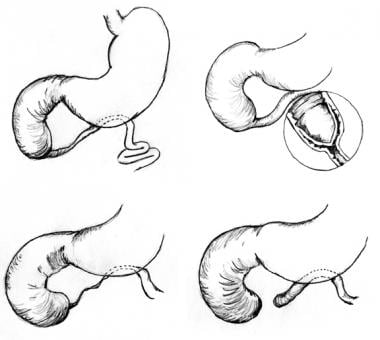
Duodenal obstruction may be complete (see Image 1) or incomplete (see Image 2). Duodenal atresia is an example of complete intrinsic obstruction. Duodenal stenosis is an example of an incomplete intrinsic abnormality; however, duodenal extrinsic stenosis can occur in association with malrotation or a preduodenal portal vein. Strictly speaking, annular pancreas does not cause an extrinsic duodenal obstruction because the duodenum within the collar of an annular pancreas is intrinsically narrowed.

Duodenal atresia can take many forms, but proximal and distal intestinal segments always end blindly. The intestine on either side of the defect may be in apposition (type 1), separated by a fibrous cord (type 2), or gap (type 3). Regardless of atresia severity, the proximal intestinal segment is typically dilated and the distal segment empty; these are hallmarks of duodenal atresia. While obstruction may occur anywhere within the duodenum, it occurs most frequently in the vicinity of the ampulla of Vater.

Stenosis may manifest as a stricture or a perforated diaphragm. The perforation within the diaphragm usually is singular and centrally located, although variations have been reported. A windsock abnormality is a thin diaphragm that has ballooned distally as a result of peristalsis. Together, both duodenal atresia and stenosis comprise a frequent cause of intestinal obstruction in the newborn.

Frequency

Reported incidence rates range from 1:2,500 to 1:40,000 live births; published US and international rates do not appear to differ. Duodenal atresia is not usually regarded as a familial condition despite isolated reports of this condition in multiple siblings.

Etiology

While the underlying cause of duodenal atresia remains unknown, its pathophysiology has been well described. Frequent association of duodenal atresia or stenosis with other neonatal malformations suggests both anomalies are due to a development error in the early period of gestation. Duodenal atresia differs from other atresias of the small and large bowel, which are isolated anomalies caused by mesenteric vascular accidents during later stages of development. No predisposing maternal risk factors are known. While one third of patients with duodenal atresia have Down syndrome (trisomy 21), it is not an independent risk factor for developing duodenal atresia.

Pathophysiology

Duodenal maldevelopment occurs secondary to either inadequate endodermal proliferation (gut elongation outpaces proliferation) or failure of the epithelial solid cord to recanalize (failure of vacuolization). Recanalization of the common duct frequently appears with 2 lumina and openings into the duodenum with 2 orifices. These 2 major canals create a narrow segment of the duodenum, and this narrow zone is the area of the duodenum that is most prone to incomplete recanalization and atresia formation.

Multiple investigators have demonstrated that the epithelium of the duodenum proliferates during 30-60 days of gestation, completely plugging the duodenal lumen. A subsequent process termed vacuolation occurs whereby the solid duodenum is recanalized. Vacuolation is believed to occur by way of apoptosis, or programmed cell death, that occurs during normal development within the lumen of the duodenum. Occasionally, duodenal atresia is associated with annular pancreas—pancreatic tissue that surrounds the entire circumference of the duodenum. This is likely due to failure of duodenal development rather than robust and/or abnormal growth of the pancreatic buds.

At the cellular level, the gastrointestinal tract develops from the embryonic gut, which is composed of an epithelium derived from endoderm, surrounded by cells of mesodermal origin. Cell signaling between these two embryonic layers appears to play a critical role in coordinating patterning and organogenesis of the duodenum. Sonic hedgehog genes encode members of the Hedgehog family of cell signals. Both are expressed in gut endoderm, whereas target genes are expressed in discrete layers in the mesoderm. Mice with genetically altered sonic hedgehog signaling display duodenal stenosis, which suggests that genetic defects in the sonic hedgehog family of genes may influence the development of duodenal abnormalities.

Clinical

Duodenal atresia is a disease of newborn infants. Cases of duodenal stenosis or perforated duodenal web (diaphragm) rarely remain undiagnosed until childhood or adulthood; these cases represent the exception rather than the rule. Duodenal atresia appears to be equally distributed between infants of both sexes, with no reported predilection for one race.

The use of modern ultrasonography has allowed infants with duodenal obstruction to be identified prenatally. In a large cohort study of 18 different congenital malformation registries from 11 European countries, 52% of infants with duodenal obstruction were identified in utero. Duodenal obstruction is characterized by a "double-bubble" sign on prenatal sonogram. The first bubble corresponds to the stomach and the second to the postpyloric and prestenotic dilated duodenal loop. Prenatal diagnosis allows the mother the opportunity to receive prenatal counseling and to consider delivery at or near a tertiary care facility that is able to care for infants with gastrointestinal anomalies.

Presenting symptoms and signs are the result of high intestinal obstruction. Duodenal atresia is typically characterized by onset of vomiting within hours of birth. While vomitus is most often bilious, it may be nonbilious because 15% of defects occur proximal to the ampulla of Vater. Some infants with duodenal stenosis escape detection of an abnormality and proceed into childhood or, rarely, into adulthood before a partial obstruction is noted. Nevertheless, one should assume any child with bilious vomiting has a proximal gastrointestinal obstruction until proven otherwise, and further workup should be begun expeditiously.

Once delivered, an infant with duodenal atresia typically has a scaphoid abdomen. One may occasionally note epigastric fullness from dilation of the stomach and proximal duodenum. Passing meconium within the first 24 hours of life is not usually altered. Dehydration, weight loss, and electrolyte imbalance soon follow unless fluid and electrolyte losses are adequately replaced. If intravenous (IV) hydration is not begun, a hypokalemic/hypochloremic metabolic alkalosis with paradoxical aciduria develops, as with other high gastrointestinal obstruction. An orogastric (OG) feeding tube in an infant with suspected duodenal obstruction typically yields a significant amount of bile-stained fluid.


Although duodenal atresia is a surgically treated disease, operating on an infant with duodenal obstruction in the middle of the night is unnecessary. Only 2 limitations apply to timing the repair: stabilization of the fluid and electrolyte balance and exclusion of overwhelming defects that would preclude use of a general anesthetic (ie, complex congenital heart disease). Correction can begin any time after these issues are addressed and optimized.


Relevant anatomy of these defects is addressed in Problem.


Contraindications to immediate repair include electrolyte or fluid balance disturbances; severe cardiac defects, which should be repaired prior to addressing the duodenal abnormality; and severe respiratory insufficiency that would preclude a safe operation. Infants can be maintained on OG suction and intravenous nutrition with aggressive repletion of fluid and electrolyte losses while these life-threatening issues are addressed.


Lab Studies

  • Serum electrolytes
    • Once delivered, neonates must be resuscitated well and electrolyte disturbances must be corrected prior to repair of duodenal atresia.
    • If duodenal atresia is diagnosed early, electrolyte and fluid balance should be normal. If the diagnosis is delayed at all, laboratory assessment of electrolyte and fluid status is imperative for an infant with duodenal atresia. As noted, prolonged vomiting can result in a hypokalemic/hypochloremic metabolic alkalosis with paradoxical aciduria.
    • Obtain blood to measure serum electrolytes in order to confirm electrolyte status to prepare for adequate resuscitation.
  • Urinalysis
    • Urine specific gravity can serve as a reliable indicator of fluid status.
    • Fluid status can also be adequately assessed by urine output, mucous membrane examination, and fontanelle character.
  • Chromosome analysis: When trisomy 21 is suspected, a full genetic analysis should be undertaken, but this is not necessary to obtain prior to operative repair of the duodenal anomaly.

Imaging Studies

  • Prenatal ultrasonography
    • Perform prenatal ultrasonography during any pregnancy with associated polyhydramnios. Examination of a fetus with duodenal atresia may reveal a dilated fluid-filled stomach and duodenum in addition to other (eg, cardiac) abnormalities. However, absence of these findings does not rule out duodenal obstruction.
    • Fetal vomiting may cause normal sonographic findings in the presence of a duodenal atresia. Mothers with amniotic fluid abnormalities should be monitored with repeat scans.
    • Prenatal ultrasonography does not detect duodenal stenosis. Diagnosis prior to birth enables prenatal consultation with a pediatric surgeon and provides parents an opportunity to discuss plans for postnatal care and management.
  • Erect and recumbent plain radiography of the abdomen
    • When duodenal atresia is suspected, erect and recumbent plain radiography of the abdomen should be the first imaging study obtained.
    • A characteristic finding of duodenal obstruction is the double bubble image of an air-filled stomach proximal to an air-filled first portion of the duodenum. Absence of gas in the remaining small and large bowel suggests atresia, whereas scattered amounts of gas distal to the obstruction suggests stenosis or malrotation/volvulus.
  • Cardiac and/or renal ultrasonography: Ultrasonography of the heart and kidneys may be warranted to identify potentially life-threatening abnormalities prior to definitive repair of the duodenal obstruction.
  • Upper gastrointestinal contrast evaluation
    • Upper gastrointestinal contrast evaluation in the infant with duodenal atresias is unnecessary unless correction is going to be delayed.
    • An upper gastrointestinal contrast study may be useful if surgery is delayed to detect the presence of malrotation with midgut volvulus or to confirm the presence of an intrinsic duodenal obstruction.

Histologic Findings

Histologic examination is rarely performed or necessary because repair does not involve removal of the obstruction.


Medical therapy

No medical therapies are available for duodenal atresia or stenosis; all treatment is surgical.

Surgical therapy

Duodenal atresia and stenosis are treated surgically. In patients with duodenal obstruction, a duodenoduodenostomy is the most commonly performed procedure. A duodenojejunostomy is now uncommonly performed due to its higher risk of long-term complications.

Preoperative details

Little preoperative preparation is necessary if the diagnosis is secured within the first 24 hours. Place an OG tube and maintain maintenance intravenous fluids in all infants with duodenal obstruction. If prolonged OG suction is necessary, intravenous fluid replacement of the gastric aspirate 1/2 mL per mL of output with 1/2 normal saline with potassium should be administered. Prior to proceeding with operative repair, the surgeon should ensure that both fluid and electrolyte derangements are adequately corrected. The surgeon should also perform a thorough examination of the infant with special attention to cardiac and pulmonary function before undertaking duodenal repair.

Intraoperative details

As with all neonatal surgery, pay attention to preserving body temperature. Seek out, when possible, an anesthesiologist with specialized training in neonatal surgery because advances in pediatric anesthesia have contributed to improved overall survival of these infants. When ready to proceed, the abdomen is entered through a transverse skin incision begun 2 cm above the umbilicus from the midline and extending approximately 5 cm into the right upper quadrant (see Image 3). Divide the abdominal musculature transversely using cautery. For adequate exposure, carefully retract the liver superiorly and pack the Morison pouch with laparotomy pads.

Thoroughly explore the abdomen for evidence of other abnormalities. Then mobilize the duodenum by a Kocher maneuver and use an OG tube to determine the location of the obstruction without opening the stomach. The stomach and proximal duodenum are often thickened and dilated. When a significant gap is present between the proximal and distal ends, the ligament of Treitz is divided and the distal duodenum adequately mobilized.

The authors prefer a duodenoduodenostomy for repair, when possible. This may be performed in either a side-to-side or a diamond-shaped fashion (authors' preference). For the side-to-side technique (see Image 4), make parallel incisions in both the proximal and distal segments. With gentle pressure on the gallbladder, document the site of the ampulla of Vater. Examine the distal segment too for other atresias or webs by passing a small red rubber catheter through the distal duodenotomy, as some 1-3% of patients with duodenal atresia have an additional distal small intestinal atresia.

When ready to proceed, the authors' preference is a single layer anastomosis with 4.0 or 5.0 PDS or Vicryl suture. Some surgeons prefer a 2-layer closure; the internal layer is completed with a running 4.0 Vicryl, and Lembert sutures of 5.0 silk are used for the outer layer. The authors prefer a diamond-shaped repair (see Image 5), whereby the duodenotomies are created differently. Make a transverse incision in the distal-most end of the proximal duodenum and a longitudinal incision of the same length in the distal segment. Silk stay sutures on the proximal segment are often helpful prior to proceeding with the anastomosis. The latter can be accomplished in a single layer (authors' preference) or double layer as described above. When completed, the duodenoduodenostomy assumes the shape of a diamond.

In patients with a duodenal web, the surgeon can identify the site of the web's origin by passing the OG tube through the pylorus into the duodenum and noting the indentation of the duodenal wall caused by tenting of the web. A duodenotomy can be performed along the site of this indentation. Again, prior to repair, examine the distal duodenum for a second defect. Thereafter, the surgeon must identify the ampulla and note its relationship to the web because the medial portion of most of these defects is located close to the ampulla. Accordingly, excision of the web should proceed from the lateral duodenal wall, leaving alone the medial third of the web to avoid damaging the sphincter of Oddi or ampulla. Oversew the resection line with 4.0 Dexon and close the duodenotomy either longitudinally or transversely in one layer as described above.

In patients with an annular pancreas, pancreatic tissue should not be divided for fear of pancreatic fistula. Instead, a diamond-type or side-to-side duodenoduodenostomy is recommended. Patients who present with associated malrotation should undergo a Ladd procedure at the time of duodenal repair. Although gastrostomy or tubes were often used in the past, complications associated with their placement and long-term problems with gastroesophageal reflux (following gastrostomy) have prompted the authors to avoid these adjuncts, except in cases where gastrostomy is going to be likely in the future (ie, an infant with trisomy 21 and complex congenital heart disease).

If possible, the authors prefer placement a small, trans-anastomotic feeding tube (5F silastic nasojejunal feeding tube) across the anastomosis to facilitate postoperative enteral feeding. The authors also always leave an OG tube in place for gastric decompression. One should consider placing a peripheral intravenous central catheter (PICC) or central intravenous catheter at the time of operation because of the expected prolonged ileus and the need for parenteral nutrition.

In patients with an extensively floppy and distended duodenum (megaduodenum), management of the potential early and late morbidity may be best addressed at the initial surgical procedure. An antimesenteric tapering duodenoplasty using an autostapling device is the most common method to resect excess duodenal tissue. Resection with a 2-layer closure or plication with interrupted sutures over a dilator can be used if autostapling devices are not available. However, in the majority of cases, the proximal dilatation of the duodenum resolves with time after a successful duodenoduodenostomy. In addition, many infants with a fairly normal caliber proximal duodenum at the time of initial repair go on to develop megaduodenum later in life, making it difficult to recommend duodenoplasty at the initial operation in all cases.

Close the abdominal wound in layers. Close the peritoneum and posterior fascia separately from the anterior fascia, employing 4.0 Dexon or Vicryl suture. Close the skin with a running subcuticular suture of 5.0 Vicryl.

For the laparoscopic approach, neonatal laparoscopic instruments (3 mm) and trocars are used. The patient is placed supine at the end of the operating table. The operating surgeon stands at the patient's feet. The abdomen is insufflated through a 5-mm umbilical port. Two other ports, one 3 mm and one 5 mm are placed in the right lower quadrant and left mid quadrant, respectively. The left mid-quadrant port is placed for the introduction of suture. At times, a fourth port is placed in the right upper quadrant to retract the liver. After the duodenum is kocherized, the site of the obstruction typically becomes easily visible. A standard diamond anastomosis is then performed using interrupted 4-0 silk sutures or u-clips (see Image 6).

As with the open repair, stay sutures are placed at each corner to facilitate the anastomosis. The distal bowel is then examined to identify another distal atretic segment or suggestion of a web. Once completed, the ports are removed and the sites are closed with absorbable suture.

Postoperative details

Maintain postoperative infants on IV hydration or alimentation. Maintain low intermittent suction on an OG tube until stool is passed and drainage from the OG is less than 1 mL/kg/h and is clear. Feeding can then be advanced slowly by mouth or by trans-anastomotic feeding tube if one has been placed.

Follow-up

See infants 2 weeks following discharge from the neonatal intensive care unit to assess wound healing and ensure adequacy of nutrition and gastrointestinal function. Thereafter, see infants on a yearly basis to assess for the long-term complications of duodenal repair and to ensure that current practices are not contributing to long-term morbidity.


Despite improvements in early mortality rates, as many as 22% of children may incur late complications. Late complications include blind-loop syndrome, megaduodenum with altered duodenal motility, gastritis with duodenal-gastric reflux, peptic ulcer, esophagitis and gastroesophageal reflux, pancreatitis, and cholecystitis. Blind-loop syndrome can be corrected by conversion to a duodenoduodenostomy. Megaduodenum with abnormal duodenal motility can be addressed by performing a tapering duodenoplasty. Today, most address these issues at the time of initial operation by performing the duodenoplasty along with duodenoduodenostomy when necessary.


The overall mortality rate for infants with duodenal atresia was 33% in a large series published in 1967. Today, the early mortality rate associated with this condition has declined to approximately 3% in most series. Most deaths occurring in association with duodenal atresia are attributed to the presence of multiple associated anomalies (usually complex cardiac defects). Improvement in survival rates is most likely a result of advances in neonatal care such as high-frequency ventilation, surfactant supplementation, nutritional support, pediatric anesthesia, and sophisticated cardiac surgery. Long-term survival is excellent at rates reported between 86% and 90%.


Endoscopic excision of a duodenal web is possible, but it is not widely practiced and is of questionable efficacy because of the precision required to avoid damaging the ampulla when excising the membrane. Laparoscopic duodenoduodenostomy is a reasonable undertaking when the surgeon is comfortable with advanced minimally invasive techniques in infants. The ideal candidate for a laparoscopic intervention is an infant of reasonable size (>2.5 kg) without significant congenital cardiac disease. The latter may preclude maintenance of a pneumoperitoneum, which is necessary to complete the procedure safely.

The value of gastrostomy at the time of duodenal repair remains controversial. In 1969, some 80% of pediatric surgeons surveyed routinely used gastrostomy. Some purport large-caliber gastrostomy offers better gastric drainage when compared to an OG tube, but the authors have had little difficulty in achieving adequate gastric decompression with OG tubes. The authors' believe that a gastrostomy tube adds no advantage in postoperative management, and it may contribute to late development of gastroesophageal reflux.

The authors use a trans-anastomotic feeding tube when it can be accomplished easily at the time of surgery. If the tube does not pass easily into the upper jejunum, attempts to place it are abandoned. A trans-anastomotic tube protects the anastomosis in the early postoperative period when reinstituting feeding and has low risk of causing postoperative complications. Previous worries of anastomotic complications following trans-anastomotic tube placement are no longer justified. The slender silicone character of newer tubes remains supple in the lumen of the bowel unlike earlier polythene and plastic tubes, which hardened in situ. Nevertheless, pediatric surgeons remain divided in their use of trans-anastomotic tubes.


Media file 1:  Complete duodenal obstruction.
Click to see larger pictureClick to see detailView Full Size Image
Media type:  Image

Media file 2:  Incomplete duodenal obstruction (duodenal stenosis).
Click to see larger pictureClick to see detailView Full Size Image
Media type:  Image

Media file 3:  Incision for duodenal exposure.
Click to see larger pictureClick to see detailView Full Size Image
Media type:  Image

Media file 4:  Side-to-side duodenoduodenostomy.
Click to see larger pictureClick to see detailView Full Size Image
Media type:  Image

Media file 5:  Diamond-shaped duodenoduodenostomy.
Click to see larger pictureClick to see detailView Full Size Image
Media type:  Image

Media file 6:  Upper GI contrast study following laparoscopic duodenal atresia repair. No leak is present, and an open anastomosis is shown. The white arrow highlights the anastomosis, which was performed using u-clips.
Click to see larger pictureClick to see detailView Full Size Image
Media type:  X-RAY


  • Adzick NS, Harrison MR, deLorimier AA. Tapering duodenoplasty for megaduodenum associated with duodenal atresia. J Pediatr Surg. Apr 1986;21(4):311-2. [Medline].
  • Aubrespy P, Derlon S, Seriat-Gautier B. Congenital duodenal obstruction: a review of 82 cases. Prog Pediatr Surg. 1978;11:109-24. [Medline].
  • Ein SH, Shandling B. The late nonfunctioning duodenal atresia repair. J Pediatr Surg. Sep 1986;21(9):798-801. [Medline].
  • Escobar MA, Ladd AP, Grosfeld JL, et al. Duodenal atresia and stenosis: long-term follow-up over 30 years. J Pediatr Surg. Jun 2004;39(6):867-71; discussion 867-71. [Medline].
  • Fonkalsrud EW, DeLorimier AA, Hays DM. Congenital atresia and stenosis of the duodenum. A review compiled from the members of the Surgical Section of the American Academy of Pediatrics. Pediatrics. Jan 1969;43(1):79-83. [Medline].
  • Grosfeld JL, Rescorla FJ. Duodenal atresia and stenosis: reassessment of treatment and outcome based on antenatal diagnosis, pathologic variance, and long-term follow-up. World J Surg. May-Jun 1993;17(3):301-9. [Medline].
  • Haeusler MC, Berghold A, Stoll C, et al. Prenatal ultrasonographic detection of gastrointestinal obstruction: results from 18 European congenital anomaly registries. Prenat Diagn. Jul 2002;22(7):616-23. [Medline].
  • Hancock BJ, Wiseman NE. Congenital duodenal obstruction: the impact of an antenatal diagnosis. J Pediatr Surg. Oct 1989;24(10):1027-31. [Medline].
  • Irving IM, Rickham PP, Lister J. Duodenal atresia and stenosis: annular pancreas. In: Lister J, Irving IM, eds. Neonatal Surgery. Boston: Butterworth-Heimann;1978:424-41.
  • Rothenberg SS. Laparoscopic duodenoduodenostomy for duodenal obstruction in infants and children. J Pediatr Surg. Jul 2002;37(7):1088-9. [Medline].
  • Spigland N, Yazbeck S. Complications associated with surgical treatment of congenital intrinsic duodenal obstruction. J Pediatr Surg. Nov 1990;25(11):1127-30. [Medline].
  • Touloukian RJ, Hobbins JC. Maternal ultrasonography in the antenatal diagnosis of surgically correctable fetal abnormalities. J Pediatr Surg. Aug 1980;15(4):373-7. [Medline].

Duodenal Atresia excerpt

Article Last Updated: Sep 18, 2006