Continually Updated Clinical Reference
 
 
  All Sources     eMedicine     Medscape     Drug Reference     MEDLINE
 
eMedicine - Partial and Total Anomalous Pulmonary Venous Connection: Surgical Perspective : Article by

Quick Find
Authors & Editors
Introduction
Indications
Relevant Anatomy
Contraindications
Workup
Treatment
Complications
Outcome and Prognosis
Future and Controversies
References


Patient Education
Click here for patient education.


Author: Jayme Scott Bennetts, MD, Fellow, Department of Cardiac and Thoracic Surgery, Flinders Medical Centre

Jayme S Bennetts is a member of the following medical societies: Royal Australasian College of Surgeons

Coauthor(s): Christopher A Caldarone, MD, Associate Professor, Department of Surgery, The Hospital for Sick Children, University of Toronto

Editors: Jonah Odim, MD, PhD, MBA, Senior Medical Officer, Transplantation Immunology Branch, Division of Allergy, Immunology, and Transplantation, National Institute of Allergy and Infectious Diseases, National Institutes of Health; Mary L Windle, PharmD, Adjunct Assistant Professor, University of Nebraska Medical Center College of Pharmacy, Pharmacy Editor, eMedicine.com, Inc; Mary C Mancini, MD, PhD, Director of Cardiothoracic Transplantation, Professor, Department of Surgery, Louisiana State University Health Sciences Center; Daniel Rauch, MD, FAAP, Director, Pediatric Hospitalist Program, Associate Professor, Department of Pediatrics, New York University School of Medicine; Stuart Berger, MD, Professor of Pediatrics, Division of Cardiology, Medical College of Wisconsin; Chief of Pediatric Cardiology, Medical Director of Pediatric Heart Transplant Program, Medical Director of The Heart Center, Children's Hospital of Wisconsin

Author and Editor Disclosure

Synonyms and related keywords: total anomalous pulmonary venous connection, TAPVC, partial anomalous pulmonary venous connection, PAPVC, total anomalous pulmonary venous drainage, TAPVD, partial anomalous pulmonary venous drainage, PAPVD, total anomalous pulmonary venous return, TAPVR, partial anomalous pulmonary venous return, PAPVR, scimitar syndrome, anomalous pulmonary venous drainage, sinus venosus atrial septal defect, cardiac defect, heart defect, mixed pulmonary venous drainage, pulmonary venous obstruction, cardiac surgery

Congenitally anomalous drainage of the pulmonary venous system results from in utero failure of the embryological pulmonary venous confluence to fuse with the forming left atrium (LA). The failure of fusion can be complete (ie. bilateral and involving all pulmonary veins) or partial, unilaterally or contralaterally involving only 1 or 2 veins per side. At least 1 vein is connected normally.

In the absence of a normal connection, an alternative pathway is formed to allow the egress of blood from the developing lung. This connection is usually to the right atrium (RA), or major systemic vein draining directly to the RA, creating a left-to-right shunt.

Patients with partial anomalous pulmonary venous drainage (PAPVD) most commonly have an associated atrial septal defect (ASD), usually of superior sinus venosus type associated with anomalous drainage of the right superior pulmonary vein. These patients often remain asymptomatic into adulthood.

Patients with total anomalous pulmonary venous drainage (TAPVD) usually present in the early neonatal period, often with profound cyanosis and shock. The pulmonary veins drain to an anomalous, usually single, connection to the systemic venous system. Less commonly, the pulmonary veins may drain to multiple sites (termed mixed pulmonary venous drainage). Supply of oxygenated blood to the systemic circulation relies on an intracardiac right to left shunt in these patients.

History of the Procedure

Wilson first described the analogy in 1798, which Brody reviewed in 1942 (37 cases in the literature). Muller performed the first surgical intervention in 1951, and the condition was first completely corrected with the use of cardiopulmonary bypass in 1956-1957.

Since then, various modifications of the technique have been proposed. For instance, free and in situ autologous tissue have been used to create a wide, unobstructed connection between the pulmonary venous confluence and the LA. Despite this technique, 10-15% of patients represent with stenosis after initial successful correction. Recurrent stenosis is often a progressive process, resulting in multiple representations requiring further procedures for correction, with an increasingly poor outcome at each representation.

Most recently, a technique to minimize the surgical trauma to the pulmonary vein intima was proposed to improve outcomes in patients with postrepair stenosis. At present, indications for using this technique are being extended to the correction of primary venous anomalies.

Problem

Total anomalous pulmonary venous drainage

In patients with TAPVD, all the venous blood returning from the lungs drains to the systemic venous system, creating a large left-to-right shunt. Supply of oxygenated blood to the systemic circulation requires intracardiac communication between the right and left sides of the heart to allow oxygenated blood to enter the left ventricle. This communication is usually through an ASD. The size of the communication determines the volume of blood able to cross to the left heart and, therefore, determines the cardiac output and systemic oxygenation.

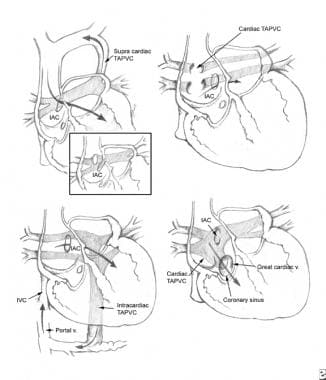
Types of TAPVD are classified by the site of pulmonary venous drainage connection to the systemic circulation, and are listed as follows (with the percentage of occurrence):

  • Supracardiac (45-55%): Pulmonary venous drainage courses through the pulmonary venous confluence behind the LA and then through a connecting vein (often termed a vertical vein) to connect with the systemic venous system at the innominate vein. Pulmonary outflow then courses, mixed with the systemic return, through the superior vena cava (SVC) to the RA. In rare cases, other sites of connection to the systemic venous system, such as direct drainage to the right-sided SVC, are seen.
  • Cardiac (15-20%): In this group, the pulmonary venous confluence connects to the coronary sinus posteriorly. This connection results in excessive blood flow through the coronary sinus, producing an enlarged coronary sinus, as the returning pulmonary blood mixes with the lesser volume coronary venous blood. In uncommon cases, the confluence drains directly to the RA.
  • Infracardiac (15-20%): The pulmonary-systemic venous connection lies inferior to the heart in a subdiaphragmatic position. Most commonly, a vertical vein lying posterior to the pericardium connects the pulmonary vein confluence with the portal vein, or the ductus venosus, after traversing the diaphragm. Blood then enters the RA via the inferior vena cava (IVC). The course of the connecting vein is often long and tortuous, resulting in a high incidence of obstruction to pulmonary venous outflow.
  • Mixed (5-10%): Pulmonary venous drainage is through multiple connections to the systemic venous circulation by a combination of the supracardiac, cardiac, and/or infracardiac types.

Although obstruction to the pulmonary venous return is most common with infracardiac type connection, stenosis is possible in all types of anomalous connection, and at various sites along the pathway to the RA. This usually results in significant hemodynamic compromise and cyanosis. Restrictive flow across the intracardiac communication is uncommonly the cause of obstruction producing significant compromise of systemic cardiac output and oxygenation.

In a supracardiac type of connection, obstruction can occur in the ascending vertical vein connecting the pulmonary venous confluence to the innominate vein. Passage of the vertical vein between the pulmonary artery and the left bronchus can cause compression in the vertical vein. Because the egress of blood from the lungs is restricted, pulmonary arterial pressure rises, causing further distention of the pulmonary artery and obstruction and creating a repeating cycle of pulmonary artery distention and further obstruction.

With the infracardiac type of pathology, focal obstruction is commonly seen at the connection between the pulmonary venous confluence and the systemic vein. In addition, the connection between the pulmonary and systemic venous systems is often long and tortuous, producing a limitation of flow without any discrete stenosis. This is a common feature of infracardiac TAPVD.

Any restriction at the level of the ASD, reducing the volume of blood able to cross to the left heart, causes elevation of the RA pressure and functional obstruction of the pulmonary venous return.

Partial anomalous pulmonary venous drainage

PAPVD is characterized by a failure of 1 or more of the pulmonary veins to incorporated with the developing LA during fetal development. The superior right-sided pulmonary vein is typically affected and has abnormal connection to the SVC. In a few cases, both pulmonary veins on the right side are anomalous, and they directly connect to the IVC or the RA. The lesion commonly occurs in association with an ASD, usually a superior sinus venosus type, though it can be present with an intact atrial septum.

The most common pattern of PAPVD is an anomalous connection of the right superior pulmonary vein with the SVC, or the junction of the RA and SVC, in association with a superior sinus venosus ASD.

A second pattern of PAPVD is in patients with scimitar syndrome, in whom both the right pulmonary veins (superior and inferior) drain to the IVC via a descending vein coursing parallel to the right-heart border. This condition is commonly associated with right lung hypoplasia of variable degrees.

Frequency

TAPVD and PAPVD account for 1-2% of congenital heart defects.

Etiology

Normal embryologic development of the pulmonary venous system involves creation of a connection between the LA and the pulmonary venous plexus with subsequent regression of pulmonary-to-systemic venous connections. Any disruption of this process can result in anomalous pulmonary venous drainage.

The primitive lungs form as buds arising from the foregut. As a consequence, venous drainage of the lung buds occurs through the cardinal and umbilical-vitelline venous systems (systemic veins). As the embryo develops, the primordial pulmonary vein arises behind the developing atrium and fuses with the plexus draining the developing lung buds, forming a confluence of pulmonary venous connection. As the atrium enlarges an outpouching, or evagination, of the common atrium forms to the left of the developing septum primum. This structure fuses with the pulmonary venous confluence behind. It becomes increasingly incorporated into the LA wall as growth continues, completing the connection of the developing lung buds to the LA, and resulting in the 4 pulmonary vein orifices. The connections between the lung buds and the systemic venous system regress.

Anomalous pulmonary venous drainage can result from failure of fusion between the LA evagination and the pulmonary venous plexus, or from malposition of the relationship between the atrial evagination and the forming atrial septum.

If all of the pulmonary veins develop anomalous connections, the lesion is termed TAPVD. If 1-3 pulmonary veins drain by means of an anomalous pathway and if at least 1 pulmonary vein drains to the LA, the lesion is termed PAPVD.

Pathophysiology

Total anomalous pulmonary venous drainage

The hemodynamic abnormality in patients with TAPVD is related to the complete diversion of pulmonary venous blood away from the LA to a systemic vein. As a consequence, 2 anatomic factors determine the patient's clinical status.

  • First, returning pulmonary venous (oxygenated) blood is mixed with systemic venous (unoxygenated) blood and cannot reach the left ventricle unless a right-to-left shunt is present. In most cases, a patent foramen ovale or ASD is present to allow blood to enter the LA and then the left ventricle to maintain systemic cardiac output. The patient's cardiac output and supply of oxygenated blood is limited by the amount of blood that can cross the atrial septum. Therefore, the characteristics of the necessary right-to-left shunt determine systemic cardiac output and oxygenation.
  • Second, an obstruction may occur in the path of the pulmonary venous drainage from the lungs to the systemic venous system. If obstruction occurs, egress of blood from the lungs is limited. The consequences of obstruction are limitation of pulmonary blood flow, pulmonary venous congestion, impairment of oxygenation, and elevation of pulmonary artery pressures. These events lead to life-threatening cyanosis in neonates.

Partial anomalous pulmonary venous drainage

The hemodynamic abnormality is related to the left-to-right shunt imposed by pulmonary venous drainage into the RA. This anomalous drainage often is accompanied by an ASD. In a common scenario, the right upper pulmonary vein drains into the RA at the site of a superior sinus venosus ASD.

As a consequence, the return of oxygenated blood from the anomalous pulmonary venous connection produces a left-to-right shunt and increases the volume of blood returning to the RA. This increased amount of blood creates a volume load on the right ventricle and results in chronic dilatation of the right ventricle, hypertrophy, and eventual dysfunction. The addition of an ASD increases the left-to-right shunt as blood passes from the LA to the RA, further adding to the volume load on the right ventricle.

Although an associated ASD usually produces a left-to-right shunt, it adds the potential for right-to-left shunting with elevated pressures on the right side of the heart.

Clinical

Total anomalous pulmonary venous drainage

The degree of pulmonary venous obstruction largely determines the clinical presentation. Patients with high-grade obstruction present postnatally with profound cyanosis and shock, or in the neonatal period with cyanosis, respiratory distress, and poor growth. On examination, the infant is tachypneic and cyanotic and has poor perfusion of the extremities. The second heart sound is prominent and split as a result of pulmonary arterial hypertension.

In contrast, patients without clinically significant pulmonary venous obstruction present in infancy or early childhood with signs and symptoms related to a large left-to-right shunt and resulting right-heart volume overload. These patients have dyspnea, poor feeding, and poor growth. They may have cyanosis on examination, but this manifestation is usually mild. Other findings include a split second heart sound and a systolic flow murmur because of increased flow across the pulmonary valve, as well as elevated right-heart pressures.

Partial anomalous pulmonary venous drainage

Patients are often asymptomatic and present with a murmur as an incidental finding on routine examination. Some patients may present with primary arrhythmia, most commonly atrial fibrillation.

Subsequent workup demonstrates PAPVD and an associated sinus venosus ASD. Symptomatic patients present with the sequelae of a large left-to-right shunt. The symptoms are often decreased exercise tolerance or poor growth. On examination, patients are not cyanotic unless they have pulmonary hypertension, which can occur as a late manifestation of a large left-to-right shunt. A split and prominent second heart sound and a systolic murmur are often present as a result of increased flow across the pulmonary valve.


Obstruction in the pulmonary venous pathway constitutes a surgical emergency in patients with TAPVD. Medical measures to stabilize and resuscitate the patient are minimally effective and include intubation, ventilation with 100% oxygen, hyperventilation, prostaglandin infusion, correction of pH, and inotropic support. The therapeutic goal is relief of pulmonary venous obstruction, which can be accomplished with only surgical repair.

In the absence of obstruction, surgery can be performed on an elective basis after diagnosis. Excellent clinical results are reported in infants, suggesting that little is gained by delaying surgical repair until the patient reaches an arbitrary size, weight, or age.


See Introduction and Pathophysiology.


TAPVD

No specific contraindications exist for the repair of TAPVD, though the surgical risk may be high in select groups of patients (eg, patients with TAPVD and pulmonary venous obstruction, a single ventricle, or heterotaxy syndromes).

PAPVD

In patients with PAPVD and an ASD, closure of the ASD may be inappropriate when pulmonary artery pressures are greater than two thirds the systemic pressure, without reversibility. Severe, fixed pulmonary hypertension with suprasystemic pressure (Eisenmenger syndrome) is associated with systemic cyanosis. The surgical risk in this group of patients may be prohibitive.


Lab Studies

  • Arterial blood gas (ABG) values, including pO2, pCO2, pH, base excess, lactate concentration, and mixed venous oxygen saturations, permit quantitative assessment of the patient's oxygenation and systemic perfusion.
    • Acute ABG evaluation assists in the resuscitation of a neonate with pulmonary venous obstruction and TAPVD.
    • Severe metabolic acidosis and mild hypoxemia are often seen.
  • Hematocrit levels are obtained and ensure adequate oxygen-carrying capacity.
  • BUN and/or creatinine levels are useful in critically ill neonates presenting with obstructed pulmonary venous return.

Imaging Studies

  • Chest radiography
    • TAPVD: Obstruction to pulmonary venous drainage determines the appearance of the lung fields on chest radiography. In patients without obstruction, pulmonary vascularity is increased as a result of the large left-to-right shunt created by drainage of pulmonary venous return into the right heart and the resulting increase in right-sided cardiac output. In patients with obstruction, the lung fields may be extremely congested because of obstruction of the egress of blood from the pulmonary veins and the left-to-right shunt. A prominence of the pulmonary artery shadow and the RA silhouette are often observed. In supracardiac drainage, the prominence of the upper mediastinal silhouette can create the classic snowman or figure-eight appearance.
    • PAPVD: Lung fields often demonstrate increased pulmonary vascular markings in patients with ASD and a large left-to-right shunt. In addition, an enlarged right-heart border from the volume loaded right heart is seen. In patients with scimitar syndrome, a diagnostic crescentic shadow is observed to the right of the mediastinal silhouette.
  • Echocardiography
    • TAPVD: Echocardiographic findings can help in accurately diagnosing TAPVD in most patients. With 2-dimensional echocardiography and color-flow Doppler mapping, the anomalous venous anatomy is usually well defined. Demonstration of turbulence or flow acceleration in the pulmonary veins is also used to diagnose obstruction in the pulmonary venous circuit. Echocardiography can also define any intracardiac shunts and show if these are restrictive or unrestrictive. In addition, right-heart pressures and other cardiac anomalies can be determined. Echocardiography has largely replaced angiography in the diagnosis of TAPVD.
    • PAPVD: Echocardiography is typically used to help delineate the anatomy of the pulmonary venous drainage and the atrial septum. Confirmation of the normal drainage of the remaining pulmonary veins is an important part of the echocardiographic examination.
  • CT and/or MRI
    • Although not usually required, either of these modalities may be used to further delineate the cardiac anatomy. The ability to form 3-dimensional reconstructions with these imaging modalities is evolving rapidly.
    • MRI provides the additional benefit of calculations of flow in both the systemic and pulmonary circuits, of the shunt fraction, and of the chamber volumes.

Other Tests

  • Cardiac catheterization is used infrequently for diagnosis in routine TAPVD or PAPVD because of the refinements in echocardiography. Cardiac catheterization is helpful in patients in whom echocardiographic findings are ambiguous or in patients with other complex defects. As a result of the mixing of oxygenated pulmonary venous effluent and deoxygenated systemic venous blood, oxygen saturations are almost identical in all chambers of the heart in patients with TAPVD.
  • Catheterization also is helpful in defining the anatomy of pulmonary-vein stenosis, which may develop after TAPVD is repaired.
  • In older patients with PAPVD, cardiac catheterization may be required to exclude coronary artery disease, to assess right-heart pressures, to ascertain the reversibility of any pulmonary arterial hypertension, and to calculate the shunt fraction.

Diagnostic Procedures

  • Balloon atrial septostomy (BAS) allows a intracardiac shunt to be created and may be helpful in hemodynamic stabilization.
  • BAS may assist in evaluations before to surgical repair and in patients with obstructed pulmonary venous return at the level of an absent or restrictive ASD.

Histologic Findings

TAPVD is associated with hypertrophy of the media of the pulmonary veins and arteries. This finding is most prominent in patients with evidence of pulmonary venous obstruction, and it is most important in the extrapulmonary and intrapulmonary veins. Intimal proliferation and fibrous thickening of the pulmonary veins, with lymphangiectasia, is a common microscopic finding in patients with TAPVD.

In patients with recurrent stenosis, often a diffuse fibrous proliferation of the intima is seen.


Medical therapy

Patients with TAPVD usually present in 1 of 2 ways. First, early in the postnatal period, patients present with profound cyanosis, acidosis and shock secondary to obstruction of pulmonary venous return. Second, late in the postnatal period, patients present with right heart failure, poor feeding, and poor growth secondary to right heart volume overload. On occasion, patients present with late-onset obstruction due to progressive stenosis in the pathway for pulmonary venous return or at the site of the intracardiac shunt.

Presentation with obstruction of TAPVD with severe cyanosis and poor systemic perfusion is a medical emergency. Anatomic impediments limit resuscitation to restore cardiac output resulting from obstruction in the pulmonary venous circuit. Maneuvers to increase effective pulmonary blood flow include correction of acidosis, ventilation with 100% oxygen, and hyperventilation. Administration of prostaglandin E1 (eg alprostadil, PGE1) may allow some right-to-left shunting at the level of the ductus arteriosus. This maneuver may increase systemic cardiac output, though it may do so at the expense of pulmonary blood flow. Correction of systemic acidosis is limited and may be impossible in this clinical situation.

Obstruction of pulmonary venous drainage in patients with TAPVD is a surgical emergency, and prompt correction of the venous anomaly is required.

In some patients with TAPVD, the obstruction is at the level of a restrictive foramen ovale. In this situation, BAS can decompress the venous circuit and improve cardiac output. This change allows time to correct systemic acidosis with bicarbonate, fluids, and inotropic support.

Patients with PAPVD most commonly present as an incidental finding of murmur or abnormal chest radiographs during routine medical examination. Those who present with primary arrhythmia or right heart failure may benefit from antiarrhythmic agents or management of right heart failure while the diagnostic workup is being completed and before surgical correction is considered.

Surgical therapy

The goal of surgical therapy for TAPVD is to create unobstructed egress of blood from the pulmonary veins into the LA.

The goal of surgical therapy for PAPVD is to correct the cardiac anatomy and divert pulmonary venous flow from the anomalous pulmonary vein into the LA in an unobstructed fashion. Associated defects (eg, ASDs) are corrected.

Preoperative details

Preoperative echocardiographic definition of the pulmonary venous anatomy and associated defects is important in planning the appropriate cannulation technique and surgical approach. This point is especially pertinent in PAPVD, in which the location of the anomalous pulmonary venous drainage influences the use of a minimally invasive sternotomy incision and placement of venous cannulae. A high junction of a right-sided anomalous pulmonary vein into the SVC makes a minimally invasive approach considerably more difficult.

In patients with obstruction resulting in cyanosis and acidosis, resuscitative correction should be attempted while emergency surgical correction is being organized.

Intraoperative details

Total anomalous pulmonary venous drainage

Aortobicaval cannulation offers flexibility to repair all forms of TAPVD. In some centers, deep hypothermic circulatory arrest is preferred, but this technique is rapidly becoming less common than before.

After cardiopulmonary bypass is started, ductus arteriosus ligation is done, as is systemic cooling to 18-20%. The aorta is cross-clamped, and cold antegrade cardioplegia is administered. The vertical vein is usually ligated, but some centers may prefer to leave this in continuity.

In supracardiac TAPVD, the pulmonary venous confluence is seen in the posterior pericardium by retracting the heart. A longitudinal incision is created in the pulmonary venous confluence to match a corresponding incision in the posterior LA extended out to the LA appendage. With care to avoid distortion, a LA-to-pulmonary confluence anastomosis is created using fine sutures. Controversy exists over the use of absorbable suture material (polydioxanon [PDS]) versus nonabsorbable suture material (eg, Prolene). Many centers report good results using nonabsorbable sutures. The benefits are thought to be due to minimizing the degree of intimal hyperplasia and potential restenosis. The primary goal is a large, unobstructed anastomosis. A short period of low-flow cardiopulmonary bypass may be desirable for a meticulous anastomosis.

For intracardiac TAPVD, a technique similar to that described above is used. An anastomosis is created between the pulmonary venous confluence, lying in the posterior pericardium, and the back of the LA. Other techniques involve unroofing the coronary sinus through an incision between the coronary sinus and the area of the foramen ovale. Then, a patch is used to reconstruct the atrial septum, leaving the pulmonary venous drainage to flow through the unroofed coronary sinus into the LA. Concern has been expressed that this unroofing technique may increase the risk of late stenosis because of the embryologic origin of the connection between the coronary sinus and the pulmonary venous confluence.

For infracardiac TAPVD, the technique is similar to that described for supracardiac TAPVD. Pulmonary venous confluence tends to be oriented vertically, creating a Y-shaped confluence, which drains through a vertical vein to the ductus venosus. As a consequence, the incision into the LA is relatively vertical or Y-shaped to maximize the size of the newly created LA. Some surgeons do not ligate the vertical vein to provide the effect of a pressure-relief valve to oxygenated blood to enter the systemic circulation if LA pressure is high in the early postoperative period.

Surgical correction of mixed TAPVD depends on the exact anatomy and site of pulmonary venous connections. A combination of the aforementioned procedures is usually required to completely redirect pulmonary venous blood to the LA.

Sutureless pulmonary venous connection is a novel technique performed to connect the pulmonary vein to the atrium by suturing the atrial wall to the incised pericardial edge overlying the incised pulmonary vein. Hemostasis is provided by continuity of the fibrous tissue between the pericardium and venous confluence. The resulting anastomosis requires no suture placement into the pulmonary vein, minimizing direct surgical trauma and intimal fibrosis and hyperplasia secondary to suturing. Although this technique was initially described for the management of recurrent stenosis in the pulmonary venous tree, indications have been extended to repair of primary pulmonary-vein stenosis and primary repair of TAPVD. For TAPVD the same approach, as outlined above, for each type is used with the anastomotic technique being a sutureless type.

Partial anomalous pulmonary venous drainage

The position of the anomalous pulmonary vein determines the site of cannulation in the SVC. In most patients, the SVC or the innominate vein is cannulated to provide venous drainage for the upper extremities. After cardioplegic arrest, systemic normothermia is maintained. The RA is opened, and the pulmonary veins and any ASDs are identified.

A glutaraldehyde-treated pericardial double-patch technique is typically used to create a baffle, redirecting pulmonary venous blood from an anomalous right upper pulmonary vein beneath the baffle and through an ASD into the LA. The second patch augmenting the remaining SVC above the baffle to prevent SVC obstruction.

A single-patch technique was recently proposed. This involves a transverse atriotomy extending along the lateral RA and across the cavoatrial junction along the SVC to just proximal to the point of inflow of an anomalous right superior pulmonary vein. A single pericardial patch is then fashioned to close the sinus venosus type of ASD and to create a baffle through the posterior SVC and over the origin of the right superior pulmonary vein. The atriotomy is then closed by incorporating the lateral limit into the suture line.

As an alternative, a new SVC-RA junction (Warden operation) is established by dividing the SVC just distal to the anomalous pulmonary venous entry and translocating the cephalic end of the SVC to a site at the RA appendage, where a SVC-to-RA anastomosis is performed. Take care to resect the trabeculations in the appendage to prevent obstruction of systemic venous drainage. The divided cardiac end of the SVC (bearing the anomalous pulmonary venous connection) is closed, and in the RA, a baffle is created from the site of the anomalous pulmonary vein to the ASD and LA.

Postoperative details

Regarding TAPVD, poor hemodynamics should raise concern of potential obstruction at the site of repair. Chest radiographs demonstrate pulmonary vascular congestion, though this finding is nonspecific. In patients with preoperative pulmonary venous obstruction, chest radiographic findings of pulmonary vascular obstruction often persist for several days despite normal hemodynamics. Any suspicion of residual postoperative pulmonary venous obstruction should prompt echocardiography to examine and interrogate the pulmonary venous anastomosis.

Patients with obstructed TAPVD often have a difficult postoperative course secondary to high pulmonary vascular resistance and poor lung compliance. Some centers advocate the routine use of extracorporeal membrane oxygenation (ECMO) after surgical correction in these patients.

Follow-up

Pulmonary venous obstruction may arise in as many as 15% of patients after repair of TAPVD. The principle mechanism may be obstruction at the site of anastomosis, presumably as a result of scarring at the repair site or an inadequate anastomosis at the time of original repair. Repeat surgery is necessary to relieve the obstruction, and results are favorable. However, a sequela more serious than this is a diffuse stenotic process that can progress throughout the pulmonary venous tree. This process may progress to almost complete unilateral occlusion in relatively asymptomatic patients. However, the process is most commonly bilateral, and the prognosis is poor. Recently developed sutureless techniques and/or lung transplantation may improve the outlook for patients in this situation.

Patients with PAPVD should also be followed up for evidence of stenosis at the site of pulmonary venous repair, though the diffuse stenosis described after repair of TAPVD is rare.

Older patients with raised pulmonary artery pressures should be followed up for resolution of these changes after surgery. As an alternative, patients presenting with arrhythmia should be followed up for control of arrhythmia and for ongoing indications for therapy.


Residual obstruction at the site of pulmonary venous repair is manifested by poor cardiac output and chest radiographic findings of pulmonary congestion. The principle diagnostic feature is turbulence at the pulmonary venous anastomotic site, as noted on echocardiographs. Residual turbulence may create a cycle of local injury, hyperplasia, and increasing turbulence, perpetuating a process of diffuse pulmonary-vein stenosis. Pulmonary-vein stenosis may remain localized to the site of anastomosis, may progress unilaterally with diffuse pulmonary-vein stenosis, or it may progress with bilateral diffuse pulmonary-vein stenosis.


Early TAPVD-associated hospital mortality ranges from 2-20%. Risk factors include poor preoperative status (eg, acidosis), obstruction, high pulmonary vascular resistance, young age, small left ventricle, and single-ventricle anatomy.

Long-term prognosis after successful repair of TAPVD is favorable. Approximately 10-15% of patients have evidence of late pulmonary-vein obstruction. For this reason, long-term surveillance is important. Postoperative stenosis tends to be recurrent and progressive.

Long-term prognosis for patients after repair of PAPVD is excellent in the absence of irreversible pulmonary hypertension. In children, closure of an associated ASD almost eliminates the risk of the late development of atrial arrhythmias. However, in adults, closure of an ASD is associated with persistent risk of late atrial arrhythmias.


Improved neonatal care and surgical techniques have vastly improved surgical survival rates in neonates requiring repair of TAPVD. However, in subsets of patients, the risk of surgical death is extremely high. In particular, patients with single ventricles and TAPVD requiring repair in the neonatal period have a high rate of surgical mortality largely because postoperative management of hemodynamics is difficult.

A second frontier in the treatment of TAPVD is in patients with postsurgical obstruction of a pulmonary vein. Improved understanding of the vascular biology responsible for diffuse pulmonary vein stenosis in this group will improve therapy. At present, surgical therapy with sutureless techniques and/or transplantation may offer the most potential.

Current changes in surgical techniques, with increasing acceptance and expanded indications for the sutureless type anastomosis, may further improve the outcomes of patients, especially those with postoperative and recurrent stenosis.


  • Bando K, Turrentine MW, Ensing GJ. Surgical management of total anomalous pulmonary venous connection. Thirty-year trends. Circulation. Nov 1 1996;94(9 Suppl):II12-6. [Medline].
  • Bauer M, Alexi-Meskishvilli V, Nakic Z, et al. The correction of congenital heart defects with less invasive approaches. Thorac Cardiovasc Surg. Apr 2000;48(2):67-71. [Medline].
  • Caldarone CA, Najm HK, Kadletz M, et al. Surgical management of total anomalous pulmonary venous drainage: impact of coexisting cardiac anomalies. Ann Thorac Surg. Nov 1998;66(5):1521-6. [Medline].
  • Caldarone CA, Najm HK, Kadletz M, et al. Relentless pulmonary vein stenosis after repair of total anomalous pulmonary venous drainage. Ann Thorac Surg. Nov 1998;66(5):1514-20. [Medline].
  • Cope JT, Banks D, McDaniel NL, et al. Is vertical vein ligation necessary in repair of total anomalous pulmonary venous connection?. Ann Thorac Surg. Jul 1997;64(1):23-8; discussion 29. [Medline].
  • Gaynor JW, Burch M, Dollery C, et al. Repair of anomalous pulmonary venous connection to the superior vena cava. Ann Thorac Surg. Jun 1995;59(6):1471-5. [Medline].
  • Gaynor JW, Collins MH, Rychik J, et al. Long-term outcome of infants with single ventricle and total anomalous pulmonary venous connection. J Thorac Cardiovasc Surg. Mar 1999;117(3):506-13; discussion 513-4. [Medline].
  • Gustafson RA, Warden HE, Murray GF, et al. Partial anomalous pulmonary venous connection to the right side of the heart. J Thorac Cardiovasc Surg. Nov 1989;98(5 Pt 2):861-8. [Medline].
  • Hawkins JA, Minich LL, Tani LY, et al. Absorbable polydioxanone suture and results in total anomalous pulmonary venous connection. Ann Thorac Surg. Jul 1995;60(1):55-9. [Medline].
  • Haworth SG. Total anomalous pulmonary venous return. Prenatal damage to pulmonary vascular bed and extrapulmonary veins. Br Heart J. Dec 1982;48(6):513-24. [Medline].
  • Huddleston CB, Mendeloff EN. Scimitar syndrome. Adv Card Surg. 1999;11:161-78. [Medline].
  • Imoto Y, Kado H, Asou T, et al. Mixed type of total anomalous pulmonary venous connection. Ann Thorac Surg. Oct 1998;66(4):1394-7. [Medline].
  • Jemielity M, Perek B, Paluszkiewicz L, et al. Results of repair of partial anomalous pulmonary venous connection and sinus venosus atrial septal defect in adults. J Heart Valve Dis. Jul 1998;7(4):410-4. [Medline].
  • Kirshbom PM, Myung RJ, Gaynor JW, et al. Preoperative pulmonary venous obstruction affects long-term outcome for survivors of total anomalous pulmonary venous connection repair. Ann Thorac Surg. Nov 2002;74(5):1616-20. [Medline].
  • Kirshbom PM, Flynn TB, Clancy RR, et al. Late neurodevelopmental outcome after repair of total anomalous pulmonary venous connection. J Thorac Cardiovasc Surg. May 2005;129(5):1091-7. [Medline].
  • Najm HK, Caldarone CA, Smallhorn J, Coles JG. A sutureless technique for the relief of pulmonary vein stenosis with the use of in situ pericardium. J Thorac Cardiovasc Surg. Feb 1998;115(2):468-70. [Medline].
  • Phillips SJ, Kongtahworn C, Zeff RH, et al. Correction of total anomalous pulmonary venous connection below the diaphragm. Ann Thorac Surg. May 1990;49(5):734-8; discussion 738-9. [Medline].
  • Smallhorn JF, Burrows P, Wilson G, et al. Two-dimensional and pulsed Doppler echocardiography in the postoperative evaluation of total anomalous pulmonary venous connection. Circulation. Aug 1987;76(2):298-305. [Medline].
  • Wilson WR Jr, Ilbawi MN, DeLeon SY, et al. Technical modifications for improved results in total anomalous pulmonary venous drainage. J Thorac Cardiovasc Surg. May 1992;103(5):861-70; discussion 870-1. [Medline].
  • Yamaki S, Tsunemoto M, Shimada M, et al. Quantitative analysis of pulmonary vascular disease in total anomalous pulmonary venous connection in sixty infants. J Thorac Cardiovasc Surg. Sep 1992;104(3):728-35. [Medline].
  • Yee ES, Turley K, Hsieh WR, Ebert PA. Infant total anomalous pulmonary venous connection: factors influencing timing of presentation and operative outcome. Circulation. Sep 1987;76(3 Pt 2):III83-7. [Medline].
  • Yun TJ, Coles JG, Konstantinov IE, et al. Conventional and sutureless techniques for management of the pulmonary veins: Evolution of indications from postrepair pulmonary vein stenosis to primary pulmonary vein anomalies. J Thorac Cardiovasc Surg. Jan 2005;129(1):167-74. [Medline].

Partial and Total Anomalous Pulmonary Venous Connection: Surgical Perspective excerpt

Article Last Updated: Jul 6, 2006