Continually Updated Clinical Reference
 
 
  All Sources     eMedicine     Medscape     Drug Reference     MEDLINE
 
eMedicine - Carcinoid Tumor : Article by

Quick Find
Authors & Editors
Introduction
Clinical
Workup
Treatment
Follow-up
References


Patient Education
Click here for patient education.


AUTHOR AND EDITOR INFORMATION

Section 1 of 7 Click here to go to the next section in this topic  

Author: Cameron K Tebbi, MD, Medical Director, Department of Pediatric Hematology-Oncology, Tampa Children's Hospital

Cameron K Tebbi is a member of the following medical societies: American Association for Cancer Research, American Society of Clinical Oncology, and American Society of Pediatric Hematology/Oncology

Editors: Kathleen Sakamoto, MD, Professor, Department of Pediatrics, Mattel Children's Hospital, David Geffen School of Medicine, Division of Hematology-Oncology and Pathology and Laboratory Medicine, University of California at Los Angeles; Mary L Windle, PharmD, Adjunct Assistant Professor, University of Nebraska Medical Center College of Pharmacy, Pharmacy Editor, eMedicine.com, Inc; William Chung; Samuel Gross, MD, Professor Emeritus, Department of Pediatrics, University of Florida, Clinical Professor, Department of Pediatrics, UNC, Adjunct Professor, Department of Pediatrics, Duke University; Max J Coppes, MD, PhD, MBA, Executive Director, Center for Cancer and Blood Disorders, Children's National Medical Center

Author and Editor Disclosure

Synonyms and related keywords: carcinoid tumor, neuroendocrine tumor, primitive stem cells, carcinoid syndrome, foregut carcinoid tumors, midgut carcinoid tumors, hindgut carcinoid tumors, gut wall tumors, carcinoid syndrome, sporadic primary tumors, achlorhydria, appendicular carcinoid tumor, atypical carcinoid syndrome, acromegaly, Cushing disease, telangiectasia

Background

Origin and general involvement and presentation

Carcinoid tumors are derived from primitive stem cells in the gut wall but can be seen in other organs (Broaddus, 2003), including the lungs (Moraes, 2003), mediastinum, thymus (Soga, 1999), liver, pancreas, bronchus, and ovaries (Piura, 1995). In children, most tumors occur in the appendix and are benign and asymptomatic.

Although rare, aggressive and metastatic disease (eg, to the brain) does occur; even tumors in the appendix can metastasize (Hlatky, 2004; Volpe, 2000). Depending on size and location, carcinoid tumors can cause various symptoms, including carcinoid syndrome. Carcinoid tumors of the ileum and jejunum, especially those larger than 1 cm, are most prone to produce this syndrome, at least in adults.

Classification

Carcinoid tumors generally are classified based on the location in the primitive gut (ie, foregut, midgut, hindgut) that gives rise to the tumor.

Foregut carcinoid tumors are divided into sporadic primary tumors and tumors secondary to achlorhydria. The term sporadic primary foregut tumor encompasses carcinoids of the bronchus, stomach, proximal duodenum, and pancreas.

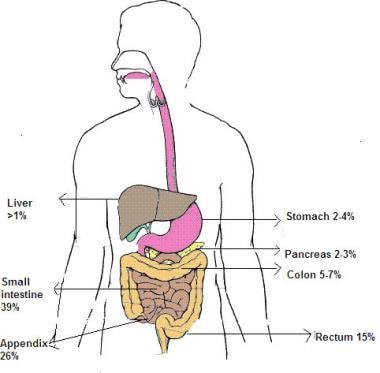
Midgut tumors are derived from the second portion of the duodenum, the jejunum, the ileum, and the right colon. These account for 60-80% of all carcinoid tumors (especially those of the appendix and distal ileum) in adults and are also seen in children (Schmittenbecher, 2001). Appendicular carcinoid tumors are most common (Bethel, 1997; Pelizzo, 2001). In children, more than 70% of these tumors occur at the tip of the appendix and are often an incidental finding in appendectomy specimens. In one study, carcinoid tumors were found in 0.169% of 4747 appendectomies (Doede, 2000). Bulky tumors are relatively rare and require somewhat extensive cecectomy or, when tumor infiltration is beyond the cecum, ileocecal resection (Soreide, 2000; D'Aleo, 2001; Pelizzo, 2001).

Hindgut carcinoid tumors include those of the transverse colon, descending colon, and rectum.

Carcinoid tumors can also arise from the Meckel diverticulum, cystic duplications, and the mesentery. Each of these entities has distinctive clinical, histochemical, and secretory features. For example, foregut carcinoids are argentaffin negative and have low serotonin content but secrete 5-hydroxytryptophan (5-HTP), histamine, and several polypeptide hormones. These tumors can metastasize to bone and may be associated with atypical carcinoid syndrome, acromegaly, Cushing disease, other endocrine disorders, telangiectasia, or hypertrophy of the skin in the face and upper neck.

Midgut carcinoids are argentaffin positive and can produce high levels of serotonin 5-hydroxytryptamine (5-HT), kinins, prostaglandins, substance P (SP), and other vasoactive peptides. These tumors have a rare potential to produce corticotropic hormone (previously adrenocorticotropic hormone [ACTH]). Bone metastasis is uncommon.

Hindgut carcinoids are argentaffin negative and rarely secrete 5-HT, 5-HTP, or any other vasoactive peptides. Therefore, they do not produce related symptomatology. Bone metastases are not uncommon in these tumors.

Pathophysiology

Carcinoid tumors are of neuroendocrine origin and are derived from primitive stem cells, which can give rise to multiple cell lineages. In the intestinal tract, these tumors develop deep in the mucosa, growing slowly and extending into the underlying submucosa and mucosal surface. This results in the formation of small firm nodules, which bulge into the intestinal lumen. These tumors have a yellow, tan, or gray-brown appearance that can be observed through the intact mucosa. The yellow color is a result of cholesterol and lipid accumulation within the tumor. Tumors can have a polypoid appearance and occasionally become ulcerated. With expansion and infiltration through the submucosa into the muscularis propria and serosa, carcinoid tumors can involve the mesentery. Metastases to the mesenteric lymph node and liver, ovaries, peritoneum, and spleen can occur.

Upon histologic examination, carcinoid tumors have 5 distinctive patterns: (1) solid, nodular, and insular cords; (2) trabecular or ribbons with anastomosing features; (3) tubules and glands or rosettelike patterns; (4) poorly differentiated or atypical patterns; and (5) mixed patterns. A combination of these patterns is often observed. Tubules can contain mucinous secretions, and individual tumor cells can contain mucin-positive material, which includes the various acidic and neutral intestinal mucin. Tumors rarely have eosinophilic stroma. Capillaries are often prominent. Cells are uniformly round or polygonal with a central nucleus and punctate chromatin, as well as small nucleoli and infrequent mitosis. The cytoplasm can be slightly acidophilic, basophilic, or amphophilic. Eosinophilic granules may be present.

In midgut carcinoids, cells are arranged in closely packed, round, regular, monomorphous masses. In the appendix, carcinoids appear as discrete yellow nodules in the lumen. Lesions associated with diffuse wall thickening are relatively uncommon. Carcinoid tumors commonly affect the tip of the appendix. Most carcinoid tumors invade the wall of the appendix, and lymphatic involvement is nearly universal. About 75% of patients have evidence of peritoneal involvement. However, only a few patients have regional or distant dissemination. The size of the tumor can be correlated with outcome of the disease; tumors smaller than 1.5 cm in diameter (after formalin fixation) rarely result in distant metastases or recurrences.

Carcinoid tumors can be associated with concentric and elastic vascular sclerosis that results in obliteration of vascular lumina and ischemia. A common finding is elastosis and fibrosis that surround nests of the tumor cells and that result in matting of the involved tissues and lymph nodes. Fibroblastic proliferation may result from the stimulation of fibroblast cells by growth factor. This stimulation may be a result of a local release of tumor growth factor (TGF)-beta, beta–fibroblast growth factor (beta-FGF), and platelet-derived growth factor.

Other products of carcinoid tumors include the following:

  • Acid phosphatase


  • Alpha-1-antitrypsin


  • Amylin


  • Atrial natriuretic polypeptide


  • Calbindin-D28k


  • Catecholamines


  • Dopamine


  • Fibroblast growth factor


  • Gastrin


  • Gastrin-releasing peptide (bombesin)


  • Glucagon, glicentin


  • 5-Hydroxyindoleacetic acid (5-HIAA)


  • 5-Hydroxytryptamine (5-HT)


  • Histamine


  • Insulin


  • Kallikrein


  • Kinins


  • Motilin


  • Neuropeptide


  • Neurotensin


  • Pancreastatin


  • Pancreatic polypeptide


  • Platelet-dermal growth factor


  • Prostaglandins


  • Pyroglutamyl-glutamyl-prolinamide


  • Secretin


  • Serotonin


  • Somatostatin (ie, SRIF)


  • Tachykinins


  • Neuropeptide K


  • Neuropeptide A


  • Substance P (SP)


  • Transforming growth factor-beta


  • Vasoactive intestinal polypeptide (VIP)

Classic carcinoid tumor cells are argentaffinic and argyrophilic. At present, immunostain and hormonal markers are used for diagnosis.

Carcinoids may have somatostatin receptors. Five identified somatostatin receptors are members of the G-protein receptor family. Five distinct genes on chromosomes 11, 14, 16, 17, and 20 encode somatostatin receptors. Somatostatin receptors are used to advantage for diagnosing and treating this disease.

Frequency

United States

Carcinoids are the most common neuroendocrine tumors, with an estimated 1.5 clinical cases per 100,000 population. The incidence in autopsy cases is higher than this at 650 cases per 100,000 population. The exact incidence in children is not known. Most tumors occur in adults and are rarities in children.

International

In 1980-1989, the overall age-standardized incidence rate for male and female populations in England were estimated to be 0.71 (0.68-0.75 and 0.87 (0.83-0.91), respectively. In Scotland, the respective rates were 1.17 (0.91-1.44) per 100,000 population and 1.36 (1.09-1.63) per 100,000 population (Newton 1994).


History

Signs and symptoms of carcinoid tumors vary greatly and depend on the location and size of the tumor and on the presence of metastases. Findings range from no tumor-related findings to full symptoms of carcinoid syndrome. Because carcinoid tumors are rare in children, clinicians rely on reports of adult patients to understand the full scope of the manifestations of the disease.

  • Anatomic distribution

    • In general, carcinoid tumors are found in various locations, including the lungs (Lal, 2005; Fink, 2001), trachea, bronchus (Fauroux, 2005), thymus, liver, rectum, appendix, midgut (with metastasis), prostate, ovaries, and testes.


    • Approximately 80% of appendicial tumors are incidentally discovered during surgery for other indications, but some cause or coexist with acute appendicitis. 
       
  • Diagnosis and differential diagnosis

    • Because symptoms can be vague and intermittent, diagnosis may be delayed, especially in children, in whom the tumor is rare and the diagnosis is unexpected.


    • Diagnostic difficulties may arise in patients who have flushing without a large tumor or metastases and in those without symptoms.


    • The diagnosis is sometimes made because of unrelated findings, such as anemia, endocrine disease, or autoimmune disease.


    • Tumors in the chest can produce symptoms because of their location or can be discovered using chest radiography.


    • In the absence of positive imaging findings and biochemical markers, consider differential diagnoses such as an adverse reaction to medications, other malignant disorders (eg, chronic myelogenous leukemia), mastocytosis, and other tumors.


    • The availability of octreotide-receptor scintigraphy allows for the detection of the tumor and metastases. When results are positive, they may also allow for therapy by using octreotide with large doses of therapeutic radioactive agents.
       
  • Clinical presentations and symptoms

    • The most common clinical presentation for a small intestinal carcinoid is periodic abdominal pain, which can be caused by fibrosis of the mesentery, kinking of the bowel, or intestinal obstruction. A constellation of symptoms called malignant carcinoid syndrome is often associated with this tumor.

    • Production of VIP may produce symptoms similar to those of neuroblastoma, which is far more prevalent than carcinoid in children.

    • Ectopic ACTH and Cushing syndrome observed with foregut carcinoid tumors must be differentiated from other tumors that produce these symptoms.

    • Likewise, rare acromegaly caused by the carcinoid tumors must be differentiated from pituitary tumors.

    • Carcinoid crisis can occur spontaneously or as a response to stress, such as anesthesia or chemotherapy. Symptoms may include intense flushing, diarrhea, abdominal pain, tachycardia, hypertension or hypotension, altered mental status, and coma. This condition can be life threatening, but treatment with somatostatin analog SMS-201-995 has improved the outcome of patients with carcinoid crisis.

    • An early and frequent (94%) symptom of carcinoid tumors, especially those of midgut with metastases, is cutaneous flushing, which typically affects the head and neck. Striking color changes range from pallor or erythema to cyanosis. Episodes are often associated with an unpleasant warm feeling, itching, palpitation, upper-body erythema and edema, salivation, diaphoresis, lacrimation, and diarrhea. Exercise, stress, or certain foods (eg, cheese) may trigger an attack, although the flushes can also be spontaneous and unrelated to any stimulation. Initial attacks are short, lasting only a few minutes. With time, the duration increases to hours. Flushes are reported to be longest in association with bronchial carcinoids. Some patients develop a constant red or cyanotic discoloration.

    • Diarrhea and malabsorption occur in up to 84% of patients. Stools are watery, frothy, bulky, or in the form of steatorrhea. Diarrhea may or may not be associated with abdominal pain, flushing, and cramps. It may be profuse and often colicky.

    • Wheezing or asthmalike syndrome is caused by bronchial constriction and may occur in as many as 25% of patients.

    • Other symptoms include valvular heart lesions. Cardiac manifestations are observed in as many as 60% of patients. Fibrosis of the endocardium, which often involves the right side of the heart, is observed. The fibrous deposit usually involves the ventricular aspect of the tricuspid valve and associated chordae. Fibrosis of the pulmonic valve is relatively uncommon and results in regurgitation or stenosis. Cardiac lesions may lead to heart failure. The mitral valve is infrequently involved.

  • Relatively uncommon complaints include joint pain, arthritis, lacrimation, confusion and changes in mental status, ophthalmologic findings associated with flushing or secondary to vascular occlusion, retroperitoneal fibrosis, obstruction of ureter, intra-abdominal fibrosis, and male sexual dysfunction.


  • Skin hyperkeratosis and pigmentation and arthritis are also relatively uncommon.


  • Associated conditions: Carcinoid tumors have occurred in association with other familial or genetic disorders, such as multiple endocrine neoplasia type 1 (MEN 1) and Peutz-Jeghers syndrome.

Causes

The etiology of carcinoid tumors is not known, but genetic abnormalities are suspected. Reported chromosomal abnormalities include changes in chromosomes, such as loss of heterogeneity, and numerical imbalances.

  • MEN 1 is an autosomal dominant disorder characterized by the occurrence of multiple tumors, particularly in the pancreatic islets, parathyroid and pituitary glands, and neuroendocrine tumors.

    • Germline mutations in the MEN 1 gene can be identified in the general population.

    • Multiple carcinoid tumors occurring in association with MEN 1 have been reported (Yazawa, 1998).

    • Although the MEN 1 gene locus is known to be involved in neuroendocrine tumors, the genetic events underlying the neoplastic process are basically unknown.

    • Although familial cases other than those associated with MEN 1 are rare, they do occur (Hemminki, 2001).

    • In several studies, loss of heterozygosity (LOH) at the MEN 1 locus has been reported (Vageli, 2006; D'adda, 2002; Pizzi, 2002; Jakobovitz, 1996).

    • Genetic abnormalities involving chromosome 11 are most common. These can be seen as a part of MEN 1 or independent of MEN 1 abnormalities (Jakobovitz, 1996). In 5 of 9 typical carcinoid tumors of the lung, 3 distinct regions of allelic loss were identified at bands 11q13.1 (D11S1883), 11q14.3-11q21 (D11S906), and 11q25 (D11S910).

    • Some atypical carcinoids have LOH at band 11q13 between markers PYGM and D11S937 and at bands 11q14.3-11q21 (D11S906), 11q23.2-23.3 (D11S939), and 11q25 (D11S910).

    • The region of band 11q13 bearing the MEN 1 gene can also be affected in some atypical carcinoid tumors more than it is in typical carcinoid tumors. Therefore, band 11q13 appears to be important in these tumors. Aggressive atypical carcinoid tumors, defined by high mitosis, vascular invasion and organ metastasis, also appear to have more allelic losses than other tumors.

    • The MEN 1 gene is located on band 11q13 and likely functions as a tumor-suppressor gene. In a study of 46 sporadically occurring tumors, 78% had LOH at this site, with almost the entire allele missing in 5 patients. In the remaining cases, genetic heterozygosity had a discontinuous pattern. Some have postulated that sporadically occurring carcinoid tumors evolve after inactivation of a tumor-suppressor gene on chromosome 11 as well as genetic mutations that affect DNA-mismatch repair.


  • Gastric neuroendocrine tumors are associated with a high incidence of LOH at chromosomal arm 8p and a lowered frequency of LOH at 7q. Chromosomal arm 8p is suspected to be the possible location of the tumor-suppressor gene associated with the genesis of gastric neuroendocrine tumors.

  • LOH on the X chromosome is seen in 15% of malignant carcinoid tumors (Pizzi, 2002).

  • Numerical imbalances of chromosomes have been observed in carcinoid tumors.

    • In 1 study of midgut carcinoids, numerical changes were found in 16 of the 18 tumors.

    • The most common aberrations were losses of bands 18q22-qter (67%), 11q22-q23 (33%), and 16q21-qter (22%) with a gain of band 4p14-qter (22%). Rates of alterations were substantially more common in metastases than in primary tumors.

  • Losses of chromosomal arms 18q and 11q were found in the primary tumors and metastases, whereas loss of 16q and gain of 4p were present only in metastases.

  • One postulate is that loss of chromosomal arms 18q and 11q may represent an early event and that the loss of 16q and gain of 4p occur as a late event in midgut carcinoids.


Lab Studies

  • Laboratory diagnosis of carcinoid tumors depends on the identification of the characteristic biomarkers of the disease. Measurement of biogenic amines levels (eg, serotonin, 5-HT, catecholamines, histamine) and its metabolites in the platelets, plasma, and urine of patients can be helpful in diagnosis.

  • Urinary 5-HIAA levels are usually increased and aid in the assessment of carcinoid tumors (Moertel, 1983, 1987, and 1987; Delcore 1994; Mani, 1994; Kulke, 1999). Measurement of urinary 5-HIAA levels can help in diagnosing carcinoid syndrome but may not help in detecting tumors at an early stage of development when they are potentially curable with resection. Although the detection of urinary 5-HIAA is the single best screening method for carcinoid tumors, the level is not always elevated, and the measurement of other peptides (eg, SP, neuropeptide K, chromogranin) may be necessary for diagnosis and follow-up.

  • Fasting plasma 5-HIAA assay is more stable than whole-blood serotonin assay and is more convenient than 24-hour urine collection (Carling, 2002). Substances produced by carcinoid tumors are listed in Pathophysiology above.

  • In one study, CDX2 was highly indicative of GI carcinoid, whereas TTF-1 had high specificity for pulmonary tumors (Saqi, 2005). One (17%) of 6 gastric carcinoids stained with CDX2, whereas 8 (53%) of 15 pulmonary carcinoids stained with TTF-1. None of the GI tumors stained with TTF-1.

Imaging Studies

  • A number of imaging modalities have been used to detect carcinoid tumors. These modalities include plain radiography, upper- and lower-GI radiography with the use of oral contrast agents, CT, MRI, angiography, positron emission tomography (PET), scintigraphy with metaiodobenzylguanidine (MIBG) and octreotide (Monsieurs, 2001; Shi, 1998), radionuclide imaging with somatostatin analogs attached to the radioactive tracer, and technetium-99m bone scanning. Depending on the location of the tumor and metastasis, a combination of these may be used.


  • GI series, CT, and MRI may be helpful in some situations.
    • For the diagnosis of chest tumors, CT combined with scintigraphy with octreotide is preferred.


    • In the large bowel, the disease is often detected with colonoscopy and does not provide an imaging challenge. Imaging diagnosis of small-bowel carcinoids is relatively difficult. Small tumors in this location are difficult to detect on upper-GI series and CT scans, and other techniques are required.


    • Mesenteric invasion and liver metastasis are often detected on CT scans. MRI can also be helpful in the diagnosis of hepatic disease but is less sensitive than CT in detection of extrahepatic lesions.
       
  • With advances in imaging studies, angiography is rarely used and is reserved for equivocal situations.


  • PET scanning can be helpful and is increasingly used for diagnosis and follow-up of the tumors.


  • Scintigraphy with MIBG and octreotide scanning have been used to successfully detect carcinoid tumors (Kaltsas, 2001). Octreotide scanning appears to be more sensitive than MIBG imaging.


  • Radionuclide imaging with somatostatin analogs attached to radioactive tracer can be used to advantage for diagnosis of carcinoid tumors.

    • Radiotracers currently used include indium-111 diethylenetriamine pentaacetic acid (111In-DTPA) and yttrium. Most neuroendocrine tumors have receptors for somatostatins. Five somatostatin receptor subtypes, designated SSTR-1 to SSTR-5, are identified. Binding affinity of somatostatin analogs to these subtypes may vary, with highest affinity for SSTR-2, medium affinity for SSTR-2 and SSTR-5, and lowest affinity for SSTR-1 and SSTR-4. Carcinoid tumors often express SSTR-1 to SSTR-3 and, infrequently, SSTR-2. Nevertheless, for tumors that measure less than 1 cm in diameter, the sensitivity of 111In-DTPA octreotide imaging reaches 80-90%.


    • This technique can be used to identify primary and metastatic disease and is approved for radionuclide scanning of carcinoid tumors. An advantage is that, if the result is positive, this technique can be used as a treatment modality.


    • In a study of 40 patients, somatostatin-receptor scintigraphy (SRS) helped in detecting localized tumors in 78% of patients versus 82% with CT scanning. However, SRS helped in identifying primary tumors in 2 patients missed on CT scanning. In 16% of patients, SRS depicted lesions not found with other modalities. No false-positive results were observed.


    • Overall, SRS appears to be the imaging method of choice for localizing and evaluating the extent of carcinoid tumor.


    • Bone metastasis is not uncommon in carcinoid tumors. In a study of 12 patients, 11 of whom had liver metastasis, 8 had bone involvement, as detected on SRS.


    • Technetium-99m bone scanning can aid in the detection of metastases.

Procedures

  • Endoscopy, including bronchoscopy, esophagogastroscopy, gastroscopy, and colonoscopy, can be used for biopsy and diagnosis.

Histologic Findings

Please see Pathophysiology above.


Medical Care

If metastases occur and surgical excision is not suitable, consider treatment with currently recommended chemotherapy.

  • Chemotherapeutic agents currently used in clinical trials to palliate metastatic carcinoid disease include the following:

    • Alkylating agents


    • Doxorubicin


    • 5-Fluorouracil


    • Dacarbazine


    • Actinomycin D


    • Cisplatin


    • Etoposide


    • Streptozotocin


    • Interferon alfa


    • Somatostatin analogs with a radioactive load 
       
  • A combination of the agents listed above is typically used.


  • In one study, 8 adults with carcinoid tumor metastatic to liver were treated with intra-arterial 5-fluorouracil and embolization of hepatic tumors with bovine collagen fiber admixed with iohexol, cisplatin, mitomycin C, and doxorubicin. This treatment resulted in symptomatic relief and tumor regression in 4 patients and stabilized the disease in the rest of the patients.


  • Octreotide, a somatostatin analog, is highly effective in reducing symptoms; however, in the pediatric age group, stunted linear growth is of concern.
    • Octreotide reduces the amount of the growth factor produced and, thus, theoretically impairs growth.


    • Intermittent and continuous infusions of octreotide have been reported, with superior results obtained with the latter.


    • Such treatment can result in near-normalization of the plasma insulinlike growth factor I and partial suppression of plasma growth hormone–releasing hormone (GHRH) (Lefebvre, 1995).


    • The availability of a long-acting somatostatin analog that can be given once a month has eliminated the need for injections 2-3 times per day, with equal efficacy (Rubin, 1999).


    • In metastatic carcinoid tumors, long-term use of octreotide is reported. However, receptor alteration induced during the use of this agent requires consecutive drug dosage increase to control the symptoms (Corleto, 2000).


    • At present, no formal, well-designed study has been performed to systematically measure the effects of this modality of therapy. Although experience is limited, adverse effects in children have been similar to those in adults. Adverse effects include gallstones and steatorrhea, which may sometimes require pancreatic enzyme replacement. Local irritation at the injection site is a common complaint. These adverse effects must be weighted against the potential benefits.
  • In situ targeted therapy with somatostatin analogs (eg, octreotide attached to a radioactive load using yttrium-90 or 111Indium-labeling agents) provides promise for patients with unresectable tumors. This therapy is currently used on an experimental basis in adults and children.

Surgical Care

The treatment of choice is surgical excision, if feasible. The surgical technique may vary according to the type or location of the tumor.

  • In most appendiceal tumors, simple appendectomy is sufficient for treatment. In intestinal carcinoids, block resection of the tumor with adjacent lymph nodes must be attempted. In the bronchial location, aggressive surgical resection, and not bronchoscopic removal, is recommended (Fink, 2001; Fauroux, 2005).


  • In localized tumors, surgical resection can result in cure, with 70-90% survival rate.


  • When total resection is not possible, debulking may provide symptomatic relief.


  • For hepatic tumors, surgical ligation of the hepatic artery can potentially deprive blood supply to the tumor cells and cause necrosis while preserving most of the normal live cells. However, new blood vessels develop over time and restore circulation.


  • Intra-arterial infusion of chemotherapeutic agents with chemoembolization of the hepatic artery may also provide effective, albeit short term, relief of symptoms due to hepatic metastasis in cases of carcinoid tumors.


  • If hepatic metastasis is present but resectable, surgical resection is preferred.


Complications

  • The most serious complication of carcinoid tumors is carcinoid crisis, which is often observed in patients who have foregut tumors and high levels of 5-HIAA.

Prognosis

  • The prognosis for patients with completely resected localized disease is excellent. However, patients with metastasis have poor outcome (Spunt, 2000).


  • In general, the survival rate of patients with carcinoid tumors is directly related to the size of the primary tumor and to the degree of distant metastasis. Tumors larger than 2 cm, positive lymph nodes, and atypical histologic features are often associated with a poor prognosis.


  • Anderson JR, Wilson BG. Carcinoid tumours of the appendix. Br J Surg. Jul 1985;72(7):545-6. [Medline].
  • Andersson A, Bergdahl L. Carcinoid tumors of the appendix in children. A report of 25 cases. Acta Chir Scand. 1977;143(3):173-5. [Medline].
  • Arnold R, Frank M, Kajdan U. Management of gastroenteropancreatic endocrine tumors: the place of somatostatin analogues. Digestion. 1994;55 Suppl 3:107-13. [Medline].
  • Bethel CA, Bhattacharyya N, Hutchinson C, et al. Alimentary tract malignancies in children. J Pediatr Surg. Jul 1997;32(7):1004-8; discussion 1008-9. [Medline].
  • Broaddus RR, Herzog CE, Hicks MJ. Neuroendocrine tumors (carcinoid and neuroendocrine carcinoma) presenting at extra-appendiceal sites in childhood and adolescence. Arch Pathol Lab Med. Sep 2003;127(9):1200-3. [Medline].
  • Carling RS, Degg TJ, Allen KR, et al. Evaluation of whole blood serotonin and plasma and urine 5-hydroxyindole acetic acid in diagnosis of carcinoid disease. Ann Clin Biochem. Nov 2002;39(Pt 6):577-82. [Medline].
  • Carrasco CH, Charnsangavej C, Ajani J, et al. The carcinoid syndrome: palliation by hepatic artery embolization. AJR Am J Roentgenol. Jul 1986;147(1):149-54. [Medline].
  • Carretta A, Chiesa G, Magnani P, et al. Imaging of bronchial carcinoid tumors associated to Cushing syndrome with 111In-Octreoscan scintigraphy and immunoscintigraphy with anti-chromogranin monoclonal antibodies. Report of two cases. J Cardiovasc Surg (Torino). Apr 1997;38(2):191-4. [Medline].
  • Chaudhry A, Funa K, Oberg K. Expression of growth factor peptides and their receptors in neuroendocrine tumors of the digestive system. Acta Oncol. 1993;32(2):107-14. [Medline].
  • Chejfec G, Capella C, Solcia E, et al. Amphicrine cells, dysplasias, and neoplasias. Cancer. Dec 1 1985;56(11):2683-90. [Medline].
  • Chow CW, Sane S, Campbell PE, Carter RF. Malignant carcinoid tumors in children. Cancer. Feb 15 1982;49(4):802-11. [Medline].
  • Cohen T, Gluzman-Poltorak Z, Brodzky A, et al. Neuroendocrine cells along the digestive tract express neuropilin-2. Biochem Biophys Res Commun. Jun 8 2001;284(2):395-403. [Medline].
  • Corleto VD, Angeletti S, Schillaci O, et al. Long-term octreotide treatment of metastatic carcinoid tumor. Ann Oncol. Apr 2000;11(4):491-3. [Medline].
  • Corpron CA, Black CT, Herzog CE, et al. A half century of experience with carcinoid tumors in children. Am J Surg. Dec 1995;170(6):606-8. [Medline].
  • Craig SR, Hamzah M, Walker WS. Video-assisted thoracoscopic pneumonectomy for bronchial carcinoid tumor in a 14-year-old girl. J Pediatr Surg. Dec 1996;31(12):1724-6. [Medline].
  • D'Adda T, Pizzi S, Azzoni C. Different patterns of 11q allelic losses in digestive endocrine tumors. 33. 2002:322-9.
  • D'Aleo C, Lazzareschi I, Ruggiero A, Riccardi R. Carcinoid tumors of the appendix in children: two case reports and review of the literature. Pediatr Hematol Oncol. Jul-Aug 2001;18(5):347-51. [Medline].
  • Delcore R, Friesen SR. Gastrointestinal neuroendocrine tumors. J Am Coll Surg. Feb 1994;178(2):187-211. [Medline].
  • Diaco DS, Hajarizadeh H, Mueller CR, et al. Treatment of metastatic carcinoid tumors using multimodality therapy of octreotide acetate, intra-arterial chemotherapy, and hepatic arterial chemoembolization. Am J Surg. May 1995;169(5):523-8. [Medline].
  • Doede T, Foss HD, Waldschmidt J. Carcinoid tumors of the appendix in children--epidemiology, clinical aspects and procedure. Eur J Pediatr Surg. Dec 2000;10(6):372-7. [Medline].
  • Dreijerink KM, Roijers JF, van der Luijt RB, et al. [Multiple endocrine neoplasia type 1: recent developments and guidelines for DNA diagnosis and periodic clinical monitoring]. Ned Tijdschr Geneeskd. Dec 16 2000;144(51):2445-9. [Medline].
  • Fauroux B, Aynie V, Larroquet M, et al. Carcinoid and mucoepidermoid bronchial tumours in children. Eur J Pediatr. Dec 2005;164(12):748-52. [Medline].
  • Feldman JM. Carcinoid tumors and syndrome. Semin Oncol. Sep 1987;14(3):237-46. [Medline].
  • Fink G, Krelbaum T, Yellin A, et al. Pulmonary carcinoid: presentation, diagnosis, and outcome in 142 cases in Israel and review of 640 cases from the literature. Chest. Jun 2001;119(6):1647-51. [Medline].
  • Gartner LA, Voorhess ML. Adrenocorticotropic hormone--producing thymic carcinoid in a teenager. Cancer. Jan 1 1993;71(1):106-11. [Medline].
  • Hajarizadeh H, Ivancev K, Mueller CR, et al. Effective palliative treatment of metastatic carcinoid tumors with intra-arterial chemotherapy/chemoembolization combined with octreotide acetate. Am J Surg. May 1992;163(5):479-83. [Medline].
  • Han HS, Kim HS, Woo DK, et al. Loss of heterozygosity in gastric neuroendocrine tumor. Anticancer Res. Sep-Oct 2000;20(5A):2849-54. [Medline].
  • Hause DW, Harvey JC. Endobronchial carcinoid and mucoepidermoid carcinoma in children. J Surg Oncol. Apr 1991;46(4):270-2. [Medline].
  • Hemminki K, Li X. Familial carcinoid tumors and subsequent cancers: a nation-wide epidemiologic study from Sweden. Int J Cancer. Nov 1 2001;94(3):444-8. [Medline].
  • Hlatky R, Suki D, Sawaya R. Carcinoid metastasis to the brain. Cancer. Dec 1 2004;101(11):2605-13. [Medline].
  • Hulka GF, Rothschild MA, Warner BW, Bove KE. Carcinoid tumor of the trachea in a pediatric patient. Otolaryngol Head Neck Surg. Jun 1996;114(6):822-5. [Medline].
  • Ilias I, Torpy DJ, Pacak K, et al. Cushing's syndrome due to ectopic corticotropin secretion: twenty years' experience at the National Institutes of Health. J Clin Endocrinol Metab. Aug 2005;90(8):4955-62. [Medline].
  • Jakobovitz O, Nass D, DeMarco L, et al. Carcinoid tumors frequently display genetic abnormalities involving chromosome 11. J Clin Endocrinol Metab. Sep 1996;81(9):3164-7. [Medline].
  • Jakobovitz O, Nass D, DeMarco L. Carcinoid tumors frequently display genetic abnormalities involving chromosome 11. 81. 1996:3164-7.
  • Johnson LA, Lavin P, Moertel CG, et al. Carcinoids: the association of histologic growth pattern and survival. Cancer. Mar 1 1983;51(5):882-9. [Medline].
  • Kaltsas G, Korbonits M, Heintz E, et al. Comparison of somatostatin analog and meta-iodobenzylguanidine radionuclides in the diagnosis and localization of advanced neuroendocrine tumors. J Clin Endocrinol Metab. Feb 2001;86(2):895-902. [Medline].
  • Kamiyoshihara M, Hirai T, Kawashima O, et al. Low-grade malignant tumors of the lung: is lymph node dissection necessary?. Oncol Rep. Jul-Aug 1998;5(4):841-3. [Medline].
  • Kema IP, Willemse PH, De Vries EG. Carcinoid tumors. N Engl J Med. Aug 5 1999;341(6):453-4; discussion 454-5. [Medline].
  • Kerr DJ, Ledermann JA, McArdle CS, et al. Phase I clinical and pharmacokinetic study of leucovorin and infusional hepatic arterial fluorouracil. J Clin Oncol. Dec 1995;13(12):2968-72. [Medline].
  • King MD, Young DG, Hann IM, Patrick WJ. Carcinoid syndrome: an unusual cause of diarrhoea. Arch Dis Child. Mar 1985;60(3):269-71. [Medline].
  • Krishnamurthy SC, Dutta V, Pai SA, et al. Primary carcinoid tumor of the liver: report of four resected cases including one with gastrin production. J Surg Oncol. Jul 1996;62(3):218-21. [Medline].
  • Kulke MH, Mayer RJ. Carcinoid tumors. N Engl J Med. Mar 18 1999;340(11):858-68. [Medline].
  • Kytola S, Hoog A, Nord B, et al. Comparative genomic hybridization identifies loss of 18q22-qter as an early and specific event in tumorigenesis of midgut carcinoids. Am J Pathol. May 2001;158(5):1803-8. [Medline][Full Text].
  • La Ferla G, Baxter RA, Tavadia HB, Harper DR. Multiple colonic carcinoid tumours in a child. Br J Surg. Nov 1984;71(11):843. [Medline].
  • Lal DR, Clark I, Shalkow J, et al. Primary epithelial lung malignancies in the pediatric population. Pediatr Blood Cancer. Oct 15 2005;45(5):683-6. [Medline].
  • Leake J, Levitt G, Ramani P. Primary carcinoid of the testis in a 10-year-old boy. Histopathology. Oct 1991;19(4):373-5. [Medline].
  • Lee GH, Dietrich RB, Pais MJ, Wang NS. Pediatric case of the day. Neuroendocrine carcinoma (atypical carcinoid/Kulchitzky-cell carcinoma II). Radiographics. Jan 1994;14(1):188-91. [Medline].
  • Lefebvre S, De Paepe L, Abs R, et al. Subcutaneous octreotide treatment of a growth hormone-releasing hormone-secreting bronchial carcinoid: superiority of continuous versus intermittent administration to control hormonal secretion. Eur J Endocrinol. Sep 1995;133(3):320-4. [Medline].
  • Lin KL, Chen CY, Hsu HH, et al. Ectopic ACTH syndrome due to thymic carcinoid tumor in a girl. J Pediatr Endocrinol Metab. Jul-Aug 1999;12(4):573-8. [Medline].
  • Loftus JP, van Heerden JA. Surgical management of gastrointestinal carcinoid tumors. Adv Surg. 1995;28:317-36. [Medline].
  • Loh KC, Yap WM, Chia FK. Ectopic Cushing's syndrome in a young female with atypical [corrected] bronchial carcinoid tumour. Singapore Med J. Jan 1997;38(1):29-31. [Medline].
  • Mani S, Modlin IM, Ballantyne G, et al. Carcinoids of the rectum. J Am Coll Surg. Aug 1994;179(2):231-48. [Medline].
  • McDougall JC, Gorenstein A, Unni K, O'Connell EJ. Carcinoid and mucoepidermoid carcinoma of bronchus in children. Ann Otol Rhinol Laryngol. Sep-Oct 1980;89(5 Pt 1):425-7. [Medline].
  • Mehta AC, Rafanan AL, Bulkley R, et al. Coronary spasm and cardiac arrest from carcinoid crisis during laser bronchoscopy. Chest. Feb 1999;115(2):598-600. [Medline][Full Text].
  • Moertel CG. Karnofsky memorial lecture. An odyssey in the land of small tumors. J Clin Oncol. Oct 1987;5(10):1502-22. [Medline].
  • Moertel CG, Dockerty MB, Judd ES. Carcinoid tumors of the vermiform appendix. Cancer. Feb 1968;21(2):270-8. [Medline].
  • Moertel CG, Johnson CM, McKusick MA, et al. The management of patients with advanced carcinoid tumors and islet cell carcinomas. Ann Intern Med. Feb 15 1994;120(4):302-9. [Medline][Full Text].
  • Moertel CG. Treatment of the carcinoid tumor and the malignant carcinoid syndrome. J Clin Oncol. Nov 1983;1(11):727-40. [Medline].
  • Moertel CG, Weiland LH, Nagorney DM, Dockerty MB. Carcinoid tumor of the appendix: treatment and prognosis. N Engl J Med. Dec 31 1987;317(27):1699-701. [Medline].
  • Monsieurs MA, Thierens HM, Vral A, et al. Patient dosimetry after 131I-MIBG therapy for neuroblastoma and carcinoid tumours. Nucl Med Commun. Apr 2001;22(4):367-74. [Medline].
  • Moraes TJ, Langer JC, Forte V, et al. Pediatric pulmonary carcinoid: a case report and review of the literature. Pediatr Pulmonol. Apr 2003;35(4):318-22. [Medline].
  • Newton JN, Swerdlow AJ, dos Santos Silva IM, et al. The epidemiology of carcinoid tumours in England and Scotland. Br J Cancer. Nov 1994;70(5):939-42. [Medline].
  • Oliveira AM, Tazelaar HD, Wentzlaff KA, et al. Familial pulmonary carcinoid tumors. Cancer. Jun 1 2001;91(11):2104-9. [Medline].
  • Parkes SE, Muir KR, al Sheyyab M, et al. Carcinoid tumours of the appendix in children 1957-1986: incidence, treatment and outcome. Br J Surg. Apr 1993;80(4):502-4. [Medline].
  • Pelizzo G, La Riccia A, Bouvier R, et al. Carcinoid tumors of the appendix in children. Pediatr Surg Int. Jul 2001;17(5-6):399-402. [Medline].
  • Petzmann S, Ullmann R, Klemen H, et al. Loss of heterozygosity on chromosome arm 11q in lung carcinoids. Hum Pathol. Mar 2001;32(3):333-8. [Medline].
  • Piura B, Dgani R, Zalel Y, et al. Malignant germ cell tumors of the ovary: a study of 20 cases. J Surg Oncol. Jul 1995;59(3):155-61. [Medline].
  • Pizzi S, D'Adda T, Azzoni C, et al. Malignancy-associated allelic losses on the X-chromosome in foregut but not in midgut endocrine tumours. J Pathol. Apr 2002;196(4):401-7. [Medline].
  • Pizzi S, D'Adda T, Azzoni c. Malignancy-associated allelic losses on the X-chromosome in foregut but not in midgut endocrine tumours. 196. 2002:401-7.
  • Roberts WC, Sjoerdsma A. The cardiac disease associated with the carcinoid syndrome (carcinoid heart disease). Am J Med. Jan 1964;36:5-34. [Medline].
  • Rubin J, Ajani J, Schirmer W, et al. Octreotide acetate long-acting formulation versus open-label subcutaneous octreotide acetate in malignant carcinoid syndrome. J Clin Oncol. Feb 1999;17(2):600-6. [Medline].
  • Rutledge RH, Alexander JW. Primary appendiceal malignancies: rare but important. Surgery. Mar 1992;111(3):244-50. [Medline].
  • Ryden SE, Drake RM, Franciosi RA. Carcinoid tumors of the appendix in children. Cancer. Oct 1975;36(4):1538-42. [Medline].
  • Sabback MS, O'Brien PH. Clinical study of 81 gastrointestinal carcinoid tumors. South Med J. Apr 1979;72(4):386-90. [Medline].
  • Saqi A, Alexis D, Remotti F, Bhagat G. Usefulness of CDX2 and TTF-1 in differentiating gastrointestinal from pulmonary carcinoids. Am J Clin Pathol. Mar 2005;123(3):394-404. [Medline].
  • Schmittenbecher PP. Carcinoid tumours of the appendix in children--epidemiology, clinical aspects and procedures. Eur J Pediatr Surg. Dec 2001;11(6):428. [Medline].
  • Scully RE, Mark EJ, McNeely WF. Case records of the Massachusetts General Hospital. Weekly clinicopathological exercises. Case 9-1997. A 39-year-old woman with pernicious anemia and a gastric mass. N Engl J Med. Mar 20 1997;336(12):861-7. [Medline].
  • Shi W, Johnston CF, Buchanan KD, et al. Localization of neuroendocrine tumours with [111In] DTPA-octreotide scintigraphy (Octreoscan): a comparative study with CT and MR imaging. QJM. Apr 1998;91(4):295-301. [Medline].
  • Slodkowska J, Sikora J, Androsiuk W, et al. Lung carcinoids. Tumor angiogenesis in relation to clinicopathologic characteristics. Anal Quant Cytol Histol. Jun 1999;21(3):267-72. [Medline].
  • Soga J, Tazawa K. Pathologic analysis of carcinoids. Histologic reevaluation of 62 cases. Cancer. Oct 1971;28(4):990-8. [Medline].
  • Soga J, Yakuwa Y, Osaka M. Evaluation of 342 cases of mediastinal/thymic carcinoids collected from literature: a comparative study between typical carcinoids and atypical varieties. Ann Thorac Cardiovasc Surg. Oct 1999;5(5):285-92. [Medline].
  • Soreide JA, van Heerden JA, Thompson GB, et al. Gastrointestinal carcinoid tumors: long-term prognosis for surgically treated patients. World J Surg. Nov 2000;24(11):1431-6. [Medline].
  • Soreide O, Berstad T, Bakka A, et al. Surgical treatment as a principle in patients with advanced abdominal carcinoid tumors. Surgery. Jan 1992;111(1):48-54. [Medline].
  • Spunt SL, Pratt CB, Rao BN, et al. Childhood carcinoid tumors: the St Jude Children's Research Hospital experience. J Pediatr Surg. Sep 2000;35(9):1282-6. [Medline].
  • Teh BT, Hayward NK, Walters MK, et al. Genetic studies of thymic carcinoids in multiple endocrine neoplasia type 1. J Med Genet. Mar 1994;31(3):261-2. [Medline].
  • Vageli D, Danill Z, Dahabreh J. Microsatellite instability and loss of heterozygosity at the MEN1 locus in lung carcinoid tumors: a novel approach using real-time PCR with melting curve analysis in histopathologic material. 15. 2006:557-64.
  • Volpe A, Willert J, Ihnken K, et al. Metastatic appendiceal carcinoid tumor in a child. Med Pediatr Oncol. Mar 2000;34(3):218-20. [Medline].
  • Wada K, Asoh T, Imamura T, et al. Rectal carcinoid tumor associated with the Peutz-Jeghers syndrome. J Gastroenterol. Oct 1998;33(5):743-6. [Medline].
  • Weissberg D. Video-assisted thoracoscopic pneumonectomy for bronchial carcinoid tumor in a 14-year-old girl. J Pediatr Surg. Jul 1997;32(7):1135. [Medline].
  • Whelan T, Gatfield CT, Robertson S, et al. Primary carcinoid of the prostate in conjunction with multiple endocrine neoplasia IIb in a child. J Urol. Mar 1995;153(3 Pt 2):1080-2. [Medline].
  • Wilkin JK. Flushing reactions: consequences and mechanisms. Ann Intern Med. Oct 1981;95(4):468-76. [Medline].
  • Williams ED, Sandler M. The classification of carcinoid tum ours. Lancet. Feb 2 1963;1:238-9. [Medline].
  • Wong VG, Melmon KL. Ophthalmic manifestations of the carcinoid flush. N Engl J Med. Aug 24 1967;277(8):406-9. [Medline].
  • Yazawa K, Kuroda T, Watanabe H, et al. Multiple carcinoids of the duodenum accompanied by type I familial multiple endocrine neoplasia. Surg Today. 1998;28(6):636-9. [Medline].
  • Young RH, Kozakewich HP, Scully RE. Metastatic ovarian tumors in children: a report of 14 cases and review of the literature. Int J Gynecol Pathol. Jan 1993;12(1):8-19. [Medline].
  • de Jong M, Bakker WH, Krenning EP, et al. Yttrium-90 and indium-111 labelling, receptor binding and biodistribution of [DOTA0,d-Phe1,Tyr3]octreotide, a promising somatostatin analogue for radionuclide therapy. Eur J Nucl Med. Apr 1997;24(4):368-71. [Medline].

Carcinoid Tumor excerpt

Article Last Updated: Apr 16, 2007