Continually Updated Clinical Reference
 
 
  All Sources     eMedicine     Medscape     Drug Reference     MEDLINE
 
eMedicine - Erythema Toxicum : Article by

Quick Find
Authors & Editors
Introduction
Clinical
Differentials
Workup
Treatment
Medication
Follow-up
Miscellaneous
Multimedia
References

Related Articles
Herpes Simplex Virus Infection

Impetigo

Listeria Infection

Neonatal Sepsis

Varicella


Patient Education
Click here for patient education.


Author: Albert C Yan, MD, Section Chief, Assistant Professor, Department of Pediatrics, Section of Dermatology, Children's Hospital of Philadelphia and University of Pennsylvania

Albert C Yan is a member of the following medical societies: American Academy of Dermatology, American Academy of Pediatrics, Society for Investigative Dermatology, and Society for Pediatric Dermatology

Editors: Kevin P Connelly, DO, Clinical Assistant Professor, Department of Pediatrics, Division of General Pediatrics and Emergency Care, Virginia Commonwealth University; Medical Director, Paws for Health Pet Visitation Program; Mary L Windle, PharmD, Adjunct Assistant Professor, University of Nebraska Medical Center College of Pharmacy, Pharmacy Editor, eMedicine.com, Inc; Robert A Schwartz, MD, MPH, Professor and Head of Dermatology, Professor of Medicine, Professor of Pediatrics, Professor of Pathology, Professor of Preventive Medicine and Community Health, UMDNJ-New Jersey Medical School; Merrily P M Poth, MD, Professor, Department of Pediatrics and Neuroscience, Uniformed Services University of the Health Sciences; Dirk M Elston, MD, Director, Department of Dermatology, Geisinger Medical Center

Author and Editor Disclosure

Synonyms and related keywords: erythema toxicum, dyspeptic erythema, erythema neonatorum allergicum, erythema papulatum of the newborn, erythema toxicum neonatorum, ETN, neonatal toxic erythema, red gum, toxic erythema of the newborn

Background

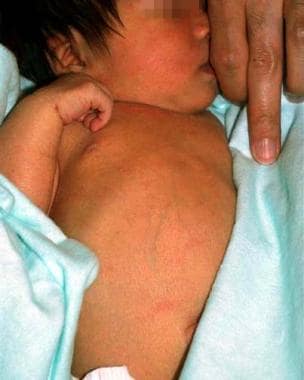
Erythema toxicum neonatorum (ETN) is a benign, self-limited, asymptomatic skin condition that only occurs during the neonatal period. The eruption is characterized by small, erythematous papules, vesicles, and, occasionally, pustules. The lesions are usually surrounded by a distinctive diffuse, blotchy, erythematous halo. Individual lesions are transitory, often disappearing within hours and then appearing elsewhere on the body.

Pathophysiology

The underlying pathophysiology is uncertain. Although the initial description of toxic erythema of the newborn is attributed to the 15th century physician Bartholomaeus Metlinger, this neonatal cutaneous eruption was recognized before the time of ancient Mesopotamia.1 Ancient Mesopotamian physicians believed this eruption to be "nature's method of cleansing the child of impure blood of the mother." In A Treatise on the Theory and Practice of Midwifery, the 18th century English physician William Smellie attributed the condition to "the costiveness of the child when the meconium hath not been sufficiently purged off."

The characteristic presence of eosinophils within the lesions has led some investigators to attribute this condition to an allergy. Work by Eitzman and Smith suggested that eosinophilia is part of the normal spectrum of the nonspecific inflammatory response in the neonate.2 This hypothesis is supported by cases in which premature neonates have infrequent eruptions that resolve within a few weeks after birth when the neonatal immune response matures.

The etiology of ETN remains uncertain; however, more recent hypotheses explaining the appearance of this eruption include the following:

  • Relative, increased, ground-substance viscosity in neonatal skin, with associated trauma leading to eosinophilic inflammation
  • Self-limited, acute, cutaneous, graft-versus-host reaction caused by maternal lymphocytes in the relatively immunosuppressed fetal circulation3
  • An innate immunologic response to commensal microbes within hair follicle epithelium.
  • An inflammatory response mediated by various inflammatory mediators, including aquaporins, psoriasin, nitric oxide synthases

Frequency

United States

The condition affects 30-70% of newborns. Carr and associates studied 270 newborns and found an incidence of 48%.4 Keitel and Yadav studied 207 consecutive newborns and found an incidence of 62%.5

International

Incidence is 25.3% in Spain, 33.7% in Taiwan, and 20.6% in India.

Mortality/Morbidity

  • This is a benign, asymptomatic, self-limited skin condition with no known sequelae.

Race

  • No significant differences based on race are apparent.
  • A study by Saracli and associates documented a low incidence among black neonates; however, this may be caused by the relative difficulty of diagnosing neonates with darker skin.6 Other sets of observations have noted no racial difference in incidence.

Sex

  • In previous studies, no significant difference in incidence is noted between the sexes. However, a recent study from China indicated a statistically significant predilection in boys.7

Age

  • This condition is limited to the neonatal period.
  • In a study of 270 cases, the typical newborn with ETN was of average birth weight and born at term.4 Of the newborns affected, 88% weighed 2500 g or more. In addition, 98% were born at least 35 weeks' gestation, with 85% born at least 39 weeks' gestation.


History

Erythema toxicum neonatorum (ETN) typically presents in term neonates aged 3 days to 2 weeks. Although ETN can occur in the first 48 hours, approximately 90% of cases occur after 48 hours. The eruption is characteristically evanescent, with lesions appearing and disappearing within minutes to hours.

Physical

Asymptomatic small papules, vesicles, and, occasionally, pustules are present on the skin. These are usually seen on dependent areas, generally starting on the trunk. They then tend to spread centripetally. The lesions are surrounded by a distinctive blotchy erythematous halo on the trunk, extremities, and face.

Causes

The underlying etiology is unknown, although various hypotheses have been described.


Herpes Simplex Virus Infection
Impetigo
Listeria Infection
Neonatal Sepsis
Varicella

Other Problems to be Considered

Miliaria rubra


Lab Studies

  • Because of the distinctive appearance of the eruption, laboratory studies typically are not indicated. Microscopic examination of a skin lesion using a Wright stain reveals numerous eosinophils. Peripheral blood studies also may reveal a circulating eosinophilia.
  • Given the distinctive appearance of the lesions, the nontoxic status of the neonate, and the evanescent nature of the eruption, the diagnosis is usually clear. If any doubt about the diagnosis exists, further studies are needed to evaluate for an underlying bacterial, viral, or fungal disease.
    • A simple Gram stain or Wright stain should reveal evidence of a sterile pustule populated primarily by eosinophils. The presence of neutrophils suggests an infectious cause.
    • Results from a direct slide (fluorescent antibody testing) of a smear or a Tzanck preparation should be negative for herpes simplex (or, rarely, varicella-zoster virus) because these are reasonably sensitive tests for these particular viruses.
    • A simple potassium hydroxide preparation can be performed to evaluate for fungal infection, such as congenital cutaneous candidiasis.
    • Blood cultures and appropriate workup for neonatal sepsis from group B Streptococcus, Listeria, Escherichia coli, and other pathogens should be considered in the appropriate context of illness in a neonate.
    • A skin biopsy may be necessary if the diagnosis is unclear.

Histologic Findings

Hyperkeratosis, follicular plugging, and accumulation of primarily eosinophils with some neutrophils in the follicular epithelium


Medical Care

Erythema toxicum neonatorum (ETN) is a benign, asymptomatic, self-limited condition that requires no treatment.

Consultations

ETN is often diagnosed easily by pediatricians and family physicians. If the features are atypical or the newborn appears ill or has risk factors for sepsis, consultation with a pediatric dermatologist may be advisable.


No pharmacologic treatment for this condition is indicated.


Further Outpatient Care

Erythema toxicum neonatorum (ETN) is a self-limited condition that typically resolves within 2 weeks after birth. If the condition persists or does not follow the usual course, prompt consultation with a specialist is advised.

Complications

No complications or sequelae are noted with this eruption. Because of the presence of eosinophils within the lesions, investigators suspect an association with atopic disease; however, studies examining these potential links to atopy have not demonstrated any clear association.

Prognosis

The prognosis is excellent. The lesions typically resolve within 2 weeks, and no cutaneous or systemic sequelae are generally observed.

Patient Education

  • Parents with older children often are not concerned by the appearance of ETN, but first-time parents should be informed in the perinatal period that an evanescent rash is likely to appear within the first 2 weeks of life. They should be reassured regarding the benign, self-limited, asymptomatic nature of the eruption.
  • Review the clinical features with parents before they go home. If any concerns arise about an atypical rash, they should be comfortable contacting their primary care physician to discuss the issues.
  • Before discharge, appropriately screen neonates who have risk factors for sepsis or neonatal herpes simplex virus infection.


Medical/Legal Pitfalls

Most cases of erythema toxicum are easily recognized; however, the clinician must properly identify important conditions that may resemble erythema toxicum neonatorum (ETN) but that have atypical presentations such as neonatal herpes simplex virus infection and bacterial and fungal (candidal) pustular eruptions.


Media file 1:  A 5-day-old newborn with erythematous papules with surrounding indistinct blotchy erythema visible on the abdomen. Image courtesy of Jining I. Wang, MD.
Click to see larger pictureClick to see detailView Full Size Image
Media type:  Photo


  1. Lehndorff H. Bartholomaeus Metlinger. A fifteenth century pediatrician. Arch Pediatr. Jul 1951;68(7):322-33. [Medline].
  2. Eitzman DV, Smith RT. The nonspecific inflammatory cycle in the neonatal infant. AMA J Dis Child. Mar 1959;97(3):326-34. [Medline].
  3. Bassukas ID. Is erythema toxicum neonatorum a mild self-limited acute cutaneous graft-versus-host-reaction from maternal-to-fetal lymphocyte transfer?. Med Hypotheses. 1992;38:334-338. [Medline].
  4. Carr JA, Hodgman JE, Freedman RI, Levan NE. Relationship between toxic erythema and infant maturity. Am J Dis Child. Aug 1966;112(2):129-34. [Medline].
  5. Keitel HG, Yadav V. Etiology of Toxic Erythema. Erythema Toxicum Neonatorum. Am J Dis Child. Sep 1963;106:306-9. [Medline].
  6. Saracli T, Kenney JA Jr, Scott RB. Common skin disorders in the newborn Negro infant. Observations based on the examination of 1,000 babies. J Pediatr. Mar 1963;62:359-62. [Medline].
  7. Liu C, Feng J, Qu R. Epidemiologic study of the predisposing factors in erythema toxicum neonatorum. Dermatology. 2005;210(4):269-72. [Medline].
  8. Duperrat B, Bret AJ. Erythema neonatorum allergicum. Br J Dermatol. Aug-Sep 1961;73:300-2. [Medline].
  9. Hurwitz S. Erythema toxicum. In: Clinical Pediatric Dermatology. 1993: 13-14.
  10. Johnson BL, Honig PJ, Jaworsky C. Erythema toxicum neonatorum. In: Pediatric Dermatopathology. 1994: 82.
  11. Marchini G, Nelson A, Edner J, et al. Erythema toxicum neonatorum is an innate immune response to commensal microbes penetrated into the skin of the newborn infant. Pediatr Res. Sep 2005;58(3):613-6. [Medline].
  12. Marchini G, Stabi B, Kankes K, et al. AQP1 and AQP3, psoriasin, and nitric oxide synthases 1-3 are inflammatory mediators in erythema toxicum neonatorum. Pediatr Dermatol. Sep-Oct 2003;20(5):377-84. [Medline].
  13. Stone OJ. High viscosity of newborn extracellular matrix is the etiology of erythema toxicum neonatorum: neonatal jaundice?: hyaline membrane disease?. Med Hypotheses. Sep 1990;33(1):15-7. [Medline].
  14. Taylor WB, Bondurant CP Jr. Erythema neonatorum allergicum; a study of the incidence in two hundred newborn infants and a review of the literature. AMA Arch Derm. Nov 1957;76(5):591-4. [Medline].

Erythema Toxicum excerpt

Article Last Updated: Oct 18, 2007