| Patient Education |
|
Click here for patient education.
|
|
You are in: eMedicine Specialties >
Radiology > GASTROINTESTINAL
Carcinoid, Gastrointestinal
Article Last Updated: Apr 2, 2008
AUTHOR AND EDITOR INFORMATION
Section 1 of 13
Author: Ali Nawaz Khan, MBBS, FRCS, FRCP, FRCR, LRCP, Chairman of Medical Imaging, Professor of Radiology, NGHA, King Fahad National Guard Hospital, King Abdulaziz Medical City, Riyadh, Saudi Arabia
Ali Nawaz Khan is a member of the following medical societies: American Institute of Ultrasound in Medicine, Radiological Society of North America, Royal College of Physicians, Royal College of Physicians and Surgeons of the United States, Royal College of Radiologists, and Royal College of Surgeons of England
Coauthor(s):
Sumaira MacDonald, MBChB, PhD, MRCP, FRCR, Lecturer, Sheffield University Medical School; Endovascular Fellow, Sheffield Vascular Institute;
David Sherlock, MBBS, FRCS, Consulting Staff, Department of Surgery, North Manchester General Hospital, Christie Hospital
Editors: John L Haddad, MD, Clinical Associate Professor, Department of Radiology, Weill Medical College of Cornell University; Director of Body MRI, Department of Radiology, Methodist Hospital in Houston; Bernard D Coombs, MB, ChB, PhD, Consulting Staff, Department of Specialist Rehabilitation Services, Hutt Valley District Health Board, New Zealand; Udo P Schmiedl, MD, PhD, Clinical Professor, Department of Radiology, University of Washington; Consulting Staff, Swedish Medical Center, University of Washington Medical Center, Seattle Radiologists; Robert M Krasny, MD, Consulting Staff, Department of Radiology, The Angeles Clinic and Research Institute; John Karani, MBBS, FRCR, Consulting Staff, Department of Radiology, King's College Hospital, London
Author and Editor Disclosure
Synonyms and related keywords:
GI carcinoid, carcinoid tumor, argentaffin tumors, argentaffinoma, enterochromaffin cells of Kulchitsky, carcinoid syndrome
Background
Gastrointestinal carcinoid, also called carcinoid tumor, is the most common primary tumor of the small bowel and appendix. Gastrointestinal carcinoid accounts for more than 95% of all carcinoids. The tumors arise from enterochromaffin cells of Kulchitsky, which are considered neural crest cells situated at the base of the crypts of Lieberkühn. Gastrointestinal carcinoids account for 1.5% of all gastrointestinal tumors. The tumors elaborate serotonin and other histaminelike substances that normally are transported to the liver, where they are metabolized. Most tumors are clinically silent, but they may cause pain or intestinal obstruction, weight loss, a palpable mass, or, rarely, bowel perforation. Carcinoid syndrome occurs when the humoral load exceeds the capacity of monoamine oxidase (MAO) present in the liver and lung to metabolize serotonin. Most patients with carcinoid syndrome have liver metastases from a bowel carcinoid, although in rare cases, the humoral load from a primary tumor may overwhelm the liver and the capacity of the lungs to metabolize serotonin. Rarer still is carcinoid syndrome that develops in patients with noncarcinoid malignant tumors and dermatomyositis.
Related eMedicine topics: Carcinoid Lung Tumors Carcinoid Tumor Carcinoid Tumor, Intestinal Lung, Carcinoid
Related Medscape topics: Specialty Site Gastroenterology Specialty Site Oncology Specialty Site Radiology Large Bowel Carcinoid Tumors
Pathophysiology
Carcinoids belong to a group of neoplasms known as neuroendocrine tumors (NETs). The NETs are composed of an interesting group of rare neoplasms that are derived from neuroendocrine cells interspersed within the gastrointestinal system and throughout the body. NETs are well known for producing various hormonal syndromes and for their indolent clinical course in most patients, although some of these tumors do not produce hormones of clinical significance.
Most gastrointestinal carcinoid tumors arise from neural crest cells, which are believed to be part of the amine precursor uptake and decarboxylation system and are programmed for endocrine function. On gross examination, tumors appear as firm, yellow submucosal nodules arising from argentophil Kulchitsky cells in the crypts of Lieberkühn. They grow through the muscularis mucosa and the bowel wall into the mesentery. Mesenteric invasion provokes an intense fibrotic reaction. If the tumors become large, they may present as intraluminal polypoid masses, and they occasionally are ulcerated. Histologically, the tumors resemble adenocarcinomas, but they do not demonstrate the same aggressive behavior. Lesions of the foregut and foregut derivatives (bronchi, pancreas), as well as those of the hindgut, show a histologic pattern somewhat different from lesions of the midgut. The argentaffin reaction may be absent, and the histologic diagnosis is based on cell morphology and histologic patterns. This may explain some of the different behaviors of carcinoids found at different sites in the gastrointestinal tract. The incidence of metastatic spread depends on the location of the primary tumor. Metastases are frequent from a midgut primary tumor, but are rare from an appendiceal carcinoid. Metastases also depend on the size of the primary tumor; tumors smaller than 1 cm metastasize in 2% of cases, tumors 1-2 cm in size metastasize in 50% of cases, and tumors larger than 2 cm metastasize in 85% of cases. The small bowel is the most common primary site giving rise to carcinoid syndrome resulting from liver metastases. Gastrointestinal carcinoids metastasize to the lymph nodes and liver. Liver metastases may produce carcinoid syndrome, although most liver metastases are clinically silent and are usually found on images obtained before surgery or on images obtained for other reasons.1 In carcinoid syndrome, deposition of fibrous tissue is found in the cardiac valves, particularly those of the right heart and endocardium, resulting in tricuspid stenosis/insufficiency stenosis of the pulmonary valve. Rarely, left-sided heart valves may be affected, with loss of trabeculation of the ventricle resulting from endocardial fibrosis. Bone metastases from gastrointestinal carcinoids are highly unusual and rarely occur in the more commonly occurring midgut carcinoids. Most osseous metastases have been reported from carcinoids of the stomach or rectum. Most bone metastases are osteoblastic, but rarely, lytic or mixed lesions occur. With increasing use of somatostatin receptor scintigraphy in the diagnosis of carcinoid tumors, more metastatic bony lesions are being identified. Regarding their biochemistry, carcinoid tumors secrete the following: - Serotonin (5-hydroxytryptophan)
- Adrenocorticotropic hormone
- Histamine
- Bradykinin
- Kallikrein
Serotonin is metabolized in the liver by MAO into 5-hydroxyindole acetic acid (5-HIAA) and is excreted in urine; 5-hydroxytryptophan is destroyed in the lungs. Carcinoids have various pathophysiologic features, as follows: - Biliary carcinoid - Tumors arising from enterochromaffin cells within the biliary tree are exceptionally rare, and only 15 cases have been reported in the world literature. They may arise from either an intrahepatic or extrahepatic location. Extrahepatic tumors have been reported more frequently because of the presentation (obstructive jaundice). Fibrosing hilar tumor mimicking a Klatskin tumor has been reported.
- Colon carcinoid - Of carcinoid tumors, 5% occur in the colon and account for 0.3% of colon tumors. The cecum is affected most frequently, and 75% of colon carcinoid tumors occur in the ascending colon. Tumors frequently have an extraluminal component and often metastasize. A carcinoid tumor is an occasional incidental finding on histologic examination of a removed appendix.
- Colon tumors are implicated in the pathogenesis of appendicitis when the tumor is located at the base of the appendix, where it may obstruct the lumen of the appendix.
- In patients with tumor at the base of the appendix or tumors larger than 2 cm, a right hemicolectomy is indicated.
- In patients with carcinoid tumor at the appendix tip, removal of the appendix usually is adequate treatment.
- In more than 70% of patients, the nodule is smaller than 1 cm in size and is located at the tip of the appendix. In 10%, the lesion is located at the base of the appendix.
- Appendiceal carcinoids follow a benign course.
- Appendiceal carcinoids are found mostly in younger patients, usually in patients aged 20-40 years, while other carcinoids occur in patients older than 50 years. Appendiceal carcinoids have been reported in children as young as 3 years.
- Malignant appendiceal carcinoids are an exception to the general rule.
- Duodenal carcinoid - Duodenal carcinoid is rare, and the duodenum is the second–least common site for carcinoid tumors, which are seen with decreasing frequency from the first to the third part of the duodenum. The tumors usually are slow growing and benign. An association with Zollinger-Ellison syndrome has been described.2
- Gastric carcinoid - These are rare tumors, making up 0.5% of gastric tumors. Multiple gastric carcinoid tumors are associated with enterochromaffin-like cell hyperplasia, chronic atrophic gastritis, and pernicious anemia, and they have a low risk of malignancy. A higher potential for metastatic disease is found in solitary gastric carcinoid tumors and/or in carcinoid tumors that are associated with multiple endocrine neoplasia type 1 (MEN-1) and Zollinger-Ellison syndrome. Through clinicopathologic characterization of gastric carcinoid neoplasia, the following 3 subtypes, each with a unique endoscopic appearance and clinical outcome, have been found1:
- Type I gastric carcinoids are small, benign tumors associated with chronic atrophic gastritis and chronic hypergastrinemia.3
- Type II gastric carcinoids may be large and polypoid. They are usually associated with MEN-1 and Zollinger-Ellison syndrome and are prone to lymph node metastases.
- Type III gastric carcinoids usually are large, solitary, sporadic tumors unassociated with hypergastrinemic states. They are prone to carcinoid syndrome, as well as to lymph node and liver metastases.
- Hepatic carcinoid - The liver is frequently involved as a result of metastatic disease from a gastrointestinal carcinoid; in fact, a liver metastatic deposit may be the presenting feature of a carcinoid. Although rare, primary hepatic carcinoid does occur and is classified as a foregut tumor that is presumed to arise from the biliary mucosa. Carcinoids metastatic to the liver are often multiple in number. They may be hypervascular, may become calcified, and are frequently associated with carcinoid syndrome.
- Esophageal carcinoid - Carcinoids of the esophagus are exceptionally rare. A dozen or so esophageal carcinoids have been reported. On the whole, prognosis is poor, and most tumors metastasize.4
- Pancreatic carcinoid - Pancreatic carcinoid tumors are rare; most occur in the tail of the pancreas. They frequently metastasize to the regional lymph nodes and liver. They often become calcified, whereas islet cell tumors usually do not.
- Rectal carcinoid - Most rectal carcinoids are asymptomatic and are discovered incidentally during proctoscopy and/or sigmoidoscopy. Carcinoids represent 1.3% of rectal tumors. They are usually benign, and they seldom metastasize to the regional lymph nodes or the liver. Rarely, liver metastasis does occur (1%), causing carcinoid syndrome. However, as in other tumors, metastases are correlated directly with the size of the tumor. The incidence of metastases increases sharply in tumors larger than 2 cm.
- Small-bowel carcinoid - One third of gastrointestinal carcinoids involve the small bowel, with these neoplasms being the most commonly occurring tumor of the small bowel. The ileum is the most common site (91%). Incidence of tumors increases with proximity to the cecum. Small-bowel tumors are multiple in number in 15-35% of cases. Liver metastases and carcinoid syndrome occur in 25-30% of cases. The tumor often infiltrates the mesentery, provoking an intense fibrotic reaction that results in kinking of the bowel segments, which may cause intestinal obstruction. A finding of kinking of the small-bowel loops is considered the hallmark of a carcinoid tumor on a small-bowel barium series.
Frequency
United States
Gastrointestinal carcinoids are the most common primary tumors of the small bowel and appendix. They account for more than 95% of all carcinoids. The overall frequency is not known.
International
Gastrointestinal carcinoids are the most common primary tumors of the small bowel and appendix. They account for more than 95% of all carcinoids. The overall frequency is not known.
Mortality/Morbidity
Patients with malignant carcinoid syndrome frequently have symptoms for several years before it is diagnosed. Survival of 10-15 years is not unusual. When a gastrointestinal carcinoid is diagnosed without lymph node or liver metastases, the prognosis is excellent.
Sex
The male-to-female ratio is 2:1.
Age
Most carcinoids occur in patients older than 50 years; appendiceal carcinoids occur in patients aged 20-40 years. The youngest reported patient with an appendix carcinoid was aged 3 years.
Anatomy
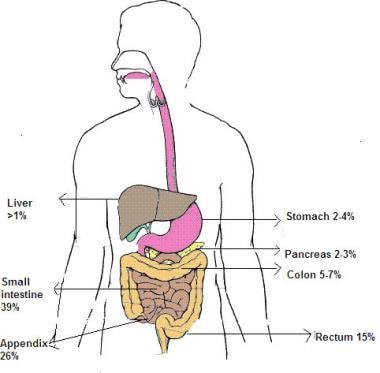
Anatomic locations of gastrointestinal carcinoid tumors are as follows:
- Esophageal - Exceptionally rare
- Gastric - 0.5%
- Small bowel - 25-35%
- Duodenum - 2%
- Jejunum - 7%
- Ileum - 91%
- Multiple sites - 15-35%
- Appendix - 30-45% (most benign)
- Base - 10%
- Middle - 20%
- Tip - 70%
- Colon - 5% (most in ascending colon)
- Rectum - 10-15%
- Pancreas - Rare
- Liver - Primary, exceptionally rare
- Biliary tract - Rare
Clinical Details
Most patients with gastrointestinal carcinoids are asymptomatic (66%), but patients with bowel carcinoids may present with pain, intestinal obstruction (19%), weight loss (16%), palpable mass (14%), or perforation or gastrointestinal hemorrhage (rare). Excess serotonin levels cause carcinoid syndrome. Apart from minor exceptions, carcinoid syndrome is regarded as evidence of malignancy. Clinical manifestations of carcinoid syndrome include the following:
- Episodes of diarrhea and abdominal cramps (70%)
- Bowel obstruction
- Gastrointestinal bleeding, either occult or apparent
- Malabsorption syndromes (eg, pellagra)
- Flushing of skin, telangiectasia of the face, and neck and skin desquamation
- Right-sided heart failure - The result of right-sided endocardial fibro-elastosis, which leads to tricuspid regurgitation and pulmonary valve stenosis
- Attacks of wheezing resulting from bronchospasm (15%)
- Fever
An association with scleroderma has been described. Hydroxytryptamine (serotonin) secreted by the carcinoid tumor is degraded in the liver to 5-HIAA and excreted in urine. Significantly higher levels of 5-HIAA are found in carcinoid syndrome. Calculations are performed by using a 24-hour collection of urine.
Preferred Examination
Diagnosis is usually achieved by using several complementary imaging techniques. The most promising imaging technique is somatostatin receptor scintigraphy.5, 6, 7 The technique can aid diagnosis by localizing primary and metastatic sites of gastro-enteropancreatic endocrine tumors. The degree of radionuclide uptake is related to somatostatin receptor density. In gastrointestinal carcinoids, the concentration at the receptor sites is high (90%). Plain radiographic findings (eg, soft-tissue mass, punctate calcification within a mass, signs of intestinal obstruction) are not specific for carcinoids. Plain radiographs are usually obtained in an acute setting, being taken, for example, in patients presenting with intestinal obstruction or perforation. Results of barium studies are nonspecific, and these tests are usually performed in patients presenting with nonspecific gastrointestinal symptoms. Clinical correlation is required. Ultrasonography is performed to investigate a variety of abdominal complaints. The radiologist must be aware of the ultrasonographic appearances of a carcinoid. Although these are nonspecific, they may lead to the most appropriate investigation and result in a diagnosis. Computed tomography (CT) scan findings in a malignant carcinoid depend on its size, degree of mesenteric invasion and desmoplastic reaction, and the presence of regional lymph node invasion. In the appropriate setting, the appearance of a malignant carcinoid on a CT scan may be highly suggestive of a diagnosis of carcinoid. Angiography is essential in interventional procedures involving liver metastases.
Somatostatin receptor scintigraphy and endoscopic ultrasonography have a direct clinical impact, because they influence individual therapeutic strategies
Limitations of Techniques
None of the radiologic techniques can provide a specific diagnosis; therefore, clinical input is obviously important. All of the imaging techniques listed above provide anatomic information, with the exception of radionuclide studies. A carcinoid is a functioning tumor, which means that clinical correlation is important. Indications for performing various imaging studies are dependent on the initial presentation. Two techniques stand out: CT scanning is better at providing anatomic information than are barium studies, and radionuclide studies add a functional element, which is obviously important in the context of carcinoid syndrome.
Liver, Metastases
Other Problems to Be Considered
Islet cell tumors of the pancreas
Other bowel neoplasms
Nongastrointestinal carcinoids
Abdominal desmoid tumors
Findings
- Biliary carcinoid - Cholangiography shows a polypoid filling defect within the biliary tree or an infiltrating form in which duct stenosis is demonstrated.
- Colon carcinoid
- On barium examination, radiologic features are similar to those of adenocarcinoma and include a filling defect within the colon caused by a sessile polyp, circumferential narrowing (apple-core lesion) associated with mucosal destruction, loss of mucosal folds, and ulceration.
- Imaging findings in a malignant carcinoid depend on its size, the degree of mesenteric invasion/desmoplastic reaction, and the presence of regional lymph node invasion.
- Bowel loops in the right iliac fossa separate and external compression, asymmetric spiculated contour, and kinking of adjacent bowel are demonstrated.
- The carcinoid tumor may not be visible because it is usually buried in the adjacent mass.
- A large-bowel barium series may show compression or infiltration of the cecum at the base of the appendix.
- Duodenal carcinoid - On barium series, tumors appear as intraluminal polypoid lesions or infiltrating lesions that cause an irregular stricture.
- Gastric carcinoid
- Imaging findings are nonspecific and depend on the type of tumor. On barium meal examination, the most common finding is a single, intramural, sharply demarcated defect that is usually 2-3 cm in diameter.
- Tumors may be located anywhere in the stomach, although a fundal location is said to be rare.
- Features may mimic leiomyoma/leiomyosarcoma.
- Tumors may be ulcerated.
- Less commonly, tumors may appear as a large ulcer or polypoid mass.
- In type I disease, multiple sessile polypoid lesions of varying sizes may be seen arising from the wall of the stomach.
- Atypical carcinoids may occur in which histology demonstrates a combination of carcinoid and adenocarcinoma. Atypical tumors have a tendency to ulcerate and show more aggressive behavior, with local tumor spread and lymph node metastasis. The prognosis in patients with atypical tumors usually is poor.
- A bull's-eye, or target, lesion may be seen. This appears as an ulcer on the apex of a nodule on barium meal examination. When a target lesion is noted, the differential diagnosis includes gastric metastases (melanoma, lymphoma, carcinoma-breast, bronchus, pancreas), leiomyoma, pancreatic rest, and gastric neurofibroma.
- Esophageal carcinoid - Tumors may present as intraluminal, extramucosal filling defects on barium studies.
- Pancreatic carcinoid - Plain radiographs may show curvilinear calcification in the region of the pancreatic bed.
- Rectal carcinoid - Tumors are indistinguishable from the more common adenomatous polyps on barium enema. Polyps may be ulcerated. Endorectal ultrasonography and endorectal magnetic resonance imaging (MRI) better demonstrate perirectal infiltration.
- Small-bowel carcinoid
- Plain abdominal radiographs may reveal curvilinear calcification within the abdomen. These are usually smaller than 15 mm in diameter and result from calcification within the tumor.
- On barium studies, findings consist of fairly well-defined, round, intraluminal bowel-filling defects. These may be associated with thickening of the valvulae conniventes resulting from interference of the bowel blood supply by the tumor.
- With invasion of the mesentery, the mesenteric mass causes rigidity, displacement/stretching, and fixation of small-bowel loops. Desmoplastic reaction from mesenteric invasion causes sharp angulation of a bowel loop or a stellate or spokelike wheel arrangement of adjacent bowel loops.
- The tumor often infiltrates the mesentery, provoking an intense fibrotic reaction that results in kinking of the bowel segments; such kinking may in turn cause intestinal obstruction.
- On a small-bowel barium series, kinking of the small-bowel loops is considered the hallmark of a small-bowel carcinoid tumor.
Degree of Confidence
Plain radiographic findings in gastrointestinal carcinoid are nonspecific and may simply reflect bowel obstruction. The calcification occasionally seen in a pancreatic or bowel carcinoid is nonspecific and has many differential diagnoses; however, kinking of the small bowel on a barium series is considered the hallmark of a small-bowel carcinoid.
False Positives/Negatives
Any cause of intestinal obstruction may mimic obstruction resulting from a carcinoid; moreover, on barium series, an intraluminal filling defect found at any location within the bowel, whether benign or malignant, may appear similar to a gastrointestinal carcinoid.
Findings
- Biliary carcinoid - CT scans may demonstrate intrahepatic biliary dilatation associated with an intraductal mass of varying attenuation in the common bile duct. A Klatskin-type tumor representing biliary carcinoid has been reported.
- Colon carcinoid - The frequent presence of an extraluminal component can be delineated better on CT scans. Generally, CT scanning is used to stage colon tumors but not to detect them. CT scan findings of colon carcinoids appear similar to those of adenocarcinoma. The tumor may be visualized as a discrete mass or as focal wall thickening.
- Gastric carcinoid - CT scanning may demonstrate thickening of the stomach wall by nodular masses. A large polypoid mass has been reported arising from the lesser curve of the stomach, with areas of low density that were presumed to represent necrosis.
- Hepatic carcinoid - Often multiple, these tumors are hypo-attenuating on nonenhanced CT scans and are strongly enhancing on contrast-enhanced CT scans. Cystic degeneration may occur. Calcification within carcinoid metastases is not unusual.
- Esophageal carcinoid - CT scanning should be able to demonstrate extraluminal extension and metastases.
- Pancreatic carcinoid - Ultrasonographic and CT scan findings from these carcinoids are indistinguishable from those of islet cell tumors, but calcification is a clue to the diagnosis. CT scans may show a low-attenuation mass associated with calcification in the pancreas. CT scanning and ultrasonography may demonstrate lymph node and liver metastases.
- Small-bowel carcinoid - CT scanning reveals a mass with soft-tissue attenuation and variable size, with spiculated borders and radiating surrounding strands. Calcification may be noted in the tumor. Linear strands within the mesenteric fat probably are thickened and retracted vascular bundles and represent peritumoral desmoplastic reaction. Lymphadenopathy and liver metastases may be visualized on CT scans. Helical CT enteroclysis has been used to detect small-bowel carcinoids and has been found to be more sensitive than are conventional barium studies.8
Degree of Confidence
When CT scanning reveals a solid mass with spiculated borders and radiating surrounding strands that is associated with linear strands within the mesenteric fat and kinking of the bowel, a diagnosis of gastrointestinal carcinoid can be made fairly confidently. Hypervascular enhancing liver metastases in the setting of a high index of clinical suspicion can also be a clue to the diagnosis.9
False Positives/Negatives
Liver and lymph node metastases from an intraluminal bowel mass with mesenteric invasion can mimic carcinoids.
Findings
Generally, MRI is not used in the diagnosis of gastrointestinal carcinoids. Liver metastases are demonstrated well on MRIs and usually have low signal intensity on T1-weighted images and high signal intensity on T2-weighted images. After the administration of a gadolinium-based contrast agent, liver metastases enhance peripherally in the hepatic arterial phase and appear as hypo-intense defects against the enhancing normal liver in the portal venous phase. MRI demonstrates biliary carcinoids as being hyperintense relative to the liver on T2-weighted images and hypo-intense relative to the liver on T1-weighted images. Gadolinium-based contrast agents (gadopentetate dimeglumine [Magnevist], gadobenate dimeglumine [MultiHance], gadodiamide [Omniscan], gadoversetamide [OptiMARK], gadoteridol [ProHance]) have recently been linked to the development of nephrogenic systemic fibrosis (NSF) or nephrogenic fibrosing dermopathy (NFD). For more information, see the eMedicine topic Nephrogenic Fibrosing Dermopathy.
The disease has occurred in patients with moderate to end-stage renal disease after being given a gadolinium-based contrast agent to enhance MRI or magnetic resonance angiography (MRA) scans. As of late December 2006, the Food and Drug Administration (FDA) had received reports of 90 such cases. Worldwide, over 200 cases have been reported, according to the FDA. NSF/NFD is a debilitating and sometimes fatal disease. Characteristics include red or dark patches on the skin; burning, itching, swelling, hardening, and tightening of the skin; yellow spots on the whites of the eyes; joint stiffness with trouble moving or straightening the arms, hands, legs, or feet; pain deep in the hip bones or ribs; and muscle weakness. For more information, see the FDA Public Health Advisory or Medscape.
Degree of Confidence
Sufficient experience has not been gained in the use of MRI to provide an assessment of the degree of confidence.
False Positives/Negatives
Any hypervascular liver metastases can appear similar on MRIs.
Findings
- Biliary carcinoid - Ultrasonography shows evidence of biliary tree dilatation associated with an intraluminal hypo-echoic or hyperechoic mass.
- Appendiceal carcinoid - A persistent fluid-filled, distended appendix without typical signs of appendicitis has been reported with a carcinoid of the appendix.
- Gastric carcinoid - One study using high-resolution transabdominal ultrasonography showed a hypo-echoic mass lesion arising from the muscular layer of the stomach.10
- Hepatic carcinoid - On ultrasonography, liver metastases vary from hypo-echoic to hyperechoic and show strong enhancement with intravenous contrast media. Tumors demonstrate peripheral hypervascularity on color and power Doppler images.
- Pancreatic carcinoid - Ultrasonographic and CT scan appearances are indistinguishable from those of islet cell tumors, but calcification is a clue to the diagnosis. Ultrasonographic findings usually demonstrate a hypo-echoic mass, which may be of varying size but tends to be small. Ultrasonography may demonstrate lymph node and liver metastases.
- Rectal carcinoid - Perirectal infiltration is better demonstrated on endorectal ultrasonography and endorectal MRI.
- Small-bowel carcinoid - Ultrasonography of the bowel can depict bowel tumors, with a pseudokidney sign. Associated lymphadenopathy and liver metastases may be demonstrated on ultrasonograms.
Degree of Confidence
On ultrasonograms, carcinoid findings are too nonspecific to offer a confident diagnosis.
False Positives/Negatives
Any bowel mass or hypervascular liver metastases can result in similar findings.
Findings
- Gastric carcinoid - Scintigraphy performed with a somatostatin receptor analogue may prove useful in the treatment of patients with hypergastrinemic states who have increased incidence of gastric carcinoids. In patients with MEN-1, localization in the upper abdomen may not be associated with a pancreatic endocrine tumor but rather with a gastric carcinoid.
- Pancreatic carcinoid - Somatostatin-analogue scintigraphy has been proven sensitive. However, the findings are nonspecific, because the study may also show positive findings for islet cell tumors.
- Small bowel carcinoid
- Somatostatin-receptor scintigraphy performed with indium-111 (111In) octreotide and 111In pentetreotide is used to image many neuro-endocrine tumors, including carcinoids with somatostatin-binding sites.6 Several studies have shown that somatostatin-receptor scintigraphy is a sensitive and noninvasive technique for imaging primary carcinoid tumors and carcinoid metastatic spread. A refinement of the technique that increases sensitivity is the addition of single photon emission CT (SPECT) scanning.
- Scintigraphy performed with iodine-123 (123I) meta-iodobenzylguanidine demonstrates a 44-63% uptake in gastrointestinal carcinoids.11 A higher frequency of radionuclide uptake is found in midgut carcinoids and tumors with elevated serotonin levels.
- [Fluorine-18]fluorodopa positron emission tomography (18F-dopa–PET) scanning has been used to image primary gastrointestinal carcinoid tumors and lymph node and organ metastases with promising results.12, 13
PET scanning with fluorodeoxyglucose (FDG) is now more available and more widely used. In general, FDG-PET scanning is useful in poorly differentiated carcinoids and other neuro-endocrine tumors, but it should not be used as a first-line imaging agent. FDG-PET scanning is primarily useful when the results of somatostatin-receptor scintigraphy are negative.14
Degree of Confidence
More than 90% of gastrointestinal carcinoids and their metastases are identified using somatostatin receptor scintigraphy, and accumulation is often seen in clinically unsuspected sites not recognized using other imaging techniques. 18F-dopa–PET scanning is a promising procedure that is a useful supplement to morphologic imaging methods. FDG-PET imaging is useful in poorly differentiated carcinoids when the results of somatostatin-receptor scintigraphy are negative.
False Positives/Negatives
Somatostatin-receptor scintigraphy is not specific for carcinoids. Uptake occurs in other lesions with a high density of somatostatin receptors; these include the following:
- Gastrinomas
- Glucagonomas
- Somatostatinomas
- Vaso-active intestinal polypeptide tumors
- Neural crest tumors (eg, paragangliomas, medullary thyroid carcinomas, neuroblastomas, pheochromocytomas)
- Oat cell lung carcinomas
- Lymphoproliferative disease (eg, Hodgkin lymphoma, non-Hodgkin lymphoma)
In addition, the possibility of uptake in areas of lymphocyte concentration in inflammatory states must be kept in mind.
Findings
Before the advent of cross-sectional imaging, mesenteric angiography provided useful information regarding characterization of small-bowel carcinoids. The angiographic appearances of small-bowel carcinoids encountered on angiograms produced for other indications, such as gastrointestinal bleeding, are worth noting. Foreshortening of the bowel occurring with desmoplastic reaction makes mesenteric arteries tortuous and frequently narrowed; it also draws the arteries into a stellate pattern. The areas involved appear hypervascular, but in reality, the number of arteries in the area does not increase. Instead, the arteries contract into a smaller area as a result of fibrosis.15 An additional arterial change associated with carcinoids is smooth, multifocal stenosis of the mesenteric arteries distant from the tumor. Tumors seldom show capillary blush or demonstrate early or dense venous drainage. Venous occlusion and mesenteric varices also have been reported. These findings are nonspecific and have been reported with sclerosing peritonitis and with a carcinoma of the pancreas invading the mesentery. Selective hepatic angiography can demonstrate hypervascular liver metastases by demonstrating capillary blush in involved areas, highlighting the potential response of tumors to embolization.16
Degree of Confidence
Foreshortening of the bowel occurring with desmoplastic reaction makes mesenteric arteries tortuous and frequently narrowed, in addition to drawing the arteries into a stellate pattern. Involved areas appear hypervascular, but in reality, the number of arteries in the area does not increase; instead, arteries contract into a smaller area because of fibrosis. With a high index of clinical suspicion, the degree of confidence in diagnosing gastrointestinal carcinoid is high when these findings are seen in combination with the other imaging features described.
False Positives/Negatives
Findings are nonspecific and have been reported with sclerosing peritonitis, desmoid tumors, and a carcinoma of the pancreas invading the mesentery.
- As with other neuro-endocrine tumors, the natural history of GI carcinoids is widely variable. Often, however, patients develop numerous small, relatively slow-growing liver metastases over a period of many years
- Carcinoids secrete a variety of potent hormones, particularly when they metastasize to the liver. Control of symptoms resulting from carcinoid syndrome is the primary object of therapy, because the lifespan of patients is long regardless of treatment. When the disease becomes resistant to pharmacologic agonists and systemic chemotherapy, patients usually benefit from hepatic arterial embolization (HAE).16 Objective response rates of 70% and symptomatic response rates of 90-100% have been reported with embolization of islet and carcinoid liver metastases. Polyvinyl alcohol, Gelfoam, or coils can be used to embolize the arteries. Polyvinyl alcohol particles are preferred at the author's institution.
- The ideal technique would be minimally invasive, have little effect on normal liver, and be readily repeatable
- Embolization partly fulfills these criteria, and some of the best published results are from repeated embolizations
- Transarterial chemo-embolization (TACE) is not associated with a higher degree of toxicity than is HAE.16, 17 TACE demonstrates trends toward improvement in time to progression, symptom control, and survival.
- Targeted radionuclide therapy with 90Y-DOTA Tyr3-octreotide (90Y-DOTATOC) is another promising technique used to achieve cytoreduction.
- Radiofrequency (RF) ablation fulfills all the desired criteria.18 RF can be used to reduce hormone secretion and/or tumor load.
- Aggressive cytoreduction can reverse somatostatin-analogue resistance and reduce drug requirements. Cytoreduction followed by octreotide analogues can be the best way to achieve prolonged symptom control.19
Medical/Legal Pitfalls
- Complications of hepatic embolization include nontarget embolization, intestinal ischemia, splenic infarction, cholecystitis, infection, and hepatic insufficiency.
- Nontarget embolization occurs in as many as 5.3% of patients.
Special Concerns
- With multiple carcinoid liver metastases, only part of the liver at a time should be embolized, because embolization of multiple metastases may incur a carcinoid crisis, which can be fatal.
- At the author's institution, embolization is usually performed in 1 lobe at a time.
- Appropriate antibiotic coverage has reduced the incidence of liver abscess to 2%.
Ramesh Chandra Raja, MBChB, FRCR, Consulting Staff, Department of Radiology, Rochdale Healthcare NHS Trust, contributed to this article.
| Media file 1:
Characteristic appearance of small-bowel carcinoid. Plain abdominal radiograph in a 55-year-old man presenting with clinical features of bowel obstruction (same patient as in Images 2-5). Small-bowel dilatation is confined to the upper abdomen. Speckled calcification is noted in a small, circular mass to the right of the mid lumbar spine. |
 | View Full Size Image | |
Media type: X-RAY
|
| Media file 2:
Characteristic appearance of small bowel carcinoid. Barium enema in a 55-year-old man presenting with clinical features of bowel obstruction (same patient as in Images 1 and 3-5). Barium enema study shows no obstructive lesion within the large bowel, but the cecum demonstrates an extrinsic impression on its medial side (arrow). |
 | View Full Size Image | |
Media type: X-RAY
|
| Media file 3:
Characteristic appearance of small bowel carcinoid in a 55-year-old man presenting with clinical features of bowel obstruction (same patient as in Images 1-2 and 4-5). Upper gastrointestinal barium series shows a smooth submucosal mass in the mid jejunum eccentrically placed and associated with thickened valvulae conniventes resulting from bowel edema and proximal small-bowel dilatation. Note the angulation of the bowel and kinking of the jejunum at the site of the submucosal mass. |
 | View Full Size Image | |
Media type: X-RAY
|
| Media file 4:
Characteristic appearance of small bowel carcinoid in a 55-year-old man presenting with clinical features of bowel obstruction (same patient as in Images 1-3 and 5). Images from an indium-111 octreotide scintigraphic study (at 44 h) show the primary lesion (straight arrow, top left image), mesenteric metastases (curved open arrow, top left image), liver metastases (arrows, top right image), and a rib metastatic deposit (arrow, bottom right image); this was confirmed on postmortem study. Bladder activity, which is a normal phenomenon, is marked by a curved solid arrow (top left image). |
 | View Full Size Image | |
Media type: Image
|
| Media file 5:
Characteristic appearance of small bowel carcinoid in a 55-year-old man presenting with clinical features of bowel obstruction (same patient as in Images 1-4). Images from an indium-111 octreotide scintigraphic study (at 68 h) show the primary lesion (straight arrow, top left image), mesenteric metastases (curved, open arrow; top left image), liver metastases (arrows, top right image), and a rib metastatic deposit (arrowhead, bottom right image); this was confirmed on postmortem study. Bladder activity, which is a normal phenomenon, is marked by a curved, solid arrow (top left image). |
 | View Full Size Image | |
Media type: Image
|
| Media file 6:
Characteristic appearance of mesenteric desmoplastic reaction from a carcinoid. Axial CT scan through the mid abdomen shows a mesenteric mass (long arrow) with shaggy borders and probable intratumoral punctate calcification (short arrow). |
 | View Full Size Image | |
Media type: CT
|
| Media file 7:
Characteristic appearance of mesenteric desmoplastic reaction from a carcinoid. A 10-mm lower CT section shows stellate radiating and beaded mesenteric neurovascular bundles of the mesentery (arrows) associated with kinking (K) of the small bowel. |
 | View Full Size Image | |
Media type: CT
|
| Media file 8:
Single-contrast-phase image of a barium enema study shows an eccentric narrowing of the splenic flexure associated with paucity of gas in the right hypochondrium resulting from a probable soft-tissue mass (see also Image 9). |
 | View Full Size Image | |
Media type: X-RAY
|
| Media file 9:
Characteristic angiographic appearance of a carcinoid mesenteric invasion. Arterial/early capillary phase of a superior mesenteric angiogram (same patient as in Image 8) shows the typical radiating configuration of the branches with tortuous peripheral vessels (curved arrows) in the region of the splenic flexure mass. Note the edge of the mesenteric mass (arrowheads) and arterial encasement (straight arrow). |
 | View Full Size Image | |
Media type: X-RAY
|
| Media file 10:
Characteristic appearance of carcinoid liver metastases with different imaging modalities. Axial sonogram through the liver shows multiple fairly well-defined echogenic liver metastases of varying sizes (see Image 11 for a right-sided image). |
 | View Full Size Image | |
Media type: Image
|
| Media file 11:
Characteristic appearance of carcinoid liver metastases with different imaging modalities. Axial sonogram through the liver shows multiple fairly well-defined echogenic liver metastases of varying sizes (see Image 10 for a left-sided image). |
 | View Full Size Image | |
Media type: Image
|
| Media file 12:
Characteristic appearance of carcinoid liver metastases. Contrast-enhanced axial CT scan through the upper abdomen shows early arterial enhancement of the liver metastases (see Image 13 for the portal venous phase). |
 | View Full Size Image | |
Media type: CT
|
| Media file 13:
Characteristic appearance of carcinoid liver metastases. Contrast-enhanced axial CT scan through the upper abdomen shows portal venous phase. The metastases appear as negative defects against the normally enhancing liver (see Image 12 for the hepatic arterial phase). |
 | View Full Size Image | |
Media type: CT
|
| Media file 14:
Characteristic appearance of carcinoid liver metastases. Gadolinium-enhanced axial MRI through the liver shows early arterial enhancement of multiple liver tumors (see Image 15 for the portal venous phase). |
 | View Full Size Image | |
Media type: MRI
|
| Media file 15:
Characteristic appearance of carcinoid liver metastases. Gadolinium-enhanced axial MRI through the liver shows portal venous phase enhancement of multiple liver tumors (see Image 15 for the hepatic arterial phase). |
 | View Full Size Image | |
Media type: MRI
|
| Media file 16:
Characteristic appearance of carcinoid liver metastases. Planar indium-111 octreotide scan shows the primary lesion (solid straight arrow), mesenteric metastases (open straight arrows), and multiple liver metastases. Bladder activity is indicated by a curved arrow (see also Image 17). |
 | View Full Size Image | |
Media type: Image
|
| Media file 17:
Characteristic appearance of carcinoid liver metastases. Planar indium-111 octreotide scan shows the primary lesion, mesenteric metastases, and multiple liver metastases. Bladder activity is indicated by a curved arrow (see also Image 16). |
 | View Full Size Image | |
Media type: Image
|
| Media file 18:
Characteristic appearance of carcinoid liver metastases. Single-photon emission CT scan obtained with indium-111 octreotide shows liver lesions in detail (see also Image 19). |
 | View Full Size Image | |
Media type: Image
|
| Media file 19:
Characteristic appearance of carcinoid liver metastases. Single-photon emission CT scan obtained with indium-111 octreotide shows the liver lesions in detail (see also Image 18). |
 | View Full Size Image | |
Media type: Image
|
| Media file 20:
Characteristic appearance of carcinoid liver metastases. Celiac-axis angiogram shows early enhancement of the liver metastases in the arterial phase (see Image 21 for the capillary phase). |
 | View Full Size Image | |
Media type: X-RAY
|
| Media file 21:
Characteristic appearance of carcinoid liver metastases. Celiac-axis angiogram shows persisting enhancement of the liver metastases in the capillary phase (see Image 20 for the arterial phase). |
 | View Full Size Image | |
Media type: X-RAY
|
| Media file 22:
Appearance of pancreatic carcinoid. Nonenhanced CT scan through the upper abdomen shows a 9-cm mass in the region of the tail of the pancreas with intratumoral pancreatic calcification and multiple mass lesions within the liver, suggestive of metastases (same patient as in Images 23-25). |
 | View Full Size Image | |
Media type: CT
|
| Media file 23:
Appearance of pancreatic carcinoid. Dynamic contrast-enhanced CT scan in the delayed portal venous phase shows enhancement of the pancreatic tail tumor (arrow) with central necrosis (same patient as in Images 22 and 24-25). |
 | View Full Size Image | |
Media type: CT
|
| Media file 24:
Appearance of pancreatic carcinoid. Right hepatic angiogram shows early enhancement of multiple liver tumors (same patient as in Images 22-23 and 25). |
 | View Full Size Image | |
Media type: X-RAY
|
| Media file 25:
Appearance of pancreatic carcinoid. Left hepatic angiogram late capillary/early venous phase shows a large, left-lobe tumor with arteriovenous shunting (curved arrow). The pancreatic tumor also derives its blood supply from the left hepatic arterial circulation (straight arrows) (same patient as in Images 22-24). |
 | View Full Size Image | |
Media type: CT
|
- Binstock AJ, Johnson CD, Stephens DH, et al. Carcinoid tumors of the stomach: a clinical and radiographic study. AJR Am J Roentgenol. Apr 2001;176(4):947-51. [Medline]. [Full Text].
- Berger MW, Stephens DH. Gastric carcinoid tumors associated with chronic hypergastrinemia in a patient with Zollinger-Ellison syndrome. Radiology. Nov 1996;201(2):371-3. [Medline]. [Full Text].
- Ho AC, Horton KM, Fishman EK. Gastric carcinoid tumors as a consequence of chronic hypergastrinemia: spiral CT findings. Clin Imaging. Jul-Aug 2000;24(4):200-3. [Medline].
- Ready AR, Soul JO, Newman J, et al. Malignant carcinoid tumour of the oesophagus. Thorax. Jul 1989;44(7):594-6. [Medline].
- Gibril F, Reynolds JC, Lubensky IA, et al. Ability of somatostatin receptor scintigraphy to identify patients with gastric carcinoids: a prospective study. J Nucl Med. Oct 2000;41(10):1646-56. [Medline].
- Kimura T, Sakahara H, Higashi T, et al. [Imaging of somatostatin receptor using 111In-pentetreotide]. Kaku Igaku. Apr 1996;33(4):447-52. [Medline].
- Kwekkeboom DJ, Lamberts SW, Habbema JD, et al. Cost-effectiveness analysis of somatostatin receptor scintigraphy. J Nucl Med. Jun 1996;37(6):886-92. [Medline]. [Full Text].
- Orjollet-Lecoanet C, Menard Y, Martins A, et al. [CT enteroclysis for detection of small bowel tumors]. J Radiol. Jun 2000;81(6):618-27. [Medline]. [Full Text].
- Fruauff A, Irwin GA, Williams HC, et al. CT demonstration of gastric carcinoid. AJR Am J Roentgenol. Jun 1987;148(6):1276-7. [Medline].
- Tsai TL, Changchien CS, Hu TH, et al. Demonstration of gastric submucosal lesions by high-resolution transabdominal sonography. J Clin Ultrasound. Mar 2000;28(3):125-32. [Medline].
- Adolph JM, Kimmig BN, Georgi P, et al. Carcinoid tumors: CT and I-131 meta-iodo-benzylguanidine scintigraphy. Radiology. Jul 1987;164(1):199-203. [Medline]. [Full Text].
- Hoegerle S, Altehoefer C, Ghanem N. Whole-body 18F dopa PET for detection of gastrointestinal carcinoid tumors. Radiology. Aug 2001;220(2):373-80. [Medline]. [Full Text].
- Koopmans KP, Neels OC, Kema IP, et al. Improved staging of patients with carcinoid and islet cell tumors with 18F-dihydroxy-phenyl-alanine and 11C-5-hydroxy-tryptophan positron emission tomography. J Clin Oncol. Mar 20 2008;26(9):1489-95. [Medline].
- Adams S, Baum R, Rink T. Limited value of fluorine-18 fluorodeoxyglucose positron emission tomography for the imaging of neuroendocrine tumours. Eur J Nucl Med. Jan 1998;25(1):79-83. [Medline].
- Bousen E, Reuter SR. Mesenteric angiography in the evaluation of inflammatory and neoplastic disease of the intestine.
|